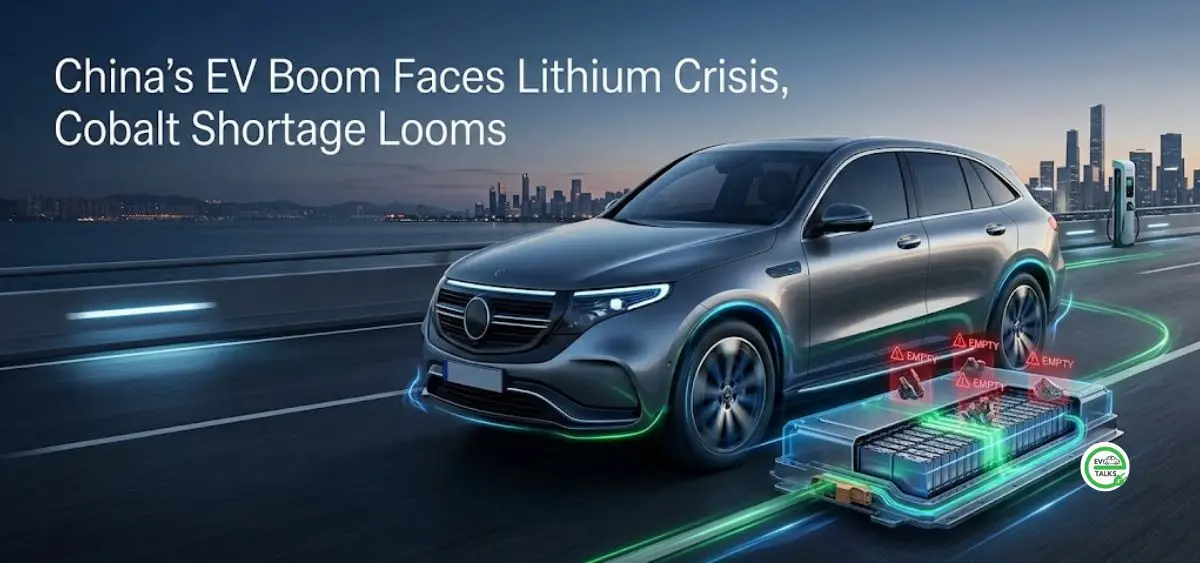

China’s electric vehicle (EV) industry is entering a new phase of growth, but the road ahead is becoming increasingly challenging due to shortages of critical battery minerals. While lithium remains the most immediate obstacle to expanding EV production, experts warn that a cobalt supply squeeze could emerge as the next major challenge. These back-to-back resource constraints could reshape the pace, cost, and environmental impact of China’s transition toward cleaner transportation. As China’s EV fleet approaches 50 million vehicles, the country is pursuing an ambitious goal of ensuring that new energy vehicles (NEVs) account for 30% of its national vehicle fleet by 2030. However, achieving this target depends not only on manufacturing capacity but also on securing reliable supplies of essential battery materials. China’s EV boom faces a lithium crisis as demand for lithium, cobalt, and nickel continues to rise at an unprecedented pace.
The Immediate Lithium Bottleneck
Lithium-ion batteries remain the backbone of China’s electric mobility revolution, making lithium the most critical raw material in the short term. As EV production accelerates, demand for lithium is rising faster than new mining capacity can be developed.
To address this challenge, China has expanded domestic lithium mining projects while strengthening national battery recycling standards to recover valuable materials from used batteries. Recycling is increasingly viewed as a long-term strategy to reduce dependence on imported minerals and improve supply security.
Automakers such as BYD and Tesla have also shifted aggressively toward Lithium Iron Phosphate (LFP) battery technology. Unlike conventional battery chemistries, LFP batteries eliminate the need for cobalt and nickel, reducing exposure to those materials. However, this transition places even greater pressure on lithium supplies because lithium remains an indispensable component of LFP batteries. As a result, China’s EV boom faces a lithium crisis despite technological changes designed to reduce reliance on other scarce minerals.
Why Cobalt Could Become the Next Major Challenge
Although lithium dominates current concerns, analysts believe cobalt may soon become the next significant bottleneck for the global EV industry.
Approximately 70% to 75% of the world’s cobalt supply is mined in the Democratic Republic of the Congo (DRC). This heavy geographic concentration makes the global battery supply chain highly vulnerable to political instability, export restrictions, mining quotas, and geopolitical tensions.
China processes a large share of the world’s cobalt, but processing facilities depend heavily on imported raw materials from the DRC. Any disruption in mining or exports can quickly affect battery manufacturers by limiting material availability and increasing costs.
While many entry-level EVs are moving toward cobalt-free LFP batteries, nearly half of the global EV market still depends on battery chemistries containing cobalt. This means future shortages could trigger sharp price increases, slow battery production, and complicate efforts to meet climate targets.
Research Highlights the Importance of Critical Mineral Security
A recent study published in Communications Earth & Environment examined how shortages of lithium, cobalt, and nickel could influence China’s long-term EV transition.
Researchers developed the Collaborative Optimization Model for Carbon Emission Reduction and Metal Resource Security (COMERS), an advanced framework that connects vehicle electrification with electricity generation, battery production, recycling systems, and mineral availability.
The model tracks the complete lifecycle of critical battery materials—from mining and battery manufacturing to vehicle use, retirement, recycling, and secondary resource recovery. It also evaluates future vehicle ownership using a Gompertz model while estimating long-term mineral supply through a Hubbert model.
Researchers analyzed seven future scenarios, including varying recycling rates, mineral supply constraints, battery technologies, international trade conditions, and low-cobalt battery chemistries. They also created a separate scenario without mineral constraints to measure how resource availability influences EV adoption and emissions.
Ignoring Mineral Constraints Could Lead to Overly Optimistic Forecasts
The findings suggest that overlooking material shortages may significantly overestimate the future growth of China’s EV market.
According to the study, ignoring supply limitations could overestimate China’s passenger EV ownership by up to 42% by 2060 while simultaneously underestimating cumulative carbon dioxide emissions and the overall costs of the clean transportation transition.
China currently depends on imports for 72% to 97% of several critical battery minerals, making supply security a central issue for long-term electrification. As global demand continues to increase, the International Energy Agency (IEA) projects that demand for lithium, cobalt, and nickel could grow 19 to 42 times by 2040 compared with 2020 levels.
These minerals are finite and concentrated in only a handful of countries, increasing the risk of supply shortages, market volatility, and geopolitical disruptions.
Outlook for China’s EV Industry
The future of electric mobility will depend not only on innovation but also on securing sustainable supplies of critical battery materials. Greater investment in domestic mining, higher battery recycling efficiency, diversified international sourcing, and next-generation battery technologies will all play important roles in reducing future risks.
As battery demand continues to surge, China’s EV boom faces a lithium crisis today, while a potential cobalt squeeze looms on the horizon. Successfully addressing both challenges will determine how quickly the country can expand EV adoption, lower transport emissions, and achieve its long-term climate goals. Ultimately, China’s EV Boom Faces Lithium Crisis serves as a reminder that the global clean energy transition depends as much on resource security as it does on technological innovation.

Related Articles: