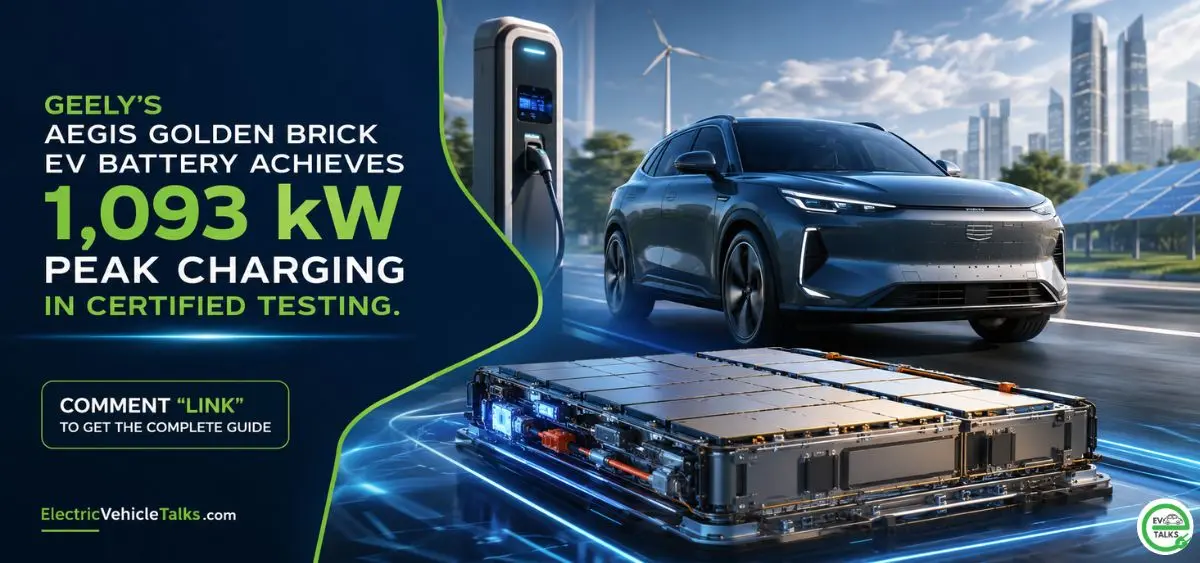

Geely has achieved a breakthrough in electric vehicle technology after its Geely’s Golden Brick EV Battery recorded a certified peak vehicle-side charging input of 1,093kW during official testing in China. The achievement makes it one of the fastest-charging mass-production EV batteries ever certified and highlights the rapid progress being made in next-generation battery technology.
The charging performance was independently verified by the China Automotive Technology and Research Center (CATARC), confirming that Geely has successfully crossed the significant 1,000kW charging barrier. The battery will make its production debut in the Lynk & Co 10 sedan and is expected to play a key role in the company’s future electric vehicle lineup.
Advanced Battery Technology Behind the Record
At the heart of this achievement is a 95kWh Lithium Iron Phosphate (LFP) battery pack built on a 900V electrical architecture. The battery uses Geely’s innovative short-blade cell design, allowing higher energy flow while maintaining long-term durability.
A major highlight is its dual-sided 3D liquid-cooling system, which surrounds individual battery cell groups with coolant. This advanced thermal management technology doubles the heat-exchange area, helping the battery safely manage the extreme heat generated during megawatt charging.
During CATARC certification tests, the battery’s maximum cell temperature reached only 64°C, remaining safely below China’s regulatory limit of 65°C. Efficient heat control is one of the biggest engineering challenges in ultra-fast charging, making this result particularly significant.
Certified Charging Performance Impresses
The certified charging results demonstrate why Geely’s Golden Brick EV Battery is attracting industry attention.
- 10% to 70% charge: 4 minutes 22 seconds
- 10% to 80% charge: 5 minutes 32 seconds
- 10% to 97% charge: 8 minutes 42 seconds
At peak performance, the battery accepts 1,093kW of charging power and can add approximately 2 kilometers of driving range every second.
Unlike many EV batteries that rapidly reduce charging speed after reaching higher states of charge, Geely’s battery maintains impressive performance by sustaining over 500kW beyond 80% charge and remaining above 300kW even at 97%, significantly reducing waiting times for drivers.
Outperforming BYD and Competing with CATL
The achievement also intensifies competition among China’s leading EV manufacturers.
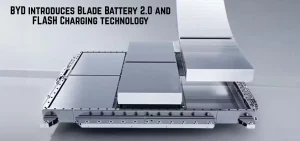
BYD’s second-generation Blade Battery, introduced earlier in 2026, claims charging times of 5 minutes from 10% to 70% and 9 minutes from 10% to 97% using its proprietary megawatt charging network. Based on certified testing, the Lynk & Co 10 equipped with Geely’s Golden Brick EV Battery delivers slightly faster charging across all comparable benchmarks.
Meanwhile, CATL’s Tianxing II battery for commercial electric vehicles can reach 80% charge in under seven minutes. However, it is designed primarily for trucks and buses rather than passenger vehicles, making direct comparisons less relevant.
Long Battery Life and Infrastructure Challenges
Despite supporting extremely high charging power, Geely claims the battery offers excellent durability with an estimated 4,500 full charging cycles, translating to a lifespan exceeding one million kilometers. The company has also open-sourced 12 thermal management and structural safety patents to encourage broader industry safety standards.
Although the battery technology has proven its capabilities, widespread adoption still depends on charging infrastructure. Achieving these record-breaking charging speeds currently requires Zeekr’s V4 megawatt charging stations, which are still being deployed across China. Until the rollout expands, most public chargers will not be able to fully utilize the battery’s maximum charging potential.
With its combination of record-setting charging speed, advanced thermal management, long-term durability, and certified safety, Geely’s Golden Brick EV Battery represents a significant step forward in the evolution of ultra-fast electric vehicle charging and reinforces China’s leadership in next-generation EV technology.

Related Articles: