
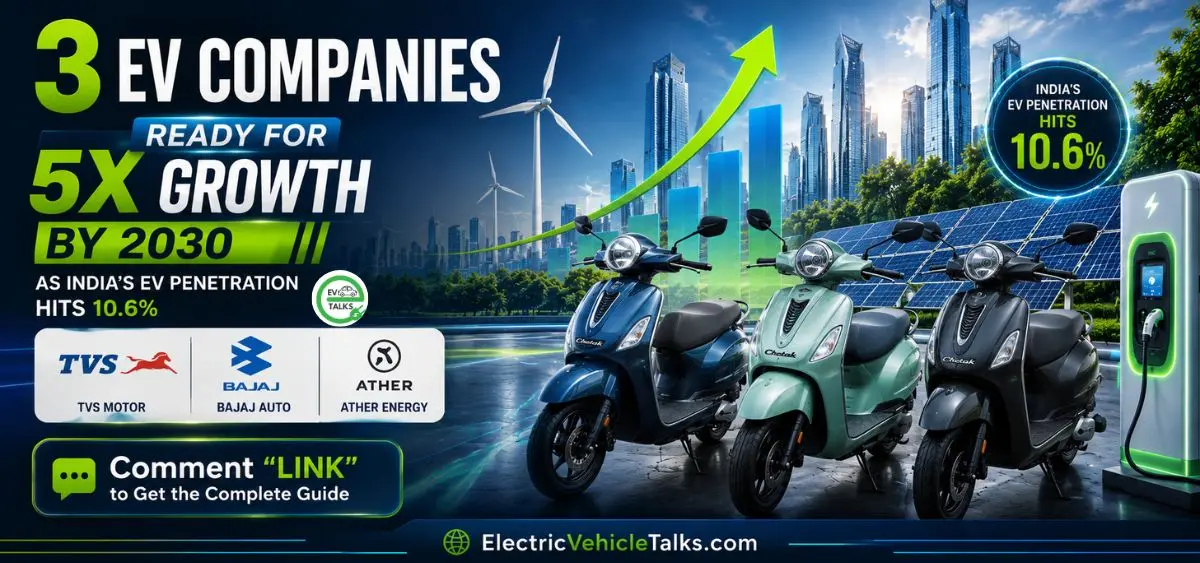

India’s electric two-wheeler (E2W) market is entering a decisive growth phase. What was once considered a niche category is rapidly becoming one of the country’s fastest-growing automotive segments. Electric two-wheeler sales crossed 14 lakh units in FY26, while EV penetration reached 10.6% in June 2026, indicating that consumer acceptance is accelerating faster than ever before. Industry experts believe the market is still in its early stages, creating a significant long-term opportunity for manufacturers with strong products, scalable production, and robust distribution networks. Against this backdrop, 3 EV Companies Ready for 5X Growth by 2030 are emerging as the frontrunners in India’s electric mobility revolution.
With industry forecasts projecting multi-fold growth over the next five years, market leaders such as TVS Motor, Bajaj Auto, and Ather Energy are investing aggressively to strengthen their competitive positions.
India’s EV Market Is Entering a New Growth Cycle
India’s electric two-wheeler industry delivered another impressive year in FY26. Sales increased by 22%, rising from approximately 11.5 lakh units in FY25 to more than 14 lakh units. Market penetration also improved significantly, reflecting growing consumer confidence in electric mobility.
The momentum has continued into FY27. By the end of June 2026, electric two-wheeler sales had already crossed 5.3 lakh units, representing nearly 38% of FY26’s total annual sales within just three months. More importantly, electric two-wheelers accounted for 10.6% of total monthly two-wheeler sales in June, marking an important milestone for the industry.
This rapid adoption suggests that India’s EV transition is moving beyond early adopters and becoming increasingly mainstream.

Why Experts Expect the EV Market to Grow Nearly Five Times by 2030
The long-term outlook remains highly encouraging.
According to McKinsey, annual electric two-wheeler sales in India could reach 70–90 lakh units by 2030, representing nearly 5X growth from current levels. Meanwhile, Kearney estimates that electric models could account for around 30% of all new two-wheeler sales by the end of this decade.
Several structural factors are supporting this transition:
- Declining lithium-ion battery costs
- Rising petrol and diesel prices
- Lower running and maintenance costs
- Expansion of public charging infrastructure
- Continuous launch of new EV models
- Supportive government policies promoting clean mobility
Together, these trends are creating one of the largest long-term opportunities in India’s automobile industry.
1. TVS Motors
Among the 3 EV Companies Ready for 5X Growth by 2030, TVS Motor currently enjoys a leadership position in India’s electric two-wheeler market.
The company sold 3.7 lakh electric scooters during FY26, registering 32.1% year-on-year growth and outperforming the overall industry. Its EV business generated nearly ₹5,000 crore in revenue, contributing over 10% of the company’s total turnover.
The success of the iQube electric scooter has played a major role in this growth. The portfolio now includes multiple battery configurations offering ranges from 94 km to over 200 km, allowing TVS to serve customers across different price segments.
To prepare for rising demand, TVS has increased monthly EV production from around 30,000 units to nearly 40,000 units, with plans to reach 50,000 units per month. The company is also expanding its overall manufacturing capacity through a ₹3,500 crore investment focused on production, software development, connected technologies, and research.
TVS is strengthening its commercial EV business as well. Its Battery-as-a-Service (BaaS) model reduces the upfront purchase cost by allowing customers to subscribe to battery usage instead of buying the battery outright. The company has also partnered with Hyundai Motor to co-develop electric three-wheelers, further expanding its presence in the commercial mobility segment.
2. Bajaj Auto
Bajaj Auto has emerged as one of India’s strongest electric mobility players by combining market expansion with profitability.
The company’s EV portfolio generated more than ₹8,000 crore in revenue during FY26, while the business achieved double-digit operating margins, making it one of the few profitable EV operations in the industry.
Its flagship Chetak electric scooter recorded its best-ever performance, with domestic sales crossing 3 lakh units during FY26. Since its relaunch, cumulative Chetak sales have surpassed 7 lakh units, reflecting strong customer acceptance.
Beyond electric scooters, Bajaj continues to dominate India’s electric three-wheeler market with over 33% market share. The company is expanding production capacity to meet growing demand while also strengthening its presence in the e-rickshaw segment through new product launches.
International expansion has become another important growth driver. Chetak exports have already begun in Sri Lanka, Nepal, and the Philippines, opening new opportunities beyond the domestic market.
Looking ahead, Bajaj plans to invest ₹500 crore during FY27, with nearly half earmarked specifically for electric mobility initiatives.
3. Ather Energy
Ather Energy has established itself as one of India’s fastest-growing EV manufacturers through innovation and premium product positioning.
During FY26, the company reported 69% growth in vehicle sales, delivering approximately 2.6 lakh electric scooters, while revenue increased by 62.8% to ₹3,672 crore.
The success of the Rizta family scooter significantly expanded Ather’s customer base, while the premium 450 series continues to strengthen its position among technology-focused buyers.
Ather’s next phase of growth will be driven by its upcoming EL Scooter Platform, which targets the high-volume mass-market category priced between ₹1 lakh and ₹1.25 lakh. This segment accounts for nearly half of India’s electric scooter market, providing substantial growth potential.
To support future demand, the company is building Factory 3.0 in Chhatrapati Sambhajinagar. Once completed, the facility will have an annual production capacity of 10 lakh units, making it Ather’s largest manufacturing plant.
The company has also expanded its retail footprint to 700 experience centers and 548 service centres, strengthening customer access across India.
How the Three EV Leaders Compare
| Company | FY26 E2W Sales | FY26 Market Position | Key Growth Driver |
|---|---|---|---|
| TVS Motor | 3.7 lakh | Market Leader | Capacity expansion, iQube portfolio, BaaS |
| Bajaj Auto | 3.0 lakh | 20.7% Market Share | Profitable EV business, Chetak, E3W leadership |
| Ather Energy | 2.6 lakh | 17.4% Market Share | EL Platform, Factory 3.0, retail expansion |
Each company is pursuing a different strategy, but all three are investing aggressively to capture the next wave of EV adoption.
What Investors Should Watch Going Forward
While demand continues to grow rapidly, investors should closely monitor production capacity, profitability, charging infrastructure expansion, battery technology, and government policy support.
TVS Motor is focused on scaling production and expanding its product ecosystem. Bajaj Auto is leveraging its profitable EV business and leadership in electric three-wheelers. Ather Energy, meanwhile, is targeting the high-volume mass-market segment with new products and a significantly larger manufacturing base.
As competition intensifies, companies that successfully balance innovation, execution, and profitability are likely to emerge as long-term winners.
Final Thoughts
India’s electric two-wheeler industry is no longer an emerging opportunity—it is becoming a mainstream growth story. With EV penetration already touching 10.6%, annual sales expected to rise sharply over the coming years, and strong structural drivers supporting adoption, the market appears well-positioned for sustained expansion.
The 3 EV Companies Ready for 5X Growth by 2030—TVS Motor, Bajaj Auto, and Ather Energy—have each built distinct competitive advantages through product innovation, manufacturing expansion, and strategic investments. As India’s EV ecosystem continues to mature, these companies are well placed to benefit from one of the country’s most significant automotive transformations over the remainder of the decade.

Related Articles:









