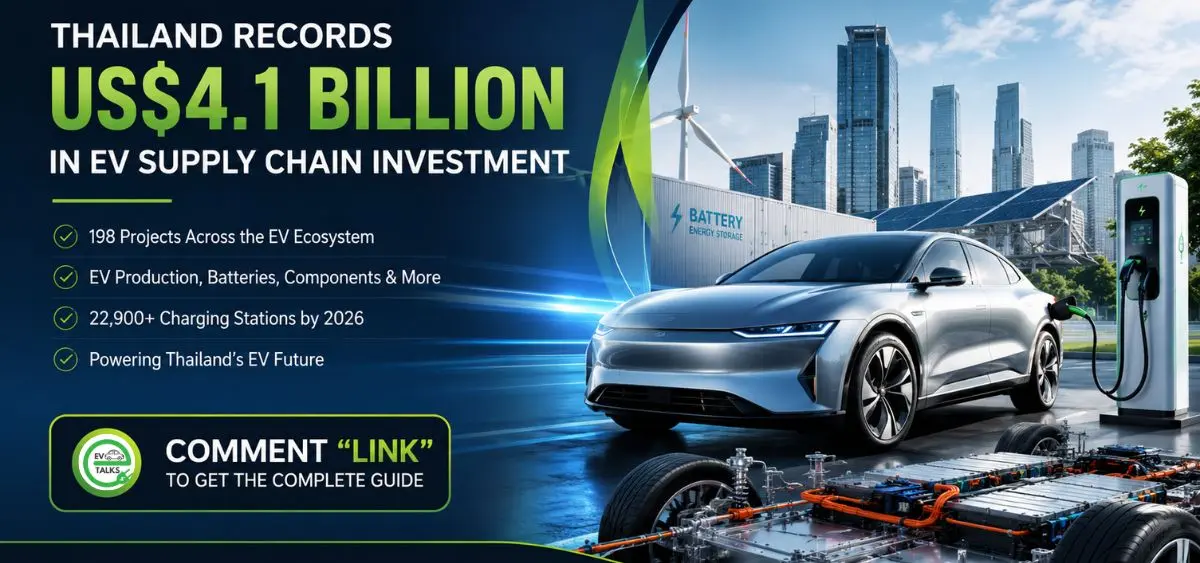

Thailand records US$4.1 billion in EV supply chain investment, marking a significant milestone in the country’s journey toward becoming Southeast Asia’s leading electric vehicle (EV) manufacturing and export hub. According to the latest figures released by the Thailand Board of Investment (BOI), the country has secured investment commitments worth more than US$4.1 billion (approximately 137 billion baht) across 198 EV-related projects covering the entire electric mobility ecosystem.
The investments span vehicle manufacturing, battery production, EV components, energy storage systems, and nationwide charging infrastructure, demonstrating Thailand’s comprehensive strategy to build a resilient and competitive EV supply chain.
Investment Distribution Across the EV Supply Chain
The BOI revealed that the investments are spread across several critical segments of the electric vehicle industry.
Battery Electric Vehicle (BEV) manufacturing accounts for US$1.18 billion across 18 projects, with a planned annual production capacity exceeding 370,000 vehicles. This expansion is expected to significantly boost Thailand’s domestic manufacturing capabilities while supporting exports to regional and global markets.
Hybrid Electric Vehicles (HEVs) and Plug-in Hybrid Electric Vehicles (PHEVs) have also attracted US$1.18 billion across 14 projects. Much of this investment builds upon Thailand’s well-established automotive production base, particularly leveraging decades of experience from Japanese automobile manufacturers operating in the country.
Battery and Energy Storage System (ESS) manufacturing has secured approximately US$1 billion across 57 projects. The primary objective is to localize battery cell and battery pack production, reducing dependence on imported batteries while strengthening domestic manufacturing.
In addition, 49 projects worth US$373 million focus on manufacturing essential EV components, including electric drive motors, battery management systems (BMS), and power control units.
Nationwide Charging Infrastructure Expansion
One of the most important developments is Thailand’s aggressive investment in EV charging infrastructure.
A total of US$292 million has been committed across 42 charging infrastructure projects, supporting the installation of more than 22,900 EV charging stations nationwide by 2026. Impressively, over 10,000 of these will be high-speed DC fast chargers, making long-distance EV travel more practical while encouraging greater consumer adoption of electric vehicles.
This large-scale charging network is expected to become one of the most extensive in Southeast Asia.
Government Policy Supports Multiple Powertrain Technologies
Unlike several countries that primarily focus on fully electric vehicles, Thailand has adopted a broader investment strategy.
The BOI offers incentives covering Battery Electric Vehicles (BEVs), Hybrid Electric Vehicles (HEVs), and Plug-in Hybrid Electric Vehicles (PHEVs). This technology-neutral policy has successfully attracted both established global automakers and emerging EV manufacturers.
As a result, Thailand records US$4.1 billion in EV supply chain investments while creating a balanced ecosystem that supports multiple vehicle technologies during the industry’s transition toward full electrification.
Global Automakers Continue Expanding Operations
Thailand’s supportive investment environment has attracted some of the world’s largest automotive manufacturers.
Mercedes-Benz became the first company to begin local BEV assembly in Thailand in 2022.
During 2024, Chinese manufacturers, including BYD, Great Wall Motor, SAIC Motor, and Aion, established domestic EV production facilities.
The expansion continued in 2025 with Changan Auto and EV Primus launching manufacturing operations.
In 2026, premium manufacturers BMW, Hyundai Mobility, and Omoda & Jaecoo also commenced BEV production in Thailand, further strengthening the country’s reputation as a regional EV manufacturing center.
Strengthening Local Suppliers and Workforce
To ensure Thai businesses benefit from the EV transition, the BOI has organized 18 supplier matchmaking events over the past two years.
These initiatives connected more than 800 qualified domestic manufacturers with international automakers, resulting in over 1,200 business matches. The BOI estimates these partnerships will generate more than US$1.79 billion in domestic procurement value as traditional automotive suppliers transition into EV component manufacturing.
BOI Secretary General Narit Therdsteerasukdi emphasized that Thailand is leveraging six decades of automotive expertise to position itself at the forefront of global mobility while ensuring local industries and workers remain central to future growth.
Thailand Emerges as Southeast Asia’s EV Investment Leader
As competition intensifies among Southeast Asian nations to attract electric vehicle manufacturing, Thailand records US$4.1 billion in EV supply chain investments that reinforce its leadership position in the regional automotive sector.
With investments spanning vehicle production, battery manufacturing, critical components, energy storage, and nearly 23,000 charging stations, Thailand is building one of Asia’s most comprehensive EV ecosystems. The country’s balanced industrial policies, expanding manufacturing base, and growing supplier network are expected to attract even more global investment in the coming years.
As electric mobility continues to reshape the automotive industry, Thailand records US$4.1 billion in EV supply chain development, which positions the nation as a key global production and export hub for next-generation transportation.

Related Articles: