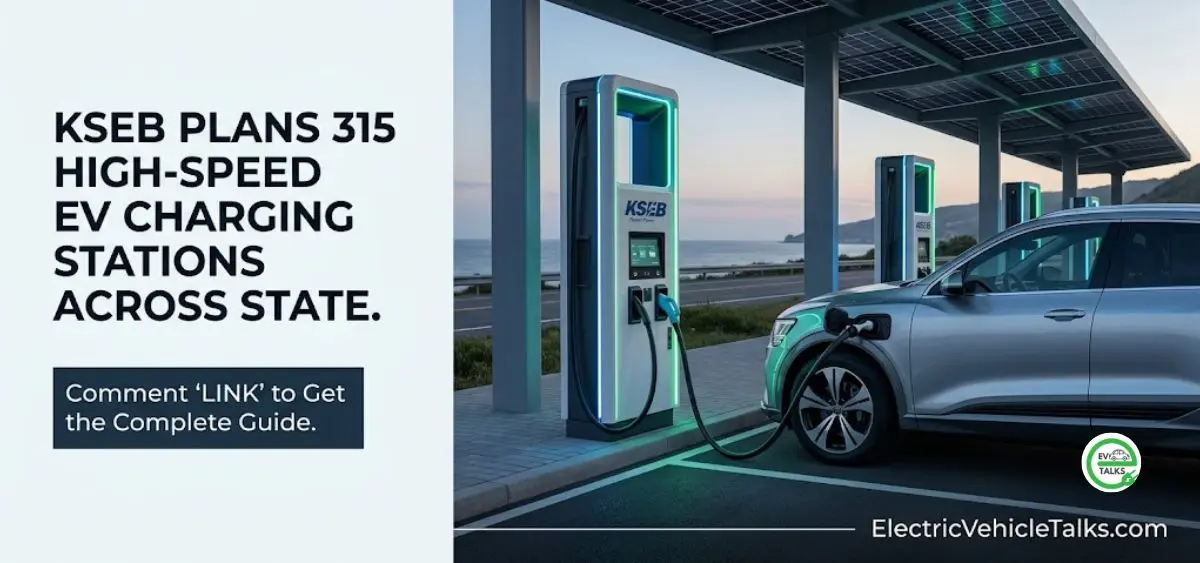

KSEB plans 315 high-speed EV charging stations across Kerala as part of a major expansion strategy to strengthen the state’s electric vehicle (EV) ecosystem. The Kerala State Electricity Board (KSEB) has submitted a proposal to establish 315 high-speed EV charging stations at 277 new locations, mainly along important highways and high-traffic routes across the state.
The proposed project will be implemented under the central government’s PM E-DRIVE scheme, with KSEB acting as the nodal agency. The expansion aims to address the growing demand for faster and more accessible EV charging facilities as electric vehicle adoption continues to increase in Kerala.
KSEB Seeks ₹60 Crore Government Subsidy for Second-Phase Expansion
The second phase of KSEB’s EV charging infrastructure project is estimated to cost around ₹120 crore. The electricity board has requested a government subsidy of approximately ₹60 crore, which accounts for nearly half of the total project cost.
This expansion follows the approval of the first phase, where the Union Ministry of Heavy Industries allocated ₹63.12 crore to install 335 chargers across 209 locations in Kerala. The first phase is currently under development and is expected to be completed by March 2027.
According to KSEB officials, the upcoming charging stations will primarily focus on major highways to create reliable EV travel corridors across the state.
Major Shift Towards Private Land and Public Partnerships
One of the biggest changes in the second phase is the increased involvement of private landowners and charging operators. Unlike earlier projects that mainly depended on government-owned land, around 95% of the new charging stations, or 299 out of 315 chargers, will be installed on private properties.
KSEB identified these locations through a public Expression of Interest (EoI) process and partnered with private landowners and Charge Point Operators (CPOs). This approach will allow faster expansion of charging infrastructure without being restricted by the availability of government land.
KSEB plans 315 high-speed EV charging stations with a stronger focus on private participation, highway connectivity, and advanced charging technology to support the future growth of electric mobility in Kerala.
Ultra-Fast Chargers to Reduce EV Charging Time
The upcoming charging network will feature advanced high-capacity chargers designed to significantly reduce waiting times for EV users.
The proposed charger distribution includes:
| Charger Type | Number of Units |
|---|---|
| 240 kW Super-Fast Chargers | 43 |
| 120 kW High-Capacity Chargers | 245 |
| 60 kW Standard Chargers | 27 |
Most of the new stations will use 120 kW and 240 kW chargers, allowing compatible electric vehicles to recharge much faster compared with older charging systems.
KSEB officials stated that these high-capacity charging stations will enable EV owners to spend considerably less time at charging points, making long-distance electric travel more convenient.
District-Wise Distribution of New EV Charging Locations
The 277 proposed locations will be spread across all districts of Kerala. The highest number of charging locations will be developed in Ernakulam, Thiruvananthapuram, Thrissur, Malappuram, and Palakkad.
| District | New Charging Locations |
|---|---|
| Alappuzha | 13 |
| Ernakulam | 39 |
| Idukki | 14 |
| Kannur | 13 |
| Kasaragod | 11 |
| Kollam | 14 |
| Kottayam | 19 |
| Kozhikode | 22 |
| Malappuram | 27 |
| Palakkad | 26 |
| Pathanamthitta | 10 |
| Thiruvananthapuram | 32 |
| Thrissur | 28 |
| Wayanad | 9 |
| Total | 277 |
First Phase Built Foundation for Kerala’s EV Charging Network
The second phase builds on the progress made during the initial rollout of KSEB’s EV charging programme. The first phase focused largely on using government-owned properties, including KSEB substations, section offices, KSRTC bus depots, KTDC hotels, universities, and BSNL premises.
With increasing EV sales and demand for better charging infrastructure, KSEB is also upgrading several existing charging stations by replacing older chargers with higher-capacity equipment.
Kerala Accelerates Towards an Electric Mobility Future
The expansion of charging infrastructure is expected to play a crucial role in supporting Kerala’s transition towards cleaner transportation. By combining government support, private partnerships, and advanced charging technology, the state aims to create a more reliable EV charging network for passenger vehicles, commercial fleets, and long-distance travelers.
KSEB plans 315 high-speed EV charging stations as a major step towards building a future-ready electric mobility ecosystem, reducing range anxiety among EV users, and encouraging more people to adopt electric vehicles across Kerala.

Related Articles: