
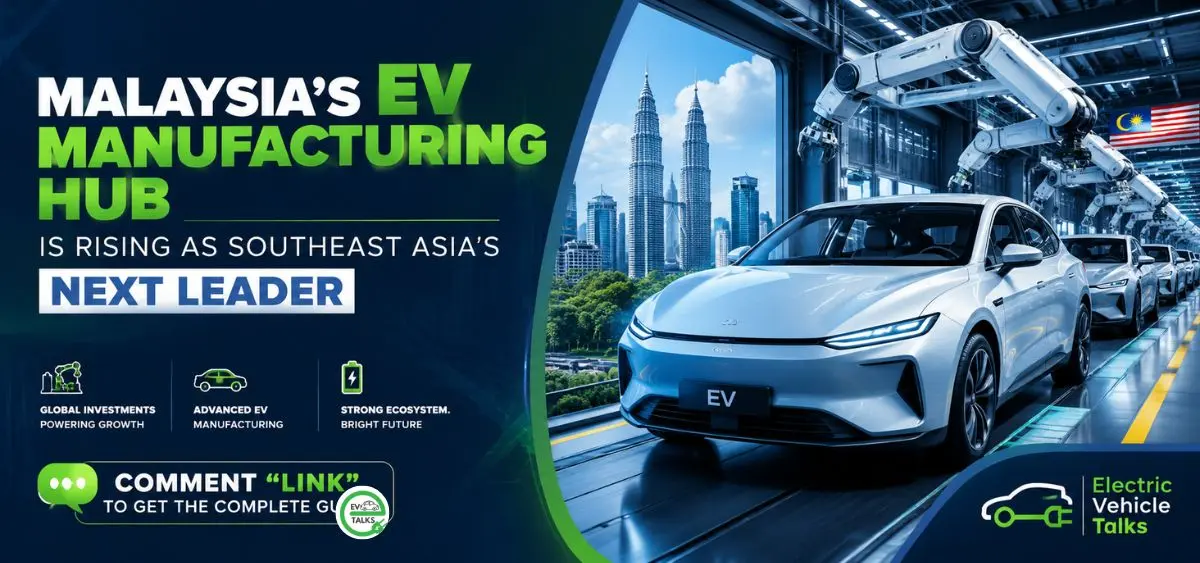

Malaysia’s EV Manufacturing Hub is rapidly emerging as one of Southeast Asia’s most important electric vehicle production centers. A combination of government-backed industrial policies, strategic investments, and partnerships with leading global automakers is transforming the country from an EV import market into a major regional manufacturing base. The latest milestone—the rollout of the first locally assembled XPENG G6 electric SUV—highlights how Malaysia is strengthening its position in the global EV supply chain while attracting long-term investments from international manufacturers.

First Locally Assembled XPENG G6 Marks a Major Milestone
A significant breakthrough came in June when the first locally assembled XPENG G6 rolled off the production line at EP Manufacturing Berhad’s (EPMB) HICOM Pegoh Industrial Park in Melaka. The achievement marks the beginning of completely knocked-down (CKD) production for one of China’s fastest-growing electric vehicle brands.
The production launch took place less than six months after XPENG and EPMB signed an agreement to localize manufacturing. The partnership initially includes the XPENG G6 electric SUV and the premium X9 MPV, including its range-extended PowerX REEV variant.
More importantly, the agreement grants EPMB the first right to assemble three future XPENG models, demonstrating the automaker’s long-term commitment to expanding its manufacturing footprint in Malaysia rather than using the country solely as an export destination.
Malaysia Becomes a Strategic Global Production Base
XPENG has identified Malaysia as one of its strategic overseas assembly locations. While the company continues manufacturing vehicles in China, it is also expanding localized production in Indonesia, and its European vehicles are assembled through Magna Steyr in Austria.
With Malaysia now joining this select group of international production sites, the country is becoming an integral part of XPENG’s global manufacturing strategy and regional supply chain expansion.
Chinese Automakers Shift from Exports to Local Production
For many years, Chinese EV manufacturers primarily exported vehicles to Southeast Asian markets. However, the strategy is rapidly evolving as automakers increasingly establish localized production facilities across the region.
Local manufacturing offers several advantages, including:
- Lower shipping and logistics costs
- Faster vehicle deliveries
- Stronger supply-chain resilience
- Improved compliance with local regulations
- Greater flexibility to respond to changing consumer demand
This shift is making Malaysia’s EV Manufacturing Hub increasingly attractive for global automakers seeking a stable and efficient production base.
Government Policies Are Driving Industrial Growth
Malaysia’s Ministry of Investment, Trade and Industry (MITI) has introduced policies that strongly encourage domestic manufacturing and higher local value creation.
Key policy measures include the following:
- Higher barriers for imported EVs: Stricter import guidelines have increased the minimum price for fully imported, completely built-up (CBU) electric vehicles to above RM300,000.
- Local assembly incentives: Manufacturers establishing local production are encouraged to export a significant portion of their vehicles, positioning Malaysia as a regional manufacturing platform.
- Focus on advanced technology: Government initiatives prioritize high-value electric vehicles featuring advanced 800-volt electrical architectures capable of supporting ultra-fast charging instead of focusing only on low-cost EVs.
These initiatives have significantly boosted investor confidence and encouraged international automakers to expand local manufacturing operations.
Major Automakers Expand Manufacturing Investments
Several global automotive companies have announced significant investments and assembly projects across Malaysia.
- XPENG and EPMB (Melaka): Successfully launched local assembly of the XPENG G6 while securing rights to manufacture future advanced EV models.
- Hyundai Motor (Kulim, Kedah): Hyundai is investing approximately US$500 million to establish its second major production facility in Southeast Asia, strengthening Malaysia’s manufacturing ecosystem.
- Leapmotor and Stellantis (Gurun, Kedah): Leapmotor has selected the Stellantis manufacturing facility as its primary ASEAN production base, supported by global manufacturing standards and advanced high-voltage safety systems.
- Proton and Perodua: Malaysia’s domestic manufacturers continue expanding their EV presence. Proton has accelerated market adoption through the e.MAS 7 lineup using Geely technology, while Perodua recently introduced the QV-E, regarded as the country’s first homegrown electric vehicle.
- MG and Great Wall Motor: Both manufacturers are expanding localized vehicle assembly operations with EPMB in Melaka, contributing to the state’s rapidly growing automotive supply chain.
A Complete EV Ecosystem Is Taking Shape
Beyond vehicle assembly, Malaysia is building a comprehensive EV ecosystem to support long-term industrial growth.
A major development includes a US$750 million investment by INV New Material Technology, which established ASEAN’s first lithium battery separator manufacturing facility in Penang. This strengthens regional battery material production while reducing dependence on imports.
Malaysia also benefits from its well-established semiconductor industry, one of the world’s leading microchip manufacturing hubs. This provides greater resilience against global automotive chip shortages and supports increasingly sophisticated electric vehicles.
Meanwhile, charging infrastructure continues expanding alongside manufacturing capacity. Kuala Lumpur recently opened the country’s largest AC charging hub at Merdeka 118, demonstrating that consumer infrastructure is developing in parallel with industrial investments.
Malaysia Strengthens Its Position as Southeast Asia’s EV Leader
With supportive government policies, expanding manufacturing capacity, major foreign investments, advanced battery production, semiconductor expertise, and rapidly growing charging infrastructure, Malaysia’s EV Manufacturing Hub is evolving into one of Southeast Asia’s leading electric vehicle production centers.
As more international automakers choose Malaysia for localized manufacturing, the country is well-positioned to become a long-term regional hub for electric vehicle production, exports, and next-generation automotive technologies. The continued expansion of Malaysia’s EV Manufacturing Hub is expected to play a vital role in shaping the future of the ASEAN electric mobility industry.

Related Articles:









