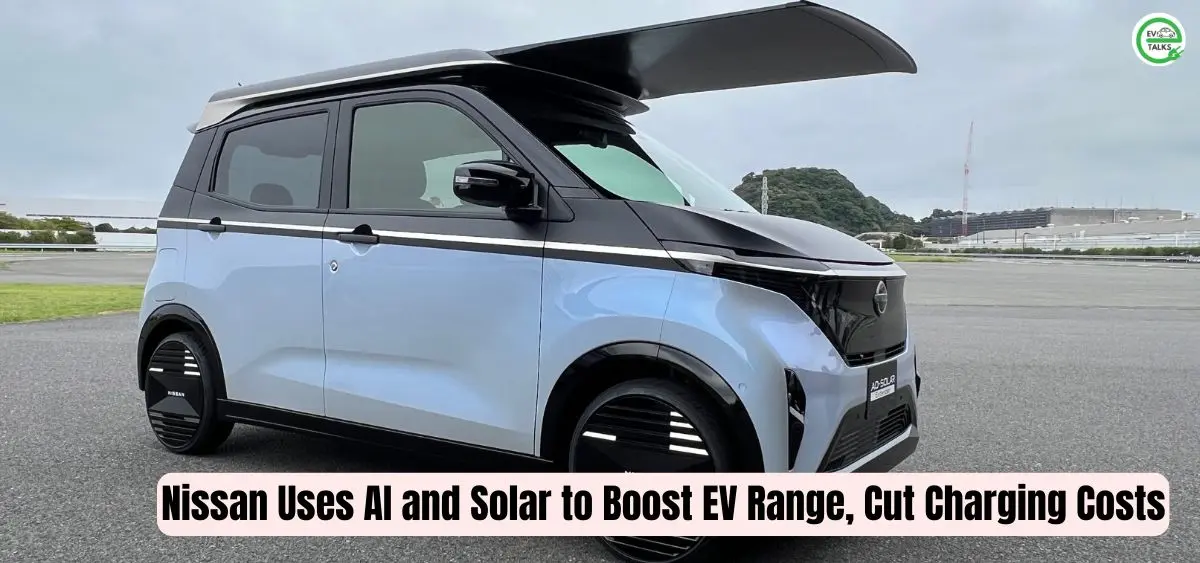

Nissan uses AI and Solar to boost EV Range through an ambitious £10 million research project supported by the UK government. The three-year initiative, known as Project SUITE (Smart Use of Integrated Technology for Electric Vehicles), is funded under the UK’s £4 billion DRIVE35 programme. The project aims to transform how electric vehicles are powered, charged, and integrated with the energy grid by combining advanced solar technology, artificial intelligence (AI), and next-generation charging systems into a single vehicle platform.
Working alongside ten industry and academic partners, Nissan plans to develop smarter EV technologies that improve driving range, lower charging costs, and make electric mobility more convenient and sustainable.
Advanced Technologies Driving the Future of EVs
The highlight of Project SUITE is the integration of several cutting-edge technologies into one electric vehicle. At the center of the project are perovskite-on-silicon tandem solar panels, developed in collaboration with Oxford PV. These highly efficient solar cells are designed to generate electricity while the vehicle is parked or in motion, helping recharge the battery and extending driving range without relying entirely on charging stations.
This innovation supports the vision that Nissan uses AI and Solar to boost EV Range, allowing drivers to travel farther on a single charge while reducing dependence on grid electricity.
The project also introduces an AI-powered gallium nitride (GaN) traction inverter that intelligently manages energy flow throughout the drivetrain. By optimizing power delivery, the inverter improves overall vehicle efficiency and maximizes battery performance.
Smarter Charging and Lower Energy Bills
Project SUITE goes beyond improving battery performance by introducing an Intelligent Charging Management System (ICMS). This AI-driven technology analyzes household electricity usage and automatically schedules EV charging during periods of lower electricity prices. As a result, EV owners can significantly reduce charging costs.
Another major feature is the Automated Charging Device (ACD) with bidirectional Vehicle-to-Grid (V2G) capability. When the vehicle is not in use, stored energy can be supplied back to the electricity grid, supporting renewable energy integration while potentially generating financial benefits for EV owners.
These intelligent charging solutions demonstrate how Nissan uses AI and Solar to boost EV Range while also creating a more efficient and resilient energy ecosystem.
Nissan LEAF Serves as the Test Platform
To validate these technologies under real-world conditions, Nissan is using the British-built Nissan LEAF as the project’s development platform. Engineers will combine solar charging, AI-powered energy management, bidirectional charging, and advanced power electronics into a single prototype to evaluate performance, efficiency, and user experience during everyday driving.
The testing phase will help determine how these integrated technologies interact and how they can be applied to future production electric vehicles.
Strong Industry and Academic Collaboration
Project SUITE brings together expertise from leading technology companies and top universities.
Industrial partners include Nissan, Oxford PV, RAM Innovations, Weeteq, and Ricardo. Academic support comes from the University of Oxford, the University of Bristol, Newcastle University, the University of Nottingham, and University College London.
Oxford PV contributes its globally recognized expertise in perovskite photovoltaic technology, which offers significantly higher solar efficiency than conventional silicon panels and opens new possibilities for vehicle-integrated renewable energy systems.
Building the Next Generation of Electric Mobility
According to Nissan’s research leadership, Project SUITE represents an important step toward making EV ownership more affordable and efficient. By combining AI-driven energy management, high-performance power electronics, integrated solar charging, and advanced Vehicle-to-Grid technology, the company aims to reduce total ownership costs while improving sustainability and customer convenience.
As Nissan uses AI and Solar to boost EV Range, the project could reshape the future of electric transportation by enabling vehicles that not only consume energy intelligently but also generate and manage it more efficiently. If successful, these innovations may influence the design of next-generation electric vehicles worldwide and accelerate the transition toward cleaner, smarter mobility.

Related Articles: