
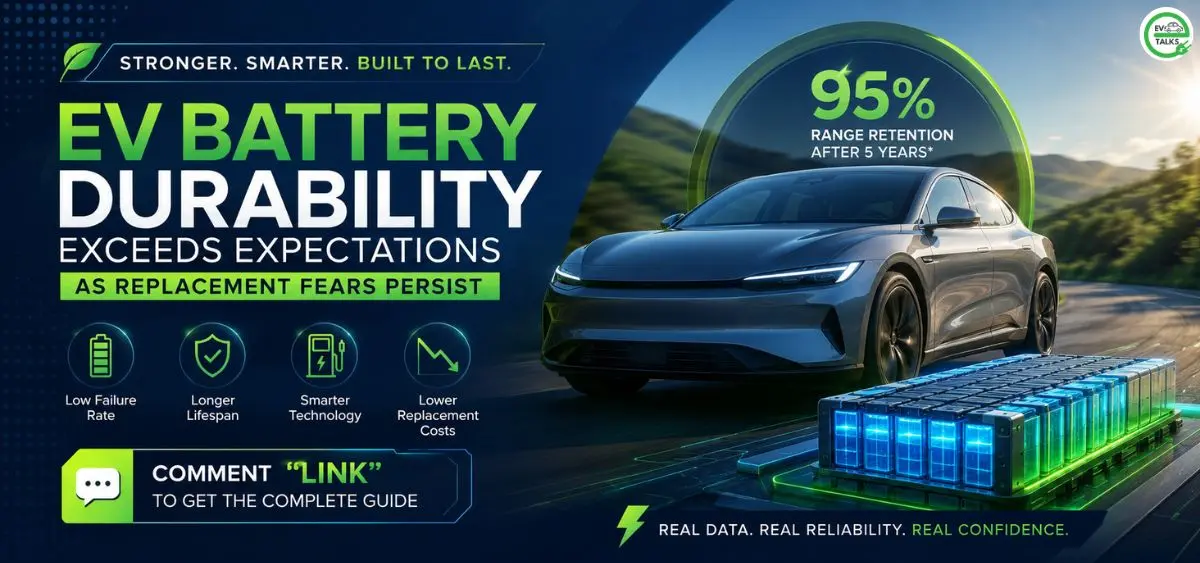

Concerns about expensive battery replacements have long discouraged many buyers from switching to electric vehicles. However, new real-world data is challenging this perception. Recent industry findings show that EV battery durability has improved dramatically, with modern electric vehicle batteries lasting far longer than many experts predicted just a few years ago.
Advancements in battery chemistry, thermal management, intelligent software, and repair technologies have significantly increased battery lifespan while reducing replacement rates. As a result, electric vehicles are becoming more reliable and cost-effective over the long term.
Real-World Data Reveals Exceptional Battery Performance
Recent battery performance analysis paints a much more positive picture than many consumers expect.
Vehicles manufactured from 2022 onwards have recorded an extremely low battery replacement rate of just 0.3%, a remarkable improvement over nearly 8% for EVs built between 2011 and 2016. This highlights how rapidly battery technology has evolved over the past decade.
At the same time, the average electric vehicle retains approximately 95% of its original driving range after five years of regular use. This means most owners experience only minimal performance loss, making modern EVs suitable for both daily commuting and long-distance travel even after several years on the road.
Additional telematics research suggests today’s liquid-cooled batteries degrade by only 1.8% to 2.3% annually, allowing many battery packs to potentially last close to 20 years—often longer than the vehicle itself.
Technology Behind Improved EV Battery Durability
The impressive improvements in EV battery durability are the result of several major technological advancements.
Active Thermal Management
Unlike many early electric vehicles that lacked proper cooling systems, modern EVs use advanced liquid cooling technology to keep batteries operating within optimal temperature ranges. Preventing excessive heat significantly slows battery degradation.
Smarter Battery Management Systems
Modern Battery Management Systems (BMS) constantly monitor charging, discharging, and cell temperatures. Many manufacturers also include hidden software buffers that prevent batteries from fully charging or completely draining, reducing long-term wear while maintaining consistent driving range.
Advanced Battery Chemistry
The adoption of improved lithium-ion batteries and increasingly popular Lithium Iron Phosphate (LFP) batteries has greatly enhanced battery stability, safety, and charging cycle life. These newer chemistries are designed to withstand thousands of charging cycles with minimal performance loss.
Battery Replacement Costs Are Falling
Even when battery repairs become necessary, the financial impact is much smaller than many buyers fear.
Automakers are increasingly designing battery packs with modular construction, allowing technicians to replace only damaged battery modules instead of an entire battery pack. This significantly lowers repair costs.
Meanwhile, global battery cell prices have fallen by more than 90% since 2010, making replacement batteries far more affordable than they once were and improving the overall economics of electric vehicle ownership.
Charging Habits Still Matter
Although modern batteries are more durable than ever, driving habits still influence long-term battery health.
Experts recommend limiting frequent high-power DC fast charging whenever possible and avoiding regular charging to 100% unless necessary for long trips. Moderate charging routines help preserve battery capacity and maintain driving range over many years.
Consumer Concerns Continue Despite Strong Evidence
Despite overwhelming improvements in EV battery durability, consumer perception has not fully caught up with reality. Surveys consistently show that fears of expensive out-of-warranty battery replacements remain one of the biggest reasons buyers hesitate to choose electric vehicles over petrol or diesel models.
This perception gap remains a challenge for automakers, even though real-world reliability data demonstrates that battery failures are now extremely rare.
A Longer Life Beyond the Vehicle
Modern EV batteries often continue to provide value even after they are no longer ideal for driving.
When battery health eventually falls to around 70–80% capacity, many packs are repurposed for stationary energy storage applications, supporting homes, businesses, and electricity grids for several more years before finally being recycled.
The Future Looks Brighter for Electric Vehicles
As electric vehicle sales continue to evolve globally, growing evidence of EV battery durability is helping reshape public confidence. Longer-lasting batteries, lower repair costs, improved charging technology, and better battery management systems are making EV ownership increasingly practical and economical.
With continuous innovation and declining battery costs, modern electric vehicles are proving that battery longevity is no longer the major concern it once was, strengthening the case for wider EV adoption in the years ahead.

Related Articles:









