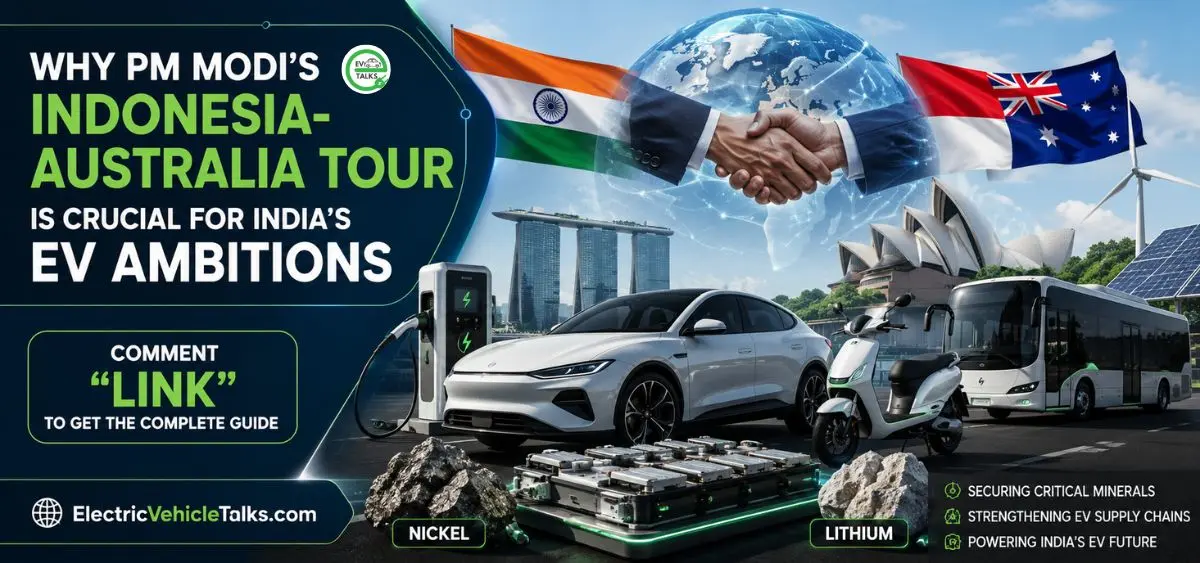

India’s electric vehicle (EV) revolution depends on more than just automobile manufacturing and charging infrastructure. The availability of critical minerals like lithium, nickel, and cobalt will determine the country’s ability to build indigenous EV batteries and reduce dependence on foreign suppliers. In this scenario, PM Modi’s Indonesia-Australia Tour has emerged as a strategically important move to secure the raw materials required for India’s clean mobility future.
According to a report by the Institute for Energy Economics and Financial Analysis (IEEFA), India remains 100% dependent on imports for lithium, cobalt, and nickel, which are essential components of EV batteries. Growing global competition, export restrictions, resource nationalism, and supply chain disruptions have made access to these minerals a major challenge for countries aiming to expand electric mobility.
Critical Minerals: The Backbone of India’s EV Future
Lithium and nickel are among the most important minerals for producing advanced lithium-ion batteries used in electric cars, buses, and two-wheelers. However, global reserves and processing facilities remain concentrated in a few countries, creating supply risks for import-dependent nations like India.
Saloni Sachdeva Michael, Lead Energy Specialist at IEEFA, highlighted that increasing restrictions and changing global mineral policies are fragmenting supply chains, leading to price volatility and uncertain availability.
For India, building reliable partnerships with mineral-rich nations has become essential to achieving self-reliance in EV manufacturing.
Indonesia: The Global Nickel Powerhouse
Indonesia plays a crucial role in the global EV battery supply chain because of its dominance in nickel production. Nickel is a key material used in high-energy-density batteries that power modern electric vehicles.
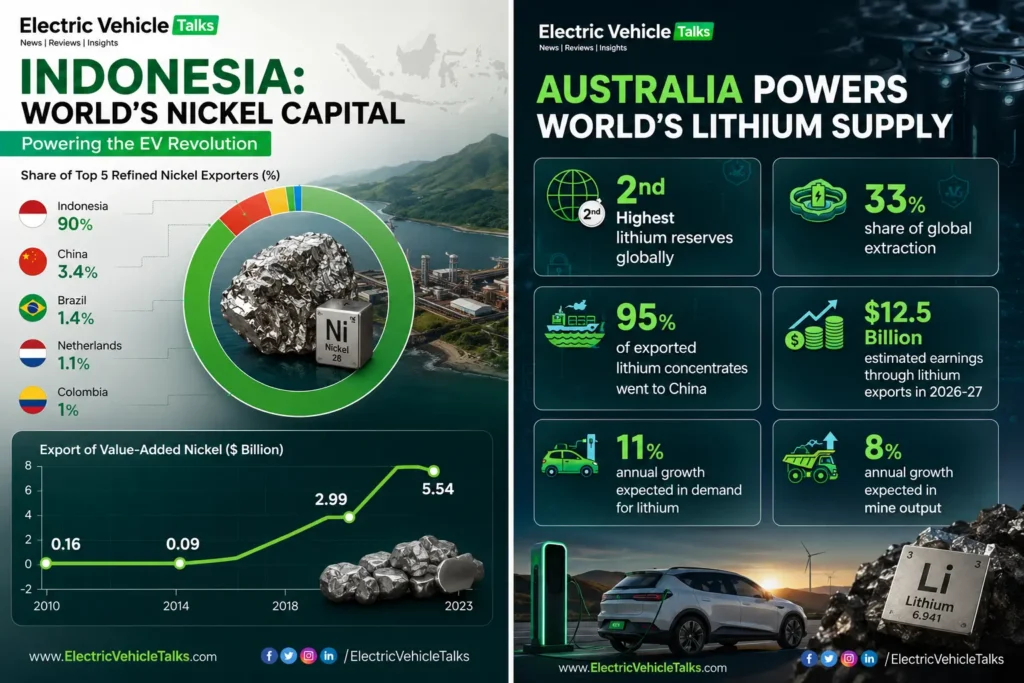
Indonesia has the world’s largest nickel reserves, estimated at around 55 million tonnes. Over the past few years, the country has rapidly expanded its influence in the nickel market, increasing its share of global nickel production from 16% in 2017 to 54% in 2023, producing around 2.02 million tonnes.
The country’s 2014 mining law transformed its mineral industry by requiring companies to process minerals domestically before exporting them. The ban on raw nickel ore exports encouraged massive investments in smelting and refining facilities.
As a result, Indonesia became a global hub for processed nickel products, accounting for nearly 90% of the world’s refined nickel exports in 2025. Its value-added nickel exports increased significantly from $0.09 billion in 2014 to $5.54 billion in 2023.
Through PM Modi’s Indonesia-Australia Tour, India is strengthening cooperation with Indonesia to create stable access to nickel resources and develop diversified supply chains for EV battery manufacturing.
Australia: India’s Gateway to Lithium Resources
While Indonesia dominates nickel, Australia is one of the world’s most important lithium suppliers. Lithium is the core element used in lithium-ion battery cells, making it indispensable for EV production.
Australia holds the second-largest lithium reserves globally and contributed around one-third of global lithium extraction in 2025. However, approximately 95% of Australia’s exported lithium concentrate has traditionally been supplied to China.
Australia’s lithium export earnings are projected to rise from $9.9 billion in 2025-26 to $12.5 billion in 2026-27. At the same time, my output is expected to grow by around 8% annually, while global lithium demand is forecast to increase by nearly 11% until 2031.
India’s engagement with Australia aims to diversify lithium supply chains and move beyond a simple buyer-seller relationship toward joint processing, technology cooperation, and value addition.
National Critical Mineral Mission Supports EV Self-Reliance
India has already taken major steps to secure critical mineral resources through the National Critical Mineral Mission (NCMM), launched in 2025. The mission focuses on developing domestic capabilities and creating reliable international partnerships for critical minerals.
The initiative is particularly important as India expands EV adoption through ambitious policies. For example, Delhi’s planned ban on registration of new petrol and CNG two-wheelers from April 2028 highlights the urgent need for large-scale electric vehicle production.
A stable supply of lithium and nickel will help Indian manufacturers develop locally produced batteries, reduce import dependency, and strengthen the domestic EV ecosystem.
Strengthening India’s Global EV Supply Chain Strategy
During discussions between Prime Minister Narendra Modi and Indonesian President Prabowo Subianto, both countries emphasized cooperation in critical minerals and rare earth elements. The focus remains on building resilient supply chains that support domestic manufacturing and clean energy technologies.
PM Modi’s Indonesia-Australia Tour represents a major step toward securing India’s EV ambitions by connecting the country with two of the world’s most important mineral suppliers. Access to Indonesian nickel and Australian lithium could accelerate battery manufacturing, strengthen EV production, and support India’s transition toward sustainable transportation.
As global demand for electric vehicles continues to rise, controlling critical mineral supply chains will become as important as manufacturing vehicles themselves. India’s partnerships with Indonesia and Australia could play a defining role in making the country a global hub for electric mobility.

Related Articles: