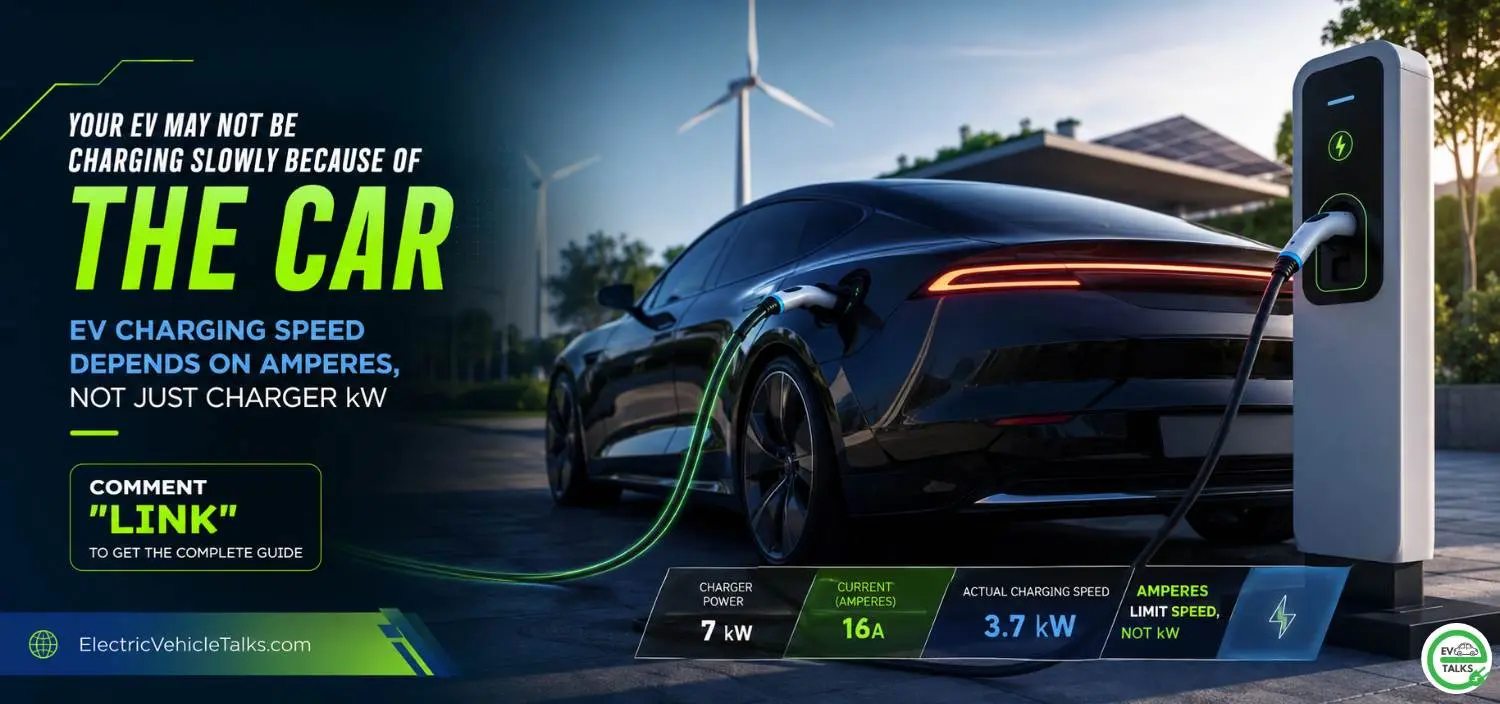

Many electric vehicle owners believe that plugging into a high-kilowatt (kW) DC fast charger automatically guarantees the fastest possible charging speed. However, this is one of the biggest misconceptions surrounding EV charging. The truth is that charging speed depends on much more than the charger’s advertised power rating (EV charging speed depends on amperes). While charger capacity in kilowatts is important, the actual charging speed is determined by a combination of:
- Charger voltage (V)
- Charger current (Ampere or A)
- Battery voltage
- The vehicle’s Battery Management System (BMS)
- Battery temperature
- State of Charge (SoC)
If any one of these factors becomes a limiting factor, your EV will charge slower than expected—even on a 180 kW or 240 kW charger.
Why Isn’t My EV Charging at the Advertised Speed?
One of the most common questions among EV owners is the following:
“Why is my car charging at only 70 kW when I’m connected to a 180 kW charger?”
The answer lies in understanding the current (in amperes) rather than looking only at the charger’s power rating.
A charger’s power output is not fixed. Instead, it depends on how much voltage and current it can deliver at any given moment.
The fundamental electrical formula is:
Power (kW) = Voltage (V) × Current (A) ÷ 1000
This means that charging power constantly changes because battery voltage changes during charging.
Why EV Charging Speed Depends on Amperes, Not just kW
Many EV owners assume that plugging into a higher-rated DC fast charger automatically guarantees the fastest charging speed. However, the charger’s advertised kilowatt (kW) rating tells only part of the story.
The actual charging speed depends on the current (amps) the charger can deliver, the voltage of the battery, and the amount of current the vehicle’s Battery Management System (BMS) allows the battery to accept.
Charging power is calculated using the formula:
Power (kW) = Voltage (V) × Current (A) ÷ 1000
This means a charger with a high kW rating but a lower current limit may not deliver the expected charging speed. For example, if your EV can safely accept 350A, but the charger is limited to 200A, the vehicle cannot reach its maximum charging potential, even if the charger is advertised as a high-power unit.
The BMS also plays a crucial role by adjusting charging current based on battery temperature, state of charge (SoC), and battery health to ensure safe and efficient charging.
So, if your EV seems to be charging slowly, the problem may not be the vehicle at all. In many cases, the charger’s Ampere limit, rather than its kW rating, is the real factor determining how quickly your battery charges. Understanding this helps EV owners choose the right charging station and set realistic charging expectations.
Maximum AC/DC Support in EV Cars
The Hidden Role of Ampere in DC Fast Charging
Most EV buyers focus on the charger’s kW rating, but experienced EV engineers pay close attention to amperes (A).
Current is often the hidden factor that limits charging speed.
Imagine two DC chargers:
- Charger A: 180 kW, maximum 200 A
- Charger B: 180 kW, maximum 400 A
Although both advertise the same maximum power, they may deliver very different charging performance depending on the vehicle connected to them.
If your EV can accept more than 200 A, Charger A will become the bottleneck.
How the Vehicle’s Battery Management System (BMS) Controls Charging
Every electric vehicle has a Battery Management System (BMS).
The BMS continuously monitors:
- Battery temperature
- Battery health
- Cell voltage
- State of charge
- Safety limits
The BMS decides exactly how much current the battery is allowed to receive.
Even if the charger can provide 400 A, the BMS may allow only the following:
- 150 A
- 220 A
- 300 A
Depending on battery conditions.
Likewise, if the charger can provide only 250 A while the battery is ready to accept 400 A, the charger becomes the limiting factor.
The charging speed will then be restricted by the charger—not the vehicle.
Why Two 180 kW Chargers Can Deliver Different Charging Speeds
This is one of the least understood aspects of EV charging.
Two chargers with identical power ratings may have completely different internal specifications.
For example:
| Charger | Rated Power | Maximum Current | Real Charging Experience |
|---|---|---|---|
| Charger A | 180 kW | 200 A | Slower for high-current EVs |
| Charger B | 180 kW | 400 A | Faster for compatible EVs |
Although both advertise 180 kW, Charger B can sustain higher current delivery, allowing compatible vehicles to charge significantly faster.
This is why experienced EV users often notice performance differences between charging networks.
Other Factors That Affect DC Fast Charging Speed
The current limit is only one part of the charging equation.
Other important factors include:
a) Battery Temperature
Cold batteries reduce charging speed to protect battery cells.
Hot batteries may also reduce charging current to prevent overheating.
b) State of Charge (SoC)
Charging is fastest between approximately 10% and 50% battery level.
As the battery approaches full charge, the BMS gradually reduces the current to protect battery longevity.
This process is known as charging taper.
c) Battery Voltage
Battery voltage rises as charging progresses.
Since power equals voltage multiplied by current, charging power changes continuously throughout the charging session.
d) Charger Capability
Different charging stations use different
- Power electronics
- Cooling systems
- Cable ratings
- Current limits
These design differences directly affect charging performance.
Why EV Owners Should Check Ampere Ratings Before Using a Charger
When comparing charging stations, don’t look only at the kW rating.
Also check:
- Maximum current (Ampere)
- Maximum voltage
- Connector compatibility
- Charging curve
- Vehicle charging capability
Understanding these specifications helps explain why one charging station may consistently outperform another.
Technical Notes
The actual charging power during DC fast charging is determined by the relationship between voltage (V) and current (A), not just the charger’s advertised power rating (kW).
Formula:
Power (kW) = Voltage (V) × Current (A) ÷ 1000
Since an EV battery’s voltage changes as it charges, the charging power is not constant throughout the session. The maximum current (in amperes) the charger can deliver, and the maximum current the vehicle’s Battery Management System (BMS) is willing to accept, together determine the real charging speed.
For example, a charger rated at 180 kW but limited to 200 A may deliver lower charging speeds than another 180 kW charger capable of supplying 400 A, especially for EVs designed to accept higher current. Likewise, even if a charger can provide 400 A, the vehicle’s BMS may reduce the accepted current based on factors such as battery temperature, state of charge (SoC), battery health, and safety requirements.
In simple terms: Two DC fast chargers with the same advertised kW rating can deliver noticeably different real-world charging performance because of differences in current limits, voltage range, and the vehicle’s charging acceptance profile. This is why looking beyond the kW rating is essential when evaluating EV charging performance.
The Bottom Line
The advertised power rating of a DC fast charger tells only part of the story.
Actual charging speed depends on the interaction between
- Charger voltage
- Charger current (Ampere)
- Vehicle battery voltage
- Battery Management System (BMS)
- Battery temperature
- State of charge
In many cases, the charger’s maximum current—not its advertised kW rating—is the factor limiting charging performance.
So the next time your EV charges slower than expected, don’t blame the vehicle immediately. The charger’s Ampere limit may be the real reason.
Real-World Examples
1. Mahindra BE 6
The Mahindra BE 6 provides an excellent example of how charging current affects real-world performance.
Under ideal battery conditions, the vehicle can accept approximately 400 A during DC fast charging.
However, imagine connecting it to a DC charger capable of supplying only the following:
- 200 A
- 250 A
- 300 A
In this situation, the vehicle cannot utilize its full charging capability.
Even if the charger is marketed as a high-power charger, the limited current output prevents the EV from reaching its maximum charging speed.
This explains why owners sometimes experience slower charging than expected despite using premium charging stations.
2. Hyundai Ioniq 5: A Quick Example of Why Ampere Matters
The Hyundai Ioniq 5 features an advanced 800V battery architecture and can charge from 10% to 80% in about 18 minutes on a compatible 350 kW DC ultra-fast charger under ideal conditions.
However, charging speed depends on more than just the charger’s kW rating. If the charger has a lower current (Ampere) limit or doesn’t support the required voltage, the Ioniq 5 won’t reach its maximum charging speed. The vehicle’s Battery Management System (BMS) also regulates how much current the battery can safely accept.
Technical Insight
Power (kW) = Voltage (V) × Current (A) ÷ 1000
800V × 350A = 280 kW
800V × 200A = 160 kW
This shows that even a high-power EV like the Ioniq 5 will charge more slowly if the charger’s current output is limited. In real-world conditions, charging speed also depends on battery temperature, state of charge (SoC), and BMS controls.
Note: Actual charging power varies based on battery temperature, state of charge (SoC), battery condition, charger capability, and the Battery Management System (BMS), which continuously adjusts the charging current to ensure safe and efficient charging.
Kia EV6: Why Ampere Matters in DC Fast Charging
The Kia EV6 features an advanced 800V E-GMP platform and can charge from 10% to 80% in around 18 minutes using a compatible 350 kW DC ultra-fast charger under ideal conditions.
However, charging speed depends on more than the charger’s kW rating. The charger must provide sufficient voltage and current (amperes), and the EV6’s Battery Management System (BMS) must allow the battery to accept that power. If the charger has a lower current limit, the charging speed will be reduced.
Technical Example
Power (kW) = Voltage (V) × Current (A) ÷ 1000
- 800V × 350A = 280 kW
- 800V × 200A = 160 kW
This shows that a charger limited to 200A can significantly reduce charging performance, even for an EV capable of ultra-fast charging. Actual charging speeds also vary based on battery temperature, state of charge (SoC), and BMS controls.
Note: Actual charging speeds depend on several factors, including battery temperature, state of charge (SoC), charger voltage, charger current capability, battery condition, and the vehicle’s Battery Management System (BMS). Under real-world conditions, charging power varies throughout the session as the BMS optimizes performance and protects the battery.
4. BYD Seal
The BYD Seal supports high-speed DC charging, but like any EV, it only reaches peak charging rates when the charger can provide sufficient voltage and current and the battery is in optimal condition.
5. Lucid Air (One of the Fastest Charging EVs)
The Lucid Air is capable of charging at over 300 kW under ideal conditions.
However, if connected to a charger with lower current capability, it will charge significantly slower despite its advanced charging system.
FAQs
Does a higher kW charger always charge an EV faster?
No. A higher kW rating alone does not guarantee faster charging. The charger’s maximum current, battery voltage, and the EV’s Battery Management System (BMS) all determine the actual charging speed.
Why is my EV charging slower than the charger rating?
Your EV may be limited by the charger’s maximum current, battery temperature, state of charge, or the vehicle’s BMS, which controls how much power the battery can safely accept.
What is the formula for EV charging power?
The charging power is calculated using:
Power (kW) = Voltage (V) × Current (A) ÷ 1000
What does Ampere mean in EV charging?
Amperes (A) measure the amount of electrical current flowing from the charger to the vehicle. A charger with a higher current capability can deliver more power if the EV is designed to accept it.
Why do two chargers with the same kW rating charge differently?
They may have different maximum current limits, cooling systems, or voltage capabilities, leading to different real-world charging performance.
Does the Mahindra BE 6 support 400 A charging?
Under suitable battery conditions, the Mahindra BE 6 can accept approximately 400 A during DC fast charging. However, the actual charging speed depends on whether the connected charger can supply that level of current.
People Also Ask (PAA)
Why is my EV not charging at maximum speed?
Charging speed may be limited by the charger’s current output, battery temperature, battery state of charge, or the vehicle’s Battery Management System.
Does charger ampere matter more than kW?
Both are important, but a charger’s maximum ampere rating can become the limiting factor even if the charger has a high kW rating.
What limits DC fast charging speed?
The main limiting factors include charger current, battery voltage, BMS restrictions, battery temperature, and charging state.
How does the BMS control EV charging?
The BMS monitors battery health, temperature, and voltage, then adjusts the charging current to ensure safe and efficient charging.
Can two 180 kW chargers perform differently?
Yes. Chargers with the same power rating can have different current limits and hardware capabilities, resulting in different charging speeds.

Related Articles: