
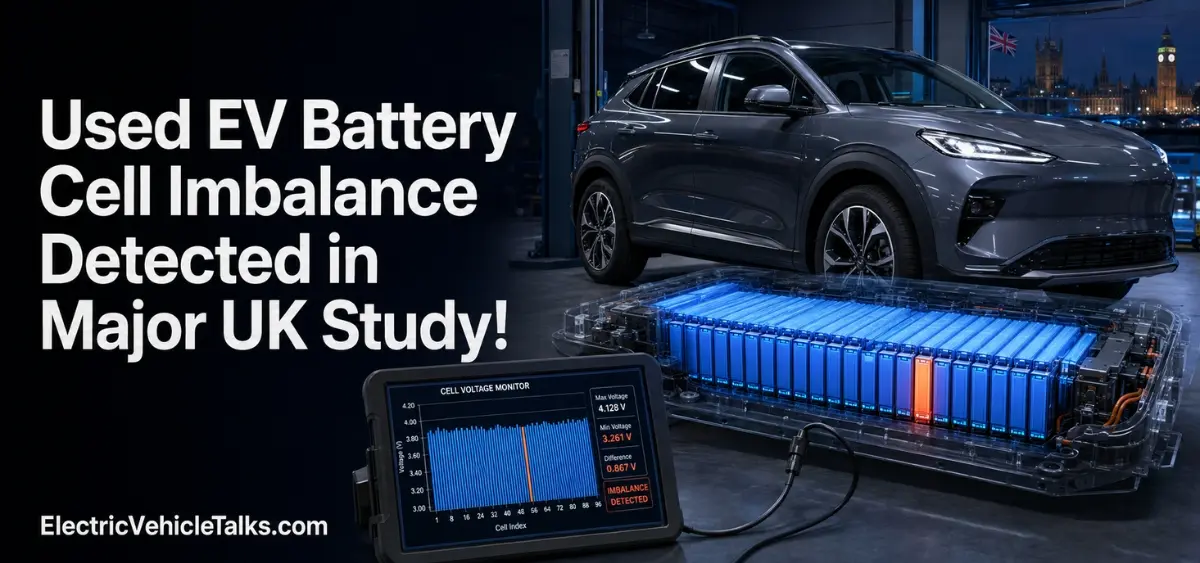

A UK study has uncovered battery faults that health reports may miss. Diagnostics company Generational analyzed cells in approximately 10,000 used electric vehicles tested. One in 85 recorded a cell-voltage spread above 50 millivolts, while one in 200 exceeded 100 mV. The findings suggest Used EV Battery Cell Imbalance deserves scrutiny as more electric cars enter the used market. Generational considers readings above 50 mV worthy of investigation, while some manufacturers may classify spreads exceeding 100 mV as failed battery packs.
Why State of Health Misses Faults
State of Health, or SoH, estimates how much usable capacity a battery retains compared with when new. However, it does not reveal whether every cell charges and discharges uniformly.
An EV battery contains hundreds of cells. Charging may stop when the fullest cell reaches its limit, while discharging can end when the weakest cell becomes depleted. One drifting cell may therefore reduce range, disturb state-of-charge estimates, restrict charging, and affect vehicle value.
Generational chief executive Oliver Phillpott explained that SoH measures capacity, not necessarily whether individual cells function correctly. An imbalance can develop without a dashboard warning, leaving buyers and dealers unaware until the fault worsens.
Most Batteries Remain Healthy
The median difference between the highest and lowest cell voltages was only 8 mV, showing most tested batteries were well balanced. Generational’s Battery Performance Index, based on 8,000 assessments, reported an average SoH of 95.15 percent, although variation increased with age.
This indicates that Used EV Battery Cell Imbalance affects a minority. Detecting outliers remains important because the battery can represent more than 40 percent of an EV’s cost.
Can Cell Imbalance Be Fixed?
When a vehicle is flagged, Generational guides the dealer through controlled cell rebalancing. Around half of identified problems persisted afterwards. Extreme imbalances above 100 mV are unlikely to disappear without module repairs, manufacturer inspection, or a warranty claim.
Why Testing Matters
Used battery-electric vehicle transactions reached record levels in the UK during the first quarter of 2026 as its EV fleet aged. However, industry knowledge of battery condition has not kept pace with vehicles entering the used market.
Annual diagnostics could help retailers, finance providers, and consumers identify Used EV Battery Cell Imbalance early, protect residual values, and reduce post-sale disputes. Cell-level testing also lets healthy vehicles demonstrate quality while ensuring vulnerable packs receive attention before becoming customer problems.

Related Articles:









