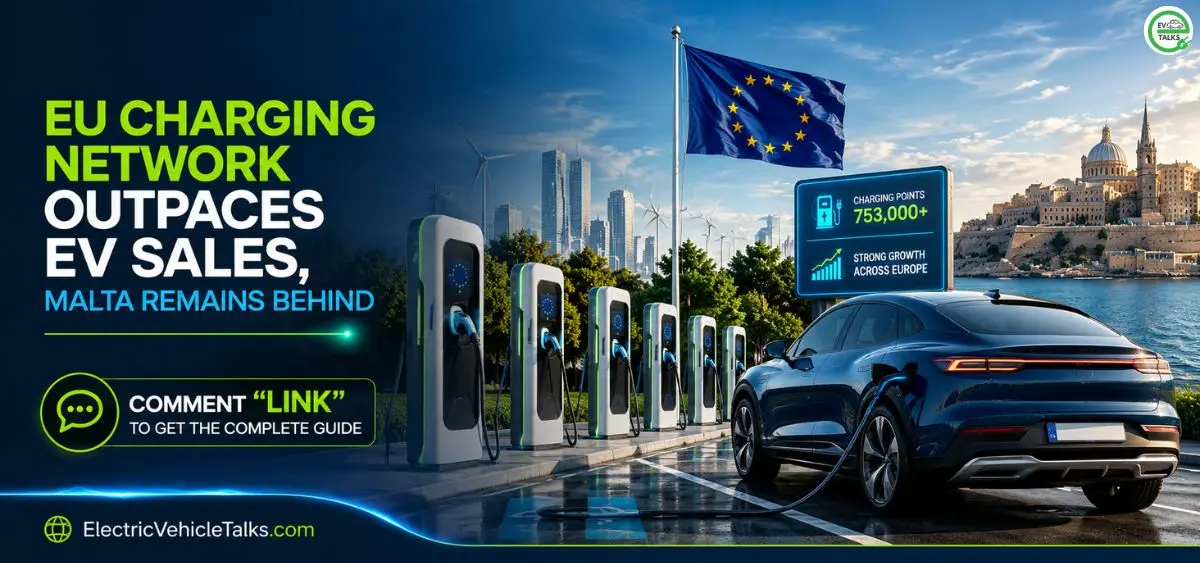

The EU charging network outpaces EV sales, according to new data, highlighting that public charging infrastructure is expanding faster than the number of electric vehicles on European roads. A recent analysis shows that nearly every European Union member state has already exceeded the public charging capacity required for its growing EV fleet, challenging long-standing concerns that insufficient charging infrastructure is slowing electric vehicle adoption.
EU Public Charging Infrastructure Reaches Record Growth
The latest findings reveal that the EU charging network outpaces EV sales by a significant margin. By the end of 2025, the European Union had installed approximately 1.1 million public charging points, representing a fivefold increase compared to 2020.
The rapid deployment of charging stations has enabled the EU to exceed the mandatory fleet-based infrastructure requirements set out in the Alternative Fuels Infrastructure Regulation (AFIR). According to the report, the bloc’s public charging capacity now stands 180% above the minimum AFIR target, indicating that infrastructure development is progressing much faster than electric vehicle registrations.
This trend directly challenges claims from some automobile manufacturers that inadequate charging infrastructure is a major reason for slowing the transition away from internal combustion engine vehicles.
Almost Every EU Country Meets Charging Capacity Targets
One of the report’s most significant findings is that all EU member states except Malta have already met the required public charging capacity for their electric vehicle fleets.
The data suggests that Europe’s charging ecosystem is now sufficiently developed to support current EV adoption levels, with charging availability growing faster than the number of vehicles requiring access.
Western European countries continue to lead infrastructure development. More than 99% of the region complies with geographic charging coverage targets, although a large proportion of Europe’s public chargers remain concentrated in the Netherlands, France, and Germany, creating regional differences in charger density.
Ultra-Fast Charging Still Needs Improvement
Although overall infrastructure growth has been impressive, the report identifies one area requiring further investment—ultra-fast charging stations.
By mid-2026, around 79% of the EU’s core transport highway network will meet the 2025 AFIR requirements for high-powered charging hubs located approximately every 60 kilometers. While this represents substantial progress, experts say the remaining transport corridors still require additional ultra-fast charging facilities to support long-distance electric mobility.
Expanding these high-speed charging hubs will improve travel convenience, reduce charging times, and strengthen confidence among EV owners across Europe.
Why Malta Remains the Only Exception
Despite the EU’s overall success, Malta remains the only member state that has not achieved the required fleet-based charging capacity.
Several unique challenges have contributed to Malta’s slower progress. Government incentives previously encouraged strong EV adoption, pushing the country’s electric vehicle market share above the EU average. However, charging infrastructure failed to expand at the same pace.
Plans to install more than 1,200 additional public charging stations have faced prolonged administrative delays, preventing the island from rapidly expanding its charging network.
Housing also presents a major obstacle. A large share of Malta’s residents live in apartment buildings where private home charging is difficult or impossible, increasing dependence on public charging stations and placing greater pressure on the existing network.
Europe’s EV Infrastructure Continues to Strengthen
The report concludes that the EU charging network outpaces EV sales, demonstrating that charging infrastructure is no longer the primary barrier to electric vehicle adoption across most of Europe. Future investments will instead focus on expanding ultra-fast highway charging, improving regional coverage, and integrating charging facilities into new residential and commercial developments.
As Europe accelerates its transition toward zero-emission mobility, continued infrastructure improvements are expected to provide greater convenience for drivers while supporting the EU’s long-term transport electrification goals.

Related Articles: