Electric car batteries may last far longer than many buyers expect, but not every model ages equally. Austrian battery diagnostics specialist AVILOO has examined more than 500,000 independent battery checks across 20 popular electric vehicles, uncovering differences in long-term performance. The AVILOO EV Battery Health Report shows that most models still retain substantial usable capacity after travelling 150,000 kilometres, with the Mercedes-Benz EQA and Hyundai Ioniq 5 among the strongest performers.
Tesla’s Model 3 and Model Y also retain much of their capacity, but individual results vary sharply. For used EV buyers, the biggest lesson is simple: test before purchasing.
Which EV Batteries Last the Longest?
According to AVILOO’s 2026 battery health research, the Mercedes-Benz EQA, Hyundai Ioniq 5 and BMW i4 were among the strongest performers after 150,000 km, retaining approximately 94%, 93.8% and 93.6% of their original usable battery capacity, respectively. The Tesla Model Y retained around 90.3%, while smaller EVs, including the Nissan Leaf and Renault Zoe, showed greater degradation. The results suggest that most modern EV batteries can remain highly usable after years of driving.
Key Highlights: What 500,000 EV Battery Tests Revealed
- 500,000+ battery tests: Analyzed across 20 popular electric vehicle models.
- Five years of data: Tests conducted between 2022 and 2026.
- Global coverage: North America, South America, Europe, Asia, and Australia.
- Three mileage milestones: Battery health evaluated at 50,000 km, 100,000 km and 150,000 km.
- Top performers: Mercedes-Benz EQA, Hyundai Ioniq 5 and BMW i4.
- Tesla results: Model Y retained approximately 90.3%, while Model 3 retained 88.94% at 150,000 km.
- Major variation: Individual vehicles of the same model showed battery health differences of up to 13.5 percentage points.
- Important takeaway: Vehicle mileage alone cannot determine the actual condition of an EV battery.
AVILOO Analyzes 500,000 Battery Tests Across 20 Popular EVs
AVILOO, an Austria-based electric vehicle battery diagnostics company, has published one of the largest independent studies examining battery health in used electric cars.
The research forms part of its Certified EV Battery Report, which uses more than 500,000 independent FLASH battery tests collected between 2022 and 2026.
These tests cover 20 popular electric vehicle models operating in different climates, driving conditions and charging environments.
The analyzed results are part of AVILOO’s larger global database, which contains more than one million battery diagnostic tests.
Unlike studies relying only on manufacturer estimates or dashboard indicators, AVILOO uses independent diagnostics to assess battery State of Health.
The company’s analysis identifies three major patterns:
- Battery capacity generally decreases as mileage increases.
- Differences in battery health between individual vehicles become larger at higher mileage.
- Some electric vehicle models consistently retain more battery capacity than others.
AVILOO plans to publish the report twice annually, providing updated insights into EV battery degradation and long-term reliability.

What Is EV Battery State of Health, and Why Does It Matter?
An electric vehicle’s State of Health (SoH) measures how much usable battery capacity remains compared with its original condition.
For example, an electric car with 95% State of Health retains approximately 95% of its original usable battery capacity.
ILLUSTRATIVE EXAMPLE
Original driving range: 400 km
At 95% battery health: ~380 km
Range may fall approximately 5% if all other conditions remain unchanged. Actual driving range also depends on temperature, speed, vehicle efficiency, and other factors.
The AVILOO EV Battery Health Report compares median battery health at three mileage milestones to explain how different models perform as they age.
The median represents the middle value of the battery health distribution, rather than the guaranteed condition of every vehicle.
This distinction is particularly important when purchasing a second-hand electric car.
EV Battery Health After 50,000 KM: Hyundai Ioniq 5 Leads
At the first milestone of 50,000 km, approximately 31,068 miles, the Hyundai Ioniq 5 emerged as one of the strongest performers.
Its median battery health remained above 97%, suggesting only minimal loss of usable capacity.
The Mercedes-Benz EQA followed closely, recording approximately 96.56% battery health.
All 20 models in the supplied comparison recorded median battery health above 90% at this stage.
Most EVs retained approximately 94% or more, with the Renault Zoe and older Nissan Leaf among the notable lower-performing models.
Why do smaller EV batteries degrade faster?
Smaller battery packs typically require more charging cycles to cover the same distance. Additional cycling can contribute to battery degradation, although battery chemistry, cooling, and charging habits also influence performance.
EV Battery Health After 100,000 KM: The Top Performers
After 100,000 km, or approximately 62,137 miles, several popular EVs continued to demonstrate impressive battery longevity.
The Hyundai Ioniq 5 again stood out, retaining more than 95% battery capacity in the overall model comparison.
Other strong performers included
| Electric Vehicle | Median battery health |
|---|---|
| Hyundai Ioniq 5 | Over 95% |
| Mercedes-Benz EQA | ~95% |
| Hyundai Kona Electric | 94.30% |
| BMW i4 | 94.30% |
| Ford Mustang Mach-E | 93.45% |
These results suggest that many modern electric vehicles can retain most of their original battery capacity even after extensive daily driving.
Apart from the lower-performing outliers, the models generally maintained median battery health of at least 90%.
For EV buyers, these numbers are encouraging because battery longevity directly affects long-term range, ownership costs and resale value.
EV Battery Health After 150,000 KM: Which Models Perform Best?
The most revealing comparison comes at 150,000 km, approximately 93,205 miles.
At this stage, most electric vehicles in the study retained roughly 90% to 94% of their original usable battery capacity.
However, noticeable differences emerged between individual models.
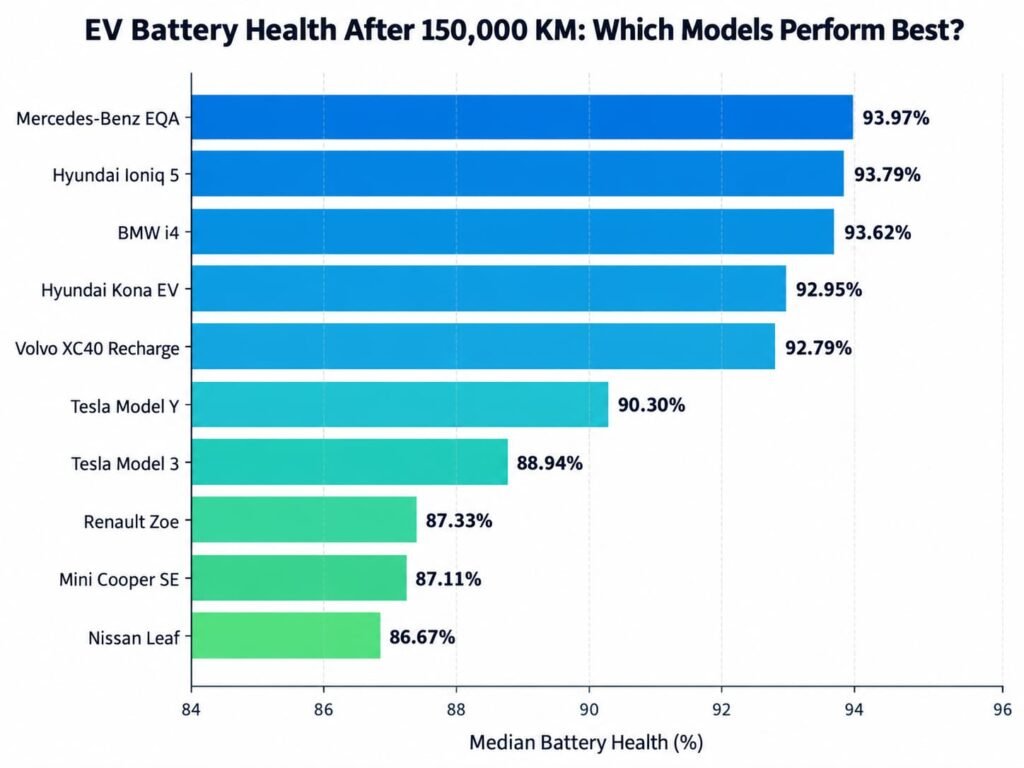
Rounded model-level values from the supplied study summary. Individual battery-pack variants may differ.
Figures are from the overall model-level comparison provided. AVILOO’s separate battery-pack-specific analysis can produce different values because battery capacities and configurations vary within a model.
Mercedes-Benz EQA and Hyundai Ioniq 5 Take the Lead
The Mercedes-Benz EQA recorded approximately 93.97% remaining capacity, narrowly ahead of the Hyundai Ioniq 5 at 93.79%.
The BMW i4 followed at 93.62%, while the Hyundai Kona Electric and Volvo XC40 Recharge also delivered strong results.
These findings position the vehicles among the strongest battery-retention performers in the study.
The Hyundai Ioniq 5 was particularly impressive because it performed strongly across all three mileage milestones.
However, a model’s ranking should not be interpreted as proof that every example of that vehicle will outperform its competitors.
Tesla Model Y and Model 3: Good Battery Life, but Not the Best
Tesla vehicles have long been associated with electric mobility innovation, battery technology and software-driven performance.
However, AVILOO’s research found that the Tesla Model Y and Model 3 did not lead the overall battery health comparison.
After 150,000 km:
- Tesla Model Y: Approximately 90.30% median battery health.
- Tesla Model 3: Approximately 88.94% median battery health.
Both vehicles retained a substantial share of their original usable capacity, although several competitors recorded higher median figures.
For the Model Y, AVILOO’s separate analysis of the 78.8 kWh battery version found approximately 94.5% capacity at 50,000 km, declining to 90.3% at 150,000 km.
The corresponding estimated real-world range declined from around 379 km to 362 km.
This demonstrates that battery degradation does not necessarily mean a dramatic reduction in everyday usability.
A Tesla can still deliver useful driving range after significant mileage, although its exact battery condition depends on multiple factors.
Nissan Leaf, Renault Zoe and Mini Cooper SE Show Higher Degradation
While most modern EV batteries performed well, several smaller electric vehicles recorded comparatively higher degradation.
The Nissan Leaf, Renault Zoe and Mini Cooper SE finished among the lower performers at 150,000 km.
The reported median battery health figures were:
- Nissan Leaf: 86.67%
- Mini Cooper SE: 87.11%
- Renault Zoe: 87.33%
These figures still indicate that the vehicles retain a substantial portion of their original battery capacity.
However, smaller battery packs may experience more frequent charging cycles for the same total distance.
The older Nissan Leaf also uses passive air cooling rather than the more sophisticated liquid thermal management systems found in many newer EVs.
Battery thermal management plays a significant role in protecting cells from excessive temperatures and supporting long-term performance.
Importantly, these findings do not suggest that every small electric vehicle will experience rapid degradation. Battery chemistry, cooling design, usage and charging habits all matter.
Why Identical EVs Can Have a 13.5 Percentage-Point Difference in Battery Health
One of the most important findings from the AVILOO EV Battery Health Report concerns the variation between individual vehicles.
Even two electric cars of the same model, with similar mileage, can have significantly different battery health.
AVILOO identified differences reaching approximately 13.5 percentage points between higher- and lower-performing examples of the same model.
The company also examined prediction intervals designed to cover approximately 99% of vehicles within specific model and mileage groups.
For example, the supplied data shows the following estimated battery-health ranges at the 150,000 km milestone:
| EV model | Lower estimate | Upper estimate |
|---|---|---|
| Tesla Model Y | 82.9% | 94.9% |
| BMW i4 | 87.5% | 96.9% |
| Ford Mustang Mach-E | 85.3% | 96.1% |
| Tesla Model 3 | 80.28% | 94.53% |
These are statistical intervals, not the measured minimum and maximum battery health of every vehicle produced.
The figures demonstrate why average model ratings cannot establish the condition of one specific used electric car.
An individual Tesla Model 3 could have substantially more or less remaining battery capacity than the model’s median.
That difference can translate into meaningful changes in driving range, vehicle valuation and future ownership expectations.
What Causes EV Batteries to Degrade Faster?
AVILOO’s findings reinforce that battery degradation depends on more than kilometres travelled.
Several factors can influence how quickly an EV battery loses usable capacity.
1. High temperatures and climate conditions
Prolonged exposure to high temperatures can accelerate chemical ageing in lithium-ion cells. This is particularly relevant for vehicles frequently operated in hot climates.
2. Frequent DC fast charging
Repeated high-power charging can increase battery stress under certain conditions, particularly when battery temperatures are elevated. Modern battery management systems are designed to control many of these risks.
3. Keeping the battery at 100% for long periods
Maintaining a battery at a high State of Charge for extended periods can increase ageing in some battery chemistries.
4. Battery chemistry
Different EVs use battery technologies such as lithium iron phosphate (LFP) and nickel-based lithium-ion chemistries.
These technologies have different energy density, charging and degradation characteristics.
5. Battery size and charging frequency
Smaller batteries may require more charging cycles to travel the same distance as larger-capacity vehicles.
6. Vehicle age and usage patterns
Calendar ageing occurs even when an electric vehicle is not driven extensively.
Driving conditions, charging behaviour, battery cooling systems and storage habits can also influence long-term health.
Together, these factors help explain why two apparently identical electric vehicles can show noticeably different levels of battery degradation.
How AVILOO Tests EV Battery Health Independently
AVILOO uses its FLASH Test technology to evaluate electric vehicle batteries without depending solely on the battery-health figure displayed by the vehicle manufacturer.
The diagnostic process takes approximately three minutes and connects through the vehicle’s onboard diagnostic port.
The system calculates State of Health using statistical models trained on extensive real-world battery data.
It considers indicators including:
- Battery age and mileage
- Charging cycle count
- Cell voltage differences
- Energy-related diagnostic data
- Battery management system information
- Other battery performance indicators
This provides an independently calculated assessment that can be compared across different vehicle manufacturers.
The approach is particularly useful in the used EV market, where buyers often lack reliable information about previous charging habits or battery condition.
Independent testing does not guarantee future battery performance, but it provides considerably more information than mileage alone.
What the AVILOO Battery Study Means for Indian EV Buyers
The findings are especially relevant as India’s electric vehicle market grows and more used electric cars enter the resale market.
Indian operating conditions can differ considerably from those in Europe and North America.
High summer temperatures, traffic congestion, charging availability and varying driving habits may influence battery ageing.
For anyone considering a used electric vehicle, the research highlights several practical considerations.
Before buying a used EV:
- Request an independent battery State of Health report where testing is available.
- Check whether the remaining battery warranty is transferable.
- Compare actual driving range with the vehicle’s original specifications.
- Review the vehicle’s charging and service history where possible.
- Inspect the battery cooling system and check for relevant diagnostic faults.
- Consider the vehicle’s age, battery chemistry and typical charging conditions.
A vehicle showing 90% battery health is not necessarily a poor purchase.
Its suitability depends on the usable driving range, asking price, remaining warranty and intended use.
Similarly, a low-mileage EV should not automatically be assumed to have a healthier battery than a higher-mileage example.
For resale dealers, fleet operators and financing companies, independently verified battery condition may also help establish more transparent vehicle valuations.
Can EV Batteries Really Last Beyond 150,000 KM?
The results are encouraging for electric vehicle owners.
Many of the tested models retained approximately 90% or more battery capacity at 150,000 km.
This challenges the perception that electric car batteries inevitably deteriorate rapidly, like ageing smartphone batteries.
However, the findings do not establish that every EV battery will perform equally well beyond this distance.
The study focuses on the tested vehicles and specified mileage milestones, rather than providing a lifetime guarantee for all battery packs.
It also does not establish which models will last longest at 200,000 km or 300,000 km.
Further long-term data will be needed to assess the durability of newer battery chemistries, charging technologies, and vehicle platforms.
Final Verdict: EV Batteries Are Lasting Longer, but Testing Matters
The AVILOO EV Battery Health Report offers an encouraging picture of modern electric vehicle battery durability.
After analyzing more than 500,000 independent battery tests across 20 popular EV models, the research indicates that most electric car batteries retain substantial usable capacity even after 150,000 km.
The Mercedes-Benz EQA, Hyundai Ioniq 5 and BMW i4 emerged among the strongest performers, while Tesla’s Model Y and Model 3 also demonstrated considerable battery retention.
However, the differences between individual vehicles are arguably the study’s most important finding.
Two examples of the same electric car can deliver significantly different battery performance, depending on their age, climate exposure, charging history, and operating conditions.
The takeaway for EV owners and buyers is clear: battery degradation is real, but it is not necessarily rapid. Choosing the right electric car matters, and independently verifying battery health is one of the smartest steps before buying a used EV.

Related Articles: