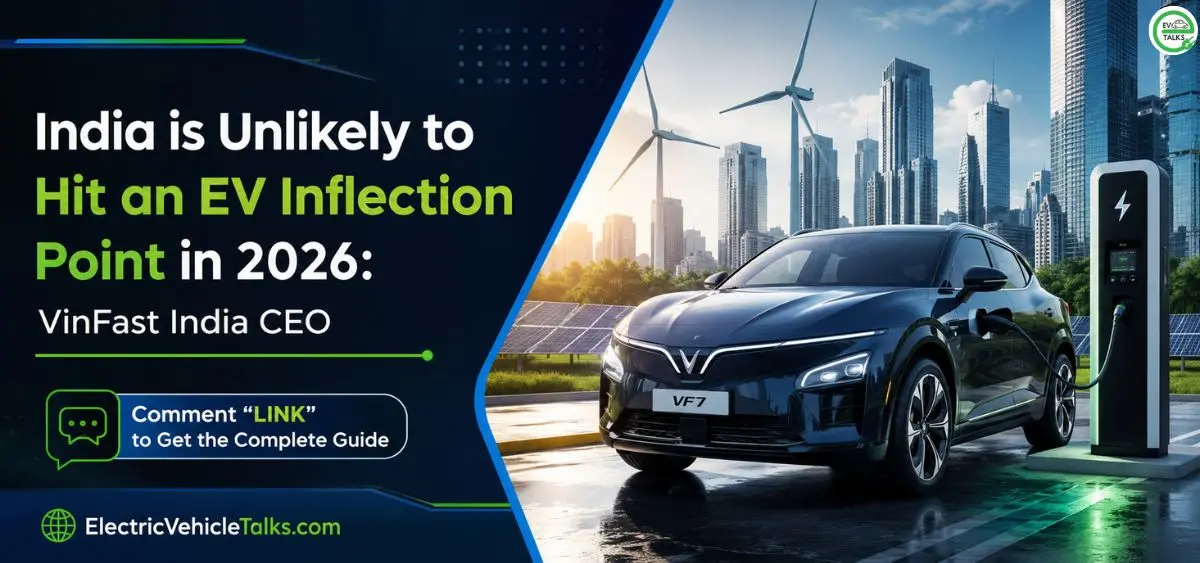

The electric vehicle (EV) market is growing rapidly, but India’s EV Growth May Slow in 2026 despite record sales and rising consumer interest. This is the view of Tapan Ghosh, CEO of VinFast India, who believes that while the country has made significant progress, the market still requires sustained government support and stronger consumer demand to reach a true tipping point.
India’s EV Growth Is Strong, But Volumes Remain Low
According to Tapan Ghosh, India has crossed the global benchmark of 5–6% EV penetration, reaching around 7.7% in June 2026. Monthly electric vehicle sales have also increased sharply, rising from approximately 7,000 units to more than 31,000 units.

However, these figures remain relatively small compared to India’s overall passenger vehicle market, where around 4 lakh vehicles are sold every month. Because of this gap, India’s EV Growth May Slow in 2026 in the near term unless EV volumes continue to grow at a much faster pace.
Government Support Will Remain Crucial
Ghosh emphasized that policy support must continue even as the industry matures. Instead of focusing only on manufacturing incentives, governments are increasingly shifting toward demand-side benefits such as lower GST rates, road tax exemptions, and customer incentives.
These measures can help make electric vehicles more affordable while encouraging wider adoption across different income groups.
Resale Value Remains a Major Challenge
One of the biggest obstacles to faster EV adoption is uncertainty around resale value. Many buyers remain hesitant to switch from internal combustion engine (ICE) vehicles because they are unsure how much their electric vehicle will be worth after several years.
Addressing this concern through guaranteed buyback programs and stronger used-EV markets could significantly improve customer confidence.
VinFast’s Rapid Growth in India
Despite entering the Indian market only in August 2025, VinFast has quickly become the country’s fifth-largest electric car manufacturer, outperforming established brands such as Hyundai as well as global EV companies like BYD and Tesla.
The company attributes its rapid success to customer-focused products, competitive pricing, and long-term investments in India’s EV ecosystem.
VinFast’s parent company, Vingroup, has also launched an all-electric taxi fleet and plans to introduce electric two-wheelers before the end of 2026, further expanding its presence in the Indian mobility sector.
Expanding Infrastructure Across India
To strengthen its nationwide footprint, VinFast has already established 55 showrooms and 120 workshops. The company plans to expand this network to 75 showrooms and around 230 workshops by the end of 2026, with a special focus on Tier III and Tier IV cities.
This expansion aims to improve vehicle accessibility, after-sales service, and customer confidence in emerging EV markets.
Manufacturing and Customer-Centric Strategy
Unlike many international automakers that initially rely on imported vehicles, VinFast chose to invest directly in local production. The company is building a 400-acre manufacturing facility in Thoothukudi, Tamil Nadu, with an initial annual production capacity of 50,000 vehicles.
Its product lineup includes models such as the VF6, VF7, and MPV7, supported by customer-friendly benefits, including three years of free charging, a 10-year battery warranty, and a guaranteed residual-value buyback program.
Outlook for India’s EV Market
While India’s EV industry continues to record impressive growth, it is unlikely to hit the EV inflection point in 2026 unless overall sales volumes increase significantly and consumer concerns are addressed. Continued government incentives, stronger charging infrastructure, improved resale confidence, and local manufacturing investments will play a decisive role in accelerating adoption.
As the market evolves, companies like VinFast are betting on long-term investments, ecosystem development, and customer-focused solutions to help drive India’s transition toward electric mobility. Although India is unlikely to hit an EV inflection point immediately, the industry’s current momentum suggests that the country is steadily moving closer to a sustainable and large-scale EV future.

Related Articles: