
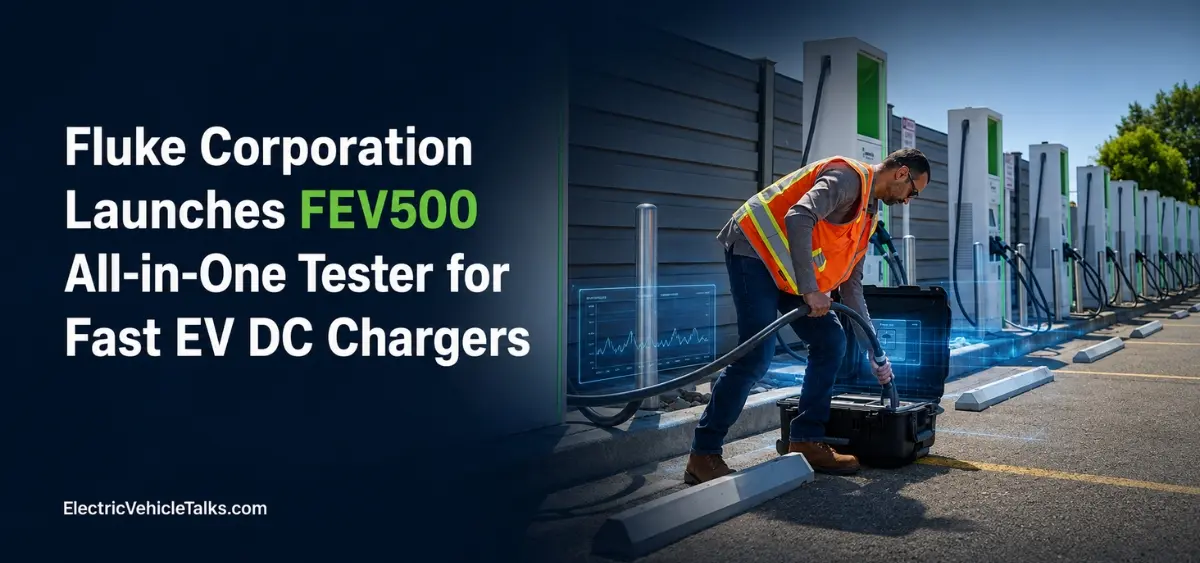

Fluke Corporation has launched the Fluke FEV500 Fast DC EV Charging Station Analyzer, a field-ready testing solution developed for high-powered Level 3 charging stations. The device allows technicians to assess charger safety, performance, interoperability, and operating faults at installation sites using one integrated platform.
Reliable Charging Becomes Crucial in India
The launch comes as India expands its electric vehicle charging infrastructure. The government is targeting 1.32 million EV charging stations by 2030, making dependable operation increasingly important. Industry findings cited by Fluke suggest 72 percent of Indian EV users have encountered charger uptime or connectivity problems. Nearly 40 percent of chargers are reportedly unavailable, while 25 percent experience frequent downtime.

Virtual EV Enables Faster On-Site Assessments
The Fluke FEV500 Fast DC EV Charging Station Analyzer works like a virtual electric vehicle. It simulates vehicle communication and charging behavior, allowing technicians to validate a station without bringing an actual EV to the site. Its internal resistive load bank can safely simulate a 2 kW charging load without needing an external power source.
This approach helps remove the cost, complexity, and uncertainty associated with vehicle-based testing. It can also accelerate charger commissioning, scheduled maintenance, compliance verification, and fault diagnosis.
One Device Replaces Multiple Testing Tools
The FEV500 combines capabilities normally requiring a digital multimeter, insulation tester, and oscilloscope. Through a single CCS connection, technicians can conduct insulation resistance, continuity, load, and residual-voltage checks without opening or disassembling charger panels.
A colour touchscreen provides guided automated workflows and immediate PASS/FAIL results. Reduced manual data entry can improve consistency, shorten troubleshooting time, and help charging operators return faulty equipment to service sooner.
The Fluke FEV500 Fast DC EV Charging Station Analyzer supports ISO 15118 and DIN SPEC 70121 communication standards, enabling technicians to assess the digital handshake between a charger and vehicle. Compatibility with CCS1 and CCS2 configurations broadens its usefulness for charging networks, commercial fleets, and charge-point operators.
Built for Field Work and Reporting
Designed for travel between depots and charging locations, the unit has a rugged wheeled chassis. Its removable battery also makes transportation more convenient where commercial air-travel battery rules apply.
Testing data can be transferred through USB-C to Fluke TruTest software. This enables automatic recordkeeping, asset ID tracking, and faster preparation of testing and compliance reports, giving operators clearer information about charger condition and performance.
Reliability Becomes Central to EV Adoption
Dr. Utsav Sharma, Product Manager at Fluke Technologies, said infrastructure growth must be matched by chargers that function reliably every day. He explained that the product was created to close the gap between charger installation and dependable operation while improving validation, safety, and uptime.
As fast DC networks grow, charger reliability is becoming a commercial priority rather than only a technical requirement. Uptime affects revenue for operators, vehicle availability for fleets and charging confidence for consumers. By consolidating essential tests and simplifying field diagnostics, the Fluke FEV500 Fast DC EV Charging Station Analyzer aims to help create a safer, more interoperable, and consistently available charging ecosystem.

Related Articles:









