Chinese new-energy vehicle manufacturers delivered another high-volume month in August 2026, led by BYD, Geely, and the rapidly expanding Leapmotor. BYD sold 433,384 passenger new-energy vehicles, while Geely recorded 175,877 NEV sales and Leapmotor crossed the 100,000-unit mark for a second consecutive month. The China EV Sales in August 2026 results also underline an important industry shift: exports are becoming increasingly important as competition intensifies and demand growth moderates in mainland China.
Quick Answer
BYD led Chinese passenger NEV sales in August 2026 with 433,384 units, followed by Geely with 175,877 units. Leapmotor was the strongest startup at 103,129 deliveries, while XPeng delivered 39,107 vehicles. BYD also moved closer to Chery in the export race, recording 189,466 overseas NEV sales against Chery’s 196,984 exports.
Important: NEV figures include battery-electric vehicles, plug-in hybrids, and, in some company reports, other electrified vehicle categories. “Sales” and “deliveries” may also be reported differently by each manufacturer.
August 2026 Chinese EV Sales at a Glance
| Automaker | August 2026 sales/deliveries | YoY change | Key highlight |
|---|---|---|---|
| BYD passenger NEVs | 433,384 | +16.7% | Export growth strengthened its overall performance. |
| Geely NEVs | 175,877 | +9.4% | Galaxy remained the group’s biggest volume contributor. |
| Chery NEVs | 120,909 | +69.8% | Also retained its lead among Chinese vehicle exporters |
| Changan NEVs | 105,000 | Not disclosed | Qiyuan, Deepal, and Avatr supported volume. |
| Leapmotor | 103,129 | +80.7% | Crossed 100,000 deliveries for the second straight month |
| HIMA | 42,101 | −5.6% | Recorded its first year-on-year decline |
| XPeng | 39,107 | +4% | GX and MONA supported deliveries. |
| Li Auto | 37,679 | +32.1% | Rebounded strongly from July |
| Nio Inc. | 35,836 | +14.5% | Nio, Onvo, and Firefly contributed. |
| Xiaomi EV | More than 30,000 | Not disclosed | Fifth consecutive month above 30,000 |
China EV Sales August 2026: What the Numbers Reveal
August produced a mixed but highly competitive picture. Established manufacturers continued to deliver substantial volumes, while newer companies such as Leapmotor expanded at a much faster rate.
Three trends stood out:
- BYD maintained a commanding lead but depended heavily on overseas growth.
- Geely’s multi-brand strategy delivered strong volume across mainstream and premium segments.
- Leapmotor widened its lead over China’s premium EV startups by crossing 100,000 monthly deliveries again.
Meanwhile, HIMA moved in the opposite direction, recording its first year-on-year contraction.
BYD Remains the Undisputed Volume Leader
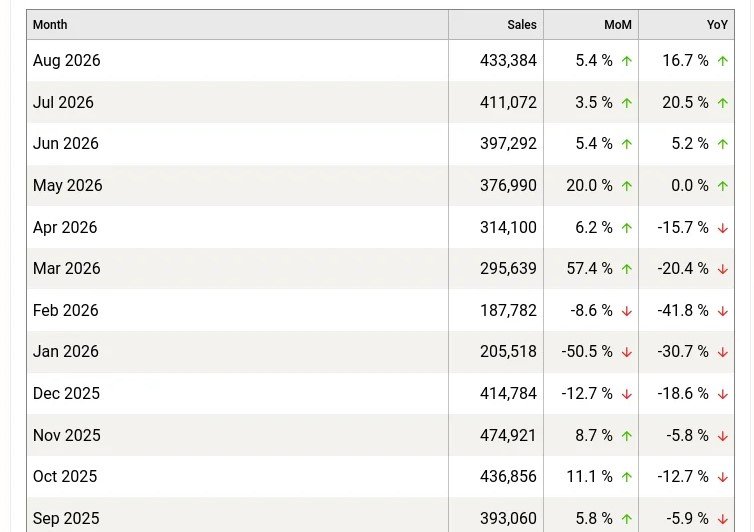
BYD sold 433,384 passenger new-energy vehicles in August, representing growth of approximately 16.7% over the same month last year and 5.4% over July.
Its wider group total, which includes commercial vehicles, reached 440,293 NEVs. The difference between these two figures is important: 433,384 refers specifically to passenger vehicles, while 440,293 represents BYD’s broader NEV sales total.
The passenger-vehicle portfolio included:
| BYD brand or series | August sales | YoY change |
|---|---|---|
| Dynasty and Ocean | 375,373 | +9.5% |
| Fang Cheng Bao | 41,568 | +155.6% |
| Denza | 16,001 | +33.4% |
| Yangwang | 442 | +9.1% |
Dynasty and Ocean continued to generate most of BYD’s volume. However, Fang Cheng Bao recorded the fastest growth, with sales increasing by more than 155% year over year.
BYD’s premium Denza brand also maintained positive momentum, while the ultra-luxury Yangwang division remained a small-volume operation.
BYD’s Export Boom Puts Chery Within Reach
Exports were one of the biggest stories behind BYD’s August performance. The company officially reported 189,466 overseas NEV sales, more than doubling from the previous year and accounting for roughly 43% of its wider monthly total.
This verified number is slightly higher than the preliminary figure of 188,746 units included in some datasets.
Chery remained China’s largest vehicle exporter, with 196,984 units shipped overseas during August. Exports represented approximately 70.3% of Chery’s total sales of 280,128 vehicles.
The gap between the two companies was therefore only 7,518 vehicles:
| Exporter | August 2026 exports |
|---|---|
| Chery | 196,984 |
| BYD | 189,466 |
| Difference | 7,518 |
BYD also generated approximately 53% of its revenue outside mainland China during the first half of 2026. This reflects the growing importance of markets such as Europe, Southeast Asia, and Latin America to its expansion strategy.
The export surge is helping BYD offset weaker conditions and intense pricing pressure in its home market. BYD’s official August filing confirms 433,384 passenger NEV sales, 440,293 total NEV sales and 189,466 overseas units.
Geely Reaches 175,877 NEV Sales
Geely sold 175,877 new-energy vehicles in August, an increase of 9.4% year over year. NEVs accounted for around 65% of the company’s total monthly vehicle sales.
Battery-electric vehicles contributed 120,590 units, while plug-in hybrids added 55,287 units.
Geely’s performance was driven by two important divisions:
- Geely Galaxy: 119,115 vehicles, up 7.6% year over year.
- Zeekr: 36,981 vehicles, up 109.8% year over year.
Galaxy remained the group’s volume engine, while premium brand Zeekr recorded its fifth consecutive monthly delivery record. Zeekr’s rapid growth demonstrates that Chinese manufacturers are expanding beyond affordable EVs and competing more aggressively in premium segments.
Changan’s NEV Division Crosses 105,000 Sales
Changan’s new-energy vehicle operations recorded approximately 105,000 sales during August.
The company’s disclosed brand-level performance included:
| Changan division | August sales | YoY change |
|---|---|---|
| Changan Qiyuan | 45,885 | +103.1% |
| Deepal | 28,659 | +1.5% |
| Avatr | 8,082 | −23.5% |
Qiyuan was the standout performer, more than doubling its sales from the previous year. Deepal remained relatively stable, while premium EV brand Avatr experienced a year-on-year decline.
Leapmotor Breaks the Startup Barrier Again
Leapmotor delivered a record 103,129 vehicles globally, an increase of 80.7% year over year and approximately 1.8% month over month.
It was the only Chinese EV startup to exceed 100,000 monthly deliveries for two consecutive months. August was also the company’s fifth straight record-setting month.
Leapmotor delivered 560,883 vehicles during the first eight months of 2026, reaching roughly 56% of its one-million-unit annual target. It would need to average close to 110,000 vehicles per month during the remaining four months to achieve that goal.
Its August total was also greater than the combined deliveries of Li Auto and Nio, highlighting how dramatically China’s startup hierarchy is changing. Leapmotor’s official announcement confirms the record 103,129 deliveries and second consecutive six-figure month.
XPeng Delivers 39,107 Vehicles
XPeng delivered 39,107 vehicles in August, rising approximately 4% year over year and 2.8% month over month.
Its GX flagship contributed 7,338 units. Meanwhile, the MONA range surpassed 310,000 cumulative deliveries, strengthening XPeng’s position in more accessible high-volume segments.
The automaker is also investing heavily in artificial intelligence and robotics. While those investments could create new long-term revenue opportunities, they add capital requirements at a time when China’s EV manufacturers are already facing intense competition.
Li Auto Rebounds Ahead of New Launches
Li Auto delivered 37,679 vehicles, representing growth of 32.1% year over year and 23.7% over July.
The increase ended a three-month sequence of declining deliveries and produced the company’s strongest annual growth rate in two years.
Li Auto expects fresh momentum from the introduction of its new-generation MEGA and i9. However, maintaining the August growth rate will be crucial if the company wants to meet its full-year target.
Nio’s Three-Brand Strategy Delivers Growth
Nio Inc. delivered 35,836 vehicles across its three brands, up 14.5% year over year.
| Nio brand | August deliveries | YoY change |
|---|---|---|
| Nio | 21,174 | +101.2% |
| Onvo | 8,810 | −46.4% |
| Firefly | 5,852 | +34.7% |
| Total | 35,836 | +14.5% |
The core Nio brand more than doubled its deliveries, while compact EV brand Firefly also expanded. Onvo, however, recorded a sharp annual decline and its third consecutive monthly contraction.
Xiaomi Holds Above 30,000 for a Fifth Month
Xiaomi delivered more than 30,000 electric vehicles for the fifth consecutive month.
Although it did not disclose a precise total, the consistent performance suggests that Xiaomi has moved beyond its initial launch phase and established itself as a serious participant in China’s electric car market.
The company’s combination of consumer technology expertise, connected-vehicle software, and strong brand recognition continues to distinguish it from traditional automakers.
HIMA Records Its First Annual Decline
Huawei’s Harmony Intelligent Mobility Alliance delivered 42,101 vehicles, falling 5.6% year over year.
Aito accounted for approximately 20,652 units—nearly half of HIMA’s total volume. The decline stands out because most leading Chinese EV startups reported growth during the month.
HIMA’s performance indicates that advanced software, intelligent cabins, and extensive retail visibility do not automatically guarantee sustained sales growth in an increasingly crowded market.
Why Chinese EV Makers Are Looking Overseas
China remains the world’s largest market for electric and plug-in hybrid vehicles, but manufacturers face aggressive pricing, crowded product segments, and moderating domestic demand.
International expansion offers several potential advantages:
- Access to markets with higher vehicle margins
- Reduced dependence on Chinese domestic demand
- Greater factory utilization
- Stronger global brand recognition
- Opportunities to establish local production and distribution networks
However, overseas expansion brings its own challenges, including tariffs, regulatory scrutiny, logistics costs, and the need to adapt vehicles to different markets.
Final Verdict
The China EV Sales in August 2026 data shows that BYD remains the clear volume leader, but Leapmotor produced the month’s most striking startup performance. Geely strengthened its position through Galaxy and Zeekr, while XPeng, Li Auto, and Nio all reported year-on-year growth.
The biggest long-term story is the export race. Chery still holds the lead, but BYD is now only a few thousand units behind. If BYD maintains its present overseas growth, China’s export rankings could change sooner than expected.

Related Articles: