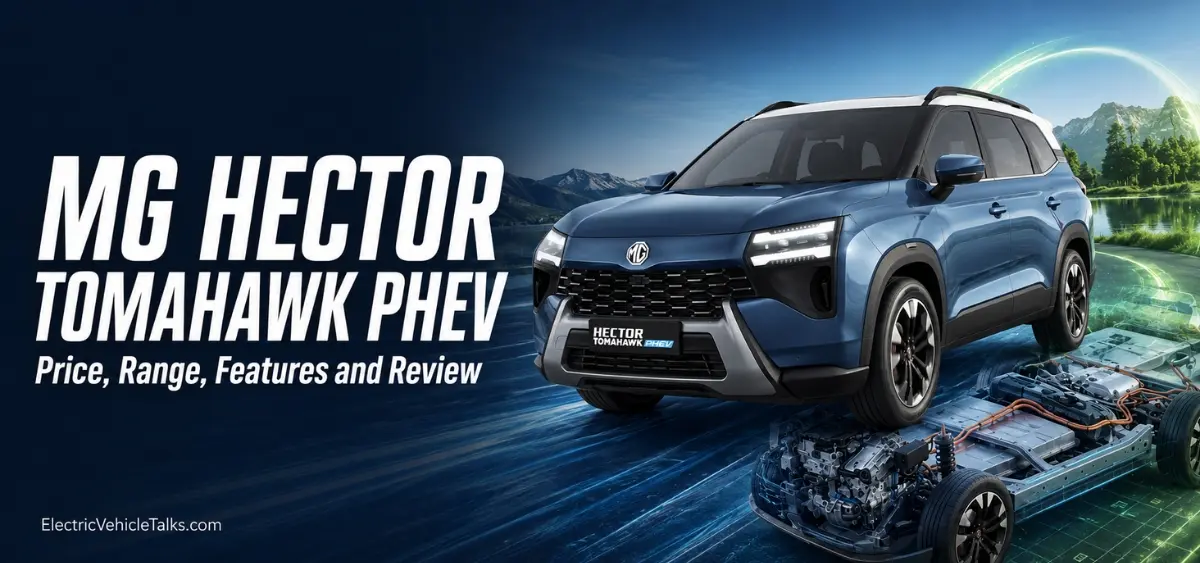

The MG Hector Tomahawk PHEV is a seven-seat plug-in hybrid SUV priced from ₹25.69 lakh outright or ₹21.79 lakh under MG’s Battery-as-a-Service programme. It combines a 20.5 kWh battery, a 148 kW electric motor and a 1.5-litre petrol engine, with a claimed electric-only range of more than 115 km.
This makes the Tomahawk PHEV especially relevant to Indian families who want the quietness and lower urban running cost of an electric vehicle but are not yet ready to depend entirely on public charging during long-distance travel.
However, it is not automatically the right choice for everyone. A plug-in hybrid delivers its biggest financial and environmental advantages only when the owner charges it regularly.
Quick answer: The MG Hector Tomahawk PHEV is best suited to buyers with home or workplace charging who drive primarily within the city but frequently undertake long highway journeys. Buyers who cannot charge regularly should carefully compare its petrol consumption and total ownership cost with conventional hybrids and diesel SUVs.
MG Hector Tomahawk PHEV: Key Specifications
| Specification | Official figure |
|---|---|
| Seating capacity | 7 seats |
| Battery capacity | 20.5 kWh |
| Petrol engine | 1.5-litre Atkinson-cycle |
| Engine power | 75 kW at 5,800 rpm |
| Engine torque | 125 Nm at 4,600–5,000 rpm |
| Electric motor | Permanent-magnet synchronous motor |
| Motor power | 148 kW, approximately 201 PS |
| Motor torque | 237 Nm |
| Transmission | Dedicated Hybrid Transmission |
| Claimed electric range | 115+ km |
| Claimed combined range | 1,100+ km |
| Fuel-tank capacity | 52 litres |
| AC charging | Approximately 7.5 hours, 10–100%, at 3.3 kW |
| DC fast charging | Approximately 35 minutes, 30–80%, at 25 kW |
| Charging connector | CCS2 |
| Length | 4,745 mm |
| Width | 1,850 mm excluding mirrors |
| Height | 1,770 mm |
| Wheelbase | 2,810 mm |
| Boot space | 192 litres; 528 litres with third row folded |
| Wheels | 18-inch, 225/55 R18 |
| Front suspension | MacPherson strut |
| Rear suspension | Multi-link independent |
| Brakes | Disc brakes on all four wheels |
MG states that final certification for the 115+ km electric range and 1,100+ km combined range was awaited at publication. Real-world results will depend on speed, traffic, load, weather, air-conditioning, and charging behavior.
What Is the MG Hector Tomahawk PHEV Launch Date?
JSW MG Motor India unveiled the Hector Tomahawk EV and PHEV on August 26, 2026. MG describes it as India’s first mass-produced, mass-market plug-in hybrid, developed on the company’s made-in-India ADAPT Multi-New Energy Vehicle platform. Bookings are open, while test drives and customer deliveries of the PHEV are scheduled to begin in November 2026.
That timeline matters to early buyers. Since independent road tests, long-term efficiency data, and an official NCAP rating were not yet available at the time of writing, customers should take a comprehensive test drive before finalizing their purchase.
MG Hector Tomahawk PHEV Price in India
There are two seven-seat variants: Exclusive and Essence.
| Variant | Outright ex-showroom price | BaaS introductory price |
|---|---|---|
| Exclusive 7-Seater | ₹25,69,800 | ₹21,79,000 + ₹3.20/km |
| Essence 7-Seater | ₹27,79,800 | ₹23,89,000 + ₹3.20/km |
These are introductory ex-showroom prices. Insurance, registration, taxes, accessories, and local charges are additional.
If you are curious to know more about MG Hector Tomahawk PHEV variants, see the table below
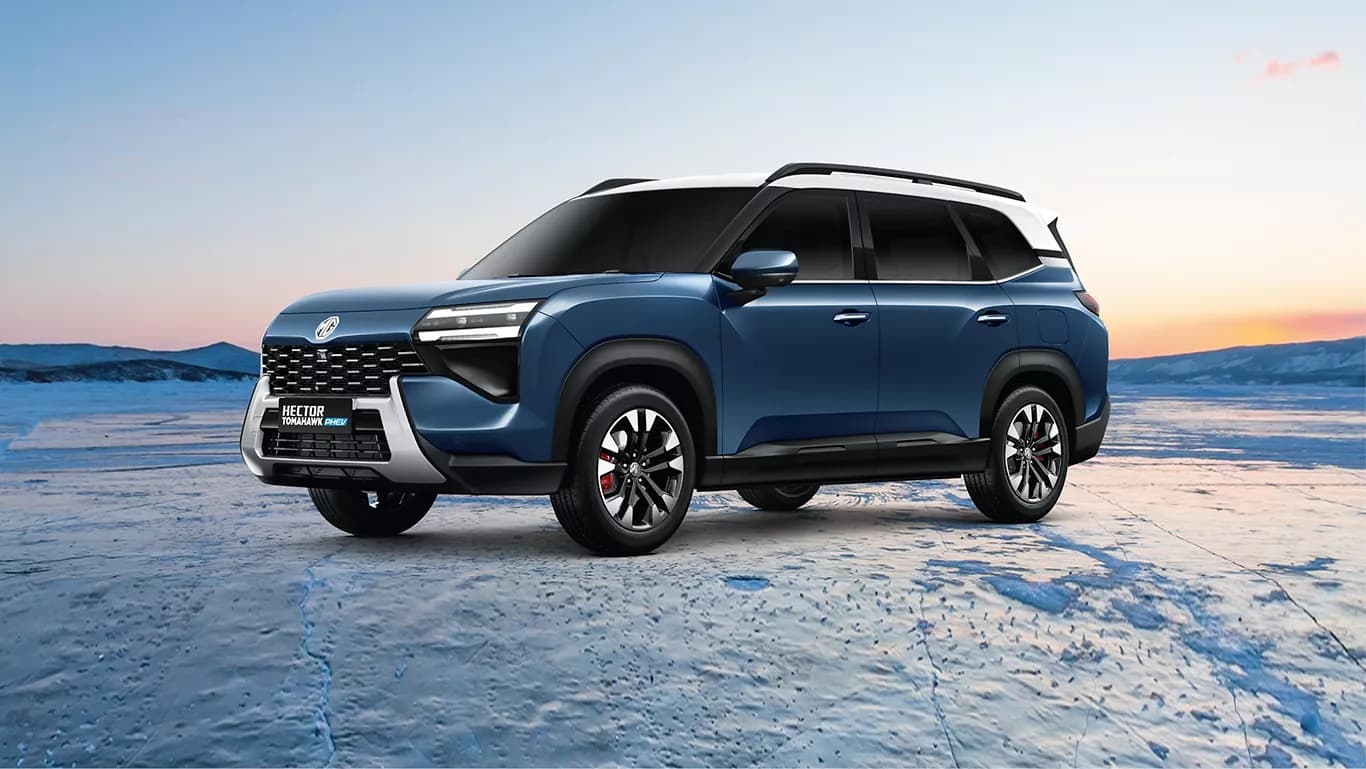 | 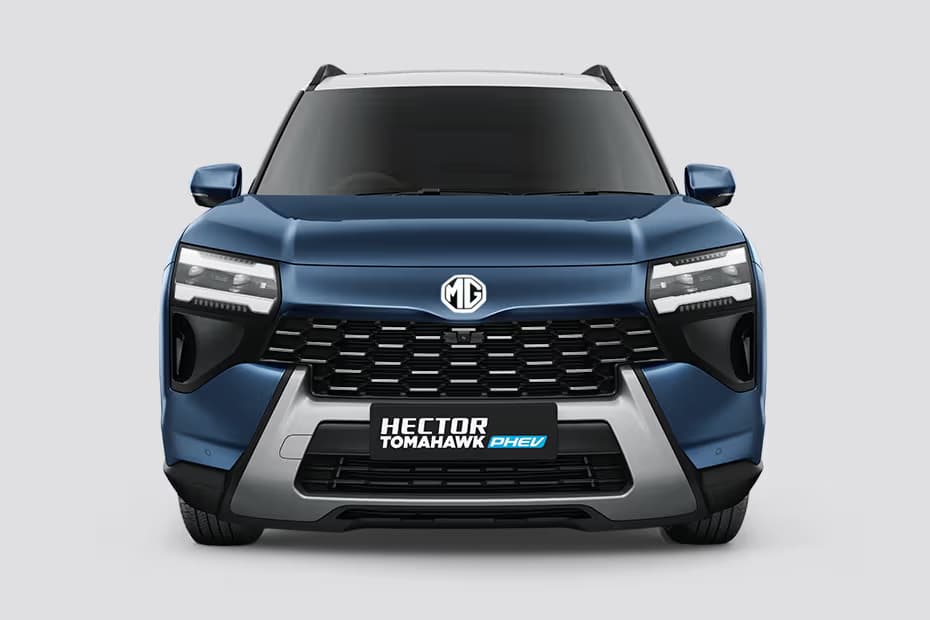 | |
| Name | MG Motor Hector Tomahawk PHEV | MG Motor Hector Tomahawk PHEV |
| Model | EXCLUSIVE 7-SEATER 20.5 KWh | ESSENCE 7-SEATER 20.5 KWh |
| Year | 2026 | 2026 |
| Price | ₹25,69,800 | ₹27,79,800 |
Powertrain ⯆ | ||
| Battery Type | LFP (Lithium Iron Phosphate) | LFP (Lithium Iron Phosphate) |
| Battery Pack | 69.2 KWh | 69.2 KWh |
| Electric Motor Type | Permanent Magnet Synchronous Motor (PMSM) | Permanent Magnet Synchronous Motor (PMSM) |
| Electric Motor Max Power (bhp@rpm/KW) | 150 kW | 150 kW |
| Electric Motor Max Torque (nm@rpm) | 310 Nm | 310 Nm |
| Drive Type | FWD | FWD |
| Number of Electric Motor | 1 | 1 |
| Dedicated Hybrid Engine | Gasoline, 1.5L, Atkinson cycle | Gasoline, 1.5L, Atkinson cycle |
| Engine Max. Power (kW@rpm) | 75 @ 5,800rpm | 75 @ 5,800rpm |
| Engine Max. Torque (Nm@rpm) | 125 @ 4,600-5,000rpm | 125 @ 4,600-5,000rpm |
| Fuel Tank capacity (L) | 52 | 52 |
| Fuel Type | Petrol | Petrol |
| Transmission | Dedicated Hybrid Transmission | Dedicated Hybrid Transmission |
Charging Info ⯆ | ||
| AC charging time (0-100% SoC) | ~7.5hrs [3.3kW] | ~7.5hrs [3.3kW] |
| DC charging time (0-100% SoC) | ||
| Charging Port | CCS2 | CCS2 |
| Charging Options | DC fast charging, 7.4 kW AC fast charging, 3.3 kW portable charging through a 15A socket, eHUB by MG charging network | DC fast charging, 7.4 kW AC fast charging, 3.3 kW portable charging through a 15A socket, eHUB by MG charging network |
| Charging Time (15/16 A Plug Point) | ||
| Wireless Mobile Charging | Yes – 50W fast wireless charger with cooling | Yes – 50W fast wireless charger with cooling |
| AC Portable Charger | Yes – 3.3 kW portable charging cable included | Yes – 3.3 kW portable charging cable included |
| Home Charger | Yes – 7.4 kW AC fast charger with standard installation | Yes – 7.4 kW AC fast charger with standard installation |
| Charging Limiter | ||
| Scheduled Charging & Scheduled Cabin Conditioning | ||
| AC charging time (0-80% SoC) | ||
| AC charging time (20-80% SoC) | ||
| DC charging time (20-80% SoC) | ~35min [25kW] | ~35min [25kW] |
| DC charging time (0-80% SoC) | ||
| Charger type / charging standard | CCS2; supports a 7.4 kW AC charger and DC fast charging up to 90 kW | CCS2; supports a 7.4 kW AC charger and DC fast charging up to 90 kW |
| DC charging time (10-80% SoC) | ||
Warranty ⯆ | ||
| Battery Warranty | Lifetime warranty | Lifetime warranty |
| Motor Warranty | ||
| Vehicle Warranty | As a Private vehicle: 3 years with unlimited kilometres & As a Commercial vehicle: 3 years or 1,00,000 km | As a Private vehicle: 3 years with unlimited kilometres & As a Commercial vehicle: 3 years or 1,00,000 km |
| Tyre Warranty | 1 year | 1 year |
| Home Charger Warranty | ||
| Portable Charger Warranty | ||
Learn More ⯆ | ||
| Read more | ||
| Watch Video | ||
Pricing ⯆ | ||
| Ex Showroom Price | 2569800 | 2779800 |
Comfort & Convenience ⯆ | ||
| Push Start | ||
| Frunk Space (litres) | ||
| Boot Space (litres) | 192L [All rows up], 528L [3rd row fold] | 192L [All rows up], 528L [3rd row fold] |
| Auto Headlamps | ||
| Rain Sensing Wipers | ||
| 2nd row AC vents | Yes, and 3rd row AC Vents | Yes, and 3rd row AC Vents |
| Seat Belt Adjustment | ||
| Console Storage Cooling | ||
| Seat Recline | 2nd Row Seat Recline | 2nd Row Seat Recline |
| Auto AC | ||
| Door Glass | All Windows Auto Up Down With Anti Pinch Function. | All Windows Auto Up Down With Anti Pinch Function. |
| Power Adjusted Driver Seat | 6-way electrically adjustable | 6-way electrically adjustable |
| Power Adjusted Co-Driver Seat | 4-way electrically adjustable | 4-way electrically adjustable |
| Electric adjust ORVM | ||
| Power fold ORVM | ||
| ORVM Auto Dip on Reverse | ||
| Auto Dimming IRVM | ||
| Ventilated Front Seats | ||
| Ventilated Rear Seats | ||
| Door Handles | Door handles with chrome finish | Door handles with chrome finish |
| Window Sun Shades | ||
| One Touch Driver Power Window | Yes – all windows have automatic up/down | Yes – all windows have automatic up/down |
| Parcel Shelf | ||
| Front Row Arm Rest with Storage | Ye | Ye |
| 2nd Row Arm Rest with Cup Holder | Ye | Ye |
| Magzine Pockets for Rear Passengers | Ye | Ye |
| Bottle Holder | Ye | Ye |
| Umbrella Holder | ||
| Heads Up Display (augmented reality HUD) | ||
| 2nd Row Recline | ||
| Soft Wrapped Dashboard & Door Trims | Man-made leather dashboard | Man-made leather dashboard |
| Keep, Pet & Camp Modes (climate control) | ||
| Interior Device Charging Port | 50W cooled wireless charger, front USB-A and fast-charging USB-C, second-row USB-A and fast-charging USB-C, plus a 12V outlet | 50W cooled wireless charger, front USB-A and fast-charging USB-C, second-row USB-A and fast-charging USB-C, plus a 12V outlet |
| Power Socket in Boot | ||
| ISOFIX Rear Seats | ||
| ESP | ||
| Door Open Alert (DOA) | ||
| Autonomous Emergency Steering (AES) | ||
| Evasive Steering Assist (ESA) | ||
| Emergency Lane Keep Assist | ||
| Highway Assist (including driver initiated auto lane change) | ||
| Rear Collision Warning (RCW) | ||
Technology ⯆ | ||
| Screen Size | 32.5 cm (12.8-inch) touchscreen | 32.5 cm (12.8-inch) touchscreen |
| Chipset & Memory | ||
| Wireless Technology | Yes, Android Auto & Apple CarPlay | Yes, Android Auto & Apple CarPlay |
| Connectivity | Wi-Fi, Bluetooth, USB-A, USB-C, FM, wireless smartphone integration, i-SMART connected services and Jio Fiber-based Home-to-Car connectivity | Wi-Fi, Bluetooth, USB-A, USB-C, FM, wireless smartphone integration, i-SMART connected services and Jio Fiber-based Home-to-Car connectivity |
| Apps | Yes, MG App Store, Jio Sphere with built-in apps, Jio Games, JioSaavn | Yes, MG App Store, Jio Sphere with built-in apps, Jio Games, JioSaavn |
| BYOD ( Bring your own Device) | ||
| Connected Features | Yes, 80+ connected-car features | Yes, 80+ connected-car features |
| Speakers | 6 speakers and tweeters | 6 speakers and tweeters |
| Dolby Atmos | ||
| Voice Commands | ||
| NFC Key | ||
| Passive Keyless Entry (PKE) | ||
| Auto Park | ||
| Video calling with in-car camera | ||
| AIR Purifier | Yes, PM2.5 filter | Yes, PM2.5 filter |
| Internet Connectivity | ||
| Power Tailgate with Gesture Control | ||
| Tailgate Ajar Warning | ||
| Vechicle to Vehicle Charging | ||
| Vehicle to Load Charging | ||
| Heater | ||
| Follow Me Home Headlamps | ||
| Memory Function Seats | ||
| LightMeUp (ambient lights) | Mono Blue ambient lighting | Mono Blue ambient lighting |
| OTA Updates (infotainment & maps) | ||
| OTA Updates (vehicle features) | ||
| OTA Updates (ePowertrain) | ||
| Ecosense & Driving Analytics | ||
| App Store | Yes – MG App Store | Yes – MG App Store |
| Music & Calling Connectivity | ||
Safety ⯆ | ||
| Airbags | 6 airbags: dual front, front side and curtain airbags | 6 airbags: dual front, front side and curtain airbags |
| Body Shell | High-strength steel body structure | High-strength steel body structure |
| Front Brake Type | Disc brake | Disc brake |
| Rear Brake Type | Disc brake | Disc brake |
| Brake Technology | ABS with EBD | ABS with EBD |
| EyeDentity (driver & occupant Monitoring) | ||
| EPB (electric park brake) | ||
| Rear Parking Sensor | ||
| Front Parking Sensor | ||
| Radar | ||
| Reverse Camera | ||
| Tyre Pressure Monitoring | ||
| Fog Lamps | Rear LED fog lamp | Rear LED fog lamp |
| Cornering Lamps | ||
| Auto Headlamps | ||
| Auto Booster Lamps | ||
| 360 Degree Camera | ||
| Blind Spot Monitor | ||
| Secure 360 - Live View & Recording | ||
| Rear Defogger | Yes – front and rear defoggers | Yes – front and rear defoggers |
| Windshield Auto Defogging | Front defogger, No automatic | Front defogger, No automatic |
| Central Locking | ||
| Child Safety Locks | ||
| Anti-lock Braking System (ABS) | ||
| Brake Assist | ||
| ADAS | ||
| Forward Collision Warning System (FCW) | ||
| Automatic Emergency Braking System (AEB) | ||
| Lane Departure Warning System (LDW) | ||
| Lane Keep Assist System (LKA) | ||
| Lane Sway Alert (LSA) | ||
| Lane Centering Function (LCF) | ||
| Traffic Sign Recognition (TSR) | ||
| Front Vehicle Start Alert (FVSA) | ||
| Adaptive Cruise Control (ACC) | ||
| Intelligent Adaptive Cruise Control (iACC) | ||
| Smart Pilot Assist (SPA) | ||
| Risk Mitigation Support | ||
| High Beam Assist (HBA) | ||
| Forward Cross Traffic Alert (FCTA) | ||
| Rear Cross Traffic Alert (RCTA) | ||
| Find My Car | Available through i-SMART | Available through i-SMART |
| Geo-Fencing | Available through i-SMART | Available through i-SMART |
| Live Location Sharing & Tracking | Available as an i-SMART premium subscription feature | Available as an i-SMART premium subscription feature |
Design ⯆ | ||
| Driving Space | Best-in-segment space claim; 85% of the floor area is usable | Best-in-segment space claim; 85% of the floor area is usable |
| Illuminated Logo | ||
| Headlamps & DRL | Beacon LED projector headlamps with LED DRLs | Beacon LED projector headlamps with LED DRLs |
| Tail Lamps | Dynamic LED tail lamps | Dynamic LED tail lamps |
| Upholstery | Man-made leather seat upholstery | Man-made leather seat upholstery |
| Wheels | R18 dual-tone precision-cut Rotor alloy wheels | R18 dual-tone precision-cut Rotor alloy wheels |
| Spare Wheel | T145/70 R17 | T145/70 R17 |
| Cladding | Side-body cladding | Side-body cladding |
| Sunroof | Dual-pane panoramic Cockpit Sunroof | Dual-pane panoramic Cockpit Sunroof |
| Steering Wheel | leather-wrapped steering wheel with mounted audio controls | leather-wrapped steering wheel with mounted audio controls |
| Cap Touch Switches | ||
| Steering Wheel & E-shifter | ||
| Mood Lighting | Mono ambient lighting in Blue | Mono ambient lighting in Blue |
| Night Trail - Carpet Lamps | ||
| Sequential Turn Indicators | Turn Indicator On ORVM | Floating Light Turn Indicators & Turn Indicator On ORVM |
| Start Up / Good bye Animations | ||
| Center Tail Lamp with Animations | ||
| Integrated Antenna | Yes – glass antenna | Yes – glass antenna |
| Length (mm) | 4,745 mm | 4,745 mm |
| Width (mm) | 1,850 mm | 1,850 mm |
| Height (mm) | 1,770 mm | 1,770 mm |
| Wheelbase (mm) | 2,810 mm | 2,810 mm |
| Ground Clearance (mm) | 230 mm | 230 mm |
| Vanity Mirror | ||
| Rear Reading Lamp | Yes – front and rear LED reading lights | Yes – front and rear LED reading lights |
| Rear Seat Headrest | Height-adjustable headrests for all rows | Height-adjustable headrests for all rows |
| Cup Holders | ||
| Digital Cluster | 22.3 cm (8.8-inch) Multi-Information Display | 22.3 cm (8.8-inch) Multi-Information Display |
| Body Type | SUV | SUV |
| Seating Capacity | 7 | 7 |
| No. of Doors | 5 | 5 |
| Rear Spoiler | ||
| Electrically Deployed Front Door Handles | ||
| Premium Finish Exterior Cladding | ||
| Rear Seating Dimensions L× W (inch.) | ||
| Front Seating Dimensions L× W (inch.) | ||
Performance ⯆ | ||
| Steering Type & Column | ||
| Steering Adjustment | Tilt and telescopic adjustment | Tilt and telescopic adjustment |
| Turning Radius (Metres) | ||
| Drive Modes | Eco, Normal, Sport and Custom | Eco, Normal, Sport and Custom |
| Regenerative Braking Levels | ||
| Single Pedal Drive | ||
| Virtual Engine Sound | ||
| Front Suspension | MacPherson strut | MacPherson strut |
| Rear Suspension | Independent multi-link suspension | Independent multi-link suspension |
| Suspension Damper Type | ||
| Shock Absorbers Type | ||
| Technology | ||
| Road Vibrations | ||
| Tyre Type & Size | 225/55 R18 | 225/55 R18 |
| Cruise Control | ||
| Boost Mode | ||
| Performance Dashboard | ||
| 1-100 Km Acceleration (Sec) | 8.2 seconds | 8.2 seconds |
| Top Speed | 160 km/h | 160 km/h |
| Real World Range | ||
| ARAI Range | 115+ km and Combined range 1100+ | 115+ km and Combined range 1100+ |
| Combined ARAI Range | ||
| Real World Combined Range | ||
Sources: All the specifications are from the official page.
How does the BaaS price work?
Battery-as-a-Service reduces the initial purchase price by ₹3.90 lakh. In return, the customer pays a battery rental of ₹3.20 for every kilometer driven.
Charging electricity and gasoline are not included in that rental. The BaaS availability and terms depend on participating finance partners, their credit policies, and the vehicle’s private-registration status.
Illustratively:
| Annual driving | Battery rent per year | Battery rent over five years* |
|---|---|---|
| 10,000 km | ₹32,000 | ₹1,60,000 |
| 15,000 km | ₹48,000 | ₹2,40,000 |
| 20,000 km | ₹64,000 | ₹3,20,000 |
| 25,000 km | ₹80,000 | ₹4,00,000 |
*Excludes financing costs, taxes, tariff revisions, electricity, and petrol.
At the present rental rate, ₹3.90 lakh in upfront savings equals approximately 121,875 km of battery rent. That is not a complete break-even calculation because loan interest, taxes, and future rental terms can alter the result, but it provides a useful starting point.
BaaS may appeal to buyers who value a lower down payment or expect moderate annual use. High-mileage users should compare written five- and eight-year quotations for both ownership models.
MG Hector Tomahawk PHEV On-Road Price
There is no single nationwide on-road price. The final amount will vary according to:
- State registration tax and PHEV taxation policy
- Insurance provider and declared value
- City-specific fees
- Extended warranty or service packages
- Accessories
- Loan and BaaS documentation charges
- Temporary introductory offers
Do not estimate the on-road price by adding an EV registration exemption unless your state explicitly includes plug-in hybrids. Many state EV policies distinguish between battery-electric vehicles and hybrids.
Ask the dealership for an itemized quotation showing the ex-showroom price, registration, insurance, tax collected at source, accessories, BaaS rent, finance charges, and any subsidy separately.
How Does the Tomahawk PHEV Powertrain Work?
A plug-in hybrid is effectively an electric vehicle with a petrol-assisted safety net. Its battery can be charged externally, while the petrol engine can drive the vehicle, generate electricity, or work with the motor depending on operating conditions.
MG says the dedicated Atkinson-cycle engine achieves 43.2% thermal efficiency, while the Dedicated Hybrid Transmission has a claimed efficiency of 98.8%. The vehicle also uses a compact 10-in-1 electric drive unit.
MG Hector Tomahawk PHEV modes
- Pure EV mode: The battery supplies the electric motor, allowing quiet, tailpipe-emission-free urban driving.
- Series hybrid mode: The motor drives the wheels while the petrol engine generates electricity. This can be useful in stop-and-go traffic.
- Parallel hybrid boost mode: The engine and motor work together when additional performance is required.
- Pure engine mode (Direct mode): The petrol engine powers the vehicle directly, primarily during steady highway cruising.
- Regeneration mode: Energy otherwise lost during deceleration or downhill driving is recovered into the battery.
- Engine drive and charge mode: The engine powers the wheels while also replenishing the battery.
The car controls most power-source transitions automatically. Its separate Eco, Normal, Sport, and Custom settings change the driving response rather than representing four additional powertrain architectures.
MG Hector Tomahawk PHEV Range and Mileage
MG claims more than 115 km of electric range and more than 1,100 km of combined range with a full battery and a full 52-liter petrol tank.
These figures should not be treated as guaranteed real-world distances. A seven-seat SUV carrying passengers and luggage at expressway speeds will normally consume more energy than it does during a controlled certification cycle.
What is the real-world electric range likely to be?
Independent testing is needed before publishing a reliable real-world number. As a planning precaution, owners should avoid building their daily schedule around receiving every kilometre of the 115+ km claim.
Range can be reduced by:
- Sustained high-speed driving
- Hard acceleration
- Heavy passenger or luggage load
- Extreme ambient temperatures
- Frequent air-conditioner use
- Low tyre pressure
- Elevation changes
- Battery age
What is the MG Hector Tomahawk PHEV mileage?
PHEV fuel economy varies dramatically depending on how often the battery is charged. A driver who begins every day with a full battery and travels 50 km may use almost no petrol during routine commuting. Another owner who rarely plugs in will carry the weight of the battery and hybrid hardware while depending heavily on the petrol engine.
MG’s website estimates running cost at around ₹1/km in regularly charged electric operation, approximately ₹3–₹3.50/km in hybrid use with charging once or twice weekly, and about ₹5/km when the vehicle is never plugged in. These are manufacturer estimates—not guaranteed mileage—and BaaS customers must add ₹3.20/km in battery rent.
Charging Time and Running-Cost Analysis
Every variant includes a 3.3 kW portable charging cable and a 3.3 kW home-charging box.
| Charging method | Official charging window | Estimated time |
|---|---|---|
| 3.3 kW AC | 10–100% | Around 7.5 hours |
| 25 kW DC | 30–80% | Around 35 minutes |
The distinction matters: the quoted DC time applies to 30–80%, not 10–80%.
Estimated home-charging cost
The following calculation uses the full nominal battery capacity for simple comparison. Actual billed energy may be higher because of charging losses, while a routine charge may use less than the entire pack.
| Residential tariff | Nominal cost of 20.5 kWh | Theoretical cost/km at 115 km |
|---|---|---|
| ₹6/kWh | ₹123 | ₹1.07 |
| ₹8/kWh | ₹164 | ₹1.43 |
| ₹10/kWh | ₹205 | ₹1.78 |
| ₹12/kWh | ₹246 | ₹2.14 |
For an outright-purchase vehicle, electric commuting can, therefore, be significantly cheaper than fueling a large petrol SUV. Under BaaS, add ₹3.20/km to the electricity cost.
Public DC charging may be more expensive than home charging, so the PHEV’s financial case is strongest when most energy comes from an overnight residential connection.
Practical charging advice
- Charge overnight during the vehicle’s scheduled window.
- Use a properly earthed circuit installed after a professional load assessment.
- Avoid relying on extension boards or unverified sockets.
- Compare charger access with your housing society’s rules before booking.
- Keep some battery reserve for congested city sections when possible.
- Use DC charging mainly when time matters; routine AC charging is generally simpler and cheaper.
MG Hector Tomahawk PHEV Interior and Practicality
The cabin uses a Moroccan Brown and Carbon Black theme with leatherette upholstery, a dual-pane panoramic sunroof and ventilated front seats. Its 2,810 mm wheelbase should help second-row space, while dedicated second- and third-row AC vents are valuable in Indian summers.
The car is offered exclusively as a seven-seater. Its boot holds 192 liters with all rows in place, expanding to 528 liters when the third row is folded.
Exclusive interior highlights
The Exclusive includes the following:
- 12.8-inch touchscreen
- 8.8-inch multi-information display
- Six-speaker audio system
- Wireless Android Auto and Apple CarPlay
- Six-way powered driver’s seat
- Four-way powered front-passenger seat
- Front-seat ventilation
- 50W cooled wireless charger
- Blue ambient lighting
- 360-degree HD camera
- Connected-car functions
What does the Essence add?
The Essence adds or upgrades:
- 15.6-inch Grand View touchscreen
- Infinity audio with 10 speakers, including a subwoofer
- 256-colour ambient lighting
- Driver-seat memory and easy-entry function
- Rear-window sunshades
- Auto-dimming inside rear-view mirror
- Front parking sensors
- Floating turn indicators and red brake callipers
- Level 2 ADAS
- Vehicle-to-Load, Vehicle-to-Vehicle, and Vehicle-to-Home capability
V2H and V2L output is listed at up to 3 kVA. V2H requires a separately purchased compatible unit, and V2V works only with compatible EVs.
Safety, ADAS, and Connected Technology
Six airbags, electronic stability control, traction control, hill-hold control, ABS with EBD, brake assist, tire-pressure monitoring, ISOFIX mounts, and all-wheel disc brakes are standard.
The Essence receives 11 Level 2 ADAS functions, including the following:
- Adaptive cruise control
- Traffic-jam assist
- Lane-keep assist
- Lane-departure warning
- Lane-departure prevention
- Forward-collision warning
- Automatic emergency braking
- Pedestrian automatic emergency braking
- Intelligent headlamp control
ADAS is an assistance system, not autonomous driving. Indian road markings, construction zones, unpredictable traffic, and difficult weather can affect its operation. The driver must remain attentive.
MG also offers 80+ connected-car features, a GenAI-supported voice assistant, 30+ Hinglish commands, scheduled charging and AC control, digital key sharing, and over-the-air updates.
An official NCAP rating had not been announced at the time of writing. Buyers should not interpret the feature count as a substitute for an independently verified crash-test result.
MG Hector Tomahawk PHEV Exclusive vs Essence
| Major feature | Exclusive | Essence |
|---|---|---|
| Price outright | ₹25.69 lakh | ₹27.79 lakh |
| Touchscreen | 12.8-inch | 15.6-inch |
| Audio | 6 speakers | 10-speaker Infinity system |
| Ambient lighting | Blue | 256 colours |
| Front-ventilated seats | Yes | Yes |
| 360-degree camera | Yes | Yes |
| Front parking sensors | No | Yes |
| Level 2 ADAS | No | Yes |
| Driver-seat memory | No | Yes |
| Auto-dimming IRVM | No | Yes |
| Rear sunshades | No | Yes |
| V2L/V2V/V2H | No | Yes |
The Exclusive is the value-oriented choice. It already covers the important comfort, connectivity, and passive-safety essentials.
The Essence costs ₹2.10 lakh more and makes sense for buyers who specifically want ADAS, the larger display, premium audio, and bidirectional power features. Of these upgrades, ADAS is likely to provide the most meaningful everyday value for frequent highway users.
MG Hector Tomahawk PHEV vs Hector Tomahawk EV
| Factor | Tomahawk PHEV | Tomahawk EV |
|---|---|---|
| Energy source | Electricity plus petrol | Electricity only |
| Battery | 20.5 kWh | 69.2 kWh |
| Claimed electric range | 115+ km | Up to 517 km |
| Claimed total range | 1,100+ km | Up to 517 km |
| Long-trip dependence on chargers | Low | Higher |
| Mechanical complexity | Higher | Lower |
| Best ownership profile | Mixed city and long-distance use | Regular charging and EV-focused use |
| Tailpipe emissions | None in EV mode; present in hybrid mode | None |
| PHEV deliveries | Planned from November 2026 | Planned from September 2026 |
Choose the PHEV if your daily travel fits inside its electric range but your family frequently undertakes unpredictable intercity journeys.
Choose the full EV if you have reliable home charging, want to eliminate petrol use and can plan highway charging stops. A buyer who rarely travels beyond the EV’s practical range may be paying for unnecessary petrol hardware by selecting the PHEV.
Benefits of the MG Hector Tomahawk PHEV
- Electric commuting without full dependence on charging infrastructure
- More than 1,100 km of claimed combined range
- Seven-seat practicality
- Low urban running cost when charged regularly
- CCS2 DC fast-charging compatibility
- Smooth electric-motor response
- Large, premium cabin
- Strong standard equipment
- Petrol flexibility for remote or highway travel
- Lifetime high-voltage battery warranty for the first private owner, subject to terms
Challenges Buyers Should Consider
- Higher mechanical complexity than a pure EV
- Electric savings depend on regular charging
- No simple petrol-mileage figure for every use case
- BaaS rent is additional to electricity and petrol
- Limited 192-litre boot with all seven seats occupied
- 3.3 kW AC charging is modest by modern EV standards
- 25 kW peak DC capability is useful but not especially fast
- Independent range, efficiency and crash-test results were unavailable at launch
- PHEV subsidy and registration treatment can differ from that of full EVs
- Resale demand for a new powertrain category remains unproven
Common PHEV Buying Mistakes
a) Buying without a reliable charging point
A PHEV that is never plugged in loses much of its purpose. Confirm parking, earthing, sanctioned electrical load, and installation permission before purchase.
b) Treating the combined range as one uninterrupted efficiency figure
The 1,100+ km claim uses both a full battery and a full fuel tank. It does not mean the SUV travels that distance on electricity.
c) Comparing only the BaaS upfront price
Calculate battery rent, finance cost, charging, petrol and annual kilometers. The advertised price is only one component of ownership cost.
d) Assuming all EV subsidies apply
Central and state incentives may exclude privately owned passenger PHEVs. Obtain written confirmation rather than relying on a salesperson’s verbal assurance.
e) Expecting the third row and full boot simultaneously
With all seven seats in use, luggage capacity is 192 litres. Families should physically test their suitcases, strollers, or mobility equipment.
Warranty and Ownership Package
MG’s e-Shield package provides:
- Lifetime high-voltage battery warranty for the first private owner, subject to conditions
- A three-year/unlimited-kilometre vehicle warranty excluding the HV battery
- Three years of roadside assistance
- Labour-free servicing for the first two scheduled services
- Optional extended warranty for up to five years with unlimited kilometres
- Optional protection plans for up to five years or 75,000 km
If ownership changes or the vehicle receives commercial registration, the high-voltage battery coverage extends to 8 years or 160,000 km from the original delivery date, whichever comes first. Commercial-use vehicles have different terms.
Buyers should ask whether the lifetime warranty covers only manufacturing defects or also specifies minimum battery-health retention. They should also obtain the complete warranty exclusions in writing.
Government Incentives and India’s Charging Ecosystem
The earlier FAME-II programme ended on March 31, 2024. The current PM E-DRIVE programme supports selected electric two-wheelers, three-wheelers, trucks, ambulances, and buses, but its listed consumer demand-incentive categories do not include private electric cars or PHEVs. Buyers should therefore not assume a central purchase subsidy for the Tomahawk PHEV.
State benefits require separate verification. Some policies offer road-tax or registration concessions only to zero-emission battery-electric vehicles, while others use broader definitions.
Charging access is improving. As of August 7, 2026, the government reported 67,657 EV chargers across India, including 1,139 chargers at battery-swapping stations. PM E-DRIVE also allocates ₹2,000 crore to public charging infrastructure. Government Subsidy for EV Charging Station
For Tomahawk PHEV owners, this network is a convenience rather than a lifeline because the petrol engine provides backup. Its greatest cost benefit will still come from home or workplace AC charging.
Expert Insight from Electric Vehicle Talks
The Tomahawk PHEV addresses a distinctly Indian ownership problem: one vehicle may need to handle weekday office travel, crowded urban roads, a seven-member family, and an occasional 700 km highway journey.
Its 20.5 kWh battery is much larger than the batteries used in many conventional hybrids. If the usable real-world range covers an owner’s daily commute, most routine travel could happen electrically. The petrol engine then becomes a long-distance range extender instead of the default energy source.
Our practical recommendation is to study your last three months of travel before booking:
- If most days are below approximately 80–100 km and you can charge nightly, the PHEV deserves serious consideration.
- If you cannot install a charger, compare it carefully with an efficient strong hybrid.
- If nearly all journeys are urban and predictable, compare the full-electric Tomahawk as well.
- If seven-seat use is frequent, test third-row comfort and luggage capacity with the entire family.
- If selecting BaaS, obtain a written schedule covering minimum kilometres, rent revisions, loan closure, resale, and accident-related battery liability.
The technology is promising, but an informed buyer should wait for independent road tests before treating the claimed range or manufacturer running-cost figures as guaranteed results.
Buying Verdict: Which Variant Should You Choose?
The Exclusive is our value recommendation. It delivers the same battery, motor, claimed range, seven-seat layout, ventilated seats, powered front seats, panoramic sunroof, 360-degree camera, and core safety equipment at a lower price.
Choose the Essence if adaptive cruise control, active-safety assistance, premium audio, the 15.6-inch display and V2L/V2H capability are priorities. The ₹2.10 lakh premium is easier to justify for frequent highway drivers than for owners who predominantly drive short urban routes.
For the payment model, outright purchase is simpler and can be attractive to high-mileage or long-term owners. BaaS reduces the acquisition cost, but its rental must be evaluated alongside energy expenses—not mistaken for an all-inclusive running cost.
People Also Ask
1. What is the MG Hector Tomahawk PHEV price in India?
The outright ex-showroom price is ₹25.69 lakh for the Exclusive and ₹27.79 lakh for the Essence. BaaS prices are ₹21.79 lakh and ₹23.89 lakh, respectively, plus ₹3.20/km battery rent.
2. What is the electric range of the MG Hector Tomahawk PHEV?
MG claims more than 115 km of electric-only range. Combined Total Range: 1,100+ km
3. What is its combined driving range?
The claimed combined range is more than 1,100 km with a full battery and a full 52-liter fuel tank.
4. How long does the Tomahawk PHEV take to charge?
A 3.3 kW AC charger takes approximately 7.5 hours from 10–100%. A 25 kW DC charger takes around 35 minutes from 30–80%.
5. Is the MG Hector Tomahawk PHEV a seven-seater?
Yes. Both Exclusive and Essence PHEV variants are offered exclusively with seven seats and three rows.
6. Does it qualify for the FAME or PM E-DRIVE subsidy?
FAME-II has ended, while the current PM E-DRIVE demand-incentive categories do not list private passenger PHEVs. State-level tax treatment must be verified individually.
7. When will deliveries begin?
MG says PHEV test drives and deliveries are planned to begin in November 2026, subject to location, variant availability, and waiting periods.
MG Hector Tomahawk PHEV: FAQs
Is the MG Hector Tomahawk PHEV worth buying?
It can be worthwhile for families that charge regularly, need seven seats, and make frequent long-distance trips. A full EV may be more suitable for predictable travel with reliable charging.
Can the PHEV run if its battery charge is low?
Yes. The vehicle can operate as a hybrid using its petrol engine. Regular external charging is still important for achieving lower running costs and maximizing electric driving.
Does the Exclusive variant receive ADAS?
No. The Level 2 ADAS package is reserved for the Essence variant. Both variants receive six airbags, stability control, traction control, TPMS, and a 360-degree camera.
What is the MG Hector Tomahawk PHEV Essence price?
The Essence costs ₹27,79,800 ex-showroom outright or ₹23,89,000 under BaaS, plus ₹3.20/km battery rent.
Does the PHEV support V2L and V2H?
The Essence supports V2L, compatible V2V, and V2H at up to 3 kVA. The required V2H equipment is sold separately. These features are not listed for the Exclusive.
What is its boot capacity?
Boot capacity is 192 liters with all three rows upright and 528 liters with the third row folded.
Does the Tomahawk PHEV have a lifetime battery warranty?
MG advertises a lifetime high-voltage battery warranty for the first private owner, subject to terms. After ownership transfer or commercial registration, eight years or 160,000 km from original delivery.
Conclusion
The MG Hector Tomahawk PHEV could become an important bridge between India’s petrol-powered present and electric future. It offers meaningful electric range for everyday commuting while retaining the long-distance reassurance of a petrol engine.
Its strongest qualities are its 115+ km claimed EV range, seven-seat cabin, flexible hybrid powertrain, and extensive equipment. Its biggest questions concern real-world efficiency, long-term complexity, subsidy treatment, and whether buyers will plug it in consistently.
For the right household—particularly one with home charging and mixed urban-highway usage—the Tomahawk PHEV may deliver a compelling balance. For buyers who rarely charge, however, its technical potential will remain underused.
Explore more EV comparisons, ownership advice, charging resources, and expert buying guides on Electric Vehicle Talks