


An EV test drive checklist should cover much more than acceleration and cabin features. Before buying an electric car, you should test real-world range behavior, regenerative braking, ride comfort, charging compatibility, rear-seat comfort, ground clearance, visibility, software, tyres, and everyday usability.
Most importantly, test the EV the way you will actually use it.
That means keeping the AC on, driving in your normal drive mode, carrying family members if the car will be used by them, and taking the vehicle through traffic, rough roads, and faster stretches whenever possible.
An EV may feel impressive during a 10-minute showroom drive. But ownership lasts for years.
The test drive is your opportunity to discover whether the vehicle fits your commute, parking space, family, charging situation, and driving habits before you spend several lakh rupees.
Quick EV Test Drive Checklist
Before getting into the detailed checks, save this quick checklist:
| Area | What to Check |
|---|---|
| Vehicle | Correct variant, battery, and wheel size |
| Driving position | Seat, steering, mirrors, and visibility |
| Rear seat | Headroom, legroom, and comfort |
| Boot | Luggage and charging cable storage |
| Acceleration | City response and highway overtaking |
| Regeneration | Different regen levels and one-pedal driving |
| Brakes | Progressiveness and emergency confidence |
| Steering | Low-speed and highway behavior |
| Ride | Speed breakers, potholes, and rough roads |
| Ground clearance | Large breakers and ramps |
| Noise | Tyre, wind, and suspension noise |
| Range | Battery % versus kilometers travelled |
| AC | Range and performance with climate control running |
| Charging | Port, connector, AC/DC capability, and cables |
| Infotainment | Navigation, CarPlay/Android Auto, and controls |
| Parking | Cameras, sensors, and turning radius |
| Warranty | Battery and vehicle warranty terms |
| Service | Maintenance intervals and service network |
| Software | OTA updates and connected features |
| Finance | Insurance, registration, and applicable incentives |
Why Does Test Driving an EV Matter?
An electric car behaves differently from a petrol or diesel vehicle.
There may be no gearbox shifts, power delivery is usually immediate, regenerative braking can slow the vehicle without conventional braking, and the heavy battery pack changes ride and handling characteristics.
These differences can be enjoyable—but they need to suit you.
For example, aggressive regenerative braking may feel natural to one driver and uncomfortable to another. A firm suspension may feel sporty on a smooth highway but irritating on broken city roads.
The EV test drive therefore answers a more important question than “Is this a good electric car?”
It answers:
“Is this the right electric car for my life?”

Complete test drive checklist of an electric vehicle
1. Confirm the Exact EV Variant Before You Drive
This is one of the easiest checks to overlook.
Do not assume the dealership’s test-drive vehicle is identical to the model you plan to purchase.
Ask the salesperson to confirm:
- Model year
- Exact variant
- Battery capacity
- Motor output
- Claimed range
- Wheel and tyre size
- ADAS availability
- Infotainment system
- Charging specifications
Higher variants can have larger wheels, different tyres, extra equipment, or even different battery and motor configurations.
A car riding comfortably on 17-inch wheels may behave differently with the 19-inch wheels offered on another variant.
Check the tyre manufacturing date.
Look at the four-digit manufacturing code on the tyre sidewall.
For example, 2526 means the tyre was manufactured in the 25th week of 2026.
This becomes particularly important when inspecting the actual vehicle allotted to you before delivery. Learn about tire speed rating.
2. Get the Driving Position Right
Do not start driving immediately.
Spend a few minutes setting up:
- Driver seat
- Steering wheel
- ORVMs
- IRVM
- Seat height
- Lumbar support
- Headrest
Then check whether you can comfortably see the road and instrument cluster.
Pay attention to thick A-pillars, rear visibility, and blind spots.
Some modern EVs prioritize aerodynamic design, which can create smaller rear windows or unusual pillar shapes.
Also make sure the accelerator and brake pedals fall naturally under your feet.
3. Test the Controls and Infotainment Before Moving
Many EVs place several functions inside the touchscreen.
That looks clean in the showroom—but ask yourself whether it remains convenient while driving.
Try changing:
- AC temperature
- Fan speed
- Regenerative braking
- Drive mode
- Music
- Navigation
- Camera view
- Vehicle settings
Test Apple CarPlay or Android Auto if available.
Pair your smartphone.
Check whether frequently used functions have physical controls or require several touchscreen taps.
A feature that looks futuristic when parked can become distracting in traffic.
4. Never Test an EV With the AC Switched Off
This is one of the biggest EV test-drive mistakes.
Take the test drive with the AC off and only in Eco mode. Keep the AC on and drive in your regular driving mode as well to get a more realistic idea of the EV’s real-world performance.
Keep the AC running at a comfortable temperature.
If you normally drive in normal mode, use normal mode.
This gives you a more realistic impression of:
- Power
- Battery consumption
- Cabin cooling
- Range prediction
- Overall efficiency
India’s hot summers make climate-control performance especially important.
Your test should reproduce your actual ownership conditions—not laboratory conditions.
5. Test Instant Acceleration—but Don’t Stop There
Instant torque is one of the most enjoyable characteristics of an EV.
Test a smooth start from traffic lights and, where safe, stronger acceleration while merging with faster traffic.
Look for predictable rather than merely dramatic performance.
A good EV should deliver power smoothly enough for congested streets while providing sufficient reserve performance for overtaking.
But acceleration should never be the only reason you choose an electric car.
Braking, suspension, steering, and range behaviour matter much more during years of ownership.
6. Test Every Regenerative Braking Mode
Regenerative braking allows the electric motor to slow the car while recovering some kinetic energy and returning it to the battery.
Many EVs offer several regeneration levels.
Try:
- Low regeneration
- Medium regeneration
- Strong regeneration
- One-pedal mode, if available
Do this at safe speeds until you understand how quickly the car decelerates after you lift the accelerator.
What should good regeneration feel like?
It should be:
- Predictable
- Progressive
- Easy to modulate
- Comfortable for passengers
Strong regeneration can reduce conventional brake use in traffic, but an overly aggressive setting may cause passengers to feel uncomfortable if the driver repeatedly accelerates and lifts off abruptly.
7. Check Conventional Braking Too
Regeneration does not replace the need to evaluate the brake pedal.
Try normal stops at different speeds.
Look for a smooth transition between regenerative braking and the mechanical brakes.
The pedal should feel predictable.
Some EVs blend regenerative and friction braking extremely well. Others may have a noticeable change in pedal feel.
That difference matters in stop-and-go city driving.
8. Drive on Real Indian Roads
A short loop around a dealership on a smooth road is not enough.
If the dealer permits it, request a route containing:
- Slow traffic
- Open road
- Speed breakers
- Potholes
- Rough surfaces
- Flyovers
- Inclines
- Parking maneuvers
India’s road conditions can expose suspension or ground-clearance issues that remain invisible on smooth roads.
Pay special attention to speed breakers.
EV batteries are generally mounted low in the vehicle floor.
That helps lower the center of gravity, but ground clearance remains important.
Take normal speed breakers carefully and notice whether the underbody feels adequately protected for roads in your area.
9. Test Ride Comfort and Handling
Battery packs make EVs relatively heavy.
The additional weight can produce a planted feel, while the low battery position usually lowers the centre of gravity.
Take a few safe corners and observe body movement.
Then evaluate the suspension over broken surfaces.
Ask:
- Does the car feel excessively stiff?
- Does the rear seat bounce?
- Are sharp bumps transmitted into the cabin?
- Does the suspension make unusual noises?
A vehicle can feel excellent from the driver’s seat while rear passengers experience a very different ride.
10. Take Your Family on the Test Drive
Do not evaluate a family EV from only the driver’s seat.
Set the front seat to your preferred driving position and then sit behind it.
Check:
- Rear legroom
- Headroom
- Under-thigh support
- Seat width
- AC vents
- USB/charging ports
- Floor height
- Ease of entry and exit
Ask family members to join the test drive wherever practical.
If you use a child seat, elderly passengers regularly travel with you, or three people frequently use the rear bench, test those real requirements.
11. Listen Carefully to the Cabin
EVs remove most engine noise.
That makes other sounds more noticeable.
At different speeds, listen for:
- Tyre roar
- Wind noise
- Mirror noise
- Suspension noise
- Dashboard rattles
If conditions safely allow, observe noise levels around 80–100 km/h.
Tyre selection is especially important in EVs because their additional weight and instant torque can place greater demands on tyres.
A quiet EV motor does not automatically mean a quiet cabin.
12. Test Parking and Manoeuvrability
Your EV will probably spend more time navigating parking spaces than performing full-power acceleration.
Test:
- Turning circle
- Reverse parking
- Front parking
- 360-degree camera
- Rear camera
- Parking sensors
- Blind-spot visibility
If your home has a narrow gate or tight basement parking, dimensions matter more than showroom appearance.
Where possible, compare the vehicle’s width and turning radius with your existing car.
13. Test the EV’s Range Properly
Range is one of the most important parts of an EV test drive checklist.
Do not judge efficiency from a five-kilometre drive.
For serious buyers, ask whether the dealership can arrange a longer test drive to better assess real-world usability, charging needs, and EV range anxiety.
Where permitted, a drive of around 50 km or more gives you a much better indication of real-world energy consumption.
Before starting:
- Record battery percentage.
- Record displayed range.
- Reset the trip meter.
- Note energy consumption if displayed.
- Keep the AC running normally.
- Use your usual driving mode.
- Record battery percentage when you return.
Do not expect the displayed range to fall exactly kilometre-for-kilometre with distance travelled.
EV range estimators consider recent consumption, driving style, terrain, temperature, and climate-control use.
The objective is to understand whether the vehicle’s real-world efficiency looks suitable for your daily requirement.
14. Calculate the Range You Actually Need
Suppose your daily driving is 50 km.
You do not necessarily need a 600 km EV.
You need enough real-world range to comfortably cover your usage while leaving a practical safety margin.
Consider:
Daily distance + unexpected trips + AC use + traffic + ageing + charging availability
For example, someone driving 40–60 km daily with reliable home charging may have very different requirements from someone regularly travelling 250 km between cities.
Buying based only on the biggest claimed range can mean paying for battery capacity you rarely use.
15. Check the Charging Port and Charging Equipment
Before leaving the dealership, inspect the charging setup.
Find the charging port yourself.
Check:
- Port location
- Ease of cable connection
- AC charging capability
- DC fast-charging capability
- Maximum supported charging power
- Charging cable supplied
- Portable charger, if supplied
- Home charger included or optional
- Installation charges
Ask the dealership to demonstrate charging if practical.
Do not simply accept the phrase “fast charging supported.”
A car’s maximum DC charging rate and its actual charging curve are two different things. Charging speed can reduce as battery state of charge rises, so peak kW alone does not tell the entire story.
16. Understand Home Charging Before Buying
For many EV owners, home charging is more important than public fast charging.
Current Indian charging rules allow EV owners to use an existing residential electricity connection for charging, subject to the applicable electrical requirements. Owners can also opt for a separate metered connection where appropriate.
Before buying, determine:
- Can you park near an electrical connection?
- Does your housing society permit charger installation?
- Is your sanctioned electrical load sufficient?
- Where will the charger be mounted?
- How long will installation take?
- Who pays for additional wiring?
- Is earthing adequate?
Resolve these questions before delivery, not after the EV reaches your home.
17. Check Public Charging Around Your Routes
India’s charging infrastructure continues to expand.
National policy aims for charging availability within roughly a 1 km × 1 km urban grid and around every 20 km along major highways and expressways, although actual availability varies widely by location and implementation.
Open the navigation or charging application you would actually use and check:
- Chargers near home
- Chargers near work
- Chargers on common highway routes
- Connector compatibility
- Charging speeds
- Reliability and access hours
The number of chargers on a map matters less than whether the right chargers exist where you need them.
18. Check Battery Health When Buying a Used EV
A used EV needs one additional test: battery condition.
Ask for a State of Health (SoH) or an equivalent diagnostic battery report where the manufacturer can provide one.
Also review:
- Battery warranty remaining
- Service history
- Charging history if available
- Fault codes
- Warning lights
- DC fast-charging behaviour
- Actual range
Battery percentage tells you how full the battery currently is.
Battery State of Health attempts to describe how much usable capacity remains compared with its original condition.
Do not confuse the two.
EV Test Drive Mistakes You Should Avoid
Mistake 1: Driving with the AC off
First mistake—taking the test drive with the AC off and only in Eco mode. Keep the AC on and drive in your regular driving mode as well to get a more realistic idea of the EV’s real-world performance.
Mistake 2: Staying only on smooth roads
Drive through traffic, rough patches, and an incline where safely possible.
Mistake 3: Checking only the driver’s seat
Test rear-seat comfort and luggage space with your family’s needs in mind.
Mistake 4: Testing only acceleration
Evaluate brakes, steering, regeneration, and suspension too.
Mistake 5: Ignoring charging and real-world range
Your charging routine determines whether EV ownership feels effortless or inconvenient.
Mistake 6: Comparing only claimed range
A slightly shorter-range EV with better efficiency, charging speed, and charger availability can be more useful than a longer-range EV with poor charging support.
Questions to Ask the Showroom Before Deciding
Do not finish an EV test drive without getting clear answers to these questions:
Battery and range
- What real-world range can I expect with AC running?
- What is the usable battery capacity?
- What factors reduce range significantly?
Warranty
- How many years is the battery warranty?
- What is the kilometre limit?
- What degradation conditions are covered?
- What circumstances can void the battery warranty?
Charging
- Which home charger is included?
- What is the AC charging time?
- What is the peak DC charging rate?
- Which cables are included?
- Is installation included?
Service
- What scheduled maintenance is required?
- Where is the nearest EV-trained service centre?
- What roadside assistance is offered?
Software
- Are updates available over the air?
- Are software upgrades free?
- Do connected features require a subscription?
Purchase
- What insurance applies?
- What is the final on-road price?
- Are any state incentives currently available?
- What is the expected delivery date?
Get important commitments documented rather than relying entirely on verbal assurances.
Expert Insight from Electric Vehicle Talks
The biggest mistake first-time EV buyers make is treating an EV test drive like a petrol-car test drive.
Electric vehicles need a different evaluation process.
Performance is usually easy to demonstrate. Even relatively affordable EVs can feel quick in city traffic because electric motors deliver torque immediately.
The harder questions concern everyday ownership:
Can you charge conveniently? Is the real-world range enough? Is the rear seat comfortable? Does regeneration feel natural? Can the car handle your local roads? Is the charging network adequate on your regular highway route?
These factors determine long-term satisfaction far more than a dramatic 0–100 km/h figure.
At Electric Vehicle Talks, our recommendation is to start with your daily running and charging situation and work backwards towards battery capacity and vehicle choice—not the other way around.
If you are seriously considering an EV, create a simple record of your normal weekly driving for seven days before visiting the showroom. That single exercise can make choosing the right battery size much easier.
People Also Ask
What is an EV test drive checklist?
An EV test drive checklist is a structured list of checks covering an electric car’s driving performance, regeneration, range, battery, charging, comfort, controls, tyres, warranty and everyday practicality before purchase.
How should I test drive an electric car?
Drive the EV with the AC running and use the drive mode you expect to use regularly. Include city traffic, rough roads, speed breakers, parking and faster roads where safely possible. Test acceleration, braking, regeneration, suspension and cabin comfort.
How long should an EV test drive be?
A normal short test can reveal comfort and driving characteristics, but buyers serious about evaluating range should request a longer drive. If the dealer allows it, around 50 km or more gives a better indication of consumption than a brief showroom loop.
Should I test all regenerative braking modes?
Yes. Different regeneration levels can significantly change how an EV feels. Try low, medium and strong regeneration, plus one-pedal driving where available.
How do I check EV range during a test drive?
Record the starting battery percentage and indicated range, reset the trip meter, drive normally with the AC running, and compare distance travelled, energy consumption and remaining battery percentage at the end.
What should I ask about EV battery warranty?
Ask for the warranty duration, kilometre limit, battery degradation conditions, exclusions, transferability and the process followed if battery capacity falls below the manufacturer’s specified threshold.
Is charging more important than claimed range?
For many owners, yes. A vehicle with reliable home charging and suitable fast chargers along regular routes can be easier to own than an EV offering more claimed range but poor charging convenience.
EV test drive Checklist FAQs
1. What is the most important thing to check during an EV test drive?
Check whether the EV fits your actual daily routine. Range, charging access, ride comfort, rear-seat usability and regeneration are generally more important than acceleration alone.
2. Should I drive an EV in Eco mode during the test drive?
Not exclusively. Try Eco mode, but spend most of the drive in the mode you expect to use every day. Otherwise, the efficiency and performance impression may not represent normal ownership.
3. Should the AC remain on during an EV range test?
Yes. If you normally use air conditioning, keep it running during the test. This produces a more realistic indication of everyday energy consumption.
4. Should I take my family on an EV test drive?
Yes, particularly when the EV will be your primary family car. Rear suspension comfort, seat height, ingress, legroom and AC effectiveness can feel very different from the rear seat.
5. Can I test EV battery health during a test drive?
For a new EV, focus on warnings, charging behaviour and vehicle diagnostics. For a used EV, request an available battery State of Health report or manufacturer diagnostic inspection.
6. What should I check before installing an EV charger at home?
Check parking access, sanctioned electrical load, wiring, earthing, charger location, housing-society permission where applicable and installation costs.
7. Is a 10-minute EV test drive enough?
It can tell you whether you like the driving position and basic performance, but it is usually insufficient for understanding range, charging behaviour, highway noise, rear-seat comfort and efficiency.
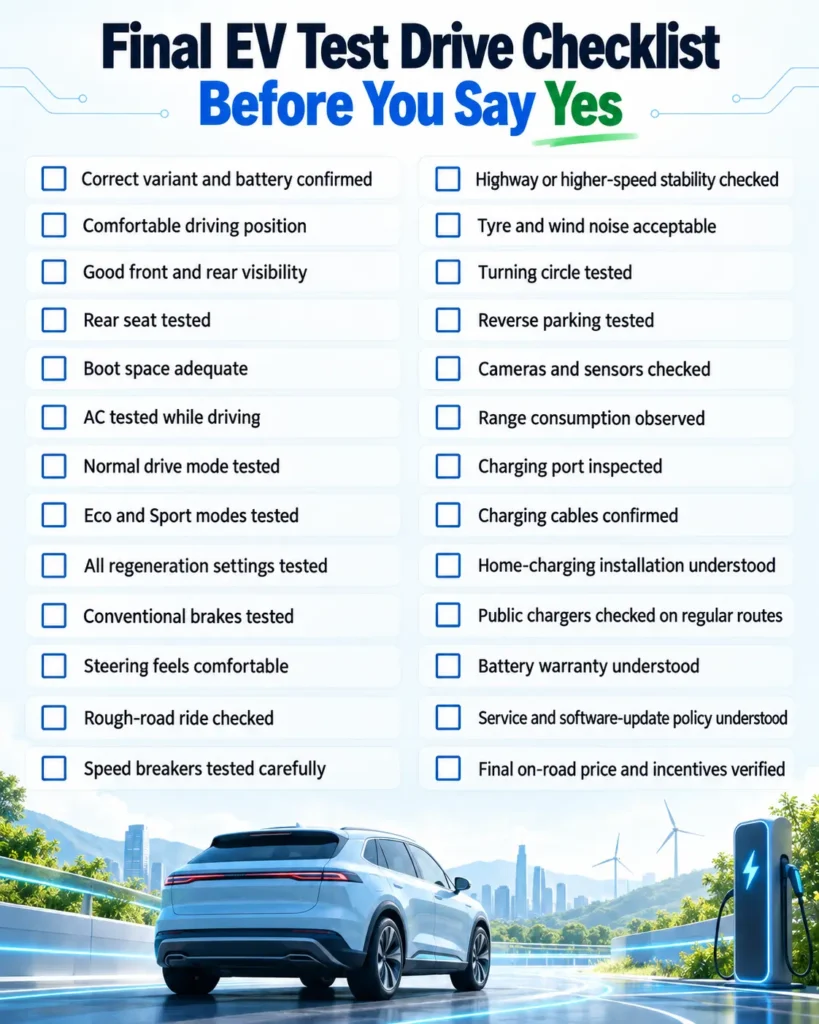
Final EV Test Drive Checklist Before You Say Yes
Before paying the booking amount, make sure you can confidently tick these boxes:
Conclusion
The best electric vehicle is not necessarily the one with the highest claimed range, biggest battery or quickest acceleration.
It is the EV that fits naturally into your daily life.
A proper EV test drive checklist helps you look beyond showroom excitement and evaluate the things that actually matter after purchase—real-world range, charging convenience, passenger comfort, road behaviour, braking, software and long-term ownership support.
Keep the AC on. Drive normally. Take your family. Find a rough road. Test regeneration. Inspect the charger. Ask detailed questions. And whenever possible, take a meaningful longer drive before making the final decision.
Electric mobility is changing quickly, and today’s EVs are becoming more capable, connected, and easier to own. But the smartest buying decision still begins with something simple: testing the vehicle under the conditions in which you will actually use it.
For more practical EV buying guides, charging information, ownership advice, and electric mobility insights, explore ElectricVehicleTalks.com.
Related Article:









