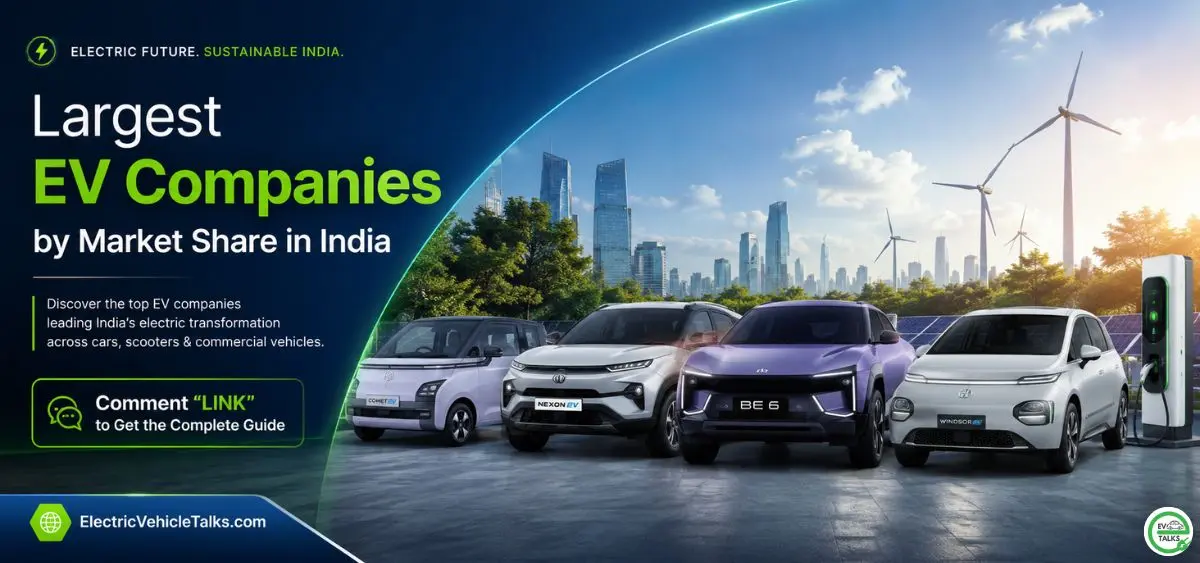

India’s electric vehicle revolution is no longer a prediction—it’s happening right now. The largest EV companies by market share in India are shaping how millions of Indians will travel over the next decade through innovative products, expanding charging networks, and advanced battery technologies.
Among passenger electric vehicles, Tata Motors, JSW MG Motor India, and Mahindra & Mahindra dominate the market, while Bajaj Auto, TVS Motor Company, and Ola Electric lead the electric two-wheeler segment. Together, these companies are accelerating India’s transition toward sustainable mobility.
For buyers, investors, fleet operators, and EV enthusiasts, understanding which companies dominate the market offers valuable insights into product reliability, after-sales service, charging ecosystem development, and long-term ownership value.
Why Market Share Matters in the EV Industry
Market share is more than just a sales number—it reflects consumer confidence, technological capability, manufacturing strength, and future growth potential.
Companies with higher market share generally benefit from the following:
- Better nationwide service networks
- Faster software and feature updates
- Higher resale values
- Greater investment in R&D
- Larger charging partnerships
- Better availability of spare parts
- Stronger customer trust
In India’s rapidly evolving EV ecosystem, these factors significantly influence purchase decisions.
India’s EV Market is Growing Faster Than Ever
India has become one of the largest EV markets in the world, driven by government incentives, falling battery prices, improved charging infrastructure, and increasing consumer awareness.
Several factors are accelerating EV adoption:
- Rising petrol and diesel prices
- FAME-II and state-level EV incentives
- GST reduction on EVs
- Expansion of public charging stations
- Corporate fleet electrification
- Improved battery technology
- Growing availability of affordable electric cars and scooters
Industry analysts expect India’s EV market to maintain strong double-digit growth over the coming years as both domestic and international manufacturers expand their presence.
Largest EV Companies by Market Share in India
Electric Passenger Vehicle (4-Wheeler) Market
The passenger EV segment has become one of India’s fastest-growing automotive categories.
| Rank | Company | FY2026 Market Share* | Key Models |
|---|---|---|---|
| 1 | Tata Motors | 38–41% | Punch EV, Nexon EV, Curvv EV, Tiago EV |
| 2 | JSW MG Motor India | ~28% | Windsor EV, ZS EV, Comet EV |
| 3 | Mahindra & Mahindra | ~24.8% | BE 6, XEV 9e |
| 4 | Others | Remaining share | BYD, Hyundai, Kia, Volvo, BMW, Mercedes-Benz |
*Approximate market estimates based on FY2026 industry sales.
Together, Tata Motors, JSW MG Motor India, and Mahindra account for nearly the entire mainstream passenger EV market in India.
1. Tata Motors
For several years, Tata Motors has remained the benchmark for electric passenger vehicles in India.
Its leadership stems from:
- Affordable pricing
- Strong nationwide dealer network
- Reliable battery technology
- Excellent safety ratings
- Continuous software improvements
- Wide product portfolio
Popular models include the following:
- Tata Punch EV
- Tata Nexon EV
- Tata Curvv EV
- Tata Tiago EV
- Tata Tigor EV
- Tata Harrier EV
Tata also continues investing heavily in battery manufacturing, localisation, and fast-charging technology, strengthening its position as India’s largest passenger EV manufacturer.
2. JSW MG Motor India
JSW MG Motor India has emerged as one of the fastest-growing EV manufacturers in India.
The company’s growth has been driven primarily by:
- MG Windsor EV
- MG ZS EV
- MG Comet EV
The Windsor EV has become particularly popular among urban families seeking premium features without entering luxury price segments.
MG has also focused heavily on:
- Connected car technology
- AI-powered infotainment
- Battery safety
- Home charging solutions
- Dealer expansion
Its increasing market share highlights growing consumer demand for feature-rich electric vehicles.
3. Mahindra & Mahindra
Mahindra has transformed its EV business through dedicated electric platforms rather than adapting existing petrol models.
The launch of:
- Mahindra BE 6
- Mahindra XEV 9e
has significantly strengthened its market position.
Consumers appreciate:
- SUV styling
- Long driving range
- Premium interiors
- Advanced ADAS features
- High-performance electric motors
Mahindra’s investment in next-generation battery architecture and software-defined vehicles positions it well for future growth.
How Do Electric Two-Wheeler Leaders Compare?
India’s electric scooter market is even more competitive than passenger cars.
| Company | Strength |
|---|---|
| Bajaj Auto | Strong dealer network and Chetak sales |
| TVS Motor Company | Reliable iQube lineup and service network |
| Ola Electric | Technology-driven scooters with wide adoption |
| Ather Energy | Premium performance scooters |
| Hero Vida | Growing nationwide expansion |
Unlike passenger cars, market leadership in electric scooters changes more frequently due to aggressive pricing and frequent product launches.
Commercial EV Leaders
Commercial electrification is another rapidly growing segment.
Key players include:
- Olectra Greentech (Electric buses)
- Tata Motors (Electric trucks and buses)
- Switch Mobility
- PMI Electro
- JBM Auto
State transport undertakings and urban mobility projects continue driving demand for electric buses across India.
What Makes These Companies Market Leaders?
Several common factors explain their success:
a) Strong Product Portfolio
Leading manufacturers offer multiple products across different price segments.
b) Nationwide Service Network
Reliable after-sales service builds long-term customer confidence.
c) Battery Technology
Modern LFP and advanced lithium-ion batteries improve safety, charging speed, and longevity.
d) Software Integration
Connected vehicle features, OTA updates, navigation, and smart charging improve the ownership experience.
e) Manufacturing Scale
Higher production volumes reduce costs and improve affordability.
Industry Trend: Local Manufacturing Is Becoming the Biggest Advantage
India is steadily reducing dependence on imported EV components. Major manufacturers are investing in:
- Local battery production
- Motor manufacturing
- Semiconductor partnerships
- Cell assembly
- Recycling facilities
This localisation helps lower vehicle costs while strengthening India’s position as a global EV manufacturing hub.
Choosing the Right EV Company: A Buyer’s Guide
Selecting an electric vehicle isn’t just about buying the latest model—it’s about choosing a manufacturer that can support you throughout your ownership journey. The largest EV companies by market share have earned consumer trust by delivering reliable products, expanding charging partnerships, and offering stronger after-sales support.
Before purchasing an EV, consider these factors:
| Factor | Why It Matters |
|---|---|
| Driving Range | Match the battery range to your daily commute and occasional long trips. |
| Charging Options | Ensure home charging is feasible and check the availability of public chargers in your area. |
| Service Network | A wide service network reduces maintenance hassles and improves ownership confidence. |
| Battery Warranty | Look for battery warranties of at least 8 years or 1.6 lakh km. |
| Safety Features | Prioritise vehicles with high safety ratings, ADAS, and multiple airbags. |
| Software Updates | Over-the-air (OTA) updates keep the vehicle secure and introduce new features. |
| Resale Value | Market leaders generally retain higher resale values due to stronger demand. |
Ownership Tips for First-Time EV Buyers
Owning an EV differs slightly from owning a petrol or diesel vehicle. Fortunately, the learning curve is minimal.
Here are some practical ownership tips:
- Install a home charger if you have dedicated parking.
- Keep the battery charge between 20% and 80% for everyday use to maximise battery life.
- Use DC fast charging only when necessary during long-distance travel.
- Plan road trips using charging station apps.
- Keep your vehicle software updated.
- Check tyre pressure regularly, as EVs are generally heavier than conventional cars.
- Use regenerative braking effectively to improve efficiency and extend driving range.
Following these practices can help improve battery longevity and reduce operating costs over the life of the vehicle.
Charging Infrastructure in India: A Key Growth Driver
One of the biggest reasons behind India’s accelerating EV adoption is the rapid expansion of charging infrastructure.
Over the past few years, India has witnessed significant investments from:
- Tata Power EZ Charge
- Statiq
- ChargeZone
- Jio-bp Pulse
- Shell Recharge
- Indian Oil
- BPCL
- HPCL
Fast-charging stations are increasingly available on highways, metro cities, shopping malls, hotels, office campuses, and residential communities.
The government’s support for public charging infrastructure, combined with private sector investment, is helping reduce range anxiety and making EV ownership more practical across urban and semi-urban India.
Battery Technology Is Transforming India’s EV Industry
Battery technology remains the most critical factor influencing EV performance, affordability, and consumer confidence.
Leading manufacturers are investing heavily in:
a) Lithium Iron Phosphate (LFP) Batteries
Known for:
- Longer life cycles
- Improved thermal safety
- Lower maintenance
- Cost efficiency
b) Nickel Manganese Cobalt (NMC) Batteries
Preferred for:
- Higher energy density
- Longer driving range
- Better performance in premium EVs
Future Battery Innovations
The next wave of innovation is expected to include:
- Solid-state batteries
- Sodium-ion batteries
- Ultra-fast charging cells
- Cell-to-pack battery architecture
- Battery recycling and second-life applications
These technologies could significantly reduce charging times, increase driving range, and lower overall ownership costs over the coming years.
Government Incentives Fueling EV Growth
India’s EV market has benefited from supportive government policies aimed at encouraging electric mobility.
Key initiatives include:
- Reduced GST on electric vehicles.
- Production Linked Incentive (PLI) schemes for advanced battery manufacturing.
- State-level purchase incentives (where applicable).
- Incentives for EV manufacturing and localisation.
- Expansion of public charging infrastructure.
- Support for battery recycling and domestic supply chains.
These measures have helped manufacturers scale production while making EVs more affordable for consumers.
Best EV Stocks in India 2026
Investors are increasingly interested in companies benefiting from India’s EV transition. While investment decisions should always be based on individual financial goals and research, several companies remain closely linked to the country’s electric mobility growth.
| Company | EV Exposure |
|---|---|
| Tata Motors | Passenger EVs, commercial EVs, battery ecosystem |
| Mahindra & Mahindra | Electric SUVs and future EV platforms |
| TVS Motor Company | Electric scooters |
| Bajaj Auto | Electric two-wheelers |
| Hero MotoCorp | VIDA electric mobility |
| Olectra Greentech | Electric buses |
| Exide Industries | Battery manufacturing |
| Amara Raja Energy & Mobility | Advanced battery solutions |
Those searching for the list of EV stocks in India should also monitor battery manufacturers, charging infrastructure providers, and component suppliers, as the EV ecosystem extends far beyond vehicle manufacturers.
Challenges Facing India’s EV Industry
Despite impressive growth, several challenges remain:
- Uneven charging infrastructure in rural regions.
- High upfront vehicle prices compared to ICE models.
- Dependence on imported battery raw materials.
- Limited public awareness in smaller cities.
- Grid capacity upgrades required for mass EV adoption.
- Battery recycling infrastructure still developing.
Addressing these issues will be essential for sustaining long-term growth.
Common Mistakes EV Buyers Should Avoid
Many first-time buyers focus solely on the purchase price, overlooking the broader ownership experience.
Avoid these common mistakes:
- Buying an EV with more range than you actually need.
- Ignoring the availability of nearby charging stations.
- Not comparing battery warranties.
- Overlooking service network quality.
- Relying exclusively on DC fast charging.
- Failing to calculate the total cost of ownership.
A well-informed purchase often results in lower running costs and greater long-term satisfaction.
Expert Insight from Electric Vehicle Talks
India’s EV market is entering a new phase where success will no longer be defined by sales volume alone. The next generation of market leaders will distinguish themselves through software innovation, charging ecosystems, battery technology, localisation, and customer experience.
Tata Motors continues to lead due to its mature EV portfolio and strong service network. Meanwhile, Mahindra’s dedicated electric platform strategy and JSW MG Motor India’s focus on connected technology have intensified competition in the passenger EV segment. In electric two-wheelers, Bajaj Auto, TVS Motor Company, and Ola Electric continue to shape consumer expectations through rapid product innovation and expanding retail presence.
At Electric Vehicle Talks, we believe the future of India’s EV ecosystem will be driven not only by better vehicles but also by accessible charging infrastructure, advanced battery technologies, and a strong domestic manufacturing ecosystem. Readers can explore more expert analysis, buying guides, charging insights, and industry news.
India-Specific EV Adoption Trends
India’s EV journey varies significantly across regions.
a) Urban India
- Strong demand for electric cars and scooters.
- Better charging infrastructure.
- Increasing apartment charging installations.
- Growing corporate fleet electrification.
b) Tier-2 and Tier-3 Cities
- Rapid adoption of electric scooters.
- Expansion of dealership networks.
- Rising interest in affordable passenger EVs.
c) Rural India
- Electric three-wheelers and cargo vehicles are driving commercial adoption.
- Government support and improving infrastructure are expected to accelerate future growth.
As battery prices continue to fall and localisation improves, EV adoption is expected to spread across every region of the country.
People Also Ask
Tata Motors currently leads India’s electric passenger vehicle market, followed by JSW MG Motor India and Mahindra & Mahindra. Together, these three companies account for the majority of passenger EV sales.
Which company leads the electric scooter market in India?
The electric two-wheeler segment is led by Bajaj Auto, TVS Motor Company, and Ola Electric, with market positions changing based on monthly sales and new product launches.
Is India becoming one of the largest EV markets?
Yes. India is among the fastest-growing electric vehicle markets globally, supported by government policies, increasing consumer demand, and expanding charging infrastructure.
Which EV company has the largest market capitalization in India?
Among listed Indian automotive companies with significant EV operations, Tata Motors and Mahindra & Mahindra are among the largest by market capitalization. However, market capitalization changes daily based on stock market performance.
Are EVs cheaper to own than petrol cars?
In most cases, yes. Although EVs may have a higher purchase price, they generally offer lower running costs, reduced maintenance, and savings on fuel over the vehicle’s lifetime.
What is the future of India’s EV industry?
Industry analysts expect continued growth driven by domestic manufacturing, improved battery technology, wider charging networks, supportive policies, and increasing consumer confidence.
FAQs about Largest EV Companies by Market Share in India
Tata Motors, JSW MG Motor India, and Mahindra & Mahindra lead the passenger EV market, while Bajaj Auto, TVS Motor Company, and Ola Electric dominate the electric two-wheeler segment.
2. Which company sells the most electric cars in India?
Tata Motors currently sells the highest number of electric passenger vehicles in India.
3. Which EV company is growing the fastest?
Mahindra & Mahindra and JSW MG Motor India have shown rapid growth due to successful new model launches and expanding customer demand.
4. Is investing in EV stocks in India a good long-term opportunity?
India’s EV sector offers significant long-term potential, but investors should conduct thorough research and consider their financial objectives before investing.
5. What factors should buyers consider before purchasing an EV?
Driving range, charging availability, service network, battery warranty, safety features, software updates, and total ownership costs are among the most important considerations.
Conclusion
India’s electric mobility revolution has reached an exciting stage. The largest EV companies by market share are no longer simply competing on vehicle sales—they are building comprehensive ecosystems that include advanced battery technologies, software-driven features, extensive charging partnerships, and reliable after-sales support.
Tata Motors continues to set the benchmark in passenger EVs, while JSW MG Motor India and Mahindra & Mahindra are rapidly closing the gap with innovative products and dedicated electric platforms. In the two-wheeler segment, Bajaj Auto, TVS Motor Company, and Ola Electric are driving mass adoption by offering practical, efficient, and increasingly affordable electric scooters.
As charging infrastructure expands, battery costs decline, and government support continues, India is well-positioned to become one of the world’s largest EV markets. For consumers, this means more choices, improved technology, and lower long-term ownership costs. For investors and industry stakeholders, it signals one of the most transformative opportunities in the automotive sector.
To stay informed about the latest EV news, detailed buying guides, charging solutions, industry trends, and expert market analysis, explore more insights on Electric Vehicle Talks.
Related Article: