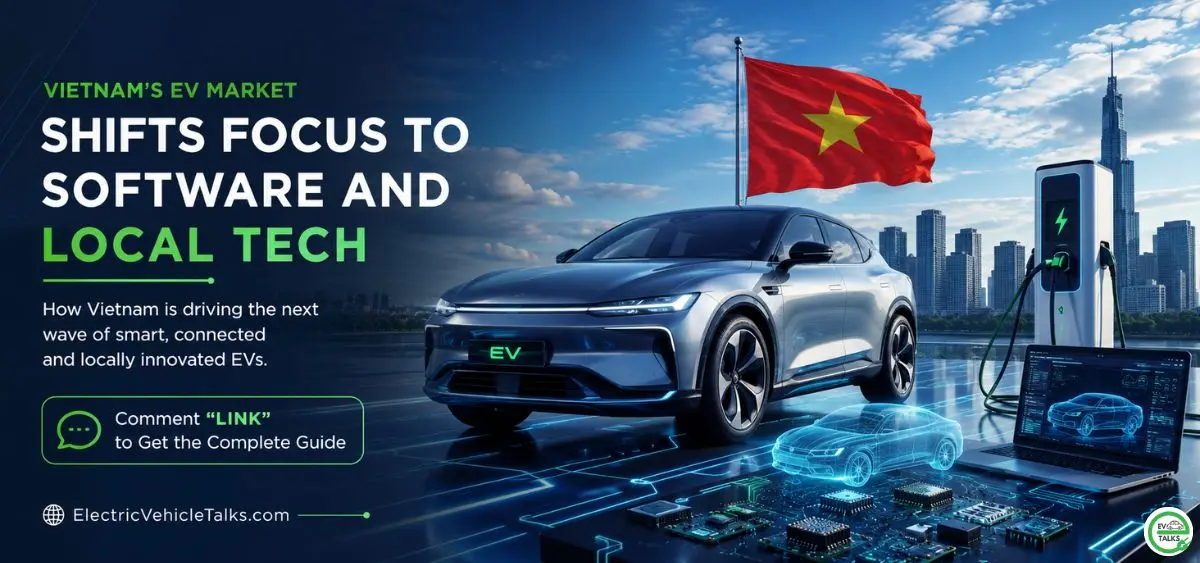

Vietnam’s EV market is entering a new phase of growth, moving beyond simply increasing electric vehicle sales to focusing on software, connectivity, and home-grown engineering capabilities. Industry experts believe this transformation will help the country strengthen its position as one of Southeast Asia’s leading electric mobility hubs while creating long-term value through technology development rather than manufacturing alone.

Vietnam’s EV Market Expands Beyond Vehicle Adoption
Speaking at a media event in Hanoi on July 21, George Chia, Sales Director for the ASEAN region at Analog Devices, Inc. (ADI), highlighted how Vietnam’s EV market has become one of the region’s most advanced.
According to Chia, while several ASEAN countries continue to concentrate on importing or assembling electric vehicles, Vietnam is increasingly investing in designing and developing automotive technologies locally. This shift is supported by strong government initiatives, a rapidly growing startup ecosystem, and experienced Vietnamese engineers returning from overseas to build technology-driven businesses.
He noted that the combination of supportive public policies and domestic innovation is creating strong momentum for the country’s electric vehicle industry.
Software-Defined Vehicles Are Reshaping the Industry
One of the biggest developments transforming Vietnam’s EV market is the emergence of Software-Defined Vehicles (SDVs). Unlike traditional vehicles, SDVs rely heavily on software to control vehicle functions, enabling continuous feature upgrades even after the vehicle has been delivered to customers.
Modern electric vehicles are becoming sophisticated computing platforms equipped with multiple cameras, digital displays, advanced driver assistance systems (ADAS), premium infotainment, and high-speed connectivity.
As vehicle electronics become increasingly complex, manufacturers are replacing traditional domain-based electronic systems with zonal architectures managed by centralized computing platforms. This new approach reduces wiring, lowers vehicle weight, improves manufacturing efficiency, and supports over-the-air software updates throughout the vehicle’s lifecycle.
Industry experts estimate that the amount of data processed inside vehicles could grow from approximately 20GB today to more than 200GB over the next decade.
Advanced Connectivity Technologies Drive Smarter EVs
Rather than building central computing systems, Analog Devices focuses on technologies that connect cameras, sensors, displays, speakers, and electronic control systems throughout the vehicle.
Chia compared these technologies to the human body’s blood vessels, explaining that while the central computer acts as the brain, the communication network enables every component to work together efficiently.
ADI highlighted three major connectivity technologies supporting future SDVs:
- GMSL (Gigabit Multimedia Serial Link): Enables high-speed, low-latency communication between cameras, displays, and central processors for ADAS and infotainment systems.
- A2B (Automotive Audio Bus): Simplifies in-vehicle audio by transmitting audio, power, and control signals through a single cable.
- E2B (Ethernet to the Edge Bus): Connects sensors and actuators within next-generation zonal vehicle architectures.
The company revealed that its GMSL technology has been deployed globally for more than two decades, with over one billion integrated circuits shipped. VinFast is among the automotive manufacturers already utilising this technology.
Local Engineering Will Define the Future
Looking ahead, Chia believes Vietnam’s EV market will be shaped by two key priorities: improving consumer convenience and expanding domestic engineering expertise.
On the consumer side, continued investment in EV charging infrastructure for electric cars and battery-swapping networks for electric motorcycles will remain essential to accelerate adoption. As charging becomes more convenient, buyers are expected to demand more premium in-car experiences powered by advanced software and connectivity.
From an industry perspective, Vietnam’s greatest opportunity lies in strengthening local engineering, research, and design capabilities. Although many Tier-1 automotive suppliers operating in Vietnam are foreign companies, domestic manufacturers still depend heavily on externally developed modules and technologies.
Building proprietary technologies and intellectual property would allow Vietnamese companies to move higher in the global automotive value chain while creating greater economic value than manufacturing alone.
Chia also emphasised that improving English-language proficiency among engineers would help them access technical documentation, collaborate internationally, and adopt emerging technologies more efficiently.
With strong government support, an expanding technology ecosystem, a leading domestic EV manufacturer, and an increasingly skilled engineering workforce, Vietnam’s EV market is well positioned to become a regional leader in software-driven electric mobility and automotive innovation.

Related Articles: