
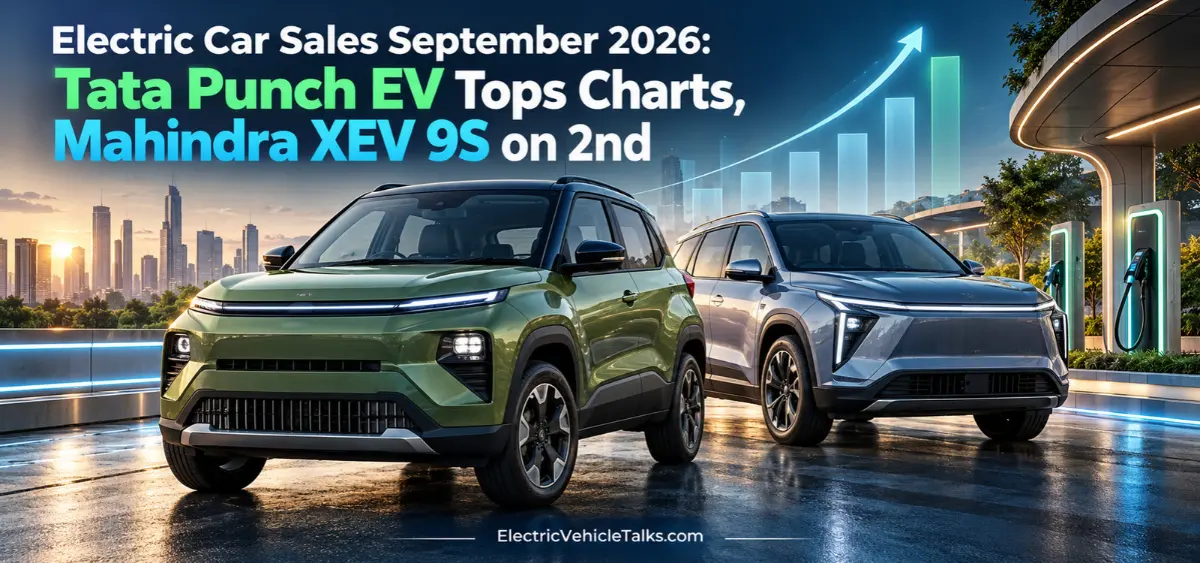

India’s electric car market delivered a dramatic shake-up in September 2026 as the Tata Punch EV overtook its closest rival, the Mahindra XEV 9S, by just 66 units. The race unfolded against a bigger rise in dispatches: Electric car sales in September 2026 reached 35,256 dispatches, up 62% from 21,757 units a year earlier. Tata Motors retained overall leadership, while Mahindra reinforced its position as a serious challenger.
The MG Windsor EV slipped in the rankings, and fresh competition from Maruti Suzuki, Kia and global brands made the electric SUV segment more crowded than ever across India’s fast-changing market this month.
Which Was India’s Best-Selling Electric Car in September 2026?
The Tata Punch EV was India’s best-selling electric car in September 2026, with 4,702 units dispatched. The Mahindra XEV 9S finished second with 4,636 units, just 66 units behind. Tata Nexon EV ranked third with 3,926 units. Overall, the reported electric passenger vehicle dispatch volume increased 62% year-on-year to 35,256 units.
September 2026 Electric Car Sales: Key Highlights
- 35,256 electric cars dispatched, compared with 21,757 units in September 2025.
- 62% year-on-year growth, adding 13,499 units over the previous year.
- Tata Punch EV takes the crown with 4,702 units and 284% annual growth.
- Mahindra XEV 9S misses No. 1 by just 66 units, securing a 13.1% volume share.
- Tata Nexon EV ranks third, recording 3,926 units and 21% growth.
- MG Windsor EV slips to fourth, with dispatches declining 30% year-on-year.
- Top 10 electric cars contribute 26,294 units, accounting for approximately 74.6% of total reported volume.
- Electric SUVs dominate the rankings, while newer offerings from Maruti Suzuki, Kia, and other manufacturers increase competition.

Top 10 Best-Selling Electric Cars in India – September 2026
| Rank | Electric Car Model | Sep 2026 | Sep 2025 | YoY Change |
|---|---|---|---|---|
| 1 | Tata Punch EV | 4,702 | 1,223 | +284% |
| 2 | Mahindra XEV 9S | 4,636 | — | New model |
| 3 | Tata Nexon EV | 3,926 | 3,251 | +21% |
| 4 | MG Windsor EV | 3,300 | 4,741 | -30% |
| 5 | Mahindra XEV 9e | 1,975 | 2,619 | -25% |
| 6 | Tata Sierra EV | 1,908 | — | New model |
| 7 | Tata Curvv EV | 1,536 | 376 | +309% |
| 8 | Mahindra BE 6 | 1,517 | 1,701 | -11% |
| 9 | Tata Harrier EV | 1,452 | 2,363 | -39% |
| 10 | Maruti Suzuki e Vitara | 1,342 | — | New model |
Note: Figures represent the supplied model-wise dispatch dataset. A dash indicates that a comparable September 2025 figure is unavailable.
Tata Punch EV Beats Mahindra XEV 9S: A 66-Unit Battle for No. 1
1. Tata Punch EV: 284% Growth Powers It to the Top
The Tata Punch EV reclaimed India’s best-selling electric car position with 4,702 dispatches in September 2026.
Its performance represents a significant improvement over September 2025, when the compact electric SUV recorded just 1,223 units. The resulting 284% year-on-year growth made it one of the fastest-growing established models in the market.
The Punch EV accounted for approximately 13.3% of total reported electric passenger vehicle dispatches.
Its strong showing highlights the continued importance of compact electric SUVs in India’s increasingly competitive EV market.
2. Mahindra XEV 9S: Just 66 Units Away From Victory
The Mahindra XEV 9S secured second place with 4,636 units, narrowly missing the top position.
After leading the electric car rankings in July and August 2026, the three-row electric SUV faced a close challenge from the Tata Punch EV in September.
Despite losing the monthly top spot, the XEV 9S accounted for approximately 13.1% of total dispatches.
Its strong performance demonstrates the growing contribution of larger and premium electric SUVs to India’s overall EV market.
Together, the Punch EV and XEV 9S contributed 9,338 units, representing approximately 26.5% of the month’s reported electric car volume.
3. Tata Nexon EV: Strong Demand Keeps It in Third Place
The Tata Nexon EV maintained its position among India’s best-selling electric SUVs with 3,926 dispatches.
Compared with 3,251 units in September 2025, the model registered approximately 21% annual growth.
Despite increasing competition from Mahindra, MG and newer electric SUVs, the Nexon EV remained a major contributor to Tata Motors’ electric vehicle portfolio.
4. MG Windsor EV: Sales Drop 30% Amid Rising Competition
The MG Windsor EV, previously one of India’s highest-volume electric cars, slipped to fourth position with 3,300 units.
In September 2025, the model had recorded 4,741 units. Its latest performance therefore represents a year-on-year decline of approximately 30%.
The drop stands out because the broader reported EV market expanded by 62% during the same period.
Although the Windsor EV remained an important model for MG, its reduced volume highlights the increasingly competitive environment created by newer electric SUVs.
5. Mahindra XEV 9e: Fifth Place Despite 25% Decline
The Mahindra XEV 9e secured fifth position with 1,975 units, compared with 2,619 units a year earlier.
This translates into a decline of approximately 25%.
Nevertheless, Mahindra’s overall presence in the rankings remained strong, particularly because the newer XEV 9S substantially outperformed the XEV 9e.
The difference suggests that Mahindra’s electric SUV dispatch mix is shifting as its portfolio expands.
6. Tata Sierra EV: New Electric SUV Records 1,908 Units
The Tata Sierra EV entered the sixth position with 1,908 dispatches in September 2026.
The model strengthened Tata Motors’ presence in the electric SUV category, complementing the company’s existing Punch, Nexon, Curvv and Harrier offerings.
Its contribution also demonstrates how newer electric SUV nameplates are gaining meaningful representation in India’s model-wise EV rankings.
7. Tata Curvv EV: Massive 309% Year-on-Year Growth
The Tata Curvv EV delivered one of the strongest annual increases among established electric models.
Dispatches jumped from 376 units in September 2025 to 1,536 units in September 2026, representing approximately 309% growth.
The sharp increase helped the Curvv EV secure seventh position.
Its improving contribution added further strength to Tata Motors’ broad electric passenger vehicle portfolio.
8. Mahindra BE 6: Holds Eighth Position With 1,517 Units
The Mahindra BE 6 recorded 1,517 dispatches in September 2026, compared with 1,701 units a year earlier.
This represents an annual decline of approximately 11%.
Even with the reduction, the BE 6 remained among India’s 10 highest-volume electric car models, supporting Mahindra’s expanding electric SUV lineup.
9. Tata Harrier EV: Dispatches Decline 39%
The Tata Harrier EV ranked ninth with 1,452 units, against 2,363 units in September 2025.
Its approximately 39% decline contrasts with the strong growth registered by the Tata Punch EV and Curvv EV.
This highlights uneven performance within Tata Motors’ electric portfolio, with some models gaining dispatch volume while others recorded declines.
10. Maruti Suzuki e Vitara: Makes the Top 10 With 1,342 Units
The Maruti Suzuki e Vitara completed the top 10 with 1,342 units dispatched.
The electric SUV accounted for approximately 3.8% of total reported September EV volume.
Its presence is significant because Maruti Suzuki is expanding its participation in an electric passenger vehicle segment long led by Tata Motors, Mahindra and MG.
The arrival of another major domestic manufacturer adds a fresh competitive dimension to India’s electric SUV market.
Conclusion
India’s electric passenger vehicle market delivered strong reported growth in September 2026, with total dispatches rising 62% year-on-year to 35,256 units.
The Tata Punch EV regained the top position, but the Mahindra XEV 9S finished just 66 units behind, highlighting the increasingly close competition between established and newer electric SUVs.
Meanwhile, the Tata Curvv EV recorded exceptional annual growth, the MG Windsor EV lost ground, and emerging models from Maruti Suzuki and Kia expanded the competitive landscape.
Electric Car Sales September 2026 highlights a market where growing vehicle choice, strong SUV participation and shifting model rankings are reshaping India’s electric mobility industry.
The coming months will show whether the Punch EV can maintain its narrow lead or whether the XEV 9S and other challengers can change the rankings again.
Disclaimer
The information presented in this article is based on viral content, publicly circulating reports, and available market data. The sales figures, rankings, and growth percentages have not been independently verified through official manufacturer or industry sources. Actual figures may vary. Readers are advised to refer to official automotive industry reports and manufacturer announcements for confirmed information.

Related Articles:









