


Imagine purchasing your dream electric car, enjoying the quiet drive and lower running costs, only to discover after an accident that your insurance does not cover the damage you expected. The surprise could be particularly expensive if the battery pack, electric motor, or high-voltage electronics are involved. An EV Car Insurance Checklist helps Indian electric car owners verify essential coverage, battery protection, policy exclusions, deductibles, charging-related risks, and claim procedures before purchasing or renewing insurance.
Electric cars are mechanically simpler than conventional vehicles in some respects, but their electrical systems introduce different repair risks. A damaged battery enclosure, water entering a high-voltage component or an electrical failure following an accident can create complicated insurance claims.
The important distinction is that comprehensive insurance does not mean every possible EV-related problem is covered.
Understanding precisely what is insured, which additional covers are necessary, and what actions could invalidate a claim is just as important as comparing premiums.
What Is an EV Car Insurance Checklist?
An EV Car Insurance Checklist is a practical set of checks designed to ensure that an electric vehicle’s insurance policy provides suitable legal, financial, and component-specific protection.
It helps owners examine the complete policy rather than relying on a headline promising comprehensive protection.
A useful checklist answers six essential questions:
- Does the insurance cover accidental damage to the battery and electric motor?
- Are flood-related water ingress, short circuits and consequential damage included?
- Are the charging cable, portable charger or home charger insured?
- How much must the owner pay through deductibles, depreciation and other exclusions?
- Can the damaged vehicle be repaired at an authorized EV service centre?
- What procedures must be followed to avoid claim rejection?
There is no requirement to buy a completely separate legal category of motor insurance simply because a car is electric. Indian EVs use the motor insurance framework applicable to other vehicles, with specialized add-ons available for certain EV-specific risks.
The challenge is selecting a policy that matches the vehicle’s technology and the owner’s actual driving and charging conditions.
Why Is an EV Car Insurance Checklist Important in India?
The most expensive insurance mistake is not necessarily choosing a cheap policy. It is purchasing a policy without understanding what happens when an expensive component fails.
An EV contains several specialized systems, including a high-voltage traction battery, Battery Management System (BMS), inverter, motor, power electronics and thermal management equipment.
Repairing these systems may require manufacturer-approved diagnostic tools, specialized replacement parts and trained high-voltage technicians.
Three practical concerns make insurance selection particularly important for Indian EV owners.
1. Battery replacement can be expensive.
A traction battery is a significant contributor to an electric car’s manufacturing cost. Its replacement cost depends on the model, battery capacity, chemistry, spare-parts pricing and whether individual modules can be repaired.
There is no reliable universal percentage that describes battery replacement costs for every electric car.
Instead of assuming the battery represents a fixed share of the vehicle’s price, request model-specific repair and replacement information from an authorized service centre.
2. Monsoon conditions introduce additional risks.
Waterlogged roads, flooded parking areas and underbody impacts deserve special attention.
Consider an electric SUV parked in a basement during heavy rainfall. Even after the water recedes, moisture may remain inside electrical connectors or damaged high-voltage components.
The insurance outcome may depend on whether the loss resulted directly from a covered flood, from a subsequent short circuit, or from operating the car despite signs of water damage.
These are materially different circumstances under some policy contracts.
3. EV claims require specialized assessment.
A conventional body repair and an EV battery assessment are not necessarily comparable.
Following an accident, a vehicle may need insulation testing, battery enclosure inspection, electronic fault diagnosis, and manufacturer-specific safety checks.
A strong policy should therefore be evaluated not only on its premium but also on its EV-capable workshop network and claims support.
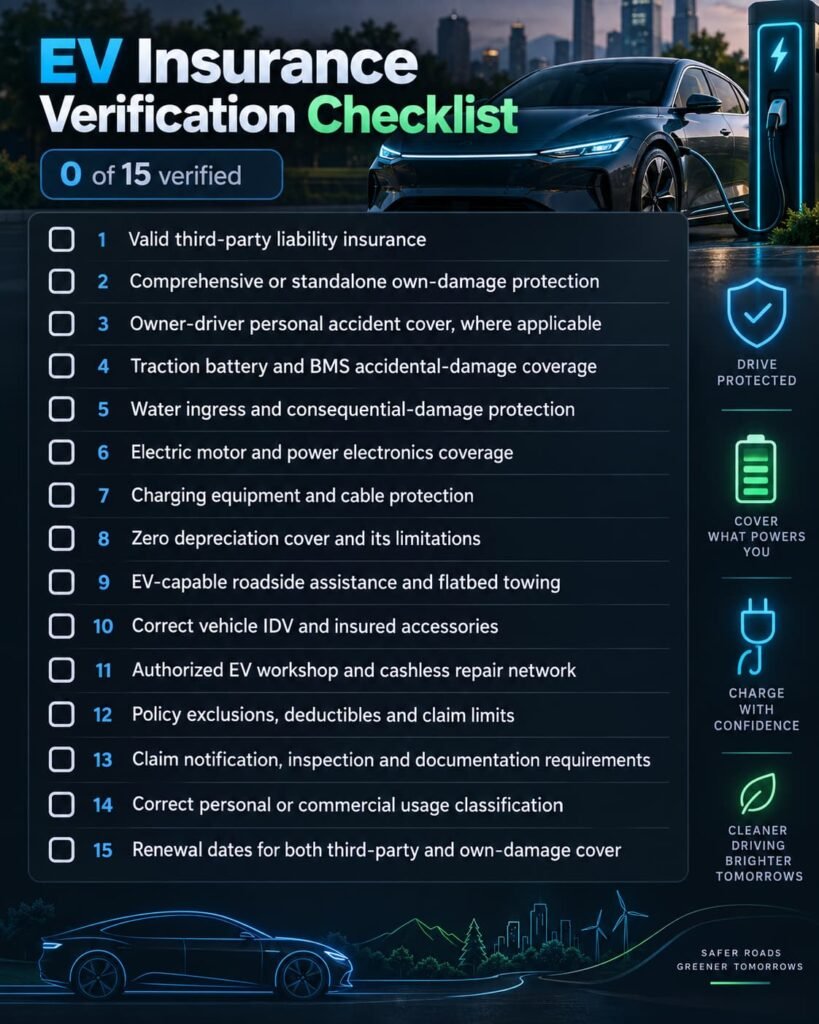
EV Car Insurance Checklist: 15 Things to Verify Before Buying
Use the following checklist when comparing quotations, speaking with an insurance adviser or reviewing a renewal.
Which Types of EV Car Insurance Are Available in India?
Understanding the basic policy structure is the first step toward choosing the correct protection.
| Insurance type | What it covers | Is it mandatory? |
|---|---|---|
| Third-party liability | Legal liability for injury, death, or property damage to others | Yes. |
| Own-damage cover | Insured vehicle damage from specified events such as accidents, fire, theft and floods | No |
| Comprehensive insurance | Third-party plus own-damage protection | No, but recommended. |
| Personal accident cover | Eligible accidental death or disability of the owner-driver | Required subject to applicable rules and exemptions |
| EV-specific add-ons | Additional defined risks involving batteries, motors, charging and related components | Optional |
Important rule for new electric car buyers
In India, new private cars generally receive three years of third-party insurance, while bundled own-damage protection normally lasts one year.
This means an EV can remain legally insured for third-party liability while its own-damage protection has expired.
Owners should check both expiry dates independently.
Which EV Insurance Add-Ons Are Actually Worth Buying?
Not every optional add-on is essential for every owner. The priority depends on the vehicle’s age, battery replacement exposure, local flood conditions, charging habits, and budget.
| Add-on | Main benefit | What to verify |
|---|---|---|
| Battery protection | Certain specified battery and BMS damage | Covered causes, consequential damage and exclusions |
| Electric motor protection | Specified motor or powertrain damage | Whether motor and power electronics are included |
| Zero depreciation | Reduces depreciation deductions on eligible replacement parts | Part exclusions, claim limits and deductibles |
| Roadside assistance | Recovery after breakdown, accidents or loss of charge | Flatbed towing, distance and number of uses |
| Charging equipment cover | Specified damage or loss of insured chargers and cables | Portable versus fixed charger, theft and surge protection |
| Consumables cover | Eligible repair consumables | Which materials and claims qualify |
| Return-to-invoice | Additional payment for qualifying theft or total loss | Eligibility, limits and included invoice expenses |
Battery protection: the most important EV-specific check
A battery protection add-on can be valuable, particularly where it extends coverage to consequential damage caused by an insured event.
Direct damage and consequential damage are not interchangeable.
For example, an accidental underbody impact may damage a battery enclosure. Later, moisture entering through that damage could harm electrical components.
Whether the subsequent electrical damage is payable depends on the policy’s definitions, covered events and exclusions.
Some add-ons expressly include short circuits, flood-related water ingress, mechanical shock and undercarriage impacts. Others may impose significant restrictions.
Do not assume the words “battery protection” guarantee coverage for every battery failure.
Does zero depreciation insurance mean a completely free repair?
No. Zero depreciation normally reduces eligible depreciation deductions on replacement parts.
It does not automatically remove compulsory deductibles, voluntary deductibles, excluded expenses, policy excesses or other conditions.
Similarly, it does not turn normal battery degradation into an insured accident.
Should EV owners insure home chargers separately?
Yes, owners should investigate charger protection, but not necessarily purchase another policy without checking existing coverage.
A portable cable supplied with the vehicle may be treated differently from a wall-mounted charger installed at the owner’s property.
Home insurance, a dedicated charger endorsement or an EV accessory cover may address different risks.
Request written confirmation covering the actual equipment, its ownership, insured location and relevant causes of loss.
What Does EV Battery Insurance Actually Cover?
This is where reading the policy wording becomes essential.
An actual EV protection add-on policy examined for this article demonstrates why two policies marketed for similar purposes can provide very different levels of protection.
Its specified covered parts include the battery, Battery Management System, electric motor, differential, and hybrid electric vehicle system. The covered events include certain short circuits, collision-related mechanical shocks, flood-related water ingress and undercarriage damage.
However, its exclusions also identify several situations that policyholders might mistakenly assume are insured. Before choosing battery protection, understand EV battery warranty terms, replacement costs, and common battery problems to distinguish insurance coverage from manufacturer warranty benefits.
EV battery insurance coverage: important distinctions
| Damage scenario | Is coverage guaranteed? |
|---|---|
| Battery damaged in a covered accident | Often covered under own-damage terms |
| Battery casing damaged by an underbody impact | Depends on coverage and consequential damage provisions |
| Battery damaged by flood-related water ingress | Depends on policy and add-on wording |
| Internal electrical short circuit | May require specified additional protection |
| Power surge while charging | Not universally covered; expressly excluded by some add-ons |
| Charging cable or wallbox catches fire | Requires separate verification |
| Battery capacity falls naturally with age | Generally excluded |
| Manufacturer defect or battery recall | Normally addressed through applicable warranty or recall arrangements. EV Extended Warranties |
| Damage involving unauthorized equipment | May be excluded under relevant policy conditions |
A real policy example: why exclusions matter
One EV protection add-on includes consequential damage from specified flood, impact and short-circuit events, yet its exclusions contain important restrictions.
These include:
- A 10% excess on assessed liability, subject to a minimum of ₹500 per claim.
- A maximum of one claim under that add-on during the applicable policy year.
- Exclusions for damage caused by unauthorized charging equipment.
- Exclusions for fire or loss caused by unexpected power surges during charging.
- Restrictions relating to repairs without prior insurer approval.
- Requirements concerning authorized servicing, maintenance and manufacturer instructions.
- Eligibility limited to qualifying vehicles not exceeding three years of age.
Importantly, the examined wording is specifically labelled for hybrid electric vehicles. Its conditions should not be represented as universal requirements for every battery-electric car policy.
The practical lesson: Never select an add-on solely because its name mentions battery protection, water damage, or electrical safety. The benefits section and exclusions must be read together.
What Are the Most Common EV Car Insurance Claim Rejection Reasons?
An insurance claim can be rejected, reduced, or delayed because of a coverage exclusion, failure to follow policy conditions, or missing evidence.
The following are important EV insurance claim rejection risks and their practical solutions.
| Common problem | Why the claim is at risk | What the EV owner should do |
|---|---|---|
| Policy expired | Loss occurred outside the coverage period | Renew before expiry |
| Repair before notification | Insurer cannot inspect or verify damage | Notify promptly and obtain repair approval |
| Invalid driving licence | Potential breach of legal or policy conditions | Ensure drivers hold valid licences |
| Excluded damage | Incident falls outside insured risks | Review exclusions before buying |
| Unauthorized charger | Charging-related exclusions may apply | Use manufacturer-approved equipment |
| Flood-related negligence | Subsequent damage may be disputed | Avoid restarting or charging a submerged EV |
| Unauthorized modifications | Modifications may cause excluded damage | Disclose modifications and obtain necessary approvals |
| Normal battery degradation | Not an insured accidental event | Use applicable battery warranty |
| Incorrect vehicle usage | Private policy may not cover commercial operations | Declare actual vehicle use |
| Incomplete claim evidence | Cause and extent of loss cannot be established | Preserve photographs, records and diagnostic reports |
1. Policy expired before the accident
Imagine an EV owner with three-year third-party insurance who forgets to renew the one-year own-damage component.
If the car suffers accidental damage after own-damage cover expires, the remaining third-party insurance does not cover repairs to the owner’s vehicle.
Solution: Record the renewal date for each component separately and activate renewal reminders. Do not wait until the last day.
2. Vehicle repaired without informing the insurer
An owner may take an accident-damaged EV directly to a workshop and authorize repairs before the insurer has inspected it.
This can create disputes over the cause, extent, and repair cost of the damage.
Solution: Photograph the damage, notify the insurer promptly, obtain a claim reference, and follow survey and approval instructions before repairs. Urgent safety and recovery measures should not be delayed.
There is no universal 48-hour or 72-hour reporting rule applicable to every EV policy. The actual contractual timeline matters.
3. Driver did not hold a valid licence
Driving without an appropriate valid licence can create serious claim complications.
However, legal treatment may differ depending on the claim category, facts and applicable law. An invalid licence should not be described as causing automatic rejection of every possible claim.
Solution: Check licence validity and vehicle-class eligibility before allowing another person to drive.
4. Claim relates to damage excluded by the policy
An owner might expect insurance to pay for a battery that gradually loses range after several years.
But normal ageing is different from sudden accidental damage.
Solution: Separate insurance claims from warranty claims. Check the battery warranty’s age, distance, State of Health thresholds, and exclusions.
5. Unauthorized charging equipment causes damage
Poor-quality adapters, incorrect electrical installations or charging equipment not approved for the vehicle may create safety risks.
Some insurance add-ons expressly exclude damage caused by unauthorized chargers. Following safe EV charging practices can help reduce avoidable charging-related risks and support responsible battery ownership.
Solution: Follow the vehicle manufacturer’s charging instructions, use compatible certified equipment, and avoid unsafe adapters or modified charging connections.
6. EV exposed to flooding and restarted
Consider an electric car left in a waterlogged parking area overnight. The owner attempts to drive or charge it immediately after the water recedes.
If moisture has entered damaged electrical components, energizing the system could increase damage and safety risks.
Solution: Never attempt to start or charge a vehicle that has been submerged or may have suffered high-voltage water damage. Keep clear of damaged electrical equipment, contact emergency services if necessary, and arrange manufacturer-approved recovery.
Coverage for the original flood event and any subsequent damage must be assessed under the policy wording.
7. Unauthorized battery or electrical modifications
Unapproved high-voltage wiring changes, battery alterations or unsuitable aftermarket electrical equipment can create insurance and warranty complications.
Not every harmless accessory automatically invalidates an entire policy. The nature of the modification, disclosure, connection to the loss, and relevant policy conditions matter.
Solution: Declare material modifications to the insurer and obtain appropriate approvals before installation.
8. Private electric car used commercially
A privately insured EV used for paid passenger transport or other commercial operations may not have suitable cover.
Solution: Ensure the vehicle registration, permitted use and insurance classification match the actual operation.
Understanding the EV insurance claim process in India can help owners avoid documentation mistakes, repair-related disputes, and unnecessary claim delays.
What Should You Do Immediately After an EV Accident?
After a collision, flood or suspected high-voltage electrical fault, personal safety comes before paperwork.
Follow this practical EV insurance claim process:
Step 1: Secure the location
Move occupants to safety, seek medical assistance if required, and avoid exposed electrical components, damaged battery casings or smoke.
Step 2: Document the incident
Capture photos and videos of the vehicle, surroundings, visible impact and water levels where relevant, without approaching an unsafe vehicle.
Step 3: Inform the insurer promptly
Register the claim within the applicable policy requirements. Report the incident to police where legally required or reasonably necessary.
Step 4: Arrange safe EV recovery
Request towing appropriate to the vehicle’s manufacturer instructions, including flatbed transport where required.
Step 5: Obtain inspection and repair approval
Preserve diagnostic evidence and obtain authorization before starting non-emergency repairs.
Step 6: Review settlement details
Verify approved repairs, exclusions, depreciation, deductibles and the final owner contribution.
For an EV battery claim, supporting documents may include the policy schedule, registration certificate, driving licence, completed claim form, incident photographs, workshop estimate, battery diagnostic report and any other documents reasonably required by the insurer. EV Insurance Claims
How Do IDV, Deductibles and Premiums Affect EV Insurance?
The cheapest quotation is not always the most economical policy.
The Insured Declared Value (IDV) represents the agreed insured value of the vehicle for relevant total-loss or theft settlements, subject to applicable terms. It is not a promise to pay the same amount for every accident.
A lower IDV may reduce the premium, but it can also lower a qualifying total-loss settlement.
Higher voluntary deductibles may similarly reduce premiums while increasing the owner’s payment when claiming.
Example: How an EV insurance deductible works
Consider a hypothetical covered repair with an assessed liability of ₹2,00,000.
| Item | Amount |
|---|---|
| Assessed covered repair liability | ₹2,00,000 |
| Add-on excess at 10% | ₹20,000 |
| Balance after this excess | ₹1,80,000 |
This illustration uses a 10% excess of the kind found in the examined add-on. It is not a general EV insurance deductible.
Other applicable deductibles, exclusions or settlement adjustments may change the actual payment.
Before purchasing, ask the insurer to illustrate a battery-damage claim using your specific car model and proposed policy.
What Government Incentives Apply to Electric Car Insurance in India?
India’s motor insurance regulations distinguish EVs from conventional vehicles for certain third-party premiums.
Under the notified 2022 motor third-party premium framework, battery-electric vehicles received approximately 15% lower third-party premiums than corresponding conventional fuel vehicles, while hybrid vehicles received an approximately 7.5% concession. The electric-vehicle differential was also confirmed in a July 2025 parliamentary response.
These concessions concern the regulated third-party premium component, not an automatic 15% reduction in the entire comprehensive insurance bill. Section 80EEB: EV Tax Benefit Rules for AY 2026-27
EV purchase incentives, road-tax concessions and registration benefits are separate from insurance benefits.
An EV owner should therefore calculate the complete ownership cost using the actual vehicle price, applicable taxes, insurance premium, charging expenses, maintenance and depreciation rather than assuming a vehicle subsidy automatically lowers insurance costs. EV Insurance Cost
How Can You Choose the Best EV Car Insurance Policy?
Instead of choosing an insurer solely by a headline claim settlement ratio or introductory premium, compare the actual terms offered for your vehicle.
Claim settlement statistics can provide context, but company-wide figures do not necessarily reveal how efficiently an insurer handles complex EV battery claims.
Use these five criteria when comparing quotations:
- Coverage quality: Compare insured causes of loss, high-voltage component definitions, exclusions, and add-on limits.
- Claims convenience: Check digital claim filing, customer assistance, survey arrangements, and access to technical assessments.
- Service network: Confirm cashless arrangements with authorized EV workshops in your city.
- Actual claim cost: Compare IDV, compulsory and voluntary deductibles, add-on excesses and depreciation.
- Ownership suitability: Choose protection based on the vehicle’s age, charging arrangements, flood exposure and permitted usage.
An owner parking in a flood-prone basement may prioritize consequential water-damage coverage. Someone frequently travelling between cities may place greater value on long-distance EV recovery support.
The best policy is the one whose covered risks and limitations match how the vehicle is actually used.
What if Your EV Insurance Claim Is Rejected?
A rejection is not necessarily the end of the process.
First, request the insurer’s written decision identifying the specific policy clause and facts relied upon.
Compare the rejection against the policy schedule, endorsements, inspection report and supporting evidence. If necessary, seek clarification from the authorized service centre about the technical cause of the damage.
If the response remains unsatisfactory, submit a written complaint to the insurer’s Grievance Redressal Officer. Unresolved or unsatisfactory complaints can be escalated through the insurance regulator’s grievance mechanism. Eligible disputes may also be taken to the Insurance Ombudsman under the applicable rules.
Keep copies of every communication, claim reference, diagnostic report and repair estimate.
Expert Insight from Electric Vehicle Talks
Electric car insurance is gradually becoming more specialized as EV adoption expands, battery systems evolve and insurers gain experience assessing high-voltage damage.
The critical issue is no longer simply whether an insurer offers a battery add-on. It is how clearly that product defines the circumstances in which the owner receives payment.
Three developments deserve particular attention.
First, battery diagnostics are becoming increasingly important. Modern EVs generate substantial operational data through their battery management systems. Diagnostic evidence can help distinguish accident-related damage from degradation, manufacturing defects, or unrelated electrical failures.
Second, repairability matters. Some battery assemblies support component-level repairs, while others require extensive replacement following significant damage. That difference can influence repair costs, insurer assessments and decisions about economic total loss.
Third, charging infrastructure protection needs to keep pace with ownership. As more households install dedicated EV charging equipment, owners should examine whether their motor, property or separate equipment insurance adequately addresses those installations.
The recommendation from Electric Vehicle Talks is straightforward: compare the actual policy contract, not just the marketing description.
A slightly higher premium may be worthwhile when it buys clearly defined protection against a costly risk. Equally, paying extra for an add-on that excludes your main concern offers little practical benefit.
Regular servicing and following the manufacturer’s recommendations are important ownership practices. Our EV maintenance and battery care guide explains common maintenance concerns.
People Also Ask: EV Car Insurance Checklist
1. What is the most important thing to check before buying EV car insurance?
Check whether accidental battery damage, consequential electrical damage and water ingress are covered, and under what conditions. Then verify deductibles, exclusions and authorized workshop availability. These factors can substantially affect an expensive EV repair claim.
2. Does comprehensive EV insurance cover the battery?
Comprehensive insurance may cover accidental damage to an insured battery arising from a covered event. However, internal electrical failure, certain consequential damage and other specific circumstances may require an additional cover or may be excluded.
3. Can EV insurance claims be rejected for using unauthorized chargers?
Yes, certain policies expressly exclude damage resulting from unauthorized charging equipment. Whether an individual claim can be denied depends on the wording and circumstances. Use manufacturer-approved charging equipment and follow the vehicle manual.
4. Does electric car insurance cover flood damage in India?
Many comprehensive policies cover direct vehicle damage caused by insured floods. Consequential battery damage, electrical failures and losses caused or aggravated by subsequent actions may be treated differently. Owners should verify water ingress and consequential-loss provisions.
5. Is battery protection insurance compulsory for electric cars?
No. Battery protection add-ons are optional. Third-party liability insurance is mandatory, while own-damage and additional EV-specific protections are voluntary. Nevertheless, suitable battery protection can reduce exposure to certain costly repairs.
Premiums depend on the vehicle’s insured value, model, location, age, risk characteristics, previous claims, selected covers, deductibles and insurer pricing. A higher premium does not necessarily guarantee broader protection.
7. Can normal EV battery degradation be claimed through insurance?
Generally, no. Gradual loss of usable battery capacity is normally treated as wear or ageing. If capacity falls below an applicable manufacturer warranty threshold, owners should investigate warranty eligibility rather than assume an insurance claim is payable.
FAQs About EV Car Insurance in India
1. Which add-ons should I prioritize for a new electric car?
Start by comparing battery protection, zero depreciation and suitable roadside assistance. Consider charger protection if you own expensive charging equipment. Prioritize protection for the specific hazards you face rather than purchasing every available add-on.
2. Will EV roadside assistance provide emergency charging?
Not necessarily. Some plans provide towing after the vehicle runs out of charge, while others may offer limited emergency charging services. Check the distance limit, assistance frequency, availability and destination rules.
3. What happens if my EV insurance expires before an accident?
Damage occurring outside the applicable own-damage policy period is generally not covered by that expired protection. A still-valid third-party policy will not substitute for expired own-damage coverage.
4. Can I use a local garage to repair my electric car after an accident?
Some policies permit repairs outside their cashless network, but reimbursement and approval conditions apply. Certain EV-specific add-ons require manufacturer-authorized service centres. Obtain approval before repairs, especially where high-voltage components are involved.
5. Does EV insurance cover battery fires while charging?
Coverage depends on the cause and contract. A fire insured under a base policy may be treated differently from an electrical failure, an unexpected power surge or damage originating in an external charger. Never assume every charging-related fire is covered.
Learn more about EV battery fire causes and prevention to understand the risks associated with damaged batteries, electrical faults and charging equipment.
6. Is zero depreciation cover useful for a five-year-old electric car?
It can be useful if the insurer offers it for that vehicle’s age and the applicable terms provide meaningful benefits. Check the premium, eligibility, excluded parts, deductible requirements and claim limits before purchasing.
7. Does the EV battery warranty replace insurance?
No. Manufacturer warranties generally address specified defects or performance obligations, whereas insurance protects against defined accidental or external events. They serve different purposes and may contain separate exclusions.
Conclusion: EV Car Insurance Checklist
Buying an electric car is an investment in cleaner, quieter and increasingly capable transportation. Protecting that investment requires understanding the technology as well as the insurance contract.
A dependable EV Car Insurance Checklist should cover legal requirements, battery and motor protection, charging-related risks, IDV, deductibles, authorized repairs and the complete claim procedure.
Above all, remember that expensive battery damage does not automatically mean an insurance payout, even when a policy is described as comprehensive.
Before purchasing or renewing, ask questions, request written clarification and review the exclusions that matter most for your vehicle.
The smartest EV insurance decision is not necessarily the cheapest policy. It is the policy whose coverage you understand before something goes wrong.
For more practical guidance on electric car ownership, charging technology, battery maintenance and sustainable mobility, explore the latest resources and expert buying guides at Electric Vehicle Talks
Related Article:









