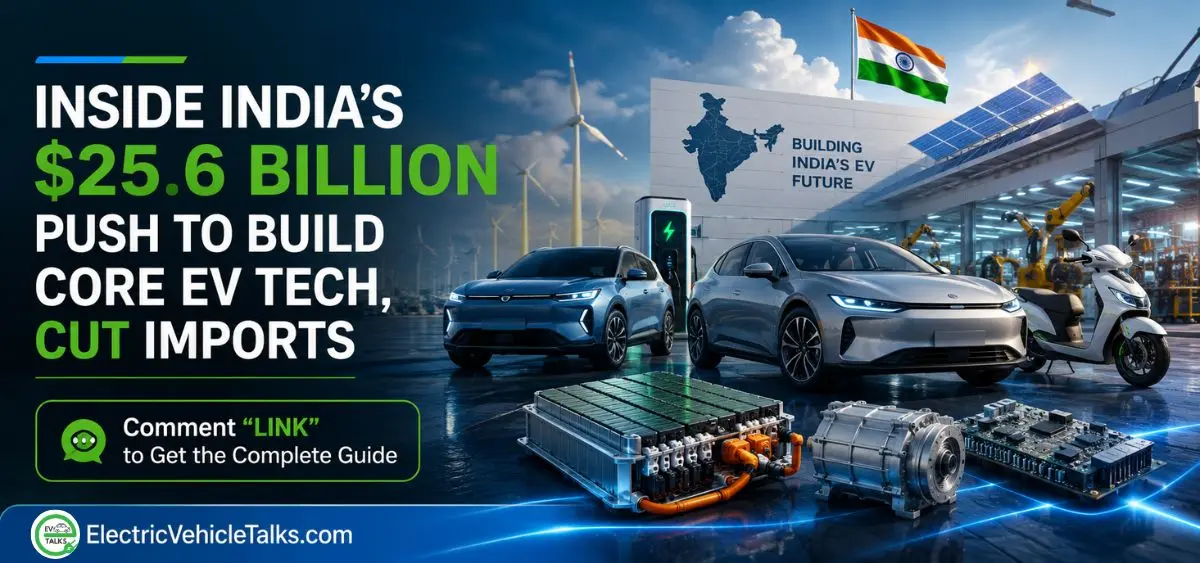

India’s electric vehicle (EV) industry is entering a decisive new phase. While the country’s initial focus was on increasing EV adoption through subsidies and incentives, the strategy is now shifting toward building the technologies that power electric vehicles. Inside India’s $25.6 Billion Push To Build Core EV Tech lies a broader vision of reducing import dependence while establishing India as a global hub for EV innovation and manufacturing.
Government Backs Domestic EV Technology with Massive Investment
The government’s ambitious plan is supported by nearly ₹2.2 lakh crore (US$25.6 billion) in policy initiatives aimed at strengthening India’s EV manufacturing ecosystem. Key programs include the ₹10,900 crore PM E-Drive Scheme, the ₹25,938 crore Production Linked Incentive (PLI) Scheme for Automobiles and Auto Components, and the ₹18,100 crore PLI Scheme for Advanced Chemistry Cells (ACC).

These initiatives are designed to encourage domestic production of batteries, electric motors, power electronics, battery management systems, and other critical EV components. The objective is to reduce India’s reliance on imported technologies while creating a stronger and more self-sufficient supply chain.
India’s EV Growth Moves Beyond Vehicle Sales
India’s EV market continues to expand rapidly, with industry estimates indicating that electric vehicle sales crossed 2 million units in FY25. However, industry leaders believe that future success will depend less on selling vehicles and more on developing the technologies behind them.
According to Piyush Verma, Co-Founder and CTO of Naxatra Labs, India’s ambition to become a global EV manufacturing hub depends on its ability to design and manufacture core technologies locally rather than simply assembling imported components. He believes the next stage of growth will be driven by indigenous expertise in electric motors, battery systems, power electronics, and embedded software.
Building Technology for Indian Roads
A major shift is already underway. Instead of adapting imported powertrains designed for overseas markets, Indian companies are engineering EV technologies specifically for local operating conditions. Heavy-load electric three-wheelers navigating rough roads and extreme temperatures require entirely different engineering solutions than vehicles built for urban markets abroad.
Companies such as Naxatra Labs are developing motors and controllers entirely in India for two-wheelers, three-wheelers, agricultural machinery, and industrial applications. As a result, more OEMs are replacing imported systems with locally developed alternatives that better suit Indian duty cycles. Inside India’s $25.6 Billion Push To Build Core EV Tech reflects this transition towards homegrown innovation.
Localisation Challenges and Export Opportunities
Despite the progress, experts acknowledge that significant challenges remain. Critical areas such as magnet supply chains, semiconductor-grade power electronics, and precision manufacturing equipment still require substantial investment. Faster testing facilities, long-term R&D funding, stronger collaboration between OEMs, suppliers, and research institutions, and greater confidence in Indian component manufacturers will be essential.
Industry leaders also highlight that locally designed technologies improve service support, reduce lifecycle costs, and strengthen supply chain resilience. Moreover, the rugged, cost-efficient engineering developed for Indian conditions could become India’s biggest export advantage across Africa, Southeast Asia, and Latin America.
As Inside India’s $25.6 Billion Push To Build Core EV Tech gathers momentum, it is positioning India not only to reduce imports but also to emerge as a leading global supplier of advanced electric mobility technologies. The success of India’s $25.6 Billion Push To Build Core EV Tech will ultimately depend on sustained innovation, infrastructure development, and collaboration across the entire EV ecosystem.

Related Articles: