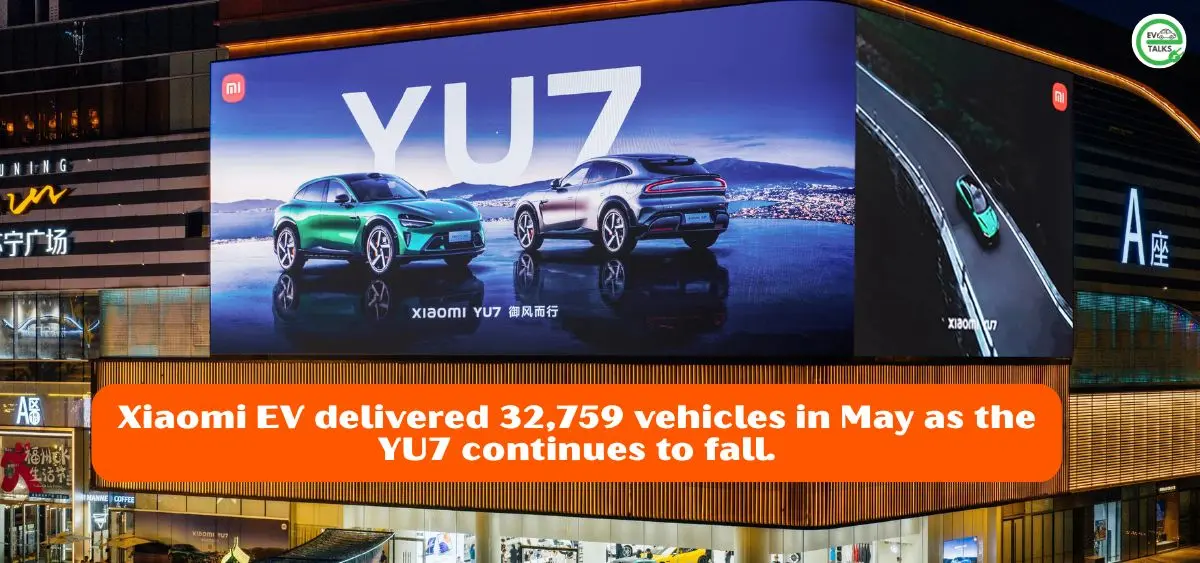

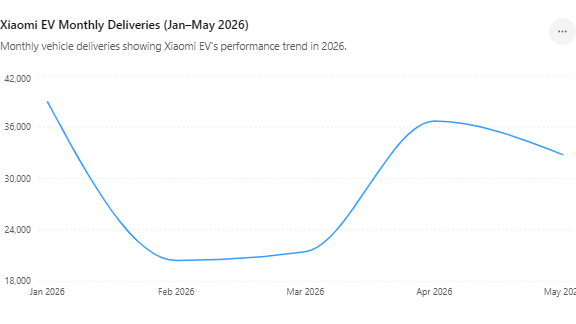
Xiaomi EV delivered 32,759 vehicles in May, demonstrating continued strength in the highly competitive electric vehicle market. According to the latest industry data, Xiaomi’s electric vehicle division delivered 32,759 vehicles during May 2026, representing a 16.94% year-on-year increase. However, deliveries declined by 10.74% compared to April, signaling short-term challenges for the company.
Earlier in June, Xiaomi had announced that its May deliveries exceeded 30,000 units, but the latest figures provide a detailed breakdown of model performance and market trends.
During the first five months of 2026, Xiaomi EV delivered a cumulative 150,317 vehicles, marking a 13.48% increase compared to the same period last year.

Monthly Delivery Trends Show Mixed Performance
The latest figures reveal that Xiaomi EV delivered 32759 vehicles in May despite experiencing pressure across its major product lineup.
The company’s flagship sedan, the Xiaomi SU7, delivered 24,023 units in May. This represented a 14.24% year-on-year decline and a 10.45% decrease from April. Notably, the SU7 has now recorded eight consecutive months of year-on-year delivery declines.
Between January and May 2026, the SU7 delivered 60,082 units, a significant 54.64% drop compared to the same period in 2025. Analysts attribute this decline largely to the model’s ongoing product transition and facelift cycle.
YU7 SUV Faces Fifth Consecutive Monthly Decline
The Xiaomi YU7 SUV, launched in June 2025 as a direct competitor to Tesla’s popular Model Y, delivered 8,736 units in May.
Although the model remains an important growth driver for Xiaomi, deliveries fell 11.54% compared to April, marking the fifth consecutive month of sequential decline. Despite the recent slowdown, the YU7 has accumulated 90,235 deliveries during the first five months of 2026.
The continued decline highlights growing competition within China’s electric SUV segment, where consumers have increasingly diverse choices.
Xiaomi Expands YU7 Lineup to Boost Market Share
To strengthen its position and attract a broader customer base, Xiaomi launched two new YU7 variants on May 21.
The first was a new entry-level YU7 model priced at 233,500 yuan ($34,422). Designed to lower the purchase barrier, this version revives a project that had originally been planned three years ago but was canceled before launch.
The company hopes the affordable variant will help it challenge Tesla’s Model Y more aggressively in the world’s largest EV market.
At the premium end, Xiaomi also introduced the YU7 GT performance SUV with a starting price of 389,900 yuan.
YU7 GT Sets Nürburgring Production SUV Record
The newly launched YU7 GT has quickly attracted attention for its impressive performance credentials.
Powered by a 990-horsepower dual-motor system, the all-electric SUV completed Germany’s Nürburgring Nordschleife circuit in 7 minutes and 22.755 seconds. This achievement established the vehicle as the fastest production SUV in Nürburgring history, enhancing Xiaomi’s growing reputation in the performance EV segment.
Profitability Challenges Continue for Xiaomi’s EV Business
While Xiaomi EV delivered 32759 vehicles in May, the company continues to face profitability challenges.
Xiaomi’s innovative business segment, which includes electric vehicles and artificial intelligence operations, reported an operating loss of 3.1 billion yuan during the first quarter of 2026.
The company attributed the loss primarily to seasonal weakness caused by the Spring Festival holiday and temporary disruptions related to the SU7 model transition. These factors negatively impacted production efficiency and profitability during the period.
Xiaomi Targets 550,000 Vehicle Deliveries in 2026
Looking ahead, Xiaomi remains focused on aggressive expansion.
The company has set an ambitious full-year delivery target of 550,000 vehicles for 2026, representing approximately 34% growth compared to the roughly 410,000 vehicles delivered in 2025.
With new YU7 variants entering the market, improved production capacity, and a broader product portfolio, Xiaomi aims to accelerate sales momentum in the second half of the year.
As Xiaomi EV delivers 32759 vehicles in May, the coming months will be critical in determining whether the company can reverse declining trends in key models and achieve its ambitious annual growth objectives.

Related Articles: