
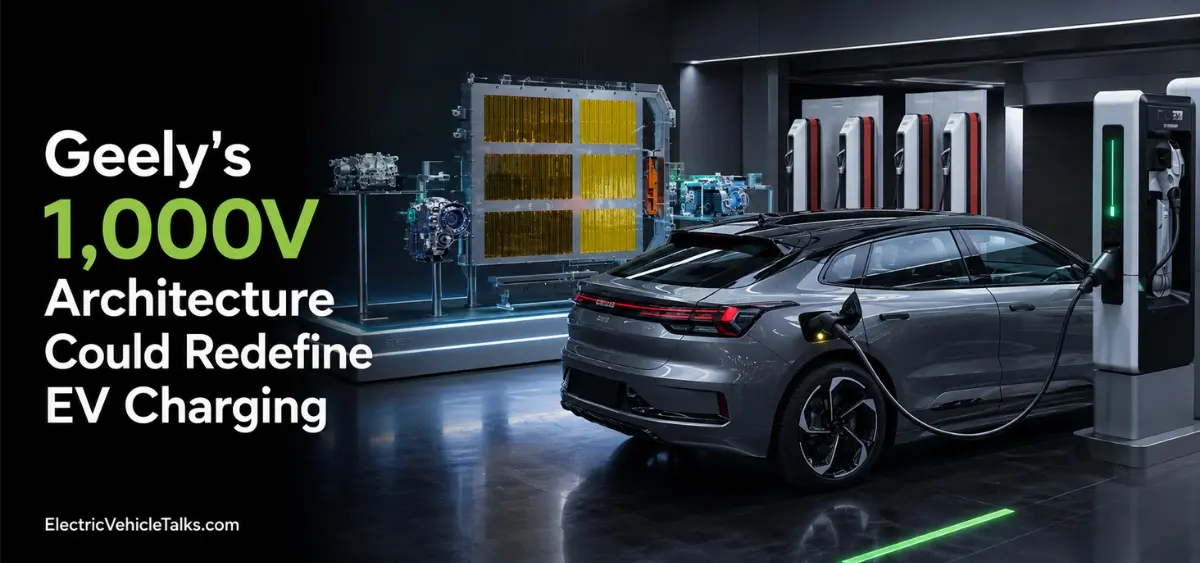

Five-Minute Charging Moves Closer
Geely is developing a dedicated 1,000V electrical architecture designed to support peak charging power of up to 1,500 kW. If delivered in production vehicles, Geely’s 1000V EV Charging could reduce a 10–80% battery recharge to under five minutes, bringing an electric-car stop remarkably close to petrol-refueling convenience.
The project builds on a charging demonstration involving the Lynk & Co 10 executive sedan. Its 95 kWh battery reportedly charged from 10–80% in 5 minutes 32 seconds and reached 97% in 8 minutes 42 seconds. Another run recorded 10–70% in 4 minutes 22 seconds, with peak power exceeding 1,000 kW.
The large sedan measures 5,028 mm long, offers a 3,005 mm wheelbase and reportedly starts near RMB 215,800 for Chinese buyers.

Why 1,000 Volts Matters
Although marketed as using 900V technology, the sedan’s battery has a reported rated voltage of 772.8V, placing it within production-grade 800V territory. Extracting roughly 1,100 kW from that system demonstrates impressive thermal and current management, but it also exposes the limitations of pushing extremely high amperage through existing hardware.
Because power equals voltage multiplied by current, raising the voltage reduces the current needed for a given output. Geely’s 1000V EV charging could, therefore, limit heat, reduce dependence on heavier cables and busbars, and sustain higher charging power longer. Advanced liquid cooling, silicon-carbide controllers, charging algorithms, and Aegis short-blade LFP batteries are central to protecting performance and battery health.
Infrastructure Becomes the Deciding Factor
Geely has reportedly deployed more than 2,100 Zeekr-branded, liquid-cooled single-gun terminals capable of delivering 1,500 kW. During testing, the Lynk & Co 10 drew around 1,100 kW at a Zeekr hub but only about 430 kW at a BYD station. The gap highlights how charger communication, cooling, and station-side energy storage can shape real-world charging curves.
Geely’s 1,000V EV Charging also intensifies China’s megawatt race with BYD, which is targeting 1,500 kW and 1,500 A while planning thousands of high-power stations.
A Global Charging Divide
China is rapidly preparing infrastructure for megawatt-capable EVs, while many European and Australian public chargers remain limited to 350 kW or less. Consequently, overseas drivers may wait longer to experience sub-five-minute charging.
Geely’s 1000V EV Charging could ultimately remove one of the strongest objections to long-distance electric travel. However, its real impact will depend on production readiness, repeatable charging performance, battery durability, and widespread access to compatible megawatt stations.

Related Articles:









