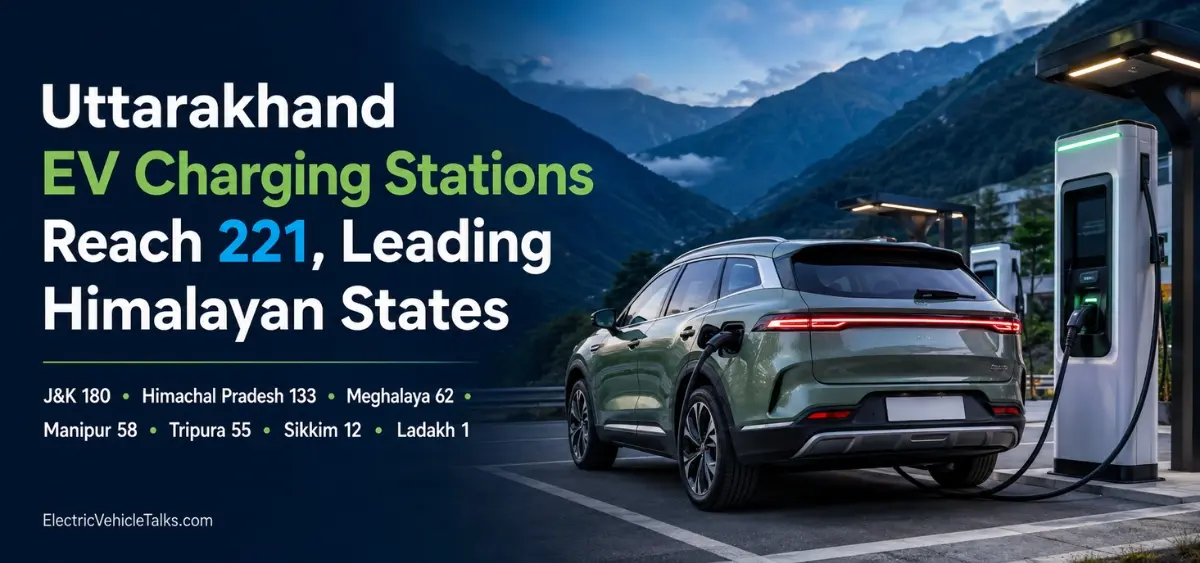

Uttarakhand has become the leading Indian Himalayan state for electric vehicle charging infrastructure, installing 221 stations during the past five years. The Uttarakhand EV Charging Stations network includes 84 fast chargers and 137 standard chargers, strengthening access across cities, highways, tourist destinations, and difficult mountain routes.
Official figures place Jammu and Kashmir second with 180 stations, including 61 fast chargers, followed by Himachal Pradesh with 133 stations and 52 fast chargers. Meghalaya has 62 stations, Manipur 58, Tripura 55, Sikkim 12, and Ladakh one. Fast-charger numbers for these latter regions were not specified.

EV Registrations Cross 1.04 Lakh
Electric vehicle adoption is accelerating alongside infrastructure growth. Uttarakhand now has more than 1.04 lakh registered EVs, with over 58,000 added during the last three years alone. Transport Minister Pradeep Batra said the government is continuously expanding Uttarakhand EV Charging Stations as ownership rises.
The state’s lead is significant because mountainous terrain, scattered settlements, and seasonal traffic make charger deployment more complex. A wider network should reduce range anxiety for residents, fleet operators, tourists, and pilgrims while making intercity electric travel more practical.
Fast Chargers Target Char Dham Routes
Authorities are prioritizing grid capacity and fast-charging facilities along busy tourism corridors and the Char Dham pilgrimage routes. Principal Secretary of Energy R Meenakshi Sundaram highlighted the need to reinforce electricity access in these high-demand areas, particularly during the pilgrimage season.
An additional 61 charging units were installed under the central government’s FAME-II scheme. Fast chargers will reduce waiting times and improve vehicle movement when seasonal demand peaks. This targeted rollout makes Uttarakhand EV Charging Stations increasingly important to the state’s tourism-led transport system.
Electricity Demand Set to Surge
EV charging currently consumes about 15.7 lakh electricity units annually. Demand is projected to reach 23.6 lakh units in 2026-27, 74.4 lakh units in 2027-28, and 234.8 lakh units in 2028-29—nearly 15 times the current level. Departments are working to provide adequate power loads as the charging grid expands.
Public Transport Electrification Next
The government plans to convert state transport corporation buses to electric power in phases and is examining retrofitting older buses. According to Batra, green mobility can cut pollution and fuel dependence while protecting Uttarakhand’s environment. Together, cleaner buses, stronger grids, and a robust statewide charging network could establish the state as a model for mountain mobility.

Related Articles: