


Does filling your electric vehicle’s tyres with nitrogen actually increase its driving range? The short answer is no—not directly. Nitrogen can help tyres retain pressure slightly longer than regular compressed air, but there is no convincing evidence that nitrogen alone delivers a meaningful improvement in EV range when tyre pressures are equal. Nitrogen vs. Normal Air
For electric vehicle owners, maintaining the correct tyre pressure is far more important than choosing between nitrogen and normal air.
However, the debate over Nitrogen vs. Normal Air is worth understanding, particularly as electric cars become more common on Indian roads.
EVs often carry substantial battery packs, deliver immediate torque and depend on efficient energy consumption to achieve their advertised driving range. Tyre condition and pressure can therefore make a noticeable difference to everyday ownership.
Imagine preparing your electric SUV for a 400-kilometer highway journey. At a tyre shop, someone recommends nitrogen filling, claiming it will improve battery range, reduce heat and make your tyres safer.
Should you pay extra for nitrogen, or is regular air sufficient?
Let’s examine the science, real-world benefits, disadvantages, costs and practical considerations for Indian EV owners.
What Is the Difference Between Nitrogen and Normal Air in Tyres?
Both nitrogen and normal compressed air are suitable for inflating most passenger EV tyres.
The main difference is their composition.
What Is Normal Compressed Air?
Normal atmospheric air contains approximately:
- 78% nitrogen
- 21% oxygen
- 1% other gases, primarily argon, with small amounts of carbon dioxide and other gases
Atmospheric air also contains variable amounts of water vapour.
The compressed air supplied by petrol pumps and tyre inflators generally has a similar gas composition, although its moisture content depends on the compressor and drying equipment.
Because ordinary air already contains almost 78% nitrogen, the difference between the two inflation options is smaller than many drivers assume.
What Is Nitrogen Tyre Inflation?
Nitrogen tyre inflation uses nitrogen-enriched gas, generally produced by equipment that separates much of the oxygen and moisture from compressed air.
Automotive nitrogen-filling equipment may deliver approximately 93–95% nitrogen or higher, depending on the system and filling procedure.
However, the final nitrogen concentration inside a tyre can be lower if the original air is not adequately displaced.
Nitrogen is relatively inert under normal tyre operating conditions and is typically supplied in a dry form.
These characteristics explain its potential advantages in pressure retention and moisture reduction.
Nitrogen vs. Normal Air in EVs: Key Differences
| Comparison | Nitrogen | Normal Air |
|---|---|---|
| Gas composition | Nitrogen-enriched, often 93–95% or higher | Approximately 78% nitrogen and 21% oxygen |
| Pressure retention | Slightly better on average | Slightly faster natural pressure loss |
| Temperature response | Changes with temperature | Changes similarly when dry |
| Moisture content | Typically very low | Depends on compressor quality |
| EV range improvement | No proven meaningful direct gain | Same efficiency at equal tyre pressure |
| Tyre wear | Possible indirect benefit through pressure retention | Comparable when maintained correctly |
| Corrosion protection | Lower internal moisture and oxygen exposure | Depends on moisture and materials |
| Filling cost | Usually chargeable | Often free or inexpensive |
| Availability in India | Selected workshops and filling stations | Widely available |
| Emergency top-up | Normal air can be added. | Easy to refill |
| Regular pressure checks | Essential | Essential |
Key takeaway: Nitrogen’s most credible practical advantage is somewhat slower pressure loss. It does not fundamentally change how an electric vehicle’s tyres generate rolling resistance at a given pressure.
Why Is Tyre Pressure More Important for Electric Vehicles?
Electric vehicles have several operating characteristics that make tyre maintenance especially relevant.
1. EVs Can Be Heavier Because of Their Batteries
Many electric cars weigh more than comparable petrol-powered vehicles because of their high-voltage battery packs.
However, this is not a universal rule. Vehicle size, battery capacity, chassis design and engineering all affect weight.
Greater vehicle mass can increase the load carried by the tyres, making correct inflation and suitable tyre load ratings important.
Underinflated tyres flex more during rotation, creating additional heat and energy losses.
2. Instant Torque Can Increase Tyre Wear
Electric motors can deliver strong torque almost immediately.
Aggressive acceleration, particularly in powerful electric cars, can increase tyre wear.
Correct inflation, suitable tyre specifications, and smooth acceleration help owners manage tyre durability.
Nitrogen itself does not protect the tread from wear caused by rapid acceleration.
Electric motors can deliver strong torque almost immediately, which is one of the key differences explained in our EV vs. ICE Driving Experience guide.
3. Rolling Resistance Affects Battery Consumption
Rolling resistance is the energy required to keep a tyre rolling under load.
As a tyre rolls, its rubber and internal structure continuously deform and recover. Some energy is lost as heat during this process.
When tyre pressure falls below the recommended level, additional deformation generally increases rolling resistance.
The vehicle then requires more energy to travel the same distance.
This is particularly relevant to EV owners because additional energy consumption can reduce the distance available from a single battery charge.
Research on tyre efficiency indicates that a 10% reduction in rolling resistance can improve overall vehicle energy efficiency by roughly 1–2%, depending on the vehicle and conditions. That does not mean nitrogen provides this improvement; tyre design and inflation are the important factors.
Maintaining the correct tyre pressure is an essential part of preventive EV maintenance. For a complete vehicle inspection guide, explore our EV Service Checklist, covering tyre health, battery diagnostics, brakes, cooling systems and regular servicing.
Does Nitrogen Increase EV Range?
Nitrogen does not directly increase an electric vehicle’s driving range. Its potential benefit is indirect: it may slow natural pressure loss, helping tyres remain closer to their recommended inflation level between checks.
Consider two identical electric cars:
- Car A uses nitrogen-filled tyres.
- Car B uses normal compressed air.
- Both have identical tyres inflated to the same recommended pressure.
- Both travel under the same driving and weather conditions.
There is no sound reason to expect a significant range advantage simply because Car A uses nitrogen.
The tyre’s construction, inflation pressure, vehicle load and driving conditions are far more important.
What Does Independent Testing Show?
A controlled 12-month evaluation compared nitrogen-filled and air-filled tyres across 31 tyre models.
Both groups were initially inflated to 30 PSI.
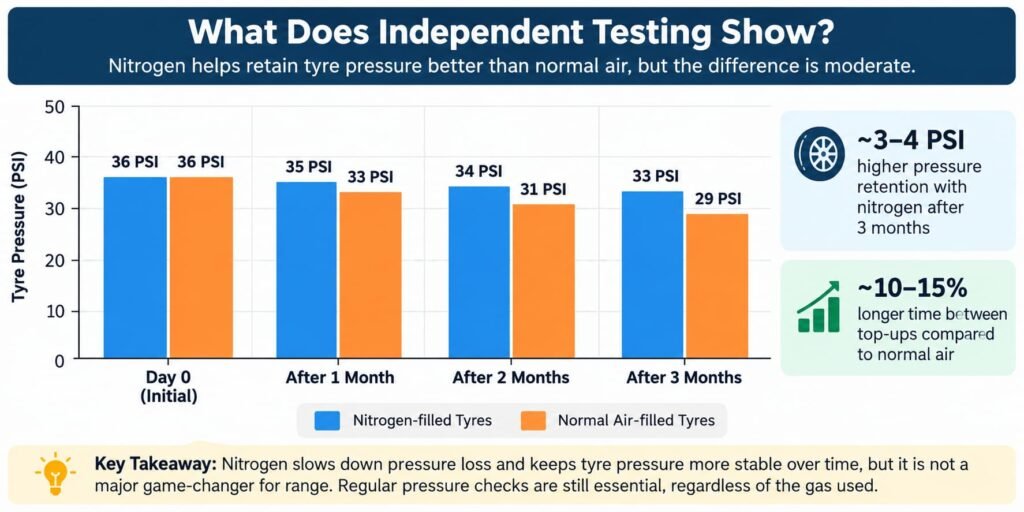
The findings demonstrate that nitrogen can reduce natural pressure loss, but the practical difference is modest.
Importantly, both types of tyres lost pressure.
This means nitrogen is not a replacement for regular tyre pressure checks, and the experiment does not establish a measurable increase in EV driving range.
Example: EV Range and Underinflated Tyres
Suppose an electric car normally achieves 350 km on a full charge.
For illustration, assume that significant underinflation increases its energy consumption by 3%.
Its estimated range would fall to approximately 340 km.
That represents around 10 km less range per charge.
This is a hypothetical calculation, not a measured result or a universal EV efficiency figure. Actual losses depend on tyre type, the amount of underinflation, speed, temperature and vehicle characteristics.
The important point is that the potential loss comes from incorrect tyre pressure—not from using normal air.
Tyre pressure is only one factor affecting everyday efficiency. To understand how charging habits, energy consumption, and battery management influence EV ownership costs, read our EV Charging FAQs.
What Are the Benefits of Nitrogen in EV Car Tyres?
Nitrogen offers several potential advantages, although owners should distinguish scientifically supported benefits from exaggerated marketing claims.
1. Slightly Better Tyre Pressure Retention
Tyres naturally lose some pressure over time through gas permeation.
Nitrogen permeates through tyre materials more slowly than oxygen under comparable conditions.
Nitrogen-enriched inflation can therefore reduce the rate of gradual pressure loss.
For owners who drive regularly, this may help maintain appropriate inflation between maintenance checks.
However, pressure retention varies with tyre construction, condition, valves and wheel seals.
2. Lower Moisture Content
A properly operating nitrogen-filling system supplies relatively dry gas.
Moisture can affect tyre pressure behaviour, particularly when liquid water is present and changes to vapour as temperatures rise.
Reducing moisture helps make pressure behaviour more predictable in certain circumstances.
This is not exclusive to nitrogen. Properly dried compressed air also provides similar moisture-related benefits.
3. Reduced Internal Oxidation and Corrosion Potential
Oxygen and moisture can contribute to oxidation of some tyre materials and corrosion of susceptible metal components over time.
Nitrogen-enriched, dry inflation reduces exposure to these substances inside the tyre.
However, this does not guarantee longer tyre life or prevent all corrosion.
Modern tyre construction already includes materials designed to withstand normal compressed-air inflation.
External exposure, road conditions, tyre age and maintenance are also important.
4. Potentially More Consistent Inflation Between Checks
Because nitrogen can reduce natural pressure loss, tyre pressure may remain closer to the recommended value for longer.
This can indirectly support consistent handling, ride comfort and energy efficiency.
But the advantage depends on how quickly the tyres would otherwise lose pressure.
A properly maintained air-filled tyre can perform just as well.
What Are the Disadvantages of Nitrogen-Filled EV Tyres?
1. Additional Filling Costs
Regular air is often available free of charge at Indian petrol pumps.
Nitrogen usually requires a specialised machine and is commonly chargeable.
The difference may be small per visit but can accumulate over repeated refills.
2. Limited Availability
Nitrogen filling is available at selected tyre shops, dealerships and service centres.
However, it is less widely accessible than compressed air, particularly outside major cities.
This is relevant for drivers travelling through rural areas or less-developed highway corridors.
3. No Guaranteed Driving Range Improvement
Some sellers associate nitrogen filling with better mileage and substantially improved battery range.
Such claims need careful interpretation.
At the same inflation pressure, nitrogen does not provide a proven direct range advantage.
4. Nitrogen Does Not Prevent Punctures
Nitrogen-filled tyres remain vulnerable to punctures, cuts, valve leaks and wheel-seal problems.
The gas inside the tyre does not make the rubber puncture-proof.
5. Regular Maintenance Remains Necessary
Even with nitrogen, EV owners must check inflation pressures periodically.
Treating nitrogen as a maintenance-free solution may actually increase risk if pressure checks are neglected.
Does Nitrogen Keep EV Tyres Cooler in Indian Summers?
A common belief is that nitrogen prevents tyres from heating up during long journeys.
This claim is misleading.
Both dry nitrogen and dry compressed air follow essentially the same physical principles when heated or cooled.
Their pressures rise with temperature and fall as temperatures decrease.
The main difference is that nitrogen inflation normally introduces less moisture.
If compressed air contains appreciable liquid water, its temperature-dependent vapour pressure can introduce additional variation.
However, nitrogen does not prevent the tyre itself from heating up.
Tyre temperatures are influenced by:
- Driving speed and duration
- Inflation pressure
- Vehicle weight and passenger load
- Road surface temperature
- Tyre construction and condition
- Ambient temperature
A tyre inflated below its recommended pressure may generate excessive heat regardless of whether it contains nitrogen or air.
Example: Summer Highway Driving
Imagine travelling in an electric SUV from Delhi towards Jaipur during summer.
The tyres gradually warm as the journey continues, causing inflation pressure to rise.
This happens with nitrogen and normal air.
A higher reading immediately after highway driving does not automatically mean that a tyre was overinflated when cold.
Do not release pressure from warm tyres simply to bring them down to the manufacturer’s cold-pressure specification.
Instead, check and adjust inflation when tyres are cold, unless the vehicle manufacturer provides a specific alternative procedure.
Indian climate verdict: Nitrogen’s dryness can be useful, but there is no convincing basis for claiming that nitrogen alone prevents heat-related tyre failures or delivers a major safety advantage during Indian summers. Continental tyres+2
Nitrogen vs. Normal Air in Tyres According to Indian Climate
India presents different tyre-maintenance challenges across regions and seasons.
| Indian driving condition | Practical consideration | Recommendation |
|---|---|---|
| Hot summers | Tyre pressure rises as temperature increases | Check cold pressure and avoid underinflation |
| Monsoon season | Wet-road grip, tread condition, and tyre damage matter | Inspect tyres and maintain specified pressure |
| Cold northern winters | Cold tyre pressure may decrease with temperature | Check inflation more frequently during temperature changes |
| Long expressway journeys | Sustained speeds and loads increase tyre demands | Verify pressure, load rating and condition before departure |
| Urban stop-and-go traffic | Potholes, impacts and repeated acceleration can affect tyres | Inspect sidewalls and tread regularly |
| Remote highway travel | Nitrogen may be difficult to find | Use normal air whenever required |
For Indian EV owners, reliable access to compressed air, an accurate pressure gauge and regular inspections generally deliver more practical value than focusing on nitrogen purity.
What Is the Best Tyre Pressure for Electric Cars?
There is no universal tyre pressure suitable for every electric car.
The correct pressure depends on the manufacturer’s specifications, tyre size, vehicle load and sometimes driving conditions.
Electric cars with different battery capacities or body types may require different pressures.
Some vehicles also specify different values for front and rear tyres or for normal and fully loaded conditions.
If you’re planning to buy an electric car, our EV Test Drive Checklist explains how to evaluate tyres, ride comfort, handling, and real-world range before making your decision.
Where Can You Find the Correct EV Tyre Pressure?
Check the following:
- The tyre-pressure label on the driver’s door frame or another manufacturer-designated location.
- The vehicle owner’s manual.
- The manufacturer’s official vehicle guidance.
- An authorised service centre if the original tyre or wheel specification has changed.
Remember that the maximum pressure printed on the tyre sidewall is not necessarily the correct recommended operating pressure for your vehicle.
How Often Should You Check EV Tyre Pressure?
For most owners, a sensible routine is to check pressure at least once a month and before long highway journeys.
Checking every two weeks can be particularly useful when temperatures fluctuate, a tyre has shown pressure loss, or the vehicle sees heavy use.
Ideally, measure the pressure before driving, when tyres are cold.
If your EV has a tyre pressure monitoring system (TPMS), use its readings as additional information rather than relying solely on warning alerts.
A TPMS may not alert the driver to every small but meaningful pressure reduction.
How Much Does Nitrogen Filling Cost in India?
Nitrogen filling prices vary by city, tyre shop, filling station and service package.
The following are indicative retail ranges, not standardised or guaranteed prices.
| Service | Typical indicative cost |
|---|---|
| Regular air at many petrol pumps | Free |
| Nitrogen top-up per tyre | ₹10–₹50 |
| Initial nitrogen fill per tyre | ₹30–₹50 |
| Initial nitrogen fill for four tyres | ₹120–₹200 |
| Regular air using an existing portable inflator | No per-fill gas charge |
Some premium service centres may charge more, while others include nitrogen filling in a tyre-related service package.
Example: Annual Nitrogen Filling Expense
Suppose an EV owner spends ₹160 on the initial nitrogen fill and ₹40 on each of six subsequent top-up visits.
The annual cost would be:
- Initial filling: ₹160
- Six top-ups: ₹240
- Total: ₹400
This is only a hypothetical ownership-cost example. Actual frequency and charges vary, and nitrogen may not require six top-up visits.
If regular compressed air is available at no cost, the additional nitrogen expenditure may not produce measurable savings in charging expenses.
Cost verdict: Paying for nitrogen is a personal convenience choice, not an investment with a reliably demonstrated EV range or charging-cost return.
Nitrogen vs. Normal Air: Pros and Cons for EV Owners
| Inflation type | Advantages | Disadvantages |
|---|---|---|
| Nitrogen | Slightly slower pressure loss, typically dry, potentially lower internal oxidation | Added cost, limited availability, no guaranteed range improvement |
| Normal air | Widely available, inexpensive, convenient for emergencies, suitable for EV tyres | Natural pressure loss may be slightly faster; moisture depends on equipment |
For most electric car owners, normal air represents the simplest and most economical choice.
Nitrogen remains an acceptable alternative for drivers who prefer it and have convenient access.
Can You Mix Nitrogen and Normal Air in EV Tyres?
Yes. Nitrogen and normal compressed air can safely be mixed in an EV tyre.
There is no harmful chemical reaction between the two under normal tyre operating conditions.
If a nitrogen-filled tyre loses pressure during a road trip and nitrogen is unavailable, topping up with regular compressed air is an appropriate solution.
Adding air reduces the nitrogen concentration and may diminish some pressure-retention or moisture-related advantages.
However, maintaining a safe inflation pressure is far more important than preserving nitrogen purity.
For example, if your EV has a tyre requiring 36 PSI when cold but its measured pressure has fallen substantially below that level, do not continue driving unnecessarily on an underinflated tyre just because a nitrogen station is unavailable.
Use suitable compressed air, follow the correct pressure procedure and investigate unusual pressure loss.
If the tyre is visibly damaged, severely underinflated or losing pressure rapidly, seek professional assistance rather than simply reinflating it.
Does Nitrogen Reduce EV Tyre Wear or Prevent Blowouts?
Nitrogen is sometimes marketed as a way to extend tyre life dramatically or prevent blowouts.
These claims are stronger than the available everyday passenger-vehicle evidence supports.
Nitrogen’s slower permeation may help reduce underinflation between checks, potentially supporting tyre longevity.
However, tyre wear depends heavily on:
- Driving style and acceleration
- Wheel alignment and suspension condition
- Tyre pressure
- Road conditions
- Vehicle loading
- Tyre design and quality
- Rotation and maintenance practices
Similarly, tyre failures can result from impact damage, deterioration, overheating, severe underinflation and manufacturing or structural problems.
Nitrogen does not eliminate these risks.
Important: Maintaining the correct cold inflation pressure, inspecting tyre condition and respecting tyre load and speed ratings are much more dependable safety practices.
For more practical advice about tyre wear, servicing expenses, battery care, and long-term reliability, explore our EV Maintenance FAQs
Common Mistakes EV Owners Should Avoid
Assuming Nitrogen Never Leaks
Every tyre can lose pressure over time.
Even nitrogen-filled tyres can leak through punctures, damaged valves, poor wheel seals or other defects.
Overinflating Tyres to Increase Range
Increasing tyre pressure beyond the vehicle manufacturer’s recommended setting is not a sensible range-improvement shortcut.
Overinflation may affect ride comfort, handling, impact resistance and tread wear.
Tyre inflation cannot improve charging speed either. If you want to understand the factors that actually influence charging performance, explore our guide to EV Charging Time.
Using Warm-Tyre Readings as Cold-Pressure Targets
Tyre pressures increase during driving.
Owners should not routinely release air from hot tyres to match a cold-pressure specification.
Ignoring Sudden Pressure Loss
If one tyre repeatedly loses more pressure than the others, investigate the cause.
Possible problems include a puncture, valve leak or wheel-seal issue.
Adding nitrogen will not repair a mechanical leak.
Believing Nitrogen Eliminates Maintenance
Nitrogen can reduce gradual pressure loss, but it cannot replace routine inspections, wheel alignment when necessary, tyre rotation or replacement of damaged tyres.
Practical EV Tyre Maintenance Checklist
Your EV tyre care checklist
☐ Check tyre pressure when cold at least monthly
☐ Use manufacturer-recommended front and rear PSI values
☐ Check pressures before every long highway trip
☐ Inspect tread, sidewalls, punctures and uneven wear
☐ Investigate repeated pressure loss or TPMS warnings
☐ Maintain correct tyre load and speed ratings
☐ Check wheel alignment when symptoms or service guidance justify it
☐ Use normal compressed air for emergency top-ups if needed
☐ Avoid unnecessary overinflation to chase additional range
☐ Keep a reliable pressure gauge or portable inflator available
This checklist is useful for electric cars and, with the relevant vehicle-specific specifications, electric scooters and motorcycles as well.
Should You Use Nitrogen in Electric Scooters and Bikes?
The same basic principles apply to electric two-wheelers.
Correct tyre pressure affects rolling resistance, handling, comfort and tyre wear.
However, electric scooters and motorcycles have their own recommended tyre pressures, which may change depending on whether the rider is travelling alone or carrying a passenger.
Do not use electric car tyre-pressure recommendations for a scooter.
Nitrogen can be used where compatible with the manufacturer’s specifications, but it does not provide a proven substantial range increase.
For most Indian electric scooter owners, regular compressed air and frequent pressure checks are practical and economical.
Expert Insight from Electric Vehicle Talks
The Indian EV market is gradually moving beyond discussions limited to battery capacity and advertised driving range.
Real-world efficiency, tyre technology and everyday ownership costs are becoming increasingly important.
At Electric Vehicle Talks, our assessment is that nitrogen inflation should be treated as an optional tyre-maintenance choice rather than an essential EV upgrade.
India’s high ambient temperatures, varied roads and long intercity journeys make correct inflation especially important. However, paying for nitrogen does not remove the need to check pressure, inspect tyres or follow the manufacturer’s recommendations.
For owners seeking better range, maintaining correct tyre pressure, selecting suitable replacement tyres and adopting smoother driving habits offer a more dependable approach.
As EV technology evolves, low-rolling-resistance tyre compounds, improved vehicle aerodynamics and intelligent tyre-monitoring systems are likely to play a more meaningful role in real-world efficiency than the choice between nitrogen and normal air.
People Also Ask: Nitrogen vs. Normal Air
1. Is nitrogen better than normal air for EV tyres?
Nitrogen has a modest advantage in natural pressure retention and is usually drier than ordinary compressed air. However, both are suitable for EV tyres. At identical pressure, tyre construction, condition and driving conditions matter much more than the inflation gas.
2. Does nitrogen improve electric car battery range?
Nitrogen does not directly improve battery range. It may indirectly help maintain efficiency if it reduces gradual tyre-pressure loss. A properly inflated normal-air tyre should deliver comparable performance under otherwise identical conditions.
3. Is nitrogen necessary for electric vehicles in India?
No. Most Indian electric cars and scooters can safely use normal compressed air when the correct tyre pressure is maintained. Nitrogen is optional unless a specific vehicle or tyre manufacturer instructs otherwise.
4. Is nitrogen better for EV tyres during summer?
Dry nitrogen can reduce moisture-related pressure variation, but nitrogen and dry compressed air respond very similarly to temperature changes. Correct inflation, tyre condition and load management are more important during hot-weather driving.
5. Can nitrogen-filled EV tyres be topped up with normal air?
Yes. Normal compressed air can be mixed safely with nitrogen. Mixing reduces nitrogen purity but does not damage the tyre simply because the gases are combined. Maintaining safe pressure is the priority.
6. Does nitrogen increase EV tyre life?
Nitrogen may offer an indirect benefit through slightly improved pressure retention and reduced moisture exposure. However, there is insufficient evidence to promise a specific improvement in tyre lifespan for everyday EV ownership.
7. Why do EV tyres need more attention than conventional car tyres?
Many EVs have substantial vehicle weight and deliver immediate motor torque. These characteristics can place additional demands on tyres. Proper inflation, suitable load ratings and smooth acceleration help maintain performance and longevity.
FAQs about Nitrogen vs. Normal Air
1. How often should nitrogen-filled EV tyres be checked?
Check their pressure at least once a month and before long journeys. Nitrogen may reduce natural pressure loss, but tyres can still lose pressure through permeation, valves, wheel seals or punctures.
2. What is the ideal nitrogen pressure for an electric car?
The ideal pressure is the same manufacturer-recommended cold inflation pressure specified for the vehicle. Nitrogen does not normally require a special PSI setting different from normal air.
3. Can nitrogen prevent tyre punctures in EVs?
No. Nitrogen does not prevent road debris, nails or sharp objects from damaging tyres. Tyre quality, tread condition, road hazards and appropriate maintenance determine puncture-related risks.
4. Does nitrogen reduce EV charging costs?
There is no established direct charging-cost benefit from nitrogen alone. Any indirect benefit would depend on maintaining more appropriate tyre pressure compared with an otherwise underinflated tyre.
5. Is nitrogen worth paying for in India?
For most daily commuters, regular compressed air is sufficient. Nitrogen may appeal to owners who prefer its modest pressure-retention and moisture-reduction advantages, particularly when inexpensive filling is conveniently available.
6. Does nitrogen protect EV alloy wheels from corrosion?
Dry nitrogen reduces internal moisture and oxygen exposure, potentially limiting certain corrosion processes. However, it cannot prevent external corrosion or guarantee protection against damage from environmental conditions.
7. Can normal air damage an EV battery?
No. Using ordinary compressed air in a tyre does not damage an EV’s high-voltage battery. Incorrect tyre pressure may affect energy consumption, but the inflation gas does not directly affect battery chemistry or health.
8. Is nitrogen better for long highway journeys?
Nitrogen’s pressure-retention and dryness advantages may be convenient, but there is no universal requirement to use it for highway travel. Proper tyre inflation, loading and inspection are substantially more important.
Conclusion: Nitrogen vs. Normal Air
The debate between Nitrogen vs. Normal Air has a straightforward conclusion.
Nitrogen offers some genuine technical advantages, particularly slightly slower natural pressure loss and lower moisture content. However, these benefits should not be confused with a guaranteed improvement in electric vehicle range, tyre safety or battery efficiency.
For most EV owners in India, normal compressed air remains a practical, economical and reliable option.
Nitrogen is a reasonable alternative when conveniently available at an acceptable cost, but it is not compulsory—even for frequent highway users.
The biggest improvements in tyre-related EV efficiency come from maintaining the manufacturer’s recommended pressure, selecting appropriate tyres, avoiding overloading and keeping tyres in good condition.
As electric mobility continues to evolve, smarter tyre engineering and improved energy management will contribute more meaningfully to driving efficiency than changing inflation gases.
The most important rule is simple: correct tyre pressure matters more than nitrogen versus normal air.
For more practical electric vehicle ownership advice, range-improvement guides, charging information and EV technology insights, explore Electric Vehicle Talks

Related Articles:









