
Electric Car vs. Petrol Car: Which Is Better to Drive?
Switching from an internal combustion engine car to an electric vehicle is surprisingly easy from a driving perspective. An EV is typically smoother, quieter, and simpler to operate—but charging, highway planning, and range management require new habits. For most Indian city drivers with reliable home or workplace charging, the EV vs. ICE driving experience increasingly favors electric. However, an ICE vehicle can still be more convenient for frequent long-distance travel, remote routes, and households without dependable charging access.
Key Takeaways
- EVs deliver immediate torque, smooth acceleration, and no conventional gear changes.
- Regenerative braking can reduce brake use and make urban driving easier.
- ICE vehicles remain faster to refuel and easier to use on poorly served highways.
- Home charging is one of the biggest factors determining whether EV ownership feels convenient.
- Electric cars normally have lower energy and routine maintenance costs, but purchase price, insurance, tyres, battery warranty, and resale value must also be compared.
- An EV is not automatically the right choice for everyone; daily distance, parking access, and highway use matter more than marketing claims.
- Buyers should take a meaningful test drive that includes traffic, flyovers, rough roads, and regenerative-braking settings.
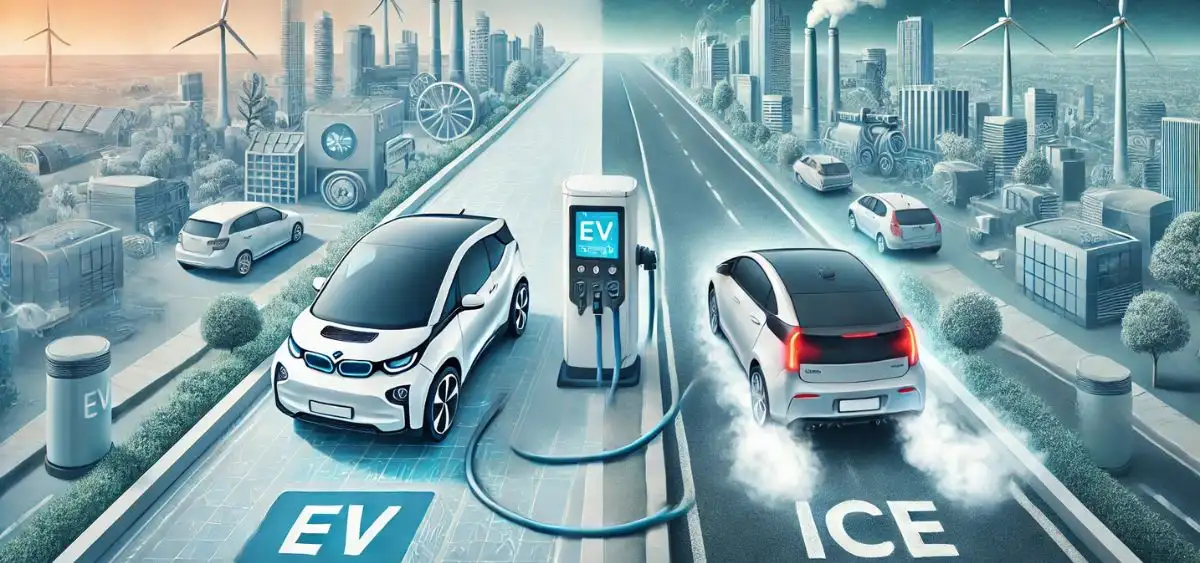
EV vs. ICE Vehicle: What Is the Fundamental Difference?
An ICE vehicle creates power by burning petrol, diesel, or another fuel inside an engine. Combustion moves pistons, and a transmission transfers that power to the wheels.
A battery-electric vehicle stores electricity in a traction battery. An inverter controls the energy supplied to one or more electric motors, which drive the wheels.
This difference affects almost every part of the ownership experience.
| Area | Battery-electric vehicle | ICE vehicle |
|---|---|---|
| Energy source | Electricity stored in a battery | Petrol or diesel |
| Power delivery | Immediate motor response | Depends on engine speed and transmission |
| Transmission | Usually single-speed reduction gear | Manual, AMT, CVT, DCT, or torque converter |
| Cabin behavior | Quiet with minimal powertrain vibration | Engine and transmission noise are present. |
| Braking | Friction brakes plus regeneration | Primarily friction brakes and engine braking |
| Refueling | Home, workplace, or public charging | Fuel station |
| Routine maintenance | Fewer powertrain service items | Oil, filters, belts, and other engine components |
| Tailpipe emissions | None | CO₂ and local air pollutants |
| Long-distance stops | Longer and route-dependent | Usually quick and widely available |
How Does an EV Feel Different to Drive?
Instant response from a standstill
An electric motor can provide strong torque immediately from very low speeds. Press the accelerator and the vehicle responds without waiting for an engine to build revolutions or a gearbox to select the correct ratio.
This makes EVs feel alert in city traffic, even when their official power output appears modest.
The effect should not be described as maximum torque being available at every speed. Motor output eventually becomes limited by power, temperature, voltage, and the motor’s operating range. The most noticeable advantage is the strong and immediate response at low and medium speeds.
Smooth acceleration without conventional gear shifts
Most battery-electric cars use a single-speed reduction gear. There is no clutch pedal and usually no perceptible upshift or downshift.
By comparison, an ICE car may:
- Pause while an automatic gearbox selects a lower gear.
- Feel jerky when an AMT changes ratios.
- Require clutch and gear operation in a manual.
- Raise engine speed noticeably during hard acceleration.
- Hunt between gears on inclines.
Premium ICE automatics can be exceptionally smooth, so the comparison is not absolute. Nevertheless, an electric motor’s direct response gives even many affordable EVs a polished character in urban driving.
Quieter cabin
EVs eliminate combustion noise, exhaust sound, and most engine vibration. Tyres, wind, suspension movement, and road noise become more noticeable because the powertrain is quieter.
The difference is especially valuable in Indian cities, where horns, buses, motorcycles, and road construction already create considerable ambient noise. A calm powertrain can reduce fatigue during congested commutes.
At low speeds, some electric vehicles generate an artificial warning sound to help pedestrians detect the vehicle. Therefore, “quiet” does not always mean completely silent.
Is an EV Easier to Drive in Indian Traffic?
For most drivers, yes. An EV is particularly well suited to stop-and-go traffic.
There is no clutch to operate, no risk of stalling, and no repeated gear selection. Accelerator response is immediate, while regenerative braking can slow the car as soon as the driver lifts off the pedal.
This creates a simple rhythm:
- Press the accelerator to move.
- Ease off to slow down.
- Use the brake pedal when stronger braking or a complete stop is required.
Some EVs offer adjustable regeneration, allowing the driver to choose between gentle coasting and strong deceleration. Others include a one-pedal mode capable of bringing the vehicle close to, or completely to, a stop.
The adjustment period usually lasts from a few drives to a couple of weeks. Passengers may initially experience head movement if the driver releases the accelerator abruptly. Smooth modulation quickly solves this.
Does regenerative braking replace normal brakes?
No. Regeneration assists deceleration and recovers some kinetic energy, but friction brakes remain essential.
Regenerative braking may be limited when:
- The battery is fully charged.
- The battery is very cold or hot.
- The vehicle is travelling slowly.
- Emergency braking is required.
- The road has low grip.
- The battery or power electronics restrict charge acceptance.
Drivers must remain prepared to use the brake pedal normally. The vehicle’s braking behavior should be tested before assuming that every EV provides the same one-pedal experience.
EV vs. ICE on Hills and Flyovers
Electric motors are particularly effective on flyovers, ramps, and steep urban roads because useful torque is available immediately. An EV can climb without waiting for a downshift, building engine speed, or coordinating a clutch.
On the descent, regenerative braking can provide controlled deceleration while returning a portion of the vehicle’s energy to the battery. This feels calmer than an ICE vehicle that may increase engine revolutions while using a lower gear for engine braking.
However, an EV’s hill performance still depends on:
- Motor power and torque.
- Vehicle weight and passenger load.
- Battery state of charge.
- Battery and motor temperature.
- Software calibration.
- Gradient and road surface.
A low-powered EV carrying several passengers will not necessarily climb faster than a powerful ICE vehicle. The electric advantage is primarily smoothness and immediate control, not unlimited performance.
EV vs. ICE Handling and Ride Quality
Many electric cars place the battery pack beneath the cabin floor. This can create a low centre of gravity, reducing body roll and improving stability.
The battery also adds considerable weight. That weight may make the vehicle feel planted at highway speeds, but it can influence ride quality, tyre wear and braking distance.
On broken Indian roads, speed breakers, and steep parking ramps, buyers should examine:
- Ground clearance when fully loaded.
- Battery-pack protection.
- Suspension comfort over sharp potholes.
- Approach and departure angles.
- Tyre size and replacement cost.
- Underbody warranty conditions.
Not every EV handles better than every ICE car. Platform design matters. A purpose-built electric platform may package its battery and cabin more effectively than an ICE-derived model converted to electric propulsion.
What Is the EV vs. ICE Driving Experience on Highways?
EVs offer quiet cruising, quick overtaking response, and smooth speed control. Their weakness is not necessarily highway performance—it is the time and planning associated with replenishing energy.
| Highway factor | EV | ICE |
|---|---|---|
| Cruising refinement | Very quiet and smooth | Depends on engine and gearbox |
| Overtaking | Immediate response in most situations | May require a downshift |
| Energy consumption | Rises substantially at high speeds | Also worsens, but often less visibly |
| Air-conditioning impact | Reduces available range | Increases fuel use |
| Stop duration | Often 20–60 minutes or more | Usually a few minutes |
| Route flexibility | Depends on charger coverage and reliability | Fuel stations are widely available. |
| Detours | Can consume a meaningful share of range | Usually easier to manage |
An EV’s certified range should never be treated as guaranteed highway range. Speed, elevation, temperature, wind, rain, payload, and climate control all affect consumption.
A practical strategy is to plan charging stops before the battery becomes critically low. For unfamiliar routes, maintain a larger reserve and identify at least one backup charger.
Charging an EV: The Biggest Lifestyle Change
Driving an EV is easy; charging determines whether living with it is easy.
Home charging
Home charging offers the best ownership experience. The vehicle can be plugged in overnight and begin the next day with sufficient energy for regular travel.
Most owners do not need to charge from empty to full every night. They simply replace the electricity used during the day.
Before buying, confirm:
- Whether you have a dedicated parking space.
- Whether the housing society permits installation.
- Available sanctioned electrical load.
- Earthing and wiring condition.
- Charger installation cost.
- Separate metering or billing rules.
- Protection against water, heat, and physical damage.
Never use an unsuitable extension cable or improvised socket for sustained vehicle charging. Installation should follow the manufacturer’s requirements and applicable electrical-safety standards.
Public charging
Public charging is improving, but the user experience remains less consistent than fuel retail. Chargers may be occupied, offline, blocked by parked vehicles, or incompatible with a particular connector.
India’s Ministry of Power issued its Guidelines for Installation and Operation of Electric Vehicle Charging Infrastructure, 2024, to support connected and interoperable charging as well as battery-swapping infrastructure across urban and rural areas. The framework is important, but actual convenience still varies by city, operator, and route.
The PM E-DRIVE programme also includes ₹2,000 crore for public charging infrastructure. Following an August 2026 amendment, the broader scheme outlay is ₹11,900 crore, with support covering several vehicle categories and charging infrastructure. Buyers should remember that a national allocation does not guarantee that a working charger will immediately be available on every route. Official PM E-DRIVE portal
Fast charging is not always equally fast.
A charger’s advertised rating is only one part of the equation. Actual speed depends on:
- The car’s maximum DC charging input.
- Battery temperature.
- Battery state of charge.
- Charger output and power sharing.
- Battery-management software.
- Ambient conditions.
Charging commonly slows as the battery approaches a high state of charge. On road trips, charging to roughly 80% and continuing to the next stop may be quicker than waiting for 100%, provided the route and reserve allow it.
EV vs. ICE Driving Experience Cost in India
Energy cost is one of the strongest arguments for electric driving, particularly when charging at home. The following calculation is illustrative, not a universal tariff or fuel-price claim.
Illustrative cost per kilometer
| Vehicle | Assumption | Estimated energy cost |
|---|---|---|
| Efficient electric car, home charging | 0.15 kWh/km × ₹8/kWh | ₹1.20/km |
| Same EV, public charging | 0.15 kWh/km × ₹18/kWh | ₹2.70/km |
| Petrol car | ₹105/liter ÷ 15 km/liter | ₹7.00/km |
| Diesel car | ₹95/liter ÷ 18 km/liter | ₹5.28/km |
Actual electricity tariffs, charging fees, and fuel prices vary by state, city, time of use, and operator. Real-world efficiency also changes with traffic, speed and weather.
Simple EV vs ICE cost calculator
Use these formulas:
EV energy cost per kilometer
Electricity price per kWh × vehicle consumption in kWh/km
If a vehicle consumes 15 kWh per 100 km:
15 ÷ 100 × electricity tariff
ICE fuel cost per kilometer
Fuel price per litre ÷ real-world mileage in km/litre
For a broader total-cost comparison, add:
- Purchase price and on-road taxes.
- Loan interest or lease cost.
- Insurance.
- Scheduled maintenance.
- Tyres and wheel alignment.
- Home-charger installation.
- Public-charging expenses.
- Expected resale value.
- Battery or extended-warranty coverage.
A high-mileage urban user with home charging can recover an EV’s higher purchase price much faster than a low-mileage buyer relying mainly on expensive public charging.
Maintenance: Is an EV Always Cheaper?
An EV motor and reduction gear contain fewer service-intensive parts than an internal combustion powertrain. There is no engine oil, spark plug, conventional clutch, or exhaust system.
Routine EV ownership can therefore avoid several common ICE expenses. However, “low maintenance” does not mean “maintenance-free.”
EV owners must still budget for:
- Tyres.
- Suspension components.
- Brakes and brake fluid.
- Air-conditioning service.
- Cabin filters.
- Cooling-system checks where applicable.
- 12-volt battery replacement.
- Software and diagnostic inspections.
- Charging-port or electrical repairs.
EVs can be relatively heavy and deliver strong torque, which may accelerate tyre wear if the vehicle is driven aggressively. Regeneration can extend friction-brake life, but brake components should still be inspected because limited use can contribute to corrosion or uneven operation.
Battery Warranty, Degradation, and Resale
Modern traction batteries are engineered for years of use, but their usable capacity gradually declines. Degradation depends on battery chemistry, temperature, charging behaviour, mileage, and battery-management quality.
Before purchasing, read the warranty rather than relying on a salesperson’s summary. Check:
- Warranty duration and kilometre limit.
- Minimum retained-capacity guarantee.
- Exclusions for physical or water damage.
- Fast-charging restrictions, if any.
- Transferability to the next owner.
- Repair policy for modules versus complete-pack replacement.
- Roadside assistance and towing terms.
For resale, documented service history and a credible battery-health report can be more valuable than an unverified dashboard range figure. India’s used-EV market will increasingly need standardized battery diagnostics and transparent state-of-health certificates.
EV vs. ICE Environmental Impact
Battery-electric vehicles produce no tailpipe emissions. This directly reduces roadside nitrogen oxides, carbon monoxide, and exhaust particulates—an important benefit in densely populated cities.
They are not zero-impact vehicles. Battery production, electricity generation, tyre wear and vehicle manufacturing all create emissions.
India’s electricity mix still includes substantial fossil-fuel generation. Nevertheless, grid emissions can decline as renewable generation grows. The Central Electricity Authority reported that the weighted-average emission factor of Indian grid electricity fell from 0.774 tonnes of CO₂ per MWh in FY2013–14 to 0.710 tonnes in FY2024–25, alongside increased renewable generation.
The fairest comparison is therefore life-cycle emissions, not merely “tailpipe versus battery.” Vehicle size, lifetime mileage, battery capacity, manufacturing energy, and charging source can materially alter the result.
Charging with rooftop solar or cleaner grid electricity can further improve an EV’s operational footprint. Responsible battery recovery and recycling will also be critical as early vehicle batteries reach end of life.
EV vs. ICE Driving Experience: Pros and Cons
| Powertrain | Advantages | Limitations |
|---|---|---|
| EV | Smooth acceleration, low-speed response, quiet cabin, regeneration, lower home-charging cost, fewer powertrain service items, no tailpipe emissions | Charging time, route planning, charger reliability, higher upfront price in some segments, battery and resale concerns |
| ICE | Fast refueling, extensive fuel network, predictable long-distance travel, wide model choice, familiar resale market | Fuel cost, engine vibration, emissions, more service items, delayed response, or gear changes |
| Strong hybrid | Lower city fuel use, no external charging, familiar touring convenience | Still uses fuel, greater mechanical complexity, limited electric-only capability |
| Series-hybrid system | Electric-motor driving feel with onboard fuel generation | Not a zero-emission vehicle, it still requires petrol and engine maintenance. |
Systems such as Nissan e-POWER demonstrate an important distinction: a vehicle can be driven solely by an electric motor while using a petrol engine as an onboard generator. It may deliver an EV-like response, but it is not a battery-electric vehicle and cannot provide the same zero-tailpipe-emission operation.
Which Is Better for Indian Roads: EV or ICE?
Choose an EV if:
- Most journeys are predictable urban or suburban trips.
- You have dependable home or workplace charging.
- Daily running is high enough to benefit from lower energy costs.
- You value quietness, smoothness, and easy traffic driving.
- Your regular highway routes have reliable, compatible chargers.
- The model offers suitable ground clearance and service support.
Consider an ICE car or strong hybrid if:
- You frequently drive through remote regions.
- You cannot install a charger at home or work.
- Your schedule does not tolerate charging delays.
- You routinely travel beyond the vehicle’s comfortable real-world range.
- Your nearest EV service centre is impractically distant.
- Your annual mileage is too low to justify a large purchase-price premium.
For a two-car household, one EV for everyday commuting and one long-distance-capable vehicle can be an effective transition. For a single-car household, the decision should be based on the most demanding regular journey—not only the average commute.
Practical Tips Before Switching to an EV
Take a proper test drive.
A short loop around a dealership may not reveal the real difference. Drive the vehicle through:
- Slow traffic.
- An open road.
- A steep ramp or flyover.
- Rough surfaces and speed breakers.
- Tight parking spaces.
- Different regenerative-braking modes.
Also sit in the rear seat while another person drives. Strong regeneration and abrupt acceleration can feel different to passengers.
Verify real-world range.
Do not plan ownership around the certified figure alone. Ask owners with similar routes, study independent tests, and calculate a reserve for air-conditioning, high speeds, elevation, and battery aging.
Audit your charging routine.
Map where the car will charge most often. Check connector compatibility, operator apps, payment methods, parking restrictions, and backup stations.
Compare service access.
EVs require fewer routine powertrain services, but specialized repairs may require trained technicians and high-voltage equipment. Confirm whether the nearest workshop can diagnose and repair the specific model.
Review insurance carefully.
Battery packs are valuable components. Understand depreciation, add-on cover, consequential-damage exclusions, charger coverage and roadside-assistance limits.
Expert Insight from Electric Vehicle Talks
The biggest advantage of an electric car is not headline acceleration—it is the consistency of its response.
In an ICE vehicle, the driver experiences a sequence of mechanical events: accelerator input, engine-speed change, clutch or torque-converter behavior, gear selection, and finally wheel torque. A well-engineered automatic disguises much of this complexity, but the process remains.
An EV shortens that chain. The result is precise low-speed movement, a clean overtaking response and effortless progress through traffic. Many drivers do not fully appreciate this advantage during their first test drive. It often becomes obvious only after they have used an EV for months and then return to a conventional car.
Yet the buying decision should not be emotional alone. The correct question is not simply, “Is an EV better to drive?” It is, “Does an EV fit where I park, how far I travel, and how reliably I can charge?”
India’s charging policy and investment environment are improving, but infrastructure quality remains uneven. Buyers who solve home charging first generally enjoy the easiest transition. Those who depend completely on public chargers must evaluate their local network more critically.
People Also Ask
1. Is an EV easier to drive than a petrol car?
Usually, yes. An EV has no clutch, does not stall, and normally has no perceptible gear changes. Immediate accelerator response and regenerative braking can make city traffic less tiring.
2. Is EV acceleration better than ICE acceleration?
EVs generally respond faster at low speeds because electric motors produce strong torque immediately. At higher speeds, performance depends on motor power, battery output, and vehicle design.
3. Can an EV be used for long-distance travel in India?
Yes, if the vehicle offers a suitable real-world range and the route has reliable, compatible chargers. Long journeys require more planning and longer stops than petrol or diesel travel.
4. What happens when an EV runs out of charge?
The vehicle provides progressively stronger warnings and may reduce power before stopping. It will normally require mobile charging where available or towing to a suitable charger.
5. Is one-pedal driving safe?
Yes, when used correctly, but it does not eliminate the brake pedal. Drivers must use conventional braking for emergencies, rapid stops and conditions where regeneration is limited.
6. Does an EV lose range in traffic?
EVs can be efficient in slow traffic because the motor does not idle like an engine and regeneration recovers some energy. Air-conditioning, extreme heat, and long stationary periods still consume battery power.
7. Are EVs suitable for rural India?
They can be, particularly for predictable local routes with access to reliable electricity. Limited fast charging, voltage quality, service support, and longer emergency journeys should be evaluated before purchase.
EV vs. ICE Driving Experience: FAQs
What is the main difference between an ICE car and an EV?
An ICE car burns fuel in an engine and uses a transmission to drive the wheels. An EV stores electricity in a battery and uses an electric motor, producing smoother and quieter propulsion.
How long does it take to adjust to regenerative braking?
Many drivers become comfortable within a few days. Starting with a low or medium regeneration setting can make the transition easier before using stronger one-pedal modes.
Is public charging more expensive than home charging?
It usually is. Public operators must recover equipment, electricity-demand, property, maintenance, and network costs. The exact difference varies by tariff, charger speed, and operator.
Do EV batteries need to be replaced frequently?
No. Traction batteries are designed for long-term use and include manufacturer warranties. Capacity gradually declines, but replacement timing depends on chemistry, temperature, usage, and warranty thresholds.
Are electric cars completely pollution-free?
They have no tailpipe emissions, but manufacturing, electricity generation, and tire wear still have environmental impacts. Their overall benefit should be measured through a life-cycle comparison.
Which is cheaper over five years: an EV or an ICE car?
It depends on purchase price, annual kilometres, electricity source, fuel prices, financing, insurance, and resale value. High-mileage drivers with home charging usually have the strongest EV cost case.
Final Verdict: Is Switching to Electric Really Easy?
From behind the steering wheel, switching is easier than many motorists expect. An EV is smooth, responsive, quiet, and remarkably relaxed in traffic. Regenerative braking and the absence of conventional gear changes can make everyday driving feel simpler within a short adjustment period.
The larger change happens away from the driver’s seat. Instead of visiting a fuel station only when the tank is low, EV owners benefit from charging whenever the car is parked. When home charging is available, this routine can be more convenient than refueling. Without it, charging can become the central ownership challenge.
For urban commuters, families with predictable travel, and high-mileage users, the EV vs. ICE driving experience in India increasingly makes a compelling case for electric. Frequent highway travelers and motorists in charging-scarce regions should evaluate infrastructure, range, and service access before switching.
Explore more EV news, ownership advice, buying guides, charging resources and technology explainers at Electric Vehicle Talks.

Related Articles: