
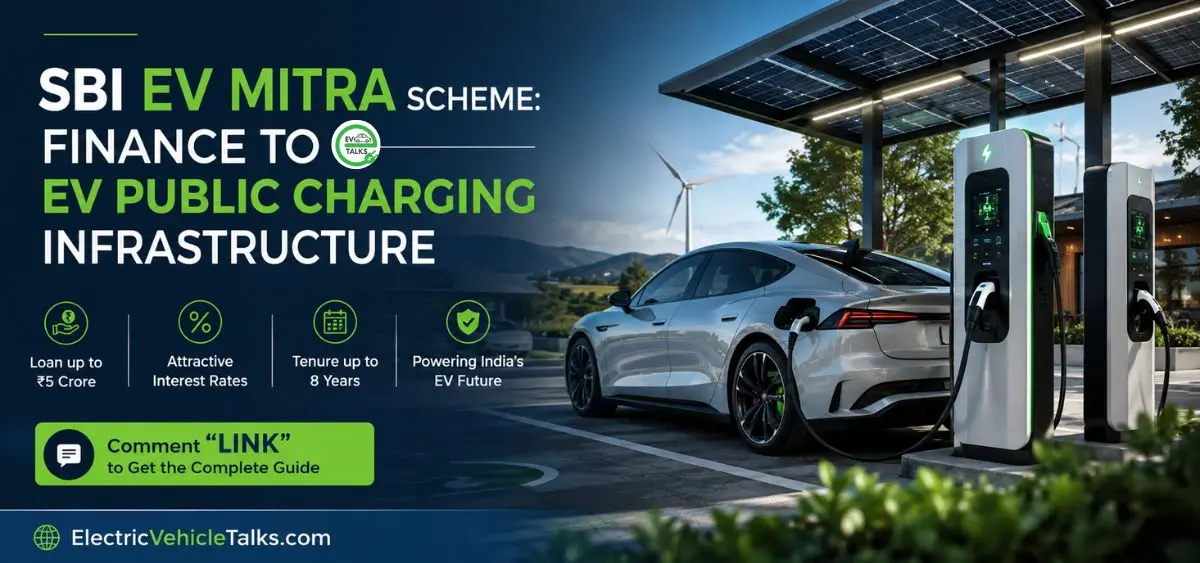

India’s electric vehicle (EV) revolution is accelerating rapidly, but the country’s charging infrastructure must grow just as fast to support millions of upcoming electric cars, scooters, buses, and commercial vehicles. Recognizing this need, the State Bank of India (SBI) introduced the SBI EV Mitra Scheme, a dedicated financing solution that helps businesses establish public and private EV charging stations.
Unlike a conventional business loan, the SBI EV Mitra Scheme is tailored specifically for EV charging infrastructure. It provides attractive financing, flexible repayment terms, and support for entrepreneurs, fuel station owners, MSMEs, fleet operators, hotels, commercial property owners, and franchise partners looking to participate in India’s fast-growing EV ecosystem.
With India’s EV market expected to expand significantly over the next decade, investing in charging infrastructure is increasingly viewed as a long-term business opportunity. This guide explains everything you need to know about the SBI EV Mitra scheme: Finance for EV Public Charging Infrastructure, including eligibility, interest rates, loan amounts, repayment structure, application process, and practical financial examples.
What is the SBI EV Mitra Scheme?
The SBI EV Mitra Scheme is a specialized term loan offered by the State Bank of India to finance the establishment of the following:
- Public Charging Stations (PCS)
- Captive Charging Stations (CCS)
- Battery Swapping Stations
- EV charging infrastructure under franchise or standalone models
The scheme officially gained momentum during FY2024–25 and expanded further through strategic partnerships with major charging infrastructure companies such as Tata Power EZ Charge, ChargeZone, and other charging point operators.
Its objective is simple:
Increase the availability of reliable EV charging infrastructure across India while helping businesses create a sustainable revenue stream.
Actionable Takeaways
- The SBI EV Mitra Scheme finances EV charging projects from above ₹10 lakh up to ₹5 crore.
- Repayment tenure extends up to 8 years, including a moratorium of up to 9 months.
- The scheme is available to MSMEs, fuel station owners, fleet operators, hotels, commercial property owners, and other eligible business entities.
- While there is no direct government cash subsidy under the scheme, eligible borrowers may benefit from competitive interest rates, partner interest concessions, and financing support.
- A well-prepared project report, a suitable location, and strong financial planning significantly improve approval prospects.
- Businesses should evaluate long-term operating costs, charger utilization, and future expansion opportunities before investing.
Why is the SBI EV Mitra Scheme Important?
India has ambitious electric mobility goals, but charging infrastructure remains one of the biggest challenges.
According to industry estimates:
| Market Indicator | Current Trend |
|---|---|
| EV sales | Growing at over 25% annually in several vehicle segments |
| Public charging demand | Increasing every year |
| Government focus | Strong emphasis on nationwide charging network expansion |
| Private investment | Rapidly increasing |
As EV adoption grows, charging stations are expected to become an essential part of fuel retail, hospitality, commercial real estate, logistics, and highway infrastructure.
Key Features of the SBI EV Mitra Scheme
| Feature | Details |
|---|---|
| Loan Type | Term Loan |
| Minimum Loan | Above ₹10 lakh |
| Maximum Loan | ₹5 crore |
| Repayment Tenure | Up to 8 years |
| Moratorium | Up to 9 months |
| Margin Contribution | Minimum 25% |
| Processing Fee | As per SBI guidelines |
| Target Applicants | MSMEs, Non-MSMEs, Fuel Stations, Hotels, Fleet Operators, Commercial Properties |
One notable feature is that project costs may also include customer amenities such as cafeterias, restrooms, or waiting lounges, provided these additional facilities do not exceed 25% of the total project cost or ₹1 crore, whichever is lower.
Know that how to get an MSME Certificate?
What is the Purpose of the SBI EV Mitra Scheme?
The scheme is designed to finance businesses planning to establish EV charging infrastructure under the following:
- Franchise model
- Independent charging network
- Commercial charging hubs
- Captive charging facilities
The objective is not only to improve charging accessibility but also to encourage entrepreneurship in the clean energy sector.
SBI EV Mitra Scheme Benefits
The scheme offers several practical advantages beyond access to capital.
- Attractive Financing: Businesses can secure funding without arranging the entire project cost upfront.
- Long Repayment Period: Repayment extends up to 8 years, reducing monthly financial pressure.
- Moratorium Support: Construction and commissioning of charging stations require time. SBI allows a moratorium of up to 9 months, enabling businesses to begin repayments after operations commence.
- Supports India’s EV Transition: The scheme contributes to India’s expanding charging ecosystem, helping reduce range anxiety and supporting EV adoption.
- Business Expansion Opportunity: Existing businesses—including hotels, fuel stations, shopping malls, and office complexes—can diversify their revenue by offering EV charging services.
Who Can Apply for the SBI EV Mitra Scheme?
The scheme caters to both existing businesses and new entrepreneurs.
Eligible applicants include:
| Applicant Category | Eligible |
|---|---|
| Existing MSMEs | ✅ |
| New MSMEs | ✅ |
| Non-MSME Enterprises | ✅ |
| Fuel Station Owners | ✅ |
| Petrol Pump Dealers | ✅ |
| Fleet Operators | ✅ |
| Commercial Property Owners | ✅ |
| Hotels & Restaurants | ✅ |
| Shopping Malls | ✅ |
| Office Complexes | ✅ |
| Franchise Partners | ✅ |
| Sole Proprietorships | ✅ (if operating as a registered business) |
Individuals can also apply, but generally through a registered business entity such as a sole proprietorship.
SBI EV Mitra Scheme Loan Amount
The financing range is designed to support projects of different sizes.
| Loan Category | Amount |
|---|---|
| Minimum | Above ₹10 lakh |
| Maximum | ₹5 crore |
This makes the scheme suitable for:
- Small charging stations
- Highway charging plazas
- Fleet charging depots
- Battery swapping facilities
- Multi-gun fast charging hubs
SBI EV Mitra Scheme Interest Rate
One of the most common questions is about the SBI EV Mitra scheme interest rate.
Unlike fixed-rate loans, the interest rate is linked to the borrower’s credit profile and the bank’s prevailing benchmark.
Indicative Interest Structure
| Benchmark | Approximate Rate |
|---|---|
| EBLR Linked | 8.65% p.a. |
| MCLR Linked | 9.35% p.a. |
The actual rate depends on:
- Internal credit rating
- CIBIL score
- Business financials
- Project feasibility
- Risk assessment
Some franchise partnerships may also offer an effective interest concession of up to 2%, reducing borrowing costs.
Does the SBI EV Mitra Scheme Provide a Subsidy?
A common misconception is that the SBI EV Mitra Scheme itself provides a government subsidy.
The answer is No.
Instead, the scheme offers:
- Competitive business loan interest rates
- Financing from ₹10 lakh to ₹5 crore
- Potential interest concessions through partner programs
- Possibility of collateral support under eligible CGTMSE-backed lending, subject to bank norms
Borrowers should also check whether their state government offers separate incentives or subsidies for EV charging infrastructure, as these vary across India.
How Does the Scheme Help Create Sustainable Income?
An EV charging station is not just an infrastructure project—it can become a recurring revenue business.
Revenue Sources
- Charging fees
- Fleet charging contracts
- Subscription plans
- Retail sales
- Food and beverage services
- Advertising
- Digital displays
- Convenience stores
- Parking income
Many highway charging hubs are evolving into integrated mobility centres, combining fast charging with cafés, restrooms, and retail outlets to improve customer experience and increase revenue opportunities.
How to Apply for the SBI EV Mitra Scheme Online
To apply for the SBI EV Mitra scheme online, go to the official SBI EV Mitra Loan Page and click the “Apply Now” button. The scheme offers term loans between ₹10 lakhs and ₹5 crores with repayment tenures of up to 8 years.
The application process is straightforward.
Step 1 – Check Eligibility
Ensure your proposed location complies with electricity distribution norms, land-use regulations, and local approvals.
Step 2 – Prepare Your Project Report
Include:
- Project cost
- Expected charging demand
- Equipment specifications
- Revenue projections
- Cash flow analysis
Step 3 – Submit the Loan Application
Provide:
- KYC documents
- Business registration
- Financial statements
- Land ownership or lease documents
- Vendor quotations
Step 4 – Credit Evaluation
SBI assesses:
- Creditworthiness
- Business viability
- Repayment capability
- Technical feasibility
Step 5 – Loan Sanction and Installation
Once approved, funds are released according to project milestones, enabling installation and commissioning of the charging station.
Documents Required
Typical documentation includes the following:
- Aadhaar Card
- PAN Card
- GST Registration
- Partnership Deed / MOA / AOA
- Income Tax Returns
- Audited Financial Statements
- Bank Statements
- Land Ownership Documents or Registered Lease Agreement
- Project Report
- Equipment Quotations
- Electricity Load Approval (where applicable)
Practical Example: ₹50 Lakh EV Charging Station Project
A real-world example helps illustrate how the scheme works.
Suppose your total project cost is ₹50 lakh.
Under the SBI EV Mitra Scheme, the bank typically finances up to 75% of the project cost, while the borrower contributes the remaining 25% as margin money.
| Component | Amount |
|---|---|
| Total Project Cost | ₹5,000,000 |
| Borrower Margin (25%) | ₹1,250,000 |
| SBI Term Loan (75%) | ₹3,750,000 |
Assuming an indicative interest rate of 9.50% per annum and a repayment tenure of 7 years (84 months):
| Financial Metric | Estimated Value |
|---|---|
| Monthly EMI | ₹61,424 |
| Total Interest Payable | ₹14.09 lakh |
| Total Repayment | ₹51.59 lakh |
These figures are illustrative and may vary depending on the final interest rate, loan tenure, and disbursement schedule.
If the Estimated Project Cost is ₹50 Lakh, What Will Be the interest rate, and Who Can Apply?
One of the most searched questions about the SBI EV Mitra scheme: Finance for EV Public Charging Infrastructure is how financing works for a ₹50 lakh charging station project.
While SBI does not publish a single fixed interest rate for every borrower, the final lending rate is generally based on:
- SBI’s prevailing External Benchmark Lending Rate (EBLR) or MCLR
- Internal credit assessment
- CIBIL/CIC score
- Business financials
- Project feasibility
- Whether the applicant is part of an approved franchise or charging network
Indicative Interest Rate Structure
| Loan Type | Approximate Interest Rate* | Remarks |
|---|---|---|
| EBLR-linked | 8.65% p.a. | Floating rate linked to SBI benchmark |
| MCLR-linked | 9.35% p.a. | Depends on prevailing MCLR |
| Strong credit profile | 8.5%–9.0% | Subject to SBI assessment |
| Average credit profile | 9.0%–10.5% | Depends on risk rating |
| Approved franchise partner | The effective rate may be lower due to partner interest concessions | Available under select tie-ups |
Note: These are indicative figures. The final interest rate is determined by SBI after evaluating the borrower’s profile and prevailing lending benchmarks.
Financial Structure for a ₹50 Lakh Project
The promoter is expected to contribute part of the project cost, while SBI finances the balance through a term loan.
| Particular | Minimum Margin (15%) | Standard Margin (25%) |
|---|---|---|
| Project Cost | ₹5,000,000 | ₹5,000,000 |
| Your Contribution | ₹750,000 | ₹1,250,000 |
| SBI Loan | ₹4,250,000 | ₹3,750,000 |
The actual margin requirement depends on SBI’s credit appraisal and the risk profile of the project.
Which Applicants are Eligible for a ₹50 Lakh EV Charging Project?
The scheme is designed primarily for business entities rather than individual consumer loans.
| Applicant Category | Eligible | Typical Use Case |
|---|---|---|
| MSMEs | ✅ | Public charging stations |
| Non-MSME businesses | ✅ | Commercial charging hubs |
| Fuel station owners | ✅ | Fast chargers at petrol pumps |
| Fleet operators | ✅ | Captive charging depots |
| Hotels & restaurants | ✅ | Destination charging |
| Shopping malls | ✅ | Customer charging facilities |
| Commercial office complexes | ✅ | Employee and visitor charging |
| Franchise partners | ✅ | Partner charging networks |
| Sole proprietorships | ✅ | Registered business applicants |
| Individual consumers | Limited | Usually through a registered business |
The base pricing formula for loans between ₹10 lakh and ₹50 lakh is the Benchmark Rate + 0.75%.
1. Standard Interest Rate Structure
The SBI EV Mitra Scheme offers competitive, benchmark-linked interest rates for financing EV charging infrastructure. Instead of a fixed interest rate, loan pricing is determined based on the borrower’s credit profile, project viability, and SBI’s prevailing lending benchmarks. For loans between ₹10 lakh and ₹50 lakh, the indicative pricing is generally based on the benchmark rate plus an applicable spread, subject to SBI’s internal lending policy.
Indicative Interest Rate Structure
| Interest Type | Benchmark | Indicative Rate* |
|---|---|---|
| EBLR-Linked (Floating) | SBI External Benchmark Lending Rate (EBLR) + applicable spread | Approx. 8.65% p.a. |
| MCLR-Linked | SBI 6-Month MCLR + applicable spread | Approx. 9.35% p.a. |
Note: The final interest rate may vary depending on the applicant’s CIBIL score, internal credit assessment, business financials, and prevailing SBI benchmark rates at the time of loan sanction.
2. Discounted Interest Rates Through Franchise Partnerships
Applicants who establish EV charging stations under approved Charging Point Operator (CPO) partnerships may be eligible for preferential financing benefits. SBI has entered strategic partnerships with leading charging infrastructure providers such as Tata Power EZ Charge, ChargeZone, and Zeon Charging, where eligible franchise partners may receive interest concessions under specific agreements.
| Partnership Benefit | Details |
|---|---|
| Eligible Applicants | Approved franchise partners of SBI-associated CPOs |
| Interest Concession | Up to 2% on standard lending rates (subject to applicable partnership terms) |
| Effective Interest Rate | May start from approximately 6.70% to 7.35% p.a., depending on the partner program and borrower profile |
Important: These concessions are available only under eligible partnership programs and are subject to SBI’s prevailing policies and the terms of the respective charging network.
3. Financial Summary for a ₹50 Lakh EV Charging Station Project
For a project with an estimated cost of ₹50 lakh, SBI typically finances 75% to 85% of the project cost, depending on the required promoter margin and loan appraisal.
| Component | 15% Margin | 25% Margin |
|---|---|---|
| Total Project Cost | ₹5,000,000 | ₹5,000,000 |
| Your Contribution | ₹750,000 | ₹1,250,000 |
| SBI Term Loan | ₹4,250,000 | ₹3,750,000 |
| Indicative Interest Rate | 8.65%–9.35% p.a.* | 8.65%–9.35% p.a.* |
| Repayment Tenure | Up to 8 years (including moratorium) | Up to 8 years (including moratorium) |
Interest rates shown are indicative and subject to SBI’s prevailing benchmark rates, internal credit evaluation, and loan approval conditions.
Understanding the Moratorium Period
Constructing an EV charging station takes time. Civil work, electrical approvals, transformer installation, utility permissions, charger commissioning, and testing may require several months.
To reduce the financial burden during this phase, SBI allows a moratorium period of up to nine months.
During the moratorium:
- Principal repayment is deferred.
- Interest continues to accrue on the disbursed loan amount.
- Full EMI repayment begins after commercial operations start.
This feature helps preserve working capital while the charging station is under development.
Comparing Two Moratorium Options
For a ₹37.5 lakh loan with a six-month construction period, borrowers generally have two approaches.
Option 1: Capitalize the Interest
No payment is made during construction. The accrued interest is added to the principal.
| Item | Amount |
|---|---|
| Original Loan | ₹3,750,000 |
| Interest Accrued (6 months) | ₹178,125 |
| Revised Principal | ₹3,928,125 |
| Estimated EMI | ₹64,201 |
| Total Repayment | ₹53.93 lakh |
Suitable For
- New entrepreneurs
- Businesses preserving cash flow
- Projects with delayed commissioning
Option 2: Pay Interest During Construction
The borrower pays only the monthly interest during the moratorium.
| Item | Amount |
|---|---|
| Monthly Interest Payment | ₹29,688 |
| Duration | 6 Months |
| EMI After Moratorium | ₹61,290 |
| Estimated Total Repayment | ₹53.26 lakh |
Suitable For
- Businesses with healthy cash reserves
- Established fuel stations
- Hotels and commercial property owners
- Fleet operators with ongoing revenue
Which Option is Better?
If conserving cash during construction is your priority, capitalizing the interest may be appropriate.
However, if you can comfortably service the monthly interest during the construction phase, doing so can reduce the overall borrowing cost and keep future EMIs lower.
Owning vs Leasing Commercial Land
The ownership status of your project site plays an important role during loan evaluation.
Option 1: You Own the Land
Advantages include:
- Stronger collateral position
- Higher confidence for lenders
- Simpler documentation
- Better financing flexibility
Typical documents include:
- Registered sale deed
- Property tax receipts
- Non-encumbrance certificate
- Utility approvals
Option 2: The Land is Leased
Leased land is also acceptable, provided the lease is sufficiently long-term.
Typical requirements include:
- Registered lease agreement
- Lease validity of 7–10 years
- Landowner’s No Objection Certificate (NOC)
- Site approval documents
Depending on the project, SBI may seek additional security where required under its lending norms.
Common Mistakes to Avoid
Many first-time charging station investors underestimate the planning required.
Avoid these common pitfalls:
- Choosing a location without studying EV traffic.
- Ignoring electricity load availability.
- Underestimating civil and transformer costs.
- Selecting chargers incompatible with future demand.
- Preparing an unrealistic revenue projection.
- Ignoring annual maintenance expenses.
- Not planning for customer amenities such as restrooms or waiting areas.
- Applying without a detailed feasibility report.
Ownership Tips for EV Charging Station Investors
Successful charging businesses focus on more than installing chargers.
Consider the following:
- Install chargers compatible with multiple vehicle brands.
- Ensure reliable uptime through preventive maintenance.
- Integrate digital payment systems.
- Offer amenities like cafés, Wi-Fi, and clean restrooms to improve customer dwell time.
- Use charging management software to monitor utilization.
- Explore partnerships with fleet operators for recurring revenue.
- Plan for future expansion as EV adoption increases.
Cost Factors That Influence Profitability
The profitability of a charging station depends on several variables.
| Cost Component | Impact |
|---|---|
| Fast charger capacity | High |
| Grid connection charges | High |
| Transformer installation | Moderate to High |
| Civil construction | Moderate |
| Software platform | Moderate |
| Annual maintenance | Moderate |
| Electricity tariff | High |
| Land lease | Variable |
Understanding these costs before applying for finance can improve project viability.
Market Trends Supporting EV Charging Investments
India’s EV ecosystem continues to evolve rapidly.
Key trends include:
- Increasing electric passenger vehicle adoption.
- Rapid growth in electric commercial fleets.
- Expansion of highway charging corridors.
- Rising investments from public and private charging operators.
- Strong policy support for clean mobility.
- Growing demand for destination charging at hotels, offices, and retail spaces.
These trends are creating long-term opportunities for businesses entering the charging infrastructure sector.
Expert Insight from Electric Vehicle Talks
At Electric Vehicle Talks, we believe charging infrastructure will become one of the most important pillars of India’s clean mobility transition.
Unlike fuel stations that primarily serve internal combustion vehicles, modern charging hubs are evolving into integrated mobility destinations. Successful operators are increasingly combining ultra-fast charging with food outlets, retail services, rest areas, and digital payment ecosystems.
For investors considering the SBI EV Mitra Scheme, financing should be viewed as only one part of the business equation. Location selection, charger utilization, electricity reliability, software management, customer experience, and long-term scalability are equally important factors.
A carefully planned charging station in a high-demand location can generate recurring revenue while contributing to India’s expanding EV ecosystem.
Future Outlook
India aims to significantly expand its public charging infrastructure over the coming years to support rising EV adoption across passenger cars, two-wheelers, commercial vehicles, buses, and logistics fleets.
Financial products such as the SBI EV Mitra Scheme are expected to play an increasingly important role by making capital more accessible to businesses investing in charging infrastructure.
As battery technology improves, charging speeds increase, and EV ownership grows, well-located charging stations are likely to become valuable long-term infrastructure assets.
Conclusion
The SBI EV Mitra Scheme: Finance to EV Public Charging Infrastructure is a timely initiative that supports India’s rapidly expanding electric mobility ecosystem by making EV charging infrastructure more accessible to businesses and entrepreneurs.
With loan amounts ranging from above ₹10 lakh to ₹5 crore, flexible repayment of up to 8 years, and a moratorium period of up to 9 months, the scheme offers a practical financing solution for setting up public charging stations, captive charging facilities, and battery swapping infrastructure. Although it does not provide a direct government subsidy, its competitive interest rates, potential interest concessions through strategic partnerships, and support for eligible MSMEs and commercial enterprises make it an attractive investment opportunity.
As EV adoption continues to accelerate, charging infrastructure is expected to become a high-demand, long-term business segment. Before applying, carefully assess your location, project feasibility, electricity availability, and financial projections. For more expert EV news, buying guides, charging insights, and industry updates, visit Electric Vehicle Talks.

Related Articles:









