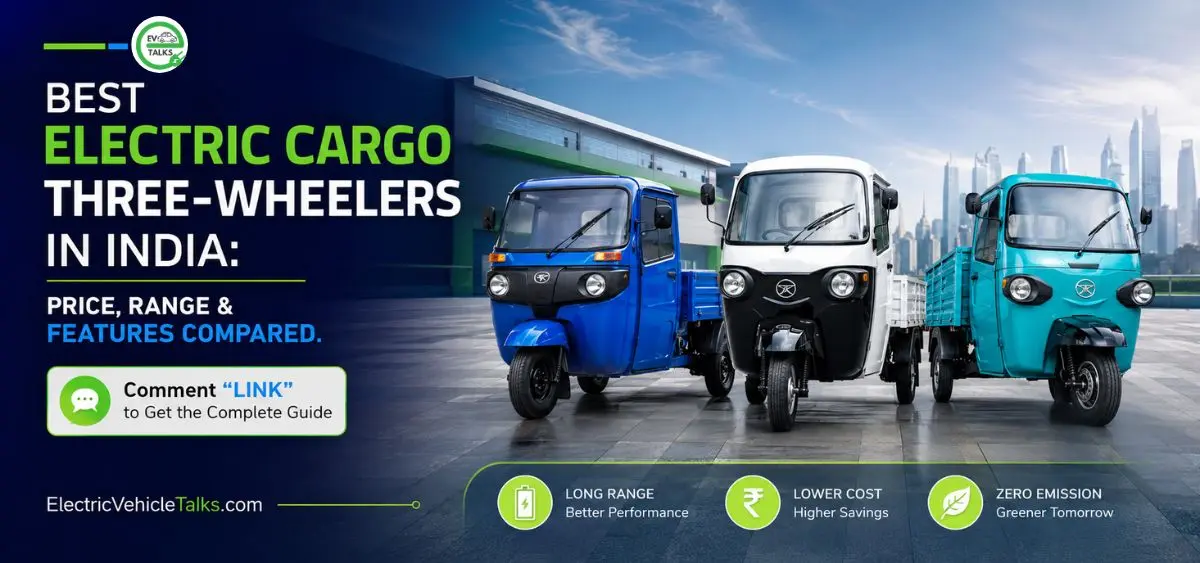

India’s logistics industry is undergoing one of the biggest transformations in decades, and electric cargo three-wheelers are leading that change. From e-commerce deliveries and FMCG distribution to vegetable markets and courier services, businesses are rapidly replacing diesel and CNG cargo vehicles with electric alternatives that offer significantly lower running costs and reduced maintenance. The best electric cargo three-wheelers in India combine high payload capacity, long driving range, low operating expenses, and dependable after-sales support.
Whether you’re an entrepreneur, fleet operator, retailer, or logistics company, choosing the right electric cargo vehicle can substantially reduce transportation costs while supporting India’s transition to sustainable mobility.
In this comprehensive guide, Electric Vehicle Talks explores the leading electric cargo three-wheelers available in India, comparing their specifications, prices, payload capacities, battery technologies, and ideal use cases to help you make an informed buying decision.
Why Are Electric Cargo Three-Wheelers Becoming So Popular?
Electric cargo vehicles are no longer limited to small businesses. Today, major logistics providers, grocery delivery platforms, e-commerce companies, and municipal services are deploying electric three-wheelers across urban and semi-urban India.
The key reasons include the following:
- Running costs as low as ₹0.30–₹0.80 per km, depending on electricity tariffs.
- Lower maintenance due to fewer moving parts than diesel vehicles.
- Zero tailpipe emissions help businesses meet sustainability goals.
- Smooth, quiet operation ideal for congested city roads.
- Government incentives encouraging EV adoption.
- Increasing availability of lithium-ion batteries with longer life and faster charging.
For businesses operating hundreds of kilometres every week, the savings can translate into lakhs of rupees over the vehicle’s lifetime.
What Are the Different Types of Electric Cargo Three-Wheelers in India?
Understanding vehicle categories is essential before purchasing an electric cargo vehicle.
India classifies electric cargo three-wheelers primarily into L3 and L5N categories under the Central Motor Vehicles Rules (CMVR).
a) L3 Category (E-Carts)
L3 vehicles are lightweight electric loaders designed for short-distance transportation.
Typical Characteristics
| Specification | Details |
|---|---|
| Top Speed | Up to 25 km/h |
| Motor Power | Under 2 kW |
| Payload | Up to 310 kg |
| Best For | Local vendors, neighbourhood deliveries, municipal work |
| Price | ₹1.2–2 lakh |
Ideal applications include:
- Vegetable vendors
- Milk delivery
- Local grocery shops
- Small retailers
- Campus logistics
b) L5N Category (Heavy Electric Cargo Three-Wheelers)
L5N vehicles are purpose-built commercial cargo carriers capable of handling significantly heavier loads and longer daily operating distances.
| Specification | Details |
|---|---|
| Top Speed | 45–60 km/h |
| Motor | High-power electric drivetrain |
| Payload | 400–700+ kg |
| Battery | Lithium-ion |
| Best For | Logistics, e-commerce, industrial transport |
These are the vehicles most businesses consider when searching for the best electric 3-wheeler cargo in India.
Comparison Table: Best Electric Cargo Three-Wheelers in India
| Model | Payload | Certified Range | Approx Price |
|---|---|---|---|
| Mahindra Treo Zor | 550 kg | 80–125 km | ₹3.1–3.8 lakh |
| Mahindra Zor Grand | 400 kg | 100–140 km | ₹4.1–4.5 lakh |
| Piaggio Ape E-Xtra FX | 506 kg | 90–110 km | ₹3.1–4.2 lakh |
| Euler HiLoad EV | 688–768 kg | Up to 151 km | ₹3.5–4.3 lakh |
| Altigreen neEV HD | High-volume cargo | Up to 150 km | ₹4.3 lakh+ |
| Omega Seiki Rage+ | 550 kg | Up to 151 km | ₹3.4–3.7 lakh |
| Montra Super Cargo | 500+ kg | 200+ km* | ₹4.3–4.6 lakh |
| Kinetic Safar Jumbo | 500 kg | Up to 120 km | ₹2.5–3.2 lakh |
| YC Electric Loader | 400 kg | 75–90 km | ₹1.35 lakh |
| Saarthi Electric Cargo | 320–500 kg | 80–100 km | ₹1.25–1.55 lakh |
| Keto Motors BULKe | 420–500 kg | 100–130 km | ₹3.5 lakh |
*Claimed range varies by configuration and operating conditions.
Top Electric Cargo Three-Wheelers in India
1. Mahindra Treo Zor
The Mahindra Treo Zor has established itself as one of India’s most trusted electric cargo vehicles. Backed by Mahindra’s extensive dealership and service network, it offers a compelling combination of reliability, affordability, and practical performance.
Its 8 kW motor delivers instant torque, making it particularly effective in stop-and-go urban traffic. The 550 kg payload allows businesses to transport groceries, courier shipments, dairy products, pharmaceuticals, and e-commerce packages efficiently.
Key Specifications
| Feature | Specification |
|---|---|
| Price | ₹3.12–3.80 lakh |
| Payload | 550 kg |
| Battery | Lithium-ion |
| Charging Time | Around 4 hours |
| Real-world Range | 80–125 km |
Best For
- Amazon and Flipkart deliveries
- Grocery distribution
- Retail supply chains
- Courier companies
Pros
- Strong service network
- Excellent reliability
- Low maintenance
- Comfortable cabin
Considerations
- Moderate range compared to newer premium competitors.
2. Mahindra Zor Grand
The Zor Grand represents Mahindra’s next-generation cargo platform, offering higher performance and enhanced practicality.
Its larger battery, improved torque, and longer range make it suitable for businesses operating multiple delivery routes every day.
The five-year battery warranty also adds confidence for fleet operators looking to minimize ownership risks.
Highlights
- 100–140 km driving range
- 400 kg payload
- Lithium-ion battery
- Around 4.5-hour charging
- Multiple cargo body configurations
Fleet operators particularly appreciate its refined suspension and stable handling, even when carrying heavy loads on uneven urban roads.
3. Piaggio Ape E-Xtra FX
Few names carry as much commercial vehicle heritage in India as Piaggio. The Ape E-Xtra FX builds on decades of expertise while embracing electric mobility.
One of its standout features is the spacious six-foot cargo deck, allowing operators to transport larger packages without compromising maneuverability.
Key Features
- 506 kg payload
- Up to 110 km range
- 9.55 kW motor
- Boost mode for improved acceleration
- Fast charging support
Its compact dimensions make it particularly suitable for crowded wholesale markets and dense city environments.
4. Euler HiLoad EV
If payload capacity is your priority, the Euler HiLoad EV deserves serious consideration.
Designed specifically for commercial logistics, it offers one of the highest payload capacities in India’s electric three-wheeler market.
Its liquid-cooled battery technology also improves thermal management during continuous commercial operation, an important advantage in India’s hot climate.
Why It Stands Out
- Up to 768 kg payload
- Certified range up to 151 km
- Liquid-cooled battery
- Fast charging capability
- Reinforced commercial chassis
Businesses transporting beverages, hardware, construction materials, and industrial goods often prefer Euler because of its heavy-duty capability.
5. Altigreen neEV HD
The Altigreen neEV HD focuses on maximizing cargo volume rather than simply increasing payload.
Its large container options make it ideal for logistics companies handling bulky but relatively lightweight goods such as e-commerce parcels and FMCG products.
Key Highlights
- Around 150 km certified range
- 11 kWh battery
- Large cargo container
- High deck configuration
- Smart fleet management features
Fleet operators also benefit from connected telematics that improve route planning and vehicle utilization.
6. Omega Seiki Rage+
The Omega Seiki Rage+ has become increasingly popular among organized logistics providers due to its versatile product lineup.
Beyond the standard cargo version, specialized variants include refrigerated transport, battery swapping, hydraulic tipper applications, and ultra-fast charging models.
This flexibility enables businesses to choose configurations tailored to specific industries.
Notable Variants
- Rage+ RapidEV
- Rage+ Swap
- Rage + Frost
- Rage+ Tipper
Specifications
| Feature | Value |
|---|---|
| Payload | 550 kg |
| Battery | 10.8 kWh |
| Certified Range | Up to 151 km |
| Charging | Fast charging available |
| Price | ₹3.4–3.7 lakh |
For businesses seeking minimal downtime, the RapidEV variant’s ultra-fast charging technology offers a significant operational advantage.
7. Montra Super Cargo
Among the newest entrants in India’s commercial EV space, the Montra Super Cargo has quickly attracted attention for its impressive range, high gross vehicle weight (GVW), and advanced charging technology. Developed by Montra Electric, part of the Murugappa Group, the vehicle is designed for businesses that require long operating hours with minimal downtime.
One of its standout features is the optional Exponent Energy rapid charging technology, which can recharge the battery from 0 to 100% in approximately 15 minutes at compatible charging stations. This is a major advantage for fleet operators running multiple shifts daily.
Key Specifications
| Specification | Details |
|---|---|
| Price | ₹4.37–4.65 lakh (Ex-showroom) |
| Battery | 13.8 kWh Lithium-ion |
| Claimed Range | 200+ km |
| Peak Torque | 70 Nm |
| GVW | 1.2 tonnes |
| Cargo Options | Pickup, 140 cu. ft., 170 cu. ft. |
Ideal Applications
- Large e-commerce fleets
- FMCG distribution
- Courier and parcel delivery
- Industrial logistics
- Cold-chain conversion
Why Buy?
- One of the longest claimed driving ranges in its segment
- Advanced safety features, including Hill Hold Assist and front disc brakes
- Large cargo volume
- Excellent fleet productivity
8. Kinetic Safar Jumbo
Kinetic Green has steadily expanded its commercial EV portfolio, and the Safar Jumbo is aimed at businesses looking for a balance between affordability and carrying capacity.
Its spacious cargo box and 500 kg payload make it well suited for retail supply chains and local logistics businesses.
Key Specifications
| Specification | Details |
|---|---|
| Price | ₹2.5–3.24 lakh |
| Payload | 500 kg |
| Range | Up to 120 km |
| Battery | Lithium-ion |
| Top Speed | 55 km/h |
Best For
- Grocery wholesalers
- Courier services
- Agricultural produce
- Retail distribution
Pros
- Competitive pricing
- Good city range
- Spacious cargo compartment
- Comfortable driving position
9. YC Electric Loader
Businesses with limited budgets often look for economical electric cargo solutions, and the YC Electric Loader addresses this need effectively.
Unlike premium L5 cargo vehicles, it belongs to the lower-speed category, making it ideal for neighborhood transportation rather than high-speed logistics.
Key Specifications
| Specification | Details |
|---|---|
| Price | Around ₹1.35 lakh |
| Motor | 1.4 kW BLDC |
| Payload | Approximately 400 kg |
| Range | 75–90 km |
| Top Speed | 25 km/h |
Suitable For
- Fruit vendors
- Small retailers
- Local delivery businesses
- Rural transportation
- Municipal waste collection
10. Saarthi Electric Cargo
The Saarthi Shaktiman has become a popular choice in Tier-2 and Tier-3 cities due to its attractive purchase price and simple operating costs.
Although its performance is modest compared to premium lithium-ion cargo vehicles, it remains an economical solution for light-duty transportation.
Highlights
- Price between ₹1.25–1.55 lakh
- Payload up to 500 kg
- Range between 80 and 100 km
- Available with lead-acid and lithium-ion batteries
Best For
- Small traders
- Dairy businesses
- Vegetable distribution
- Daily local deliveries
11. Keto Motors BULKe
The Keto Motors BULKe focuses on commercial fleet operators looking for smart connectivity, GPS tracking, and efficient fleet management.
It offers respectable payload capacity while incorporating telematics that improve fleet visibility.
Specifications
| Specification | Details |
|---|---|
| Price | Around ₹3.5 lakh |
| Payload | 420–500 kg |
| Range | 100–130 km |
| Motor | 5 kW |
| Charging | Fast charging supported |
Advantages
- Fleet tracking
- Digital instrument cluster
- Remote diagnostics
- Smart fleet management
Electric 3-Wheeler Cargo Price in India
One of the most common questions buyers ask is
“How much does an electric cargo three-wheeler cost in India?”
The answer depends on battery technology, payload, speed category, and manufacturer.
| Vehicle Category | Approximate Price |
|---|---|
| L3 Electric Loader | ₹1.2–2 lakh |
| Standard L5 Cargo EV | ₹3–4 lakh |
| Premium Fleet Models | ₹4–5 lakh |
While premium vehicles require a higher upfront investment, they usually deliver lower total ownership costs over five to seven years.
Buying Guide: How to Choose the Best Electric Cargo Three-Wheeler in India
Choosing the right vehicle involves more than comparing prices. Consider the following factors before making a purchase.
1. Daily Driving Distance
Estimate your average daily kilometres.
- Under 60 km → Budget L3 models
- 80–120 km → Standard L5 vehicles
- 150+ km → Premium long-range cargo EVs
2. Payload Requirements
Never purchase based only on battery size.
Instead, calculate your average daily cargo weight.
Examples:
- Grocery deliveries
- LPG cylinders
- Construction materials
- FMCG goods
- E-commerce parcels
Each application demands different payload capacities.
3. Charging Availability
Ask yourself:
- Will charging happen overnight?
- Is fast charging available nearby?
- Can your warehouse install charging points?
- Does your fleet operate in multiple shifts?
These questions directly influence battery selection.
4. Service Network
A vehicle with nationwide service support often delivers better long-term value than one with slightly better specifications but limited after-sales infrastructure.
5. Battery Warranty
Look for:
- Minimum 5-year battery warranty
- 100,000 km or more
- IP67 protection
- Liquid cooling for heavy-duty use
Electric Cargo Vehicle Running Cost Analysis
Electric cargo three-wheelers are significantly cheaper to operate than diesel alternatives.
| Expense | Diesel Cargo | Electric Cargo |
|---|---|---|
| Fuel Cost/km | ₹5–7 | ₹0.40–0.80 |
| Engine Oil | Required | Not required |
| Clutch | Frequent replacement | Not applicable |
| Gearbox Maintenance | High | Minimal |
| Noise | High | Very low |
Fleet operators often recover the higher purchase price through lower operating costs within a few years, depending on daily usage.
Charging Cost Analysis
Assuming an electricity tariff of ₹8 per unit:
| Battery Size | Approximate Cost per Full Charge |
|---|---|
| 8 kWh | ₹64 |
| 10 kWh | ₹80 |
| 12 kWh | ₹96 |
| 14 kWh | ₹112 |
For most businesses, a full day’s delivery operations can cost less than the price of a liter of diesel.
Battery Technology Used in Modern Electric Cargo Three-Wheelers
The Indian commercial EV industry has largely transitioned to Lithium-ion batteries, replacing older lead-acid systems.
Advantages of Lithium-ion
- Faster charging
- Longer lifespan
- Higher energy density
- Better reliability
- Lower maintenance
- Improved resale value
Premium manufacturers now also offer:
- Liquid-cooled batteries
- Battery management systems (BMS)
- Regenerative braking
- Connected diagnostics
These technologies improve efficiency and extend battery life, especially under demanding commercial usage.
Government Incentives for Electric Cargo Three-Wheelers
Although the FAME-II scheme has concluded, the Indian government continues to support EV adoption through new initiatives, production-linked incentives (PLI), and state-level subsidy programs.
Many states also offer additional benefits, such as the following:
- Road tax exemptions
- Registration fee waivers
- Capital subsidies for commercial EVs
- Incentives for charging infrastructure
- Reduced electricity tariffs for EV charging
Businesses should check the latest policies in their respective states before making a purchase, as incentives can significantly reduce the total cost of ownership.
Common Mistakes Buyers Should Avoid
Many first-time buyers focus solely on the purchase price, overlooking other critical factors that affect long-term profitability.
Avoid these common mistakes:
- Choosing a vehicle with insufficient payload capacity.
- Ignoring battery warranty and service support.
- Overestimating real-world driving range.
- Not evaluating charging infrastructure.
- Selecting a model without readily available spare parts.
- Failing to calculate the total cost of ownership instead of just the upfront price.
Expert Insight from Electric Vehicle Talks
India’s electric cargo three-wheeler market is evolving rapidly, with manufacturers shifting their focus from merely offering affordable vehicles to delivering complete fleet solutions. Longer-range batteries, connected vehicle technologies, fast-charging capabilities, and specialized cargo body configurations are becoming standard across premium models.
At Electric Vehicle Talks, our analysis suggests that fleet operators should prioritize total cost of ownership (TCO) rather than purchase price alone. Factors such as battery warranty, charging infrastructure, after-sales service, and uptime have a much greater impact on long-term profitability than the initial investment.
For small businesses, a reliable L3 electric loader may be sufficient for local deliveries. However, organizations managing high daily utilization, e-commerce logistics, or industrial distribution should consider premium L5N electric cargo three-wheelers that offer higher payloads, better range, and advanced fleet management capabilities.
List of Electric Three-Wheeler Manufacturers in India
India is home to a rapidly growing ecosystem of electric three-wheeler manufacturers catering to various commercial applications, from light-duty e-carts to heavy-duty cargo carriers. Established automotive companies and innovative EV startups are driving competition through better battery technology, higher payload capacities, and improved after-sales support.
| Manufacturer | Popular Cargo Models |
|---|---|
| Mahindra Electric | Treo Zor, Zor Grand |
| Piaggio Vehicles | Ape E-Xtra FX |
| Euler Motors | HiLoad EV |
| Altigreen | neEV HD |
| Montra Electric | Super Cargo |
| Omega Seiki Mobility | Rage+ Series |
| Kinetic Green | Safar Jumbo |
| YC Electric | E-Loader |
| Saarthi EV | Shaktiman Cargo |
| Keto Motors | BULKe |
| Lohia Auto | Narain Cargo |
| Atul Auto | Elite Cargo EV |
| Gayam Motor Works | Cargo variants |
| Mini Metro EV | Cargo Loader |
| Jezza Motors | Commercial e-loaders |
The growing number of manufacturers is creating healthy competition, leading to continuous improvements in technology, safety, and ownership experience.
Which Electric Cargo Three-Wheeler Is Best for Different Businesses?
Not every business requires the same type of electric loading vehicle. The ideal choice depends on daily mileage, payload, operating environment, and budget.
| Business Type | Recommended Model |
|---|---|
| E-commerce deliveries | Montra Super Cargo |
| Courier companies | Mahindra Treo Zor |
| Grocery distribution | Piaggio Ape E-Xtra FX |
| Heavy logistics | Euler HiLoad EV |
| FMCG distribution | Altigreen neEV HD |
| Cold-chain transport | Omega Seiki Rage+ Frost |
| Municipal services | YC Electric Loader |
| Small retailers | Saarthi Electric Cargo |
| Agricultural transport | Kinetic Safar Jumbo |
| Fleet operators | Mahindra Zor Grand |
Sustainability Impact of Electric Cargo Three-Wheelers
The transition to electric cargo vehicles is about more than reducing fuel expenses—it also plays a significant role in creating cleaner, healthier cities.
Compared to conventional diesel three-wheelers, electric cargo vehicles offer several environmental benefits:
- Zero tailpipe emissions help improve urban air quality.
- Reduced greenhouse gas emissions, particularly when charged using renewable energy.
- Lower noise pollution makes them ideal for residential and commercial areas.
- Improved energy efficiency, as electric drivetrains convert more energy into motion than internal combustion engines.
- Reduced dependence on imported fossil fuels supports India’s energy security goals.
As India’s electricity grid incorporates more renewable energy, the environmental advantages of electric commercial vehicles will continue to grow.
Future Outlook for Electric Cargo Three-Wheelers in India
India’s commercial EV market is entering a new phase of rapid innovation. Over the next five years, several trends are expected to shape the future of electric cargo mobility:
a) Longer Driving Ranges
Battery capacities are increasing, enabling real-world ranges of over 200 km, reducing range anxiety for commercial operators.
b) Faster Charging
Ultra-fast charging solutions capable of replenishing batteries in under 30 minutes are becoming more common, significantly reducing downtime.
c) Battery Swapping
Battery-swapping networks are expanding in major cities, allowing commercial fleets to replace depleted batteries within minutes instead of waiting for charging.
d) Connected Fleet Management
Advanced telematics are enabling businesses to monitor:
- Vehicle location
- Battery health
- Driver behavior
- Route efficiency
- Maintenance schedules
This improves operational efficiency and reduces overall fleet costs.
e) Stronger Government Support
India’s continued focus on electrification through manufacturing incentives, charging infrastructure development, and state-level EV policies is expected to accelerate commercial EV adoption across urban and rural markets.
Expert Buying Recommendations
Before purchasing an electric cargo three-wheeler, ask yourself the following questions:
- How many kilometres will the vehicle travel daily?
- What is the average weight of the cargo?
- Is overnight charging available?
- Do you need fast charging or battery swapping?
- How accessible is the manufacturer’s service network?
- What is the battery warranty?
- What is the estimated total cost of ownership over five years?
Answering these questions will help ensure that the vehicle aligns with your operational requirements and delivers long-term value.
People Also Ask
Which is the best electric cargo three-wheeler in India?
The best electric cargo three-wheeler depends on your business needs. For overall performance, the Mahindra Treo Zor, Euler HiLoad EV, Montra Super Cargo, Piaggio Ape E-Xtra FX, and Altigreen neEV HD are among the top choices due to their balance of payload, range, reliability, and after-sales support.
What is the price of an electric cargo three-wheeler in India?
Electric cargo three-wheelers typically cost between ₹1.25 lakh and ₹4.7 lakh (ex-showroom). Entry-level L3 models are more affordable, while premium L5N vehicles with larger batteries and higher payload capacities command higher prices.
How much does it cost to charge an electric cargo three-wheeler?
Charging costs depend on battery size and local electricity tariffs. A full charge generally costs between ₹60 and ₹120, making electric cargo vehicles significantly cheaper to operate than diesel alternatives.
How long does an electric cargo three-wheeler battery last?
Most modern lithium-ion batteries are designed to last 5–8 years or approximately 100,000–150,000 km, depending on usage, charging practices, and maintenance.
Can electric cargo three-wheelers carry heavy loads?
Yes. Premium L5N electric cargo vehicles can carry payloads ranging from 400 kg to over 700 kg, making them suitable for e-commerce, FMCG distribution, industrial logistics, and municipal applications.
Are electric cargo three-wheelers suitable for rural areas?
Yes. While charging infrastructure is still developing in some regions, many rural businesses benefit from depot or home charging. Models with higher ground clearance and robust suspension are particularly well-suited for uneven rural roads.
Is an electric cargo three-wheeler profitable for business?
For businesses with consistent daily usage, electric cargo three-wheelers can significantly reduce fuel and maintenance expenses, resulting in lower operating costs and improved profitability over the vehicle’s lifespan.
FAQs about the best electric cargo three-wheelers in India
1. Which electric cargo three-wheeler offers the longest driving range?
The Montra Super Cargo currently offers one of the highest claimed ranges in its segment, exceeding 200 km on select variants.
2. Which electric cargo vehicle is best for e-commerce deliveries?
The Mahindra Treo Zor, Piaggio Ape E-Xtra FX, Montra Super Cargo, and Euler HiLoad EV are widely used by e-commerce and logistics companies due to their reliability, payload capacity, and operational efficiency.
3. Are lithium-ion batteries better than lead-acid batteries?
Yes. Lithium-ion batteries provide faster charging, longer lifespan, lower maintenance, better energy efficiency, and improved performance compared to traditional lead-acid batteries.
4. What maintenance does an electric cargo three-wheeler require?
Routine maintenance typically includes checking brakes, tires, suspension, electrical systems, and battery health. Since electric vehicles have fewer moving parts than diesel vehicles, maintenance requirements are generally lower.
5. Is financing available for electric cargo three-wheelers?
Yes. Most manufacturers collaborate with banks and NBFCs to offer financing options, making electric cargo vehicles accessible to small businesses and fleet operators.
6. Are electric cargo three-wheelers safe for daily commercial use?
Modern electric cargo three-wheelers are equipped with safety features such as regenerative braking, hill-hold assist, reinforced chassis, seat belts, and advanced battery management systems, making them suitable for demanding commercial operations.
Conclusion
Electric cargo three-wheelers have become an integral part of India’s rapidly evolving commercial mobility landscape. Rising fuel costs, advancements in battery technology, supportive government policies, and increasing demand for sustainable logistics have made these vehicles a practical and financially attractive choice for businesses of all sizes.
Whether you’re a small retailer looking for an affordable neighborhood delivery solution or a fleet operator managing high-volume logistics, today’s market offers a wide range of options tailored to different operational requirements. Models such as the Mahindra Treo Zor, Euler HiLoad EV, Montra Super Cargo, Piaggio Ape E-Xtra FX, and Altigreen neEV HD demonstrate how electric mobility is reshaping last-mile transportation through improved efficiency, lower running costs, and enhanced sustainability.
For more expert buying guides, in-depth EV reviews, charging insights, and the latest electric mobility news, explore Electric Vehicle Talks. Our goal is to help businesses, fleet operators, and EV enthusiasts make informed decisions as India accelerates toward a smarter and more sustainable transportation ecosystem.
Related Article: