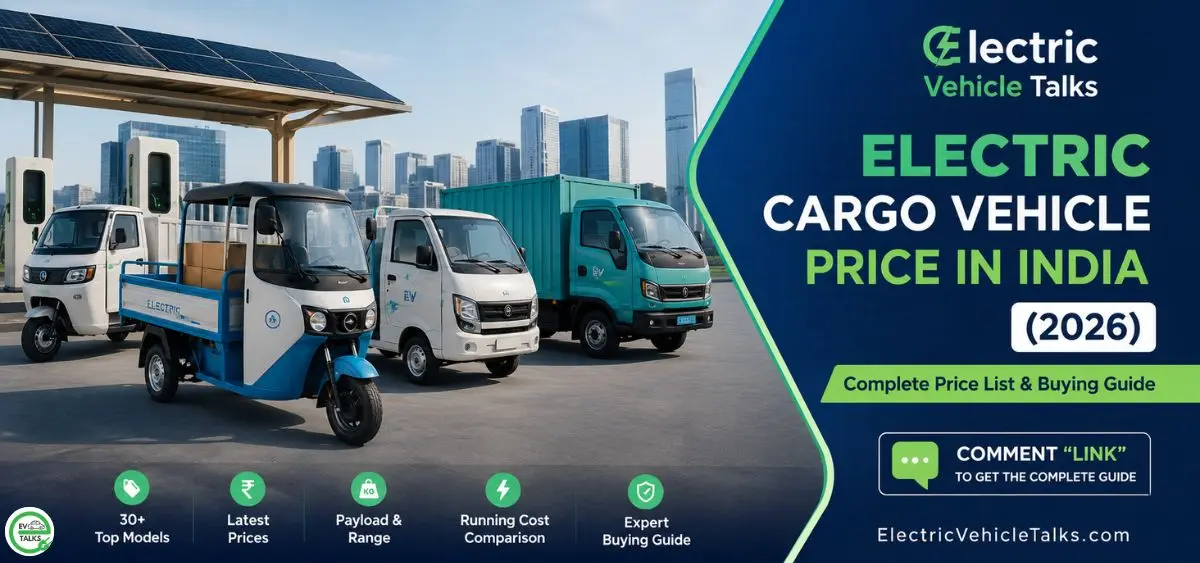

The electric cargo vehicle price in India starts from around ₹1.04 lakh for entry-level electric cargo three-wheelers and goes up to nearly ₹17 lakh for premium electric mini trucks and light commercial vehicles. Prices vary depending on payload capacity, battery size, driving range, charging technology, and intended business applications.
As India’s logistics, e-commerce, and last-mile delivery sectors rapidly electrify, electric cargo vehicles have become a practical investment for businesses looking to reduce fuel costs and comply with stricter emission norms. Whether you’re a small business owner, fleet operator, or entrepreneur, understanding the latest pricing and features can help you choose the right vehicle for your operational needs.
In this comprehensive guide, Electric Vehicle Talks explores the latest electric cargo vehicle prices in India, compares popular models, and explains what buyers should know before investing.
Why Are Electric Cargo Vehicles Becoming So Popular in India?
India’s commercial transportation industry is undergoing one of its biggest transformations in decades. Rising diesel prices, growing urban delivery demand, government support for electric mobility, and lower operating costs have accelerated the adoption of electric cargo vehicles.
Today, electric cargo vehicles are commonly used by the following:
- E-commerce companies
- Courier and logistics services
- Grocery deliveries
- Dairy and milk distribution
- Pharmaceutical transport
- Municipal waste collection
- Construction material transport
- Small businesses
- FMCG distributors
- Local wholesalers
Compared to diesel vehicles, electric cargo vehicles offer the following:
- Lower running costs
- Reduced maintenance
- Zero tailpipe emissions
- Quieter operation
- Better profitability for fleet owners
- Easier city access where emission restrictions apply

Electric Cargo Vehicle Price in India at a Glance
| Vehicle Type | Starting Price | Premium Models |
|---|---|---|
| Electric Cargo Three-Wheelers | ₹1.04 lakh | ₹4.65 lakh |
| Electric Mini Trucks | ₹6.50 lakh | ₹16.99 lakh |
| Medium Electric Commercial Trucks | ₹15.10 lakh | ₹16.99 lakh |
Electric Cargo Three-Wheeler Price in India (2026)
Electric cargo three-wheelers remain the most affordable commercial EVs in India. They are widely used for urban deliveries because they combine low purchase prices with significantly lower operating costs than petrol or diesel alternatives.
Popular Electric Cargo Three-Wheelers
| Model | Approx. Ex-Showroom Price | Payload / GVW |
|---|---|---|
| Atul Elite Cargo | From ₹1.04 Lakh | Payload: 400 kg |
| Komaki CAT 3.0 | From ₹1.06 Lakh | Payload: 500 kg |
| YC Electric E Loader | From ₹1.35 Lakh | GVW: 742 kg |
| Deltic Vayu | ₹1.55–₹1.59 Lakh | GVW: 655 kg |
| Mahindra E-Alfa Cargo | From ₹1.56 Lakh | Payload: 310 kg |
| Kinetic Safar Shakti | From ₹1.56 Lakh | Payload: 380 kg |
| Piaggio Ape E Xtra FX | From ₹3.20 Lakh | Payload: 506 kg |
| OSM Rage Plus | ₹3.40–₹3.70 Lakh | Payload: 500 kg |
| Kinetic Safar Jumbo Ranger | From ₹3.45 Lakh | Payload: 500 kg |
| Mahindra Treo Zor | ₹3.55–₹3.94 Lakh | Payload: 578 kg |
| Bajaj Maxima XL Cargo E-TEC 9.0 | From ₹3.94 Lakh | GVW: 708 kg |
| Mahindra Zor Grand | ₹4.12–₹4.52 Lakh | High-efficiency cargo EV |
| Euler Motors HiLoad EV | From ₹4.32 Lakh | Payload: 768 kg |
| Montra Electric Super Cargo | ₹4.37–₹4.65 Lakh | GVW: 1,200 kg |
| Bajaj Maxima XL Cargo E-TEC 12.0 | From ₹4.45 Lakh | GVW: 900 kg |
Which Electric Cargo Three-Wheeler Offers the Best Value?
Different businesses require different payload capacities. Here’s a quick guide:
1. Budget Segment (₹1–2 Lakh)
Ideal for:
- Small shops
- Vegetable vendors
- Local distributors
- Milk delivery
Recommended models:
- Atul Elite Cargo
- Komaki CAT 3.0
- YC Electric E Loader
- Deltic Vayu
- Mahindra E-Alfa Cargo
- Kinetic Safar Shakti
These vehicles provide an affordable entry point into electric commercial mobility while keeping operating expenses low.
2. Mid-Range Segment (₹3–4 Lakh)
Suitable for:
- Courier businesses
- Food delivery
- FMCG distribution
- Urban logistics
- Daily commercial operations
Popular choices include:
- Piaggio Ape E Xtra FX
- OSM Rage Plus
- Kinetic Safar Jumbo Ranger
- Mahindra Treo Zor
- Bajaj Maxima XL Cargo E-TEC 9.0
These models generally offer higher payload capacities, improved range, and enhanced driver comfort, making them ideal for businesses with regular city routes.
3. Premium Segment (Above ₹4 Lakh)
Designed for:
- Fleet operators
- E-commerce companies
- Heavy urban logistics
- High-volume delivery businesses
Leading options:
- Mahindra Zor Grand
- Euler Motors HiLoad EV
- Montra Electric Super Cargo
- Bajaj Maxima XL Cargo E-TEC 12.0
These vehicles deliver stronger performance, higher payload capacities, and greater productivity for demanding commercial applications.
What Factors Affect Electric Cargo Vehicle Prices?
Several factors influence the electric cargo vehicle price in India, including:
- Battery capacity and chemistry
- Payload capacity
- Driving range
- Motor power
- Fast-charging capability
- Build quality and chassis strength
- Safety features
- Brand reputation
- Warranty coverage
- Connected vehicle technology
- Fleet management software integration
While entry-level models focus on affordability, premium commercial EVs offer advanced telematics, longer battery warranties, higher efficiency, and improved uptime for fleet operators.
Buying Tips Before Choosing an Electric Cargo Vehicle
Before investing in an electric cargo EV, consider the following:
- Match the payload capacity to your daily business requirements.
- Evaluate the claimed range against your actual daily route.
- Check the availability of service centres in your region.
- Understand charging options and downtime.
- Compare battery warranty periods.
- Estimate the total cost of ownership instead of only the purchase price.
- Review financing options and available government incentives.
A slightly higher upfront investment can often result in significant long-term savings through lower fuel and maintenance costs.
Electric Cargo Four-Wheeler Price in India (2026)
As businesses expand beyond small urban deliveries, electric cargo four-wheelers are becoming the preferred choice for transporting larger loads over longer distances. These vehicles offer higher payload capacities, improved cabin comfort, enhanced safety, and better productivity, making them ideal for fleet operators, logistics companies, FMCG distributors, and e-commerce businesses.
Although their upfront prices are higher than electric cargo three-wheelers, the lower running and maintenance costs often make them more economical over the vehicle’s lifetime.
Electric Cargo Mini Truck Price List in India
| Model | Payload Capacity | Average Ex-Showroom Price |
|---|---|---|
| Tata Ace Pro EV | 750 kg | ₹6.50 Lakh |
| Mahindra Zeo V1 FSD | 765 kg | ₹7.88 Lakh |
| Mahindra Zeo V2 FSD | 765 kg | ₹8.06 Lakh |
| Mahindra Zeo V1 DV | 765 kg | ₹8.19 Lakh |
| Mahindra Zeo V2 DV | 765 kg | ₹8.37 Lakh |
| Euler Storm EV T1250 | 1,250 kg | ₹8.99 Lakh |
| Tata Ace EV (Ace EV 2100) | 600 kg | ₹10.51 Lakh |
| EKA K1.5 | 1,500 kg | ₹11.00 Lakh |
| Tata Ace EV 1000 | 1,000 kg | ₹11.30 Lakh |
| Switch Mobility IeV3 | 1,200 kg | ₹12.32 Lakh |
| Euler Storm EV LR 200 | 1,250 kg | ₹12.99 Lakh |
| Tata Ultra E.9 | 4,000 kg | ₹15.10 Lakh |
| Switch Mobility IeV4 | 1,700 kg | ₹15.29 Lakh |
| Montra Electric Aviator | 1,707 kg | ₹16.00 Lakh |
| Eicher Pro X (2730/3.5T) | 1,760 kg | ₹16.99 Lakh |
Detailed Overview of Every Electric Cargo Mini Truck
1. Tata Ace Pro EV
Price: ₹6.50 Lakh
Payload: 750 kg
The Tata Ace Pro EV is one of the most affordable electric mini trucks in India. Designed primarily for city logistics, it suits grocery suppliers, courier businesses, retail distribution, and small enterprises seeking a dependable electric workhorse.
Best for:
- Local deliveries
- FMCG distribution
- Kirana store logistics
- Small fleet owners
2. Mahindra Zeo V1 FSD
Price: ₹7.88 Lakh
Payload: 765 kg
Mahindra’s Zeo V1 FSD focuses on balancing payload capacity with low operating costs. It is well suited for urban cargo movement and businesses requiring frequent stop-and-go deliveries.
3. Mahindra Zeo V2 FSD
Price: ₹8.06 Lakh
Payload: 765 kg
The V2 FSD builds upon the V1 with feature enhancements and improved operational efficiency, making it a practical upgrade for fleet operators.
4. Mahindra Zeo V1 DV
Price: ₹8.19 Lakh
Payload: 765 kg
Designed for commercial users demanding greater versatility, the V1 DV offers dependable daily performance and lower maintenance compared to diesel alternatives.
5. Mahindra Zeo V2 DV
Price: ₹8.37 Lakh
Payload: 765 kg
The premium variant in the Zeo range, the V2 DV offers improved comfort, technology features, and productivity for businesses with intensive delivery schedules.
6. Euler Storm EV T1250
Price: ₹8.99 Lakh
Payload: 1,250 kg
The Euler Storm EV T1250 significantly increases carrying capacity while maintaining electric efficiency. It is built for demanding commercial applications, including industrial supply chains and regional logistics.
Ideal for:
- Warehouse distribution
- Heavy city logistics
- Manufacturing units
- Large retailers
7. Tata Ace EV (Ace EV 2100)
Price: ₹10.51 Lakh
Payload: 600 kg
The Tata Ace EV 2100 combines Tata Motors’ proven Ace platform with an electric powertrain. It is a popular choice among organised logistics companies due to its reliability, service network, and brand trust.
8. EKA K1.5
Price: ₹11.00 Lakh
Payload: 1,500 kg
The EKA K1.5 is designed for businesses that need higher payload capacity without moving into medium-duty truck territory. It suits intercity distribution, warehousing, and industrial logistics.
9. Tata Ace EV 1000
Price: ₹11.30 Lakh
Payload: 1,000 kg
Offering a balance between payload and efficiency, the Ace EV 1000 is suitable for businesses transporting heavier goods while maintaining the compact footprint required for urban roads.
10. Switch Mobility IeV3
Price: ₹12.32 Lakh
Payload: 1,200 kg
The IeV3 is built for professional fleet operators, combining advanced telematics, efficient battery management, and a spacious cargo deck for commercial use.
11. Euler Storm EV LR 200
Price: ₹12.99 Lakh
Payload: 1,250 kg
The LR 200 variant focuses on extended range, making it suitable for businesses with longer delivery routes and multiple daily trips.
12. Tata Ultra E.9
Price: ₹15.10 Lakh
Payload: 4,000 kg
Among the heaviest electric commercial vehicles in this list, the Tata Ultra E.9 caters to medium-duty logistics, municipal operations, and large-scale cargo transportation.
13. Switch Mobility IeV4
Price: ₹15.29 Lakh
Payload: 1,700 kg
The IeV4 offers a larger payload and enhanced capability for businesses requiring efficient transportation of heavier commercial loads.
14. Montra Electric Aviator
Price: ₹16.00 Lakh
Payload: 1,707 kg
Montra Electric’s Aviator is positioned as a premium electric cargo vehicle, combining high payload capacity with advanced technology and comfortable driver ergonomics.
15. Eicher Pro X (2730/3.5T)
Price: ₹16.99 Lakh
Payload: 1,760 kg
The Eicher Pro X represents one of the most capable electric light commercial trucks in the Indian market. It is aimed at organized logistics providers, large fleet operators, and businesses looking for long-term operating cost savings.
Which Electric Cargo Four-Wheeler Should You Buy?
| Business Requirement | Recommended Models |
|---|---|
| Budget Fleet | Tata Ace Pro EV |
| Urban Delivery | Mahindra Zeo Series |
| FMCG Distribution | Tata Ace EV 1000 |
| Heavy Urban Logistics | Euler Storm EV T1250 |
| Long-Distance Delivery | Euler Storm EV LR 200 |
| Large Warehouses | EKA K1.5 |
| Fleet Operators | Switch Mobility iEV3 & iEV4 |
| Heavy Commercial Applications | Tata Ultra E.9 |
| Premium Fleet Operations | Montra Electric Aviator |
| Industrial Logistics | Eicher Pro X |
Electric Cargo Vehicle Running Cost Comparison
One of the biggest advantages of electric commercial vehicles is their exceptionally low running cost compared to diesel-powered alternatives.
| Vehicle Type | Approximate Running Cost |
|---|---|
| Electric Cargo Three-Wheeler | ₹0.40–₹0.80 per km |
| Electric Mini Truck | ₹0.80–₹1.50 per km |
| Diesel Cargo Vehicle | ₹5–₹8 per km (fuel only) |
For businesses covering thousands of kilometres each month, this difference can translate into substantial annual savings.
Charging Cost Analysis
Charging costs depend on battery size, electricity tariffs, and charging method. For most operators charging at commercial or industrial electricity rates:
| Vehicle Category | Typical Battery Size | Estimated Full Charging Cost |
|---|---|---|
| Entry-Level Cargo Three-Wheeler | 7–10 kWh | ₹60–₹100 |
| Premium Cargo Three-Wheeler | 10–15 kWh | ₹90–₹150 |
| Electric Mini Truck | 18–30 kWh | ₹150–₹300 |
| Heavy Electric Commercial Vehicle | 35–60 kWh | ₹300–₹550 |
Actual costs vary by state electricity tariffs and charging infrastructure.
Total Cost of Ownership (TCO)
When evaluating an electric cargo vehicle, don’t focus solely on the purchase price. Consider the total cost of ownership, including:
- Fuel or electricity expenses
- Routine maintenance
- Battery warranty and expected lifespan
- Insurance premiums
- Vehicle financing costs
- Downtime and charging availability
- Resale value
For businesses with predictable daily routes, electric cargo vehicles often recover their higher initial investment through lower operating costs over several years.
Charging Tips for Fleet Owners
To maximize efficiency and battery health:
- Schedule overnight charging during off-peak hours where possible.
- Avoid frequent deep discharges to extend battery life.
- Use manufacturer-approved chargers.
- Plan routes around available charging infrastructure.
- Monitor tire pressure, as it affects energy efficiency.
- Leverage telematics to optimize driver behavior and reduce energy consumption.
What Are the Benefits of Buying an Electric Cargo Vehicle?
Electric cargo vehicles are no longer niche products. They are becoming an integral part of India’s logistics ecosystem as businesses seek cost-effective and sustainable transportation solutions.
Here are the biggest advantages.
1. Significantly Lower Operating Costs
For most commercial operators, fuel is the single largest recurring expense. Electric cargo vehicles replace diesel or petrol with electricity, reducing running costs dramatically.
Typical estimates show that:
- Electric cargo three-wheelers can cost as little as ₹0.40–₹0.80 per kilometre to operate.
- Electric mini trucks generally range between ₹0.80 and ₹1.50 per kilometre, depending on battery size and electricity tariffs.
Businesses travelling 100–200 km daily can potentially save lakhs of rupees over the vehicle’s lifetime compared to conventional fuel-powered alternatives.
2. Lower Maintenance Expenses
Electric powertrains have far fewer moving parts than internal combustion engines.
This means there are no:
- Engine oil changes
- Clutch replacements
- Fuel filters
- Timing belts
- Exhaust systems
- Gearbox oil changes (in many EV designs)
As a result, maintenance costs are generally lower, and fleet uptime can improve.
3. Zero Tailpipe Emissions
Electric cargo vehicles produce no tailpipe emissions, helping reduce urban air pollution. This is particularly valuable in densely populated Indian cities where commercial vehicles operate throughout the day.
Many municipalities are also encouraging cleaner fleets through policy support and dedicated EV initiatives.
4. Quiet Operation
Electric motors are much quieter than diesel engines, making deliveries more comfortable for drivers and reducing noise pollution in residential areas.
This is especially useful for:
- Early-morning grocery deliveries
- Night-time logistics
- Hospital supplies
- Residential courier services
5. Strong Instant Torque
Unlike conventional engines that build power gradually, electric motors deliver maximum torque almost instantly.
For cargo vehicles, this translates into:
- Easier movement with heavy loads
- Better acceleration in city traffic
- Smoother driving on inclines
- Reduced driver fatigue
Challenges of Electric Cargo Vehicles
While electric commercial vehicles offer compelling advantages, buyers should also understand the current limitations.
Higher Initial Purchase Price
Electric vehicles generally cost more upfront than equivalent diesel or CNG models because of battery costs.
However, many businesses recover this additional investment through lower fuel and maintenance expenses over several years.
Charging Infrastructure Availability
India’s charging network is expanding rapidly, but coverage still varies across regions.
Fleet operators should evaluate the following:
- Depot charging facilities
- Public charging availability
- Fast-charging options on delivery routes
- Local electricity supply reliability
Businesses with fixed daily routes often find depot charging to be the most practical solution.
Payload vs. Range Trade-Off
Carrying heavier cargo increases energy consumption, which can reduce real-world driving range.
When selecting a vehicle, buyers should assess the following:
- Typical daily load
- Route distance
- Number of trips
- Charging opportunities
Battery Replacement Costs
Although modern lithium-ion batteries are designed for long service life, they will eventually require replacement.
Checking the manufacturer’s battery warranty and expected lifespan is an important part of evaluating the total cost of ownership.
Common Mistakes Buyers Should Avoid
Purchasing an electric cargo vehicle is a long-term investment. Avoiding these common mistakes can improve profitability.
Choosing Only the Purchase Price
A lower purchase price does not always mean a lower lifetime cost.
Consider:
- Energy efficiency
- Warranty
- Maintenance costs
- Service network
- Residual value
Ignoring Daily Route Planning
Always calculate:
- Average kilometres travelled each day
- Maximum payload carried
- Charging opportunities
- Seasonal variations in demand
Buying a vehicle with either too little or excessive range can reduce overall value.
Overestimating Payload Requirements
Many businesses purchase larger vehicles than necessary.
Choosing the right payload capacity helps reduce:
- Purchase costs
- Energy consumption
- Charging time
Not Verifying After-Sales Support
Commercial vehicles generate revenue only when they are on the road.
Before buying, verify:
- Dealer network
- Service centre availability
- Spare parts supply
- Mobile service support
- Battery warranty terms
Battery Technology Powering Electric Cargo Vehicles
Modern electric cargo vehicles primarily use lithium-ion battery technology due to its balance of energy density, charging speed, and longevity.
Common battery chemistries include:
Lithium Iron Phosphate (LFP)
Benefits include:
- Longer lifespan
- Improved thermal stability
- Better safety
- Lower maintenance
LFP batteries are widely used in commercial EVs because they can withstand frequent charging cycles.
Nickel Manganese Cobalt (NMC)
Advantages include:
- Higher energy density
- Longer driving range
- Lighter battery packs
Some premium electric cargo vehicles use NMC batteries where longer range is a priority.
Charging Infrastructure in India
India’s EV charging ecosystem continues to expand, supported by public and private investments.
Today’s charging options include the following:
- AC slow chargers for overnight depot charging
- DC fast chargers for quicker turnaround
- Fleet charging hubs
- Commercial charging stations
- Workplace charging solutions
Many logistics companies are also installing dedicated charging infrastructure at warehouses and distribution centers to reduce downtime.
Government Support for Electric Cargo Vehicles in India
Government initiatives have played a crucial role in accelerating the adoption of electric commercial vehicles.
Key developments include the following:
- Incentive programmes encouraging electric commercial vehicle adoption
- State-level EV policies offering benefits such as road tax and registration fee exemptions in certain regions
- Investments in public charging infrastructure
- Production-linked incentives (PLI) supporting domestic EV manufacturing and battery production
- Policies aimed at strengthening India’s EV supply chain and reducing dependence on imports
As incentives vary by state and evolve, buyers should verify the latest benefits available in their region before making a purchase.
Indian Consumer Preferences Are Changing
Indian businesses are increasingly evaluating vehicles based on total operating cost rather than purchase price alone.
Current market trends include:
- Rapid growth in e-commerce and quick commerce
- Expansion of organised logistics fleets
- Increased adoption by MSMEs
- Greater demand for higher-payload electric mini trucks
- Rising interest in connected fleet management solutions
Reliability, service support, battery warranty, and financing options are becoming just as important as driving range.
Sustainability Impact of Electric Cargo Vehicles
Commercial vehicles cover significantly higher annual distances than private cars. Electrifying even a small percentage of these fleets can meaningfully reduce fuel consumption and local emissions.
Additional benefits include the following:
- Lower urban air pollution
- Reduced greenhouse gas emissions when paired with cleaner electricity sources
- Less noise pollution
- Improved energy efficiency
- Support for India’s broader clean mobility goals
As renewable energy adoption increases, the environmental advantages of electric cargo vehicles are expected to become even stronger.
Expert Insight from Electric Vehicle Talks
Based on current market trends, Electric Vehicle Talks believes India’s electric cargo vehicle segment is entering a phase of rapid expansion. Growth is no longer driven solely by environmental considerations; it is increasingly supported by sound business economics.
For urban logistics and last-mile delivery, electric cargo three-wheelers have already demonstrated that lower running and maintenance costs can improve profitability. Meanwhile, electric mini trucks are emerging as practical alternatives for businesses handling heavier loads, thanks to improving battery technology, better payload capabilities, and expanding charging infrastructure.
Before making a purchase, fleet operators should focus on total cost of ownership, after-sales support, battery warranty, financing options, and operational requirements rather than simply comparing ex-showroom prices. A vehicle that aligns with daily routes, payload needs, and charging availability is likely to deliver stronger long-term returns than one selected solely on its purchase cost.
As manufacturers continue to introduce new models and battery technology advances, the range of options available to Indian businesses is expected to grow further, making electric cargo vehicles an increasingly attractive choice across multiple commercial applications.

Related Article: