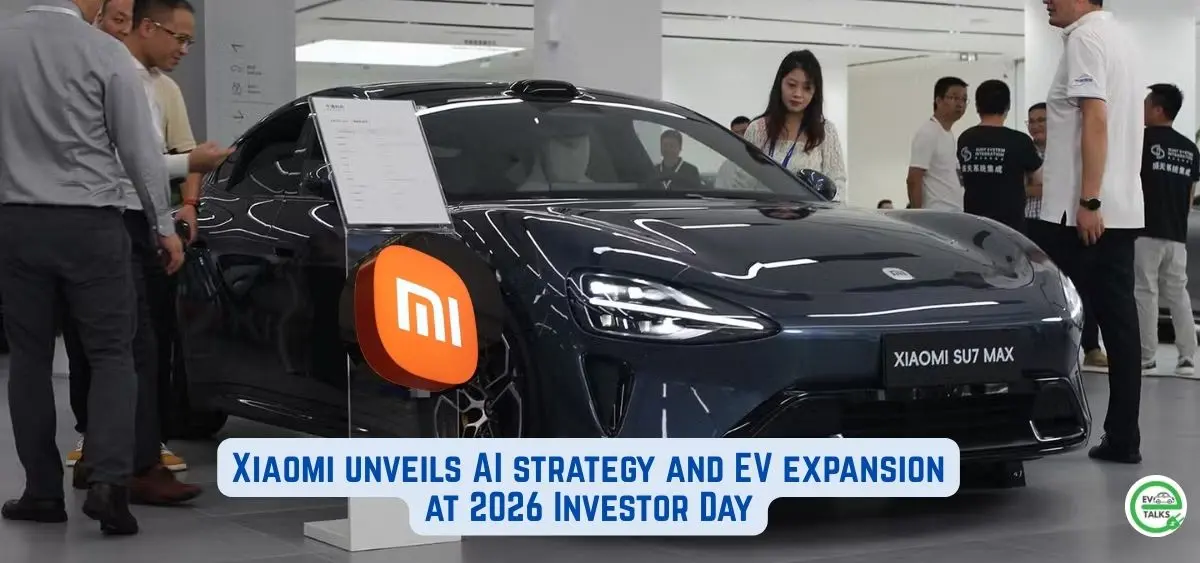

At its 2026 Investor Day held in Beijing on April 27, Xiaomi presented an ambitious roadmap that signals a major transformation beyond smartphones. The announcement, summarized by the theme “Xiaomi unveils AI strategy and EV expansion,” highlights the company’s push to become a leader in its integrated “Human × Car × Home” ecosystem.
AI Takes Center Stage with Massive Investment
A key highlight of the event was how Xiaomi unveiled its AI strategy and EV expansion by placing artificial intelligence at the core of its future growth. The company committed over 60 billion yuan (approximately $8.7 billion) to AI development over the next three years, part of a broader 200 billion yuan R&D investment plan.
Xiaomi introduced its proprietary large language model, MiMo-V2.5-Pro, featuring more than one trillion parameters. The model is designed for “agentic” AI applications capable of handling complex, multi-step tasks autonomously. According to the Artificial Intelligence Index, it ranks among the world’s leading open-source models.

The company also revealed strong early monetization results, with a 35% conversion rate for its AI token-based subscription plans. Beyond revenue generation, Xiaomi is deploying AI agents internally to improve efficiency and manage operating costs.
Aggressive EV Expansion and Global Ambitions
Another major focus of how Xiaomi outlines its AI strategy and EV expansion lies in its fast-growing electric vehicle business. After a strong domestic performance, the company aims to deliver 550,000 vehicles in 2026, up from 412,000 units in 2025.
The upcoming 2026 version of the SU7 sedan will feature standard LiDAR across all variants and an advanced 800-volt architecture for faster charging. Additionally, the YU7 GT—set for launch by May 2026—marks the first vehicle developed at Xiaomi’s European R&D center in Munich.
Xiaomi confirmed its entry into the European EV market in the second half of 2027, followed by expansion into right-hand-drive markets in early 2028. The company plans to compete in the premium segment with multiple new models, including SUVs priced up to 550,000 yuan.
Smartphone Challenges and Ecosystem Shift
Despite its expansion, Xiaomi acknowledged potential challenges in its core smartphone market, predicting a 10% contraction in 2026. To counter this, the company plans to increase average selling prices through premiumization and faster product cycles, including an early launch of the Xiaomi 17T series.
In markets like India, Xiaomi is pivoting toward tablets, wearables, and smart home devices to strengthen its ecosystem presence.
A Unified Future Vision
Overall, Xiaomi outlines an AI strategy and EV expansion as part of a broader vision to unify technology across devices, vehicles, and homes. With heavy investments in AI and an aggressive EV roadmap, the company is positioning itself as a global technology ecosystem leader rather than just a smartphone manufacturer.

Related Articles: