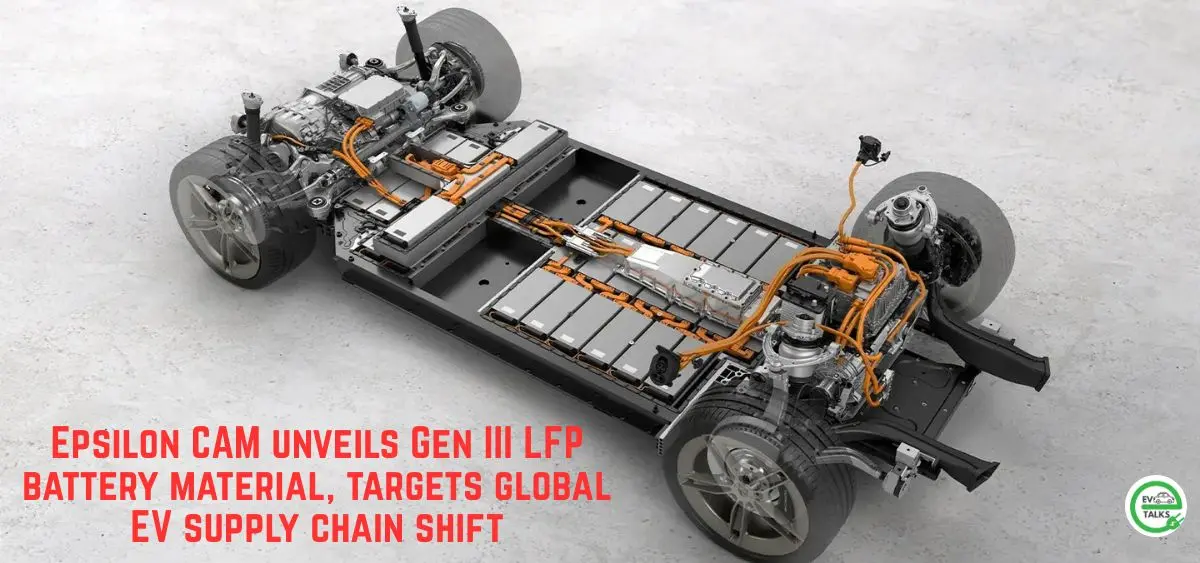

In a major development for the electric vehicle (EV) industry, Epsilon CAM unveils Gen III LFP battery material, marking a breakthrough that could reshape global battery supply chains. Announced on April 27, 2026, the innovation positions the company as a key non-Chinese player in advanced lithium iron phosphate (LFP) technology.
Breakthrough in Battery Performance
With Epsilon, CAM unveils Gen III LFP battery material, introducing a high-performance cathode designed to meet leading global standards. The new material delivers a discharge capacity of 159 mAh/g, enabling greater energy output per cell. Additionally, it achieves an electrode density of 2.51 g/cc, allowing more compact and efficient battery architectures.

The Gen III LFP material also stands out for its durability, offering up to twice the cycle life compared to current industry benchmarks. This translates into longer-lasting battery packs for EVs. Its enhanced thermal stability ensures reliable performance even in high-temperature environments, reducing safety risks and long-term maintenance concerns.
Strategic Push Beyond Chinese Dominance
The announcement that Epsilon CAM unveils Gen III LFP battery material comes at a time when the global EV sector is seeking alternatives to Chinese-dominated supply chains. LFP chemistry, widely used in EVs and energy storage systems, has long been concentrated in China, raising concerns about geopolitical risks and supply vulnerabilities.
Epsilon’s innovation provides automakers with a competitive, non-Chinese option, helping diversify sourcing strategies and improve supply chain resilience. Industry experts see this as a crucial step toward balancing the global battery ecosystem.
North American Market Advantage
A key highlight of the launch is regulatory alignment. The new cathode material complies with Prohibited Foreign Entity (PFE) standards, making it eligible for use in U.S. automotive and battery manufacturing supply chains. This compliance offers a significant advantage, as Western markets increasingly prioritize secure and transparent sourcing.
According to company leadership, this positions the material as a strong contender for North American EV manufacturers seeking both performance and regulatory assurance.
Global R&D and India Manufacturing Hub
The research behind the innovation was conducted at Epsilon’s advanced technology center in Moosburg, Germany, where the company has built a strong intellectual property base with over 145 patents. This global R&D effort underscores the scale of the breakthrough.
Looking ahead, Epsilon CAM unveils Gen III LFP battery material with a clear manufacturing roadmap centered on India. The company plans to scale production to 30,000 tonnes per annum by 2030, supporting India’s ambition to become a major hub for clean energy manufacturing.
A New Chapter for EV Batteries
As Epsilon CAM unveils Gen III LFP battery material, the move represents more than just a technological upgrade—it signals a strategic shift in how and where EV batteries are developed and produced. With strong performance metrics, regulatory compliance, and global manufacturing plans, the innovation could play a pivotal role in the future of sustainable mobility.

Related Articles: