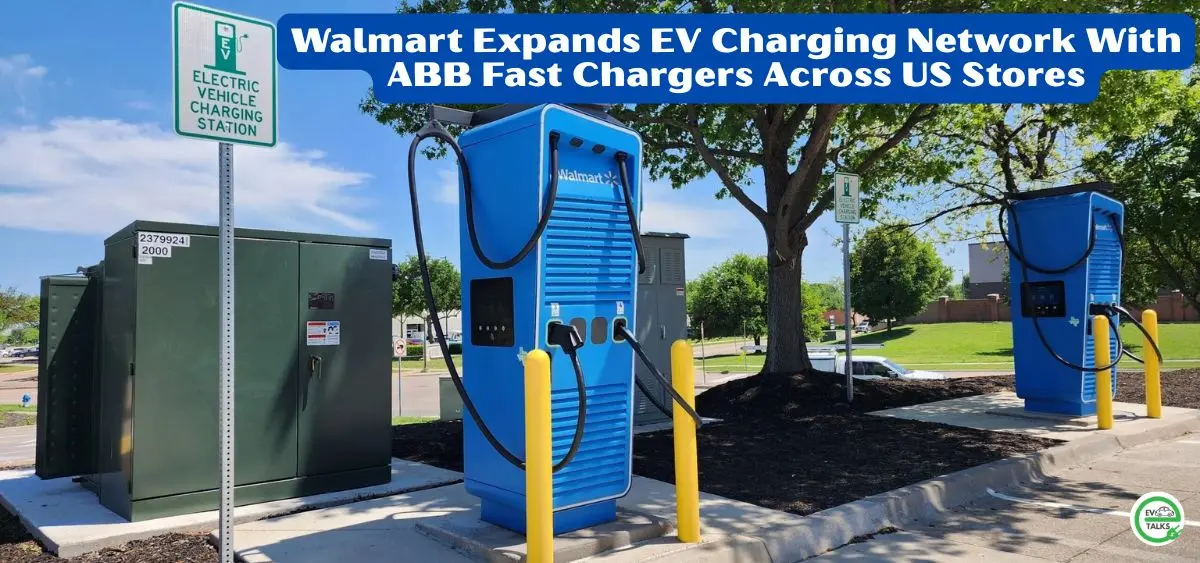

Walmart is accelerating its clean mobility strategy with a large-scale rollout of fast EV charging stations across its U.S. retail stores. As of 2026, the company is actively deploying its own Walmart Expands EV Charging Network initiative in partnership with ABB E-mobility. This marks a major shift as Walmart moves beyond hosting third-party chargers to operating its own branded charging infrastructure.
The rollout reflects Walmart’s goal of making EV charging more accessible by integrating it directly into its retail ecosystem, where customers can shop while their vehicles recharge.
Major Expansion of Charging Infrastructure
The initiative, titled Walmart Expands EV Charging Network, focuses on deploying ABB’s advanced A400 All-in-One fast chargers at select Walmart and Sam’s Club locations. The rollout began after pilot installations in the Phoenix, Arizona, metro area, including cities like Mesa, Tempe, and Apache Junction. Additional deployments are now expanding into Texas, Florida, Colorado, and Georgia, signaling a wider national rollout strategy.
Walmart’s long-term vision is ambitious. The company plans to scale its EV charging footprint to thousands of stores by 2030, leveraging its massive retail presence of more than 5,200 locations across the United States.
High-Power ABB A400 Fast Chargers
At the heart of the expansion is ABB’s A400 fast-charging system, capable of delivering up to 400 kW of power. These chargers are designed for speed and flexibility:
- Can charge two vehicles simultaneously
- Deliver up to 200 kW per vehicle when shared
- Support both CCS1 and NACS connectors
- Feature integrated 32-inch user display screens
- Include pull-through stalls for larger vehicles and trailers
This technology ensures compatibility with a wide range of electric vehicles while significantly reducing charging time, making Walmart Expands EV Charging Network a key milestone in EV infrastructure development.
Seamless Integration With Shopping Experience
A major highlight of Walmart Expands EV Charging Network is its integration with Walmart’s digital ecosystem. Customers can locate, access, and pay for charging sessions directly through the Walmart mobile app. This creates a unified experience where users can shop, charge, and manage payments on one platform.
Walmart also emphasizes convenience by positioning chargers in store parking areas, allowing customers to charge their vehicles while completing daily shopping tasks.
Pricing and Customer Benefits
Walmart aims to maintain competitive and transparent pricing aligned with its “Everyday Low Price” philosophy. Charging rates vary by time of day, with higher daytime pricing and discounted overnight rates. Reports indicate pricing remains competitive with other major networks, sometimes slightly lower than rival fast-charging providers.
This pricing strategy supports Walmart’s expansion of its EV Charging Network as an affordable alternative in the fast-growing EV charging market.
Market Context and Competition
Many Walmart locations already host third-party chargers such as Electrify America. However, Walmart’s decision to build its own network marks a strategic shift toward infrastructure ownership and control. This allows better integration, app-based services, and pricing flexibility.
EV charging analysts note that high-power chargers (300 kW and above) are rapidly becoming standard, positioning Walmart’s 400 kW systems at the forefront of the industry.
Future Outlook
With EV adoption rising across the United States, Walmart Expands EV Charging Network represents a long-term investment in mobility infrastructure. The company aims to establish itself as a major player in the EV ecosystem by combining retail convenience with ultra-fast charging capabilities.
By 2030, Walmart’s charging network could become one of the largest retail-based EV charging systems in the country, reshaping how Americans refuel their electric vehicles.

Related Articles: