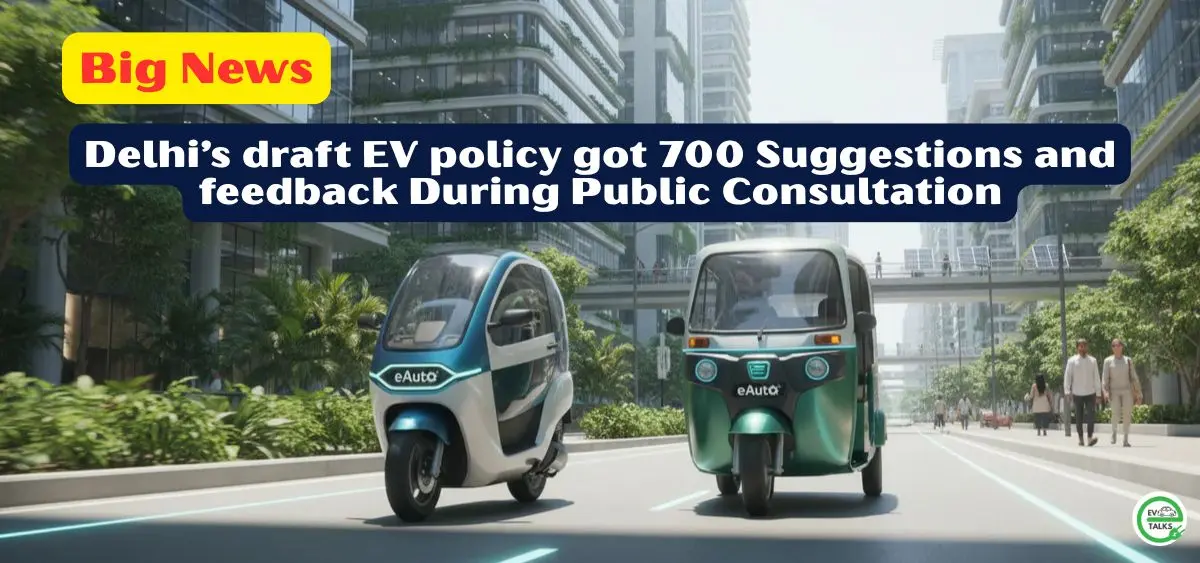

The Delhi Government’s push toward clean mobility has received a strong response, as Delhi’s draft EV policy got 700 Suggestions during its month-long public consultation. The Draft Delhi EV Policy 2026, also known as EV Policy 2.0, attracted broad participation from citizens, industry stakeholders, institutions, and government bodies.
Consultation Process and Participation
The consultation exercise, conducted by the Transport Department, remained open for 30 days and concluded on May 10, 2026. The initiative aimed to gather practical inputs before finalizing a comprehensive electric mobility framework for the national capital.

As a result, Delhi’s draft EV policy gets 700 Suggestions, reflecting growing awareness and interest in sustainable transport solutions.
Breakdown of Submissions
- General Public (~400 submissions): Feedback came from residents, commuters, students, vehicle owners, delivery workers, gig economy participants, and Resident Welfare Associations (RWAs).
- Industry (~200 submissions): Contributions were made by vehicle manufacturers (OEMs), charging infrastructure providers, battery swapping firms, fleet operators, recyclers, and power distribution companies.
- Institutions (50+ submissions): Inputs were received from NGOs, think tanks, universities, research organisations, and environmental groups.
- Government Bodies (~12 submissions): Various ministries and statutory authorities also shared recommendations.
Key Concerns and Suggestions
The feedback highlighted several important areas that the final policy must address:
- Subsidy Reforms: Stakeholders requested higher subsidies for electric two-wheelers, especially for gig workers and delivery riders.
- Charging Infrastructure: There were strong calls for expanding the charging network and increasing financial support for infrastructure installation.
- Sector-Specific Needs: Suggestions included deploying more electric buses for schools and introducing separate permits for e-autos.
- Battery and Lifecycle Issues: Concerns were raised about battery replacement costs, recycling mechanisms, and vehicle scrappage policies.
- Industry Challenges: Some manufacturers expressed concerns over strict mandates for electric motorcycles due to limited availability and infrastructure gaps.
These discussions further highlight how Delhi’s draft EV policy gets 700 Suggestions that are both detailed and implementation-focused.
Government’s Vision and Next Steps
Delhi Transport Minister Dr. Pankaj Kumar Singh stated that the overwhelming response reflects strong public support for cleaner mobility solutions. He emphasized that the government aims to develop a practical, future-ready EV policy that balances environmental goals with industry feasibility.
Officials confirmed that both online and offline consultations were conducted, including stakeholder meetings and sector-specific discussions involving manufacturers, fleet operators, battery recyclers, and charging companies.
Toward a Cleaner Transport Future
The government is currently reviewing all submissions, and relevant suggestions will be incorporated into the final policy. With Delhi’s draft EV policy receiving 700 Suggestions, the upcoming framework is expected to significantly boost EV adoption, strengthen infrastructure, and reduce pollution levels in the capital.
The final policy aims to position Delhi as a leading model for sustainable urban mobility, not only in India but globally.

Related Articles: