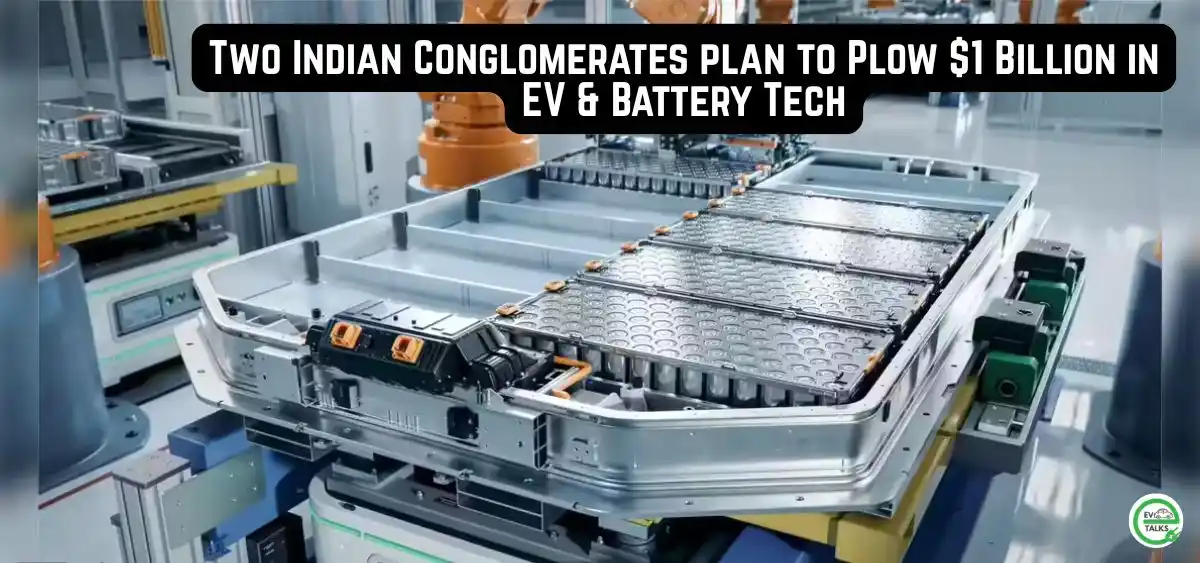

India’s push toward clean mobility has received a major boost as two Indian conglomerates plan to Plow $1 Billion into electric vehicle (EV) and battery technology development. Industry giants Tata Group and JSW Group are leading this ambitious investment, signaling a decisive shift toward reducing reliance on foreign—especially Chinese—technology.
Strategic Investment to Build Local Capabilities
The initiative, where two Indian Conglomerates to Plow $1 Billion, reflects a growing urgency among India’s largest corporations to strengthen domestic innovation. With batteries being the most expensive and technologically complex component of EVs, building local expertise has become a strategic priority.

Geopolitical factors are also at play. China, a dominant player in battery technology, has become increasingly cautious about sharing critical know-how amid global trade tensions. This has prompted Indian firms to fast-track their plans for self-reliance in EV ecosystems.
Tata Group’s Battery Innovation Push
At the forefront of this transformation is Tata’s battery arm, Agratas Ltd., which is investing over $400 million in a cutting-edge research and development facility in Bengaluru. The focus is on next-generation battery chemistries such as Lithium Iron Phosphate (LFP) and Lithium Manganese Iron Phosphate (LMFP).
These technologies are gaining traction globally due to their efficiency and safety, especially in battery energy storage systems. Through this initiative, Tata aims to develop indigenous battery cells, reduce imports from China, and build valuable intellectual property.
The company already leverages nickel manganese cobalt (NMC) technology sourced from South Korea but is now prioritizing in-house innovation to strengthen its competitive edge.
JSW Group’s Vision for Advanced EV Systems
Meanwhile, JSW Group is making a parallel move, committing at least $500 million over the next five to six years to establish a major research hub in Maharashtra. This effort further reinforces how two Indian Conglomerates to Plow $1 Billion into building a robust EV ecosystem.
JSW’s focus extends beyond batteries to include advanced vehicle systems, proprietary software, and connected technologies. The goal is to localize global vehicle designs and tailor them for Indian conditions, ensuring affordability without compromising on international quality standards.
A Defining Shift in India’s EV Landscape
The combined efforts of these conglomerates mark a turning point for India’s EV sector. As two Indian conglomerates plan to Plow $1 Billion, the move is expected to accelerate domestic manufacturing, create high-value jobs, and position India as a serious contender in the global EV supply chain.
By investing heavily in research, innovation, and intellectual property, Tata and JSW are not just building products—they are shaping the future of India’s clean mobility ecosystem.

Related Articles: