


Andhra Pradesh offers a 25% capital subsidy of up to ₹3 lakh per eligible public EV charging station under its Sustainable Electric Mobility Policy 4.0 (2024–2029). The incentive targets the first 5,000 public charging stations established during the specified five-year period.
Additional support is available through the central government’s PM E-DRIVE programme, under which eligible projects may receive funding for electrical infrastructure and charging equipment. However, central assistance depends on location classification, government approvals, and project-specific eligibility.
For entrepreneurs planning an EV charging business in Visakhapatnam, Vijayawada, Tirupati, or along Andhra Pradesh’s highways, these incentives can reduce initial investment. But an important distinction matters: a government-announced subsidy is not the same as an automatically approved payment.
Here is what the policy provides, what an applicant can actually claim, and how to plan a commercially viable charging station in 2026.
Read about EV Subsidy in Andhra Pradesh.
EV Charging Station Subsidy in Andhra Pradesh 2026: Quick Answer
| Incentive or benefit | Amount or provision |
|---|---|
| State capital subsidy | 25% of eligible public charging station cost |
| Maximum state subsidy | ₹3 lakh per public charging station |
| Total stations covered | First 5,000 eligible stations over five years |
| Eligible expenditure | Qualifying public charging station equipment |
| Excluded expenditure | Land, electricity connection costs, distribution transformer and civil works |
| Central PM E-DRIVE support | Up to 80–100% for eligible upstream infrastructure; up to 70–100% for charging equipment in specified categories |
| Electricity tariff | Separate EV charging tariff categories, including ToD and dynamic pricing provisions. |
| Public charging service charge | Policy mentions a ₹15/kWh maximum ceiling, or a rate determined by the electricity regulator. |
| Nodal agency | New & Renewable Energy Development Corporation of Andhra Pradesh (NREDCAP) |
| State policy period | 11 December 2024 to 10 December 2029 |
Important: The ₹3 lakh figure is a subsidy ceiling, not a fixed payment to every charging station. The actual subsidy depends on eligible expenditure, project approval, applicable operational guidelines, and remaining scheme allocation.
Similarly, the percentages announced under PM E-DRIVE cannot be treated as automatically available to every private charging station owner.
What Is Andhra Pradesh’s EV Charging Infrastructure Subsidy Policy?
Andhra Pradesh’s charging infrastructure incentives operate within two connected state policy frameworks.
1. Sustainable Electric Mobility Policy 4.0 (2024–2029)
Issued through G.O.Ms.No.88 on 11 December 2024, this policy aims to accelerate electric vehicle adoption, encourage investment and establish a comprehensive sustainable mobility ecosystem.
Its major infrastructure targets include:
- One charging station every 30 km along notified green corridors.
- One charging station within each 3 km × 3 km grid in designated e-mobility cities.
- Development of model e-mobility cities across five regions.
- Electrification of the APSRTC fleet.
- Private-sector participation in public charging networks.
The policy also seeks to register at least 2 lakh new electric two-wheelers, 10,000 electric three-wheelers and 20,000 battery-electric four-wheelers by 2029.
These targets indicate why the state is encouraging public charging investment. More EVs require reliable chargers, while better charging access can make EV ownership practical for more households and businesses.
2. Andhra Pradesh Integrated Clean Energy Policy 2024
The Integrated Clean Energy Policy provides additional implementation detail for public charging infrastructure.
It includes provisions for selecting charge point operators, allocating public sites, offering capital assistance, and coordinating electricity supply.
The state subsidy is calculated as:
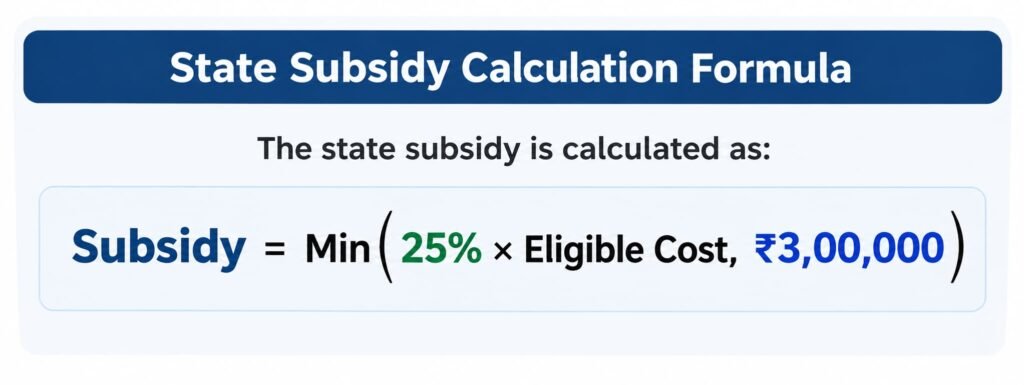
For example:
| Eligible charging station cost | Calculated subsidy | State subsidy |
|---|---|---|
| ₹4 lakh | ₹1 lakh | ₹1 lakh |
| ₹8 lakh | ₹2 lakh | ₹2 lakh |
| ₹12 lakh | ₹3 lakh | ₹3 lakh |
| ₹20 lakh | ₹5 lakh | ₹3 lakh |
These examples assume the full stated cost is eligible and the application is approved. They do not include land, transformers, connection, or other excluded expenses.
The subsidy reaches its ₹3 lakh ceiling when eligible expenditure reaches ₹12 lakh.
Business takeaway: Increasing the charger’s price beyond ₹12 lakh in eligible cost does not increase the maximum state subsidy. Equipment selection should be driven by local demand and expected utilization, not by subsidy alone.
Who Is Eligible for the EV Charging Business Subsidy?
The state policy allows public charging stations to be established by government entities, private developers and charge point operators (CPOs).
Potential applicants include private charging businesses, existing charging network operators, commercial property developers and entrepreneurs participating in approved charging infrastructure projects.
However, the following conditions are particularly important:
- Public accessibility: The proposed project must meet the requirements for an eligible public charging station.
- Location approval: The applicant must have legal permission to use the site.
- Technical compliance: Chargers must meet applicable Indian charging, interoperability, and electrical safety standards.
- Grid feasibility: The relevant DISCOM must be able to provide the required electricity connection.
- Registration and documentation: The applicant must submit the prescribed company, site, equipment and project information.
- Scheme approval: Any subsidy claim must satisfy the applicable guidelines and sanction process.
A privately owned commercial property can potentially host a public charging station. But installing a charger in a private garage does not make it eligible for the public charging subsidy.
Are battery-swapping stations eligible?
Battery-swapping infrastructure is explicitly recognised under the state’s wider electric mobility and charging infrastructure framework.
Battery-swapping projects may also receive support for eligible upstream infrastructure under PM E-DRIVE Category D.
However, operators should not assume that every swapping installation automatically qualifies for the state’s ₹3 lakh public charging station incentive. The precise treatment of swapping equipment and project category must be confirmed before investment.
What Subsidy Is Available Under PM E-DRIVE in 2026?
The PM Electric Drive Revolution in Innovative Vehicle Enhancement (PM E-DRIVE) programme provides central financial assistance to support EV adoption and charging infrastructure.
Its charging infrastructure component has an allocation of ₹2,000 crore, and the overall programme has been extended until 31 March 2028, subject to applicable component timelines and available funding.
The central government issued detailed EV public charging station operational guidelines on 26 September 2025.
PM E-DRIVE charging infrastructure subsidy categories
| Category | Eligible location type | Upstream infrastructure subsidy | Charger equipment subsidy |
|---|---|---|---|
| A | Eligible government premises with unrestricted public access | 100% | 100% |
| B | Eligible government-controlled public locations, including municipal parking, certain transport hubs and public-sector fuel outlets | 80% | 70% |
| C | Other public charging locations, including private commercial sites and qualifying highway locations | 80% | Not provided under this category |
| D | Battery-swapping and battery-charging stations | 80% | Not provided under this category |
Subsidy percentages apply to eligible benchmark or actual costs, whichever is lower, with exclusions and project conditions specified in the operational guidelines.
Can a private entrepreneur directly claim PM E-DRIVE funding?
This is one of the most important distinctions for potential investors.
Private entrepreneurs generally cannot submit direct charging infrastructure subsidy proposals to the central ministry as individual applicants.
Eligible government entities and their appointed nodal agencies aggregate charging infrastructure proposals and submit them through the prescribed mechanism.
Private CPOs may participate through approved selection, implementation, concession or partnership arrangements.
Therefore, the practical route for an entrepreneur is to identify a qualifying project, coordinate with the nodal agency and participate in the applicable procurement or implementation process.
A privately owned charging hub might fall within Category C, but that does not mean the owner automatically receives 80% of its electricity connection expenditure.
Can the state subsidy and PM E-DRIVE subsidy be combined?
Both frameworks may be relevant to the same project, but receiving both subsidies is not automatically guaranteed.
The applicant must establish whether the state and central schemes permit assistance for different eligible cost components of the same project without double financing.
A charging operator should obtain written confirmation of the applicable funding structure before including both amounts in financial projections.
What Are the Latest Andhra Pradesh EV Charging Policy Updates in 2026?
Several developments matter for charging infrastructure investors.
| Date | Policy or program development | Importance |
|---|---|---|
| 11 December 2024 | Andhra Pradesh Sustainable Electric Mobility Policy 4.0 was announced. | Establishes a state EV and infrastructure incentive framework. |
| 9 April 2025 | State operating guidelines issued through G.O. Ms. No. 48 | Clarifies procedures for specified EV-related incentives |
| August 2025 | PM E-DRIVE scheme extension announced | Extends the national programme to March 2028 |
| 26 September 2025 | National public charging station guidelines issued | Defines subsidy categories and implementation process |
| December 2025 | Central charging infrastructure FAQs published | Clarifies eligible locations, funding recipients and project requirements |
| October 2026 | NREDCAP lists a high-priority charging corridor landowner EOI | Indicates an opportunity for eligible landowners to explore participation |
The important 2026 development is the gradual move from broad policy announcements toward identifying sites, developing implementable projects and coordinating charging infrastructure investment.
What remains unconfirmed: The reviewed materials do not establish the number of Andhra Pradesh projects that have actually received and been paid the state’s ₹3 lakh incentive, or the remaining availability within the 5,000-station limit.
Businesses should therefore confirm available allocation and the applicable claim process before committing capital.
How to Apply for an EV Charging Station Subsidy in Andhra Pradesh
NREDCAP provides an online application for the registration of proposed charging infrastructure.
This is a useful starting point for developers, but it is essential to understand that registration of a charging infrastructure proposal is not the same as approval of a capital subsidy.
Step 1: Prepare your business and location details
Choose the proposed charging station location, business structure, and required charger capacity.
Confirm site ownership or obtain a suitable lease or land-use agreement.
The project should have adequate access, parking space, vehicle circulation, and a practical electricity connection.
Step 2: Assess electricity supply feasibility
Contact the relevant Andhra Pradesh electricity distribution company.
Depending on the location, this may involve APEPDCL, APSPDCL, or APCPDCL.
Request clarification on sanctioned load, voltage level, connection expenses, transformer requirements and applicable EV charging tariffs.
A station with a 60 kW DC charger may require a higher sanctioned connection capacity after considering equipment losses and auxiliary loads.
Step 3: Complete NREDCAP online registration
The application requires information such as:
- Applicant organisation, registered address, PAN and GST details.
- Authorised contact person and business information.
- Financial turnover or prescribed supporting certification for new entrepreneurs.
- Site location, land details and geographical coordinates.
- Nearest electricity substation and proposed charging capacity.
- Charger type, number of chargers, connector details and testing information.
- Estimated project cost and expected commissioning period.
- Registration fee payment information.
The registration page also requests project drawings and supporting documents.
Step 4: Submit the required enclosures
The published registration requirements include the registration certificate, PAN, GST registration, authorised signatory documentation, equipment certification and charging infrastructure layout.
Applicants are instructed to submit soft copies of supporting documents after online submission and provide the required hard copies to the designated office.
The registration page contains a fee-payment section, but the public page reviewed does not establish a universally applicable ₹1,180 fee. Applicants should verify the current payable amount with NREDCAP instead of relying on a quoted figure.
Step 5: Complete technical approvals and commissioning
Arrange electrical installation through qualified professionals.
Obtain applicable safety clearances, complete DISCOM requirements and conduct equipment testing before opening the station.
Keep installation reports, commissioning records, invoices and electricity connection documents.
Step 6: Apply for the applicable incentive
Confirm the currently prescribed procedure for the state charging infrastructure incentive with NREDCAP.
For PM E-DRIVE-supported projects, follow the appointed nodal agency’s approved proposal or procurement route.
Do not assume the online registration form itself represents the complete subsidy claim mechanism.
Official registration portal: NREDCAP EV Charging Infrastructure Application. This is the user-provided government application portal, shown here separately from the editorial article.
How Much Does It Cost to Open an EV Charging Station in Andhra Pradesh?
Investment depends heavily on charging capacity, electricity supply, location and business model.
A small AC charging installation can be relatively affordable. A public DC fast-charging station requires more substantial hardware, protection systems, software, grid connectivity and parking infrastructure.
Indicative investment estimates for 2026
| Charging business model | Indicative initial investment |
|---|---|
| Small AC charging installation | ₹1–3 lakh |
| Commercial AC charging hub | ₹3–8 lakh |
| Single 30 kW DC charging installation | ₹7–14 lakh |
| Single 60 kW DC fast-charging installation | ₹10–22 lakh |
| Multi-charger highway fast-charging hub | ₹25–60 lakh or more |
These are illustrative planning estimates, not government-notified project costs or guaranteed vendor quotations. Land purchase is excluded, and substantial grid upgrades can increase the investment significantly.
For public charging projects, electricity connection charges and transformer requirements can make the difference between a commercially attractive location and an expensive one.
Charger prices and central subsidy benchmarks
The revised national reference benchmarks published in the charging infrastructure FAQs include:
| CCS2 DC charger rating | Published benchmark value |
|---|---|
| 60 kW | ₹3.40 lakh |
| 120 kW | ₹5.00 lakh |
| 240 kW | ₹8.00 lakh |
| 360 kW | ₹12.50 lakh |
These are reference values used in the national subsidy framework, not guaranteed market selling prices or complete station installation costs. Refundable deposits and GST are not eligible for central subsidy reimbursement.
Is an EV Charging Station Business Profitable in Andhra Pradesh?
Profitability depends more on charger utilisation than on simply installing high-powered equipment.
Consider a public station using a 60 kW DC charger.
Assume the operator sells electricity at ₹15/kWh, purchases power at an illustrative ₹8/kWh, and has other recurring fixed expenses of ₹30,000 per month.
| Average electricity sold daily | Monthly revenue | Gross electricity margin | Balance after assumed fixed expenses |
|---|---|---|---|
| 100 kWh | ₹45,000 | ₹21,000 | -₹9,000 |
| 200 kWh | ₹90,000 | ₹42,000 | ₹12,000 |
| 300 kWh | ₹1,35,000 | ₹63,000 | ₹33,000 |
The table uses a 30-day month and an assumed ₹7/kWh difference between selling price and energy purchase cost.
It excludes financing costs, depreciation, taxes and any additional variable or demand-related charges not captured by the assumptions.
These figures are hypothetical and do not represent an approved Andhra Pradesh retail tariff.
The lesson is straightforward: a station with expensive infrastructure and little traffic may lose money, even after receiving a subsidy.
For this example, approximately 143 kWh of daily sales would be needed just to cover the assumed ₹30,000 monthly fixed expenses from the electricity margin.
A good location must generate repeat demand, not simply appear attractive on a map.
Where Are the Best Opportunities for EV Charging Businesses?
Potential markets to evaluate, not a ranking of approved subsidy locations
Andhra Pradesh has several potentially attractive charging markets.
Visakhapatnam has opportunities associated with urban mobility, commercial transport, workplaces and tourism.
Vijayawada and Guntur provide access to business travel, urban commuting and intercity vehicle movement.
Tirupati may benefit from tourism, pilgrimage and hotel-based charging demand.
Rajamahendravaram, Nellore and Kurnool deserve consideration for intercity and regional charging corridors.
However, city population or highway visibility alone cannot establish demand. Investors should assess EV registrations, existing charger availability, traffic patterns, property access and grid capacity at the actual site.
What Are the Electricity Tariff Benefits for Charging Operators?
Andhra Pradesh’s policy provides for a separate electricity tariff category for EV charging operators, including time-of-day and dynamic tariff mechanisms.
A time-of-day tariff means the electricity rate can vary depending on when power is consumed.
This creates a potential opportunity for charging operators to schedule compatible fleet charging during lower-cost periods.
The policy also mentions a maximum ceiling tariff of ₹15 per unit for end consumers, or such rate as determined by the electricity regulator under applicable guidelines.
Importantly, the retail charging service charge and the electricity purchase tariff are two different things.
Operators must check the prevailing regulatory order for the correct energy rate, demand charges, taxes and applicable service-charge limits.
What Subsidy Do EV Buyers Receive in Andhra Pradesh?
The state’s incentives extend beyond charging infrastructure.
The April 2025 operating guidelines clarify purchase incentives and road-tax relief for eligible electric vehicles.
EV purchase incentives
Eligible buyers may receive 5% of the relevant vehicle price without scrapping an old vehicle, or 10% when qualifying scrappage conditions and a valid Certificate of Deposit are satisfied.
The purchase-incentive window specified in the guidelines is 10 January 2025 to 31 March 2027.
| Eligible category | Maximum vehicle cost used for incentive calculation | Illustrative maximum at 5% | Illustrative maximum at 10% with qualifying CoD |
|---|---|---|---|
| Electric two-wheeler | ₹1 lakh | ₹5,000 | ₹10,000 |
| Electric three-wheeler | ₹2 lakh | ₹10,000 | ₹20,000 |
| Electric bus | ₹2 crore | ₹10 lakh | ₹20 lakh |
| Electric goods carrier | ₹5 lakh | ₹25,000 | ₹50,000 |
| Electric tractor | ₹8 lakh | ₹40,000 | ₹80,000 |
These calculations show the effect of the stated vehicle-price ceilings. Actual entitlement requires satisfying eligibility and validation conditions.
The guidelines cover eligible private or corporate electric two-wheelers and specified commercial or public-transport vehicle categories. Private electric passenger cars are not included in the listed state purchase-incentive categories.
For the enhanced scrappage benefit, the scrapped vehicle category must match the new eligible EV category, and the Certificate of Deposit must meet the prescribed conditions.
Road-tax exemption
The state operating guidelines specify 100% road-tax exemption for eligible battery-electric vehicles purchased and registered in Andhra Pradesh from 10 January 2025 to 11 December 2029.
Hybrid vehicles are excluded.
This is a separate incentive from the purchase subsidy and can be especially meaningful for higher-priced electric cars.
Important distinction: The purchase incentive runs to March 2027 under the stated guidelines, while the specified road-tax exemption period extends into December 2029. They should not be presented as having the same deadline.
What Are the Biggest Challenges in Starting an EV Charging Business?
The most common problem is investing in equipment before validating real customer demand.
Other major challenges include:
- Low charger utilisation: EV traffic may be insufficient to recover investment within the expected timeframe.
- Grid connection delays: Additional sanctioned load or transformer upgrades can substantially delay commissioning.
- Charging compatibility: Different vehicles support different AC and DC charging capabilities.
- Equipment downtime: Faulty chargers damage customer trust and reduce repeat visits.
- Electricity costs: Demand charges, energy tariffs and fixed expenses can weaken profitability.
- Subsidy uncertainty: Applications, eligibility verification and fund availability can affect the timing of assistance.
An additional risk is selecting a charger simply because it offers a higher advertised power rating.
For instance, a 120 kW charging station will not necessarily charge every EV twice as quickly as a 60 kW station. Charging speed depends on the vehicle’s maximum DC charging acceptance, battery temperature and state of charge.
Five mistakes new charging station operators should avoid
- Buying expensive DC chargers without studying local EV demand.
- Assuming the maximum advertised subsidy will be approved.
- Signing a long-term property lease before confirming grid feasibility.
- Ignoring software reliability, payment integration and maintenance support.
- Calculating earnings using theoretical charger capacity instead of realistic electricity sales.
For public charging stations, regular maintenance, visible pricing, convenient parking and reliable digital payments are essential.
How Can EV Charging Infrastructure Support Sustainable Mobility?
Public charging infrastructure directly influences whether people feel comfortable choosing electric transportation.
A dependable charging network allows EV drivers to travel longer distances without unnecessary uncertainty. It also helps businesses introduce electric delivery vehicles, taxis and shared mobility fleets.
Andhra Pradesh’s interest in green corridors and e-mobility cities could support the gradual electrification of intercity transportation.
However, EV charging is not automatically emission-free. Its environmental benefits depend partly on how the electricity is generated.
Integrating solar power, renewable electricity procurement and appropriately designed battery storage systems can potentially reduce operating emissions and improve energy management.
For charging business owners, combining reliable charging infrastructure with cleaner electricity can become an important long-term competitive advantage.
Expert Insight from Electric Vehicle Talks
The most important shift in India’s charging industry is from simply installing chargers to operating infrastructure that customers can depend on.
Andhra Pradesh’s ₹3 lakh capital subsidy can help an entrepreneur reduce initial equipment expenditure. But a subsidy cannot create EV traffic, compensate for an unsuitable location or guarantee profitability.
We recommend prioritising three factors before investing: confirmed charging demand, affordable electricity connectivity and dependable equipment uptime.
A smaller charging installation serving a predictable customer base may perform better financially than an expensive highway fast charger with limited daily usage.
For entrepreneurs entering the market in 2026, the best opportunity may be to identify gaps in existing networks, establish partnerships with commercial properties or fleet operators, and expand capacity as real utilisation increases.
What Should an EV Charging Business Owner Do in 2026?
Before purchasing equipment or committing to a charging network franchise, follow this practical action plan.
EV charging business readiness checklist
- Choose the Right Location: Select an easily accessible site with sufficient EV traffic and parking facilities.
- Analyse Market Demand: Check nearby public charging stations, EV adoption trends, and potential customer demand.
- Verify Electricity Availability: Contact the local DISCOM to confirm power supply, sanctioned load, and connection feasibility.
- Estimate Installation Costs: Compare charger specifications, equipment prices, civil works, and total setup expenses.
- Check NREDCAP Subsidy Guidelines: Review the latest registration requirements, eligibility criteria, and application procedures.
- Explore PM E-DRIVE Benefits: Determine whether your proposed charging station qualifies for central government infrastructure assistance.
- Confirm Subsidy Eligibility: Obtain written clarification on whether state and central subsidies can be combined.
- Calculate Business Profitability: Estimate electricity costs, charging revenue, maintenance expenses, and return on investment without relying on subsidy payments.
- Complete Required Approvals: Secure applicable electrical safety clearances, equipment certifications, statutory permissions, and maintenance arrangements before starting operations.
A strong investment decision should remain commercially sensible even if subsidy disbursement takes longer than expected.
People Also Ask
1. How much subsidy is available for EV charging stations in Andhra Pradesh in 2026?
Under the state’s Sustainable Electric Mobility Policy framework, eligible public charging stations may receive 25% of qualifying capital expenditure, capped at ₹3 lakh per station, for the first 5,000 stations over five years. Actual assistance depends on scheme eligibility and approval.
2. Is the Andhra Pradesh EV charging station subsidy available for private businesses?
Yes, the state policy includes private developers and charging point operators within the eligible public charging infrastructure framework. However, the installation must qualify as a public charging station and satisfy the applicable conditions. Private home chargers are not automatically covered.
3. Can I receive a ₹10 lakh subsidy for installing a fast DC charger?
The reviewed current state charging infrastructure provisions establish a general cap of ₹3 lakh per eligible public charging station. A separate universal ₹10 lakh fast-charger subsidy was not verified in the applicable provisions. Entrepreneurs should not use that higher figure in investment calculations without a specific government sanction or applicable order.
4. Can I apply for the subsidy online?
NREDCAP offers an online portal for charging infrastructure project registration. However, project registration and capital subsidy approval are separate processes. Applicants must confirm the prescribed claim mechanism before submitting an incentive request.
5. Is PM E-DRIVE subsidy available for private highway charging stations?
Qualifying private highway charging locations may fall under Category C, which provides up to 80% support for eligible upstream electrical infrastructure. The project must follow the prescribed government nodal-agency process. Direct cash reimbursement to every private operator is not guaranteed.
6. How much investment is required for a 60 kW charging station?
A 60 kW DC public charging installation may require approximately ₹10–22 lakh as an indicative planning range. Actual cost depends on equipment, installation, connection infrastructure, property requirements and site conditions. A detailed quotation and DISCOM feasibility assessment are necessary.
7. Do EV buyers receive government subsidies in Andhra Pradesh?
The state’s operating guidelines provide purchase incentives of 5% or 10% for specified eligible EV categories, depending on scrappage conditions and maximum eligible vehicle costs. Eligible battery-electric vehicles also receive the specified road-tax exemption. The purchase-incentive window is scheduled to end on 31 March 2027 unless extended.
EV Charging Station Subsidy in Andhra Pradesh FAQs
1. What is the validity of the Andhra Pradesh EV Policy 2024–2029?
The Sustainable Electric Mobility Policy 4.0 operates from 11 December 2024 to 10 December 2029, subject to amendments and individual incentive conditions.
2. What is the maximum capital subsidy for a public charging station?
The specified maximum is ₹3 lakh per eligible station, calculated at 25% of eligible capital costs. Land, electricity connection costs, distribution transformers and civil works are excluded from the specified state subsidy calculation.
3. Is there a subsidy for installing an EV charger at home?
The reviewed public charging station capital subsidy provisions do not establish a general direct cash subsidy for individual residential home chargers. Home charging must follow applicable electricity and safety requirements.
4. Can I start an EV charging station without owning land?
Yes. Entrepreneurs may explore leased properties, site-host partnerships and projects involving government or private landowners. The required land-use rights, approvals and operating agreements must be secured.
5. Is an electricity distribution company approval necessary?
Operators must coordinate with the relevant DISCOM for connection feasibility, sanctioned load, metering and applicable electricity tariffs. Electrical safety and other statutory requirements must also be fulfilled.
6. Are EV charging stations eligible for an automatic SGST refund?
A universal 100% net SGST reimbursement for every charging station operator is not established by the reviewed public charging subsidy provisions. Manufacturing-related incentives should not be confused with incentives for operating charging stations.
7. Does registration with NREDCAP guarantee subsidy approval?
No. The registration system collects business, location, equipment and investment information. Financial assistance remains subject to the relevant scheme’s eligibility, verification, sanction and disbursement conditions.
Conclusion
Andhra Pradesh’s electric mobility policies provide a meaningful opportunity for entrepreneurs entering the public charging infrastructure industry.
The 25% state capital subsidy, capped at ₹3 lakh, offers a potential reduction in charging equipment investment, while PM E-DRIVE creates additional opportunities for qualifying projects developed through approved government implementation arrangements.
The state is also encouraging green corridors, e-mobility cities, electric public transport and broader charging coverage.
However, long-term success will depend on choosing the right location, ensuring reliable electricity supply, investing in compatible charging technology and maintaining sufficient daily utilisation.
For business owners planning to invest in 2026, the smartest approach is to establish commercial feasibility first, verify subsidy eligibility second and purchase equipment only after the project’s costs and approvals are understood.
As India’s EV ecosystem continues to mature, reliable public charging infrastructure will become increasingly important to drivers, fleets and businesses.
For more practical EV insights, charging infrastructure guides, electric vehicle comparisons and ownership resources, explore Electric Vehicle Talks
Related Articles:









