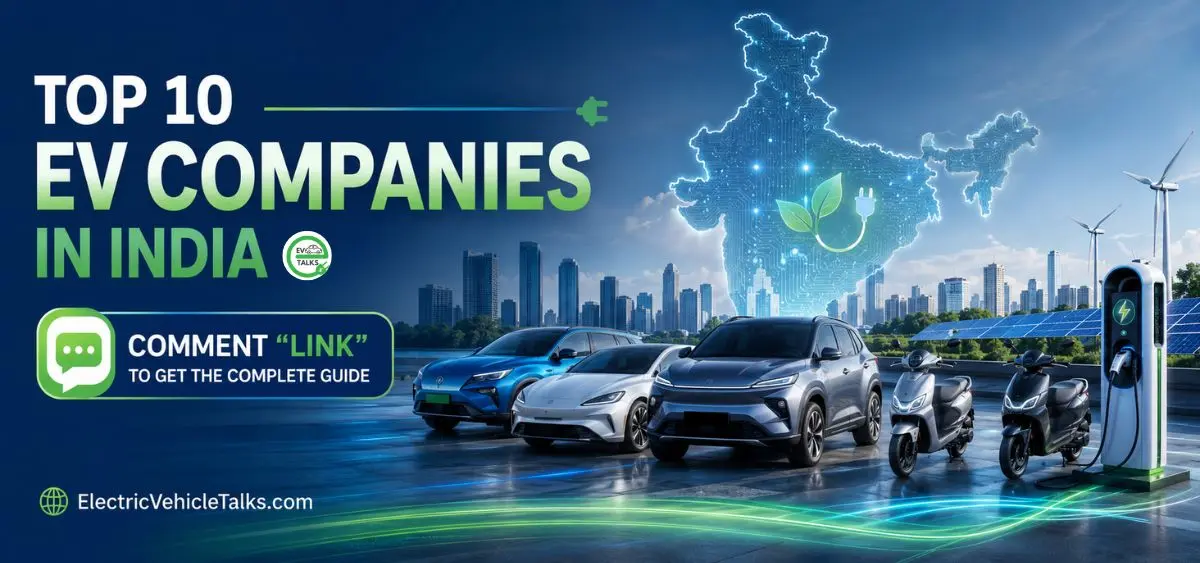

India’s electric vehicle revolution is being powered by a mix of established automobile giants and innovative EV startups. The Top 10 EV companies in India are transforming the way Indians travel by introducing affordable electric cars, high-performance scooters, commercial EVs, and advanced charging technologies.
From Tata Motors leading the passenger electric car segment to Ola Electric reshaping urban two-wheeler mobility, India’s EV ecosystem has entered a new phase of rapid growth.
The shift toward electric mobility is no longer only about reducing emissions. It is now about lower running costs, better technology, energy independence, and creating a cleaner transportation future for more than 1.4 billion people.
According to industry estimates, India’s EV market is expected to grow significantly over the next decade, supported by government initiatives, rising fuel prices, battery cost reductions, and increasing consumer awareness.
For EV buyers, understanding the best EV companies in India helps identify brands offering reliable technology, strong after-sales support, efficient batteries, and long-term ownership value.
India’s Electric Vehicle Industry: A Rapidly Growing Market
India has become one of the fastest-growing electric mobility markets globally.
The growth is being driven by multiple factors:
- Rising petrol and diesel prices
- Government push for clean transportation
- Expansion of EV charging infrastructure
- Increasing battery technology improvements
- Lower maintenance costs compared with ICE vehicles
- Growing consumer interest in sustainable mobility
The Indian government has supported EV adoption through initiatives such as the following:
- FAME schemes for electric vehicle adoption
- PM E-DRIVE initiative supporting EV manufacturing and charging infrastructure
- State-level EV policies offering incentives and subsidies
- Battery manufacturing incentives under production-linked incentive (PLI) schemes
The result is a competitive EV landscape where traditional automakers and new-age companies are investing heavily in electric mobility.
Top 10 EV Companies in India Leading Electric Mobility
The following companies represent the strongest contributors to India’s EV ecosystem across passenger vehicles, two-wheelers, and commercial transportation.
1. Tata Motors
When discussing the Top EV companies in India, Tata Motors remains the most influential name in the passenger electric vehicle segment.
The company has successfully created mass-market acceptance for EVs with practical, affordable, and reliable electric cars.
Popular Tata EV models include:
| Model | Segment | Key Highlights |
|---|---|---|
| Tata Nexon EV | Compact SUV | High sales volume, long range, and advanced features |
| Tata Punch EV | Compact SUV | Affordable urban electric SUV |
| Tata Tiago EV | Hatchback | Budget-friendly electric car |
| Tata Tigor EV | Sedan | Fleet and personal mobility |
| Tata Curvv EV | Electric SUV Coupe | Premium design and technology |
Tata Motors has focused on solving major EV buyer concerns:
- Battery reliability
- Service network availability
- Affordable pricing
- Real-world driving range
The company’s large dealership and service network gives it a major advantage over many emerging EV brands.
Why Tata Motors Leads India’s EV Market
- Strong brand trust among Indian consumers
- Wide EV portfolio
- Competitive pricing
- Growing charging ecosystem
- Continuous battery technology improvements
For first-time EV buyers in India, Tata remains one of the safest choices due to its ownership experience and nationwide support network.
2. Mahindra & Mahindra
Mahindra is one of India’s most respected SUV manufacturers and is aggressively entering the premium electric vehicle space.
The company believes electric SUVs will dominate India’s future mobility market.
Its electric strategy revolves around the advanced INGLO platform, designed specifically for next-generation EVs.
Current and upcoming electric products include:
| Model | Category | Highlights |
|---|---|---|
| Mahindra XUV400 EV | Electric SUV | Performance-focused compact SUV |
| BE series | Electric SUVs | Futuristic EV architecture |
| XEV models | Premium EVs | Advanced technology platform |
Mahindra’s biggest strength is its SUV expertise.
Indian buyers prefer SUVs because of the following:
- Higher ground clearance
- Better road presence
- Family-friendly practicality
This makes Mahindra’s electric SUV approach highly relevant for Indian conditions.
3. JSW MG Motor India
JSW MG Motor India has created a unique position by combining British automotive heritage with modern EV technology.
The company focuses heavily on connected features, smart interiors, and urban electric mobility.
Major EV models include:
| Model | Segment | Highlights |
|---|---|---|
| MG Comet EV | Compact city EV | Ideal for urban commuting |
| MG ZS EV | Electric SUV | Premium electric SUV |
| MG Windsor EV | Crossover EV | Comfort-focused electric vehicle |
MG vehicles are known for:
- Large infotainment systems
- Connected car technology
- Premium cabin experience
- Strong safety features
The MG Comet EV especially targets city commuters looking for a compact and affordable electric vehicle.
4. Hyundai Motor India
Hyundai is among the most established global automobile brands in India and is investing heavily in electric mobility.
The company focuses on premium EV technology with global platforms.
Popular Hyundai electric vehicles include:
| Model | Segment | Highlights |
|---|---|---|
| Hyundai Kona Electric | SUV | Early premium EV offering |
| Hyundai Ioniq 5 | Premium EV | Advanced global EV platform |
Hyundai’s strengths include the following:
- Global EV technology
- Premium interiors
- Strong safety standards
- Advanced battery management systems
The company is expected to expand its EV portfolio in India with more locally produced models.
5. Kia India
Kia entered India’s EV segment with a focus on premium customers seeking advanced design and performance.
The Kia EV6 introduced global EV technology to Indian consumers.
Key strengths:
- Futuristic styling
- High-performance electric powertrain
- Premium interiors
- Fast charging capability
Kia’s EV strategy focuses on customers upgrading from luxury internal combustion vehicles to premium electric cars.
6. Ola Electric
Ola Electric is one of the most recognized electric vehicle startups in India and has played a major role in accelerating electric scooter adoption.
The company became one of India’s largest electric two-wheeler manufacturers within a short period.
Popular models include the following:
| Model | Segment | Highlights |
|---|---|---|
| Ola S1 | Electric Scooter | Affordable smart scooter |
| Ola S1 Pro | Premium Scooter | Long range and performance |
| Ola S1 X | Mass-market scooter | Value-focused EV |
Ola’s advantages include:
- Large manufacturing facility
- Strong digital-first approach
- Feature-rich scooters
- Competitive pricing
The company has focused on making electric scooters aspirational for younger Indian consumers.
7. Ather Energy
Ather Energy is considered one of India’s most technology-driven EV startups.
The company built its reputation through premium electric scooters offering excellent performance and connected features.
Popular models:
| Model | Highlights |
|---|---|
| Ather 450X | Performance-focused electric scooter |
| Ather Rizta | Family-oriented electric scooter |
Ather focuses strongly on:
- Ride quality
- Software experience
- Battery safety
- Charging infrastructure
The company’s charging network, known as Ather Grid, has helped improve customer confidence in electric scooters.
8. TVS Motor Company
TVS Motor Company is one of India’s largest two-wheeler manufacturers and has successfully transitioned into electric mobility.
Its flagship EV product:
TVS iQube
The iQube has become popular because it combines the following:
- Trusted brand value
- Practical range
- Comfortable riding experience
- Wide service availability
TVS understands Indian scooter customers and has used its existing dealer network to strengthen EV adoption.
9. Bajaj Auto
Bajaj Auto transformed its iconic Chetak brand into a modern electric scooter.
The Bajaj Chetak EV combines the following:
- Classic design
- Metal body construction
- Premium feel
- Reliable engineering
Its major advantage is Bajaj’s decades of customer trust.
The company continues expanding its electric scooter portfolio to compete in India’s growing EV two-wheeler market.
10. Olectra Greentech
While passenger EVs receive most attention, commercial electric vehicles are equally important.
Olectra Greentech is one of India’s leading electric bus manufacturers.
The company supplies electric buses for:
- State transport corporations
- Urban public transport systems
- Smart city mobility projects
Its contribution is important because public transportation electrification can significantly reduce urban pollution.
Top 10 EV Companies in India: Quick Comparison
| Company | Main Segment | Popular EV Products |
|---|---|---|
| Tata Motors | Electric Cars | Nexon EV, Punch EV |
| Mahindra | Electric SUVs | XUV400, Future EV SUVs |
| JSW MG Motor | Cars | Comet EV, ZS EV |
| Hyundai | Premium Cars | Ioniq 5 |
| Kia | Premium Cars | EV6 |
| Ola Electric | Scooters | S1 Pro, S1 X |
| Ather Energy | Scooters | 450X, Rizta |
| TVS Motor | Scooters | iQube |
| Bajaj Auto | Scooters | Chetak EV |
| Olectra Greentech | Electric Buses | Electric Bus Range |
Why Are EV Companies Growing Rapidly in India?
The growth of the Top 10 EV companies in India is not accidental. It reflects a major transformation in how Indians think about transportation.
For decades, vehicle ownership decisions were mainly influenced by fuel efficiency, resale value, and brand reputation. Today, EV buyers are also considering the following:
- Monthly running cost savings
- Environmental impact
- Smart technology features
- Battery performance
- Charging convenience
- Government incentives
An electric vehicle that costs more initially can often become cheaper over time because electricity is significantly less expensive than petrol or diesel.
For example, a petrol scooter may require thousands of rupees every month in fuel expenses, while an electric scooter can often complete the same daily commute at a fraction of the cost.
Benefits of Buying an Electric Vehicle in India
1. Lower Running Costs
One of the biggest advantages of EV ownership is reduced operating expenses.
A typical electric vehicle has:
- No engine oil replacement
- Fewer moving mechanical components
- Lower maintenance requirements
- Reduced fuel expenses
For daily commuters traveling 30–50 km, EV savings can become substantial over several years.
2. Better Driving Experience
Modern EVs offer instant torque, meaning power delivery happens immediately when the accelerator is pressed.
This results in:
- Quick acceleration
- Smooth driving experience
- Silent operation
- Less vibration
Many first-time EV owners are surprised by how refined electric vehicles feel compared with traditional vehicles.
3. Environmental Benefits
Transportation is one of India’s largest sources of urban air pollution.
Electric vehicles help reduce:
- Tailpipe emissions
- Noise pollution
- Dependence on imported fossil fuels
As India’s electricity generation becomes cleaner through renewable energy growth, the environmental advantages of EVs will continue increasing.
Challenges Faced by EV Buyers in India
Despite rapid growth, EV adoption still faces several challenges.
1. Charging Infrastructure Availability
Charging availability remains one of the biggest concerns among new EV buyers.
India is expanding its charging network through:
- Highway charging corridors
- City charging stations
- Apartment charging solutions
- Workplace charging facilities
However, charging density is still lower compared with petrol pumps.
2. Battery Replacement Concerns
Many buyers worry about battery life and replacement costs.
Modern EV batteries are designed to last several years, often with manufacturer warranties covering battery performance.
Important factors affecting battery life include:
- Charging habits
- Temperature exposure
- Driving patterns
- Battery management technology
3. Higher Initial Purchase Price
Electric vehicles generally cost more upfront compared with equivalent petrol models.
However, the ownership cost gap is reducing due to the following:
- Falling battery prices
- Government support
- More affordable EV models
- Improved manufacturing scale
How to Choose the Best EV Company in India?
Choosing among the Best EV brands in India depends on individual requirements.
For Electric Cars
Consider:
Battery Range
Look beyond claimed range figures.
Real-world range depends on:
- Traffic conditions
- Driving style
- Weather
- Air conditioning usage
Charging Speed
A vehicle supporting faster charging can be more convenient for highway travel.
Check:
- AC charging speed
- DC fast charging compatibility
- Charging network availability
Service Network
A strong service network is extremely important.
Established manufacturers like Tata Motors, Mahindra, Hyundai, TVS, and Bajaj benefit from existing customer support infrastructure.
For Electric Scooters
Buyers should evaluate:
| Factor | Why It Matters |
|---|---|
| Battery capacity | Determines riding range |
| Build quality | Important for Indian roads |
| Suspension | Improves comfort |
| Charging time | Affects daily usability |
| Service availability | Ensures ownership confidence |
EV Charging Cost in India: How Much Does It Cost?
One of the biggest attractions of EV ownership is affordable charging.
Approximate home charging cost:
| Vehicle Type | Approximate Charging Cost |
|---|---|
| Electric Scooter | ₹15–₹40 per full charge |
| Small Electric Car | ₹300–₹500 per full charge |
| Large Electric SUV | ₹700–₹1,000 per full charge |
Actual cost depends on the following:
- Electricity tariff
- Battery size
- Charging efficiency
- State electricity rates
Home charging remains the cheapest option for most EV owners.
Government Support for EV Adoption in India
The Indian government has introduced several initiatives to accelerate electric mobility.
FAME Scheme
The Faster Adoption and Manufacturing of Hybrid and Electric Vehicles (FAME) initiative helped increase EV adoption by supporting manufacturers and consumers.
PM E-DRIVE Initiative
The PM E-DRIVE scheme focuses on the following:
- EV adoption
- Charging infrastructure
- Electric buses
- Domestic EV ecosystem development
State EV Policies
Several Indian states provide additional benefits, such as:
- Purchase incentives
- Road tax exemptions
- Registration fee benefits
- Charging infrastructure support
States including Maharashtra, Delhi, Gujarat, Tamil Nadu, Uttar Pradesh, and Karnataka have actively promoted EV adoption.
Future of EV Industry in India: What Can Buyers Expect?
The Future of the EV industry in India looks highly promising.
The next phase of growth will be driven by:
1. Better Battery Technology
Future batteries will focus on:
- Longer driving range
- Faster charging
- Lower cost
- Improved safety
Technologies such as advanced lithium-ion batteries, sodium-ion batteries, and solid-state batteries could reshape EV development.
2. More Affordable Electric Vehicles
Indian manufacturers are working toward reducing EV prices.
Future EV models are expected to offer:
- Better range
- More features
- Lower ownership cost
3. Expansion of Charging Infrastructure
Charging networks will become more accessible through:
- Highway charging stations
- Battery swapping
- Smart charging solutions
- Renewable energy integration
4. Growth of Electric Commercial Mobility
Electric buses, delivery vehicles, and last-mile transport will play a major role.
Companies like Olectra Greentech and other commercial EV manufacturers are helping cities transition toward cleaner public transportation.
Common Mistakes New EV Buyers Should Avoid
Many first-time EV buyers make decisions based only on advertised range.
Avoid these mistakes:
1. Buying Without Checking Daily Usage
Choose an EV based on your regular travel distance, not maximum claimed specifications.
2. Ignoring Charging Availability
Before buying, check:
- Home parking availability
- Charging connection options
- Nearby public chargers
3. Focusing Only on Purchase Price
A cheaper EV may not always provide the best ownership experience.
Consider:
- Battery warranty
- Service network
- Software updates
- Resale value
Expert Insight from Electric Vehicle Talks
The Indian EV market has moved beyond experimentation and entered a serious adoption phase.
According to market observations, successful EV brands will not only compete through battery range but also through a complete ownership experience.
For Indian consumers, factors such as reliable service, charging convenience, battery safety, and affordability will determine long-term EV success.
The strongest companies in the future will be those that combine the following:
- Manufacturing capability
- Battery innovation
- Software technology
- Customer support
- Sustainable mobility solutions
At Electric Vehicle Talks, we believe the next decade will see electric vehicles becoming mainstream across Indian cities and smaller towns. Buyers should focus on practical requirements rather than simply choosing the highest range or most feature-loaded model.
For detailed EV comparisons, ownership guides, charging updates, and electric mobility insights, readers can explore Electric Vehicle Talks.
People Also Ask (PAA)
1. What are the Top 10 EV companies in India?
The Top 10 EV companies in India include Tata Motors, Mahindra & Mahindra, JSW MG Motor India, Hyundai, Kia, Ola Electric, Ather Energy, TVS Motor, Bajaj Auto, and Olectra Greentech.
These companies lead different EV segments, including electric cars, scooters, and commercial vehicles.
2. Which company sells the most electric cars in India?
Tata Motors currently holds a leading position in India’s electric passenger vehicle market with popular models such as Nexon EV, Punch EV, and Tiago EV.
3. Which is the best electric scooter company in India?
The best electric scooter company depends on customer requirements.
- Ola Electric offers a wide product range.
- Ather Energy focuses on premium technology.
- TVS and Bajaj provide strong brand trust and service support.
4. Are EVs cheaper than petrol vehicles in India?
EVs usually have a higher purchase price but lower running and maintenance costs.
Over several years of ownership, many EVs can become more economical than petrol vehicles.
5. How long do EV batteries last in India?
Most modern EV batteries are designed to last several years, with manufacturers offering battery warranties depending on the model.
Battery lifespan depends on usage patterns, charging habits, and environmental conditions.
6. Is India ready for electric vehicles?
India is gradually becoming EV-ready with expanding charging infrastructure, government support, and increasing availability of electric vehicles across segments.
However, charging availability in some regions still needs improvement.
FAQs
Q1. Which is the No. 1 EV company in India?
Tata Motors is currently considered one of India’s leading EV companies due to its strong electric car portfolio and market presence.
Q2. Which are the best electric vehicle manufacturers in India?
The best EV manufacturers include Tata Motors, Mahindra, Ola Electric, Ather Energy, TVS Motor, Bajaj Auto, Hyundai, Kia, MG Motor, and Olectra Greentech.
Q3. Which EV brand has the best charging network in India?
Charging infrastructure is expanding rapidly, with companies including Tata Motors, Ather Energy, and multiple charging network providers investing heavily in charging solutions.
Q4. Should I buy an electric car or an electric scooter?
The choice depends on usage.
- Electric scooters are ideal for daily city commuting.
- Electric cars are better for families, longer journeys, and highway travel.
Q5. What is the future of EV companies in India?
The future is highly positive as manufacturers continue investing in batteries, charging infrastructure, affordable models, and sustainable transportation technologies.
Conclusion
The rise of the Top 10 EV companies in India represents one of the biggest transformations in the country’s automotive history.
From Tata Motors’ electric cars and Mahindra’s upcoming electric SUVs to Ola, Ather, TVS, and Bajaj revolutionizing electric scooters, every company is contributing to a cleaner transportation ecosystem.
The Indian EV industry is moving toward a future where electric mobility becomes accessible, practical, and affordable for millions of consumers.
Explore more EV news, electric vehicle buying guides, charging updates, and technology insights with Electric Vehicle Talks — your trusted destination for understanding the future of electric mobility.
Related Article: