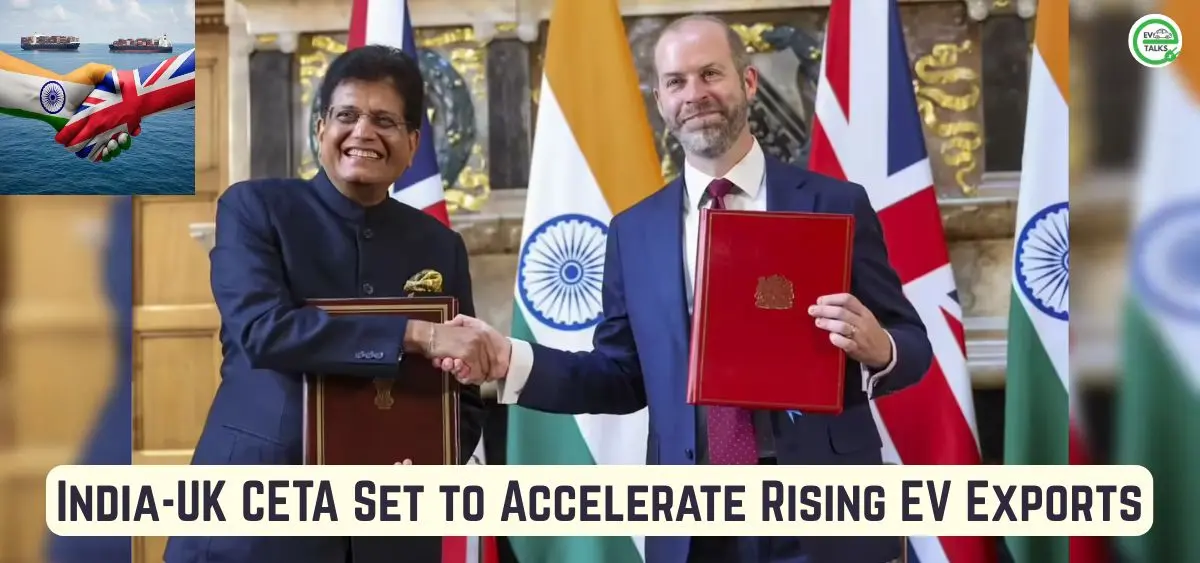

The India-UK CETA is poised to reshape India’s electric vehicle export landscape, creating fresh opportunities for domestic automakers in one of Europe’s most important right-hand-drive markets. Effective from July 15, 2026, the landmark agreement offers a structured roadmap for duty-free access of Indian-made electric, hybrid, and hydrogen-powered passenger vehicles to the United Kingdom, strengthening India’s position as a global EV manufacturing hub.

India’s EV Export Boom Continues
India’s electric vehicle exports have witnessed extraordinary growth in the last financial year. According to the latest trade data, total EV exports surged from $80.28 million in FY25 to $707.4 million in FY26, representing nearly a ninefold increase.
The United Kingdom has emerged as India’s second-largest export destination for electric vehicles. During FY26, India exported $168.5 million worth of EVs to the UK, accounting for 23.82% of the country’s total EV exports.
One of the most remarkable shifts has been the dominance of electric vehicles over conventional cars. EVs contributed 97.67% of all passenger vehicle exports from India to the UK during FY26, highlighting a dramatic transformation from previous years when internal combustion engine (ICE) vehicles led exports. This rapid expansion further reinforces the momentum behind Rising EV exports.
Duty-Free Market Access Under a Phased Framework
Under the India-UK CETA, Indian-made electric, hybrid, and hydrogen-powered passenger cars will receive 0% import duty in the UK through a phased, quota-based system.
The tariff concessions will begin in the sixth year of the agreement (around 2031-32) and apply to vehicles priced up to £80,000. Premium vehicles priced above this threshold will not qualify for duty exemptions.
The annual export quota will gradually increase over time:
- Under £20,000: 6,800 units initially, rising to 34,000 units.
- £20,000-£40,000: 6,800 units initially, increasing to 34,000 units.
- Above £40,000 to £80,000: 4,000 units initially, expanding to 20,000 units.
Overall, the annual allocation will grow from 17,600 vehicles in Year 6 to a maximum of 88,000 vehicles by Year 15, creating substantial opportunities for Rising EV exports.
Balanced Automotive Trade Framework
While opening its market for Indian clean-energy vehicles, the agreement also grants limited access for UK-made conventional ICE vehicles.
India will reduce import duties on eligible UK-manufactured ICE passenger cars from the current 100-110% to 10%, subject to a cumulative quota of 378,000 vehicles over 15 years, beginning with 20,000 units in the first year.
Importantly, India has safeguarded its domestic EV manufacturing ecosystem by excluding imported electric vehicles priced below £40,000 from tariff concessions, ensuring continued support for local manufacturers.
Indian Automakers Prepare for Global Expansion
Leading Indian automobile manufacturers have welcomed the agreement, viewing it as a strategic opportunity to strengthen exports.
Maruti Suzuki has already started exporting its flagship eVITARA to European markets and considers the UK a key destination for future growth.
Mahindra & Mahindra is expected to introduce premium electric models such as the BE 6 and XUV 9e to British customers under the new framework.
Tata Motors has also supported the agreement, stating that the phased approach will enhance the global competitiveness of Indian-made sustainable mobility technologies.
Stronger Bilateral Trade Ahead
The automotive provisions form a crucial part of the broader India-UK Comprehensive Economic and Trade Agreement, which aims to double bilateral trade between both nations to $100 billion by 2030.
With expanding production capacity, supportive government policies, and improved market access, the agreement is expected to position India as a leading global hub for clean mobility manufacturing. As the phased implementation progresses over the coming years, Rising EV exports are likely to play a pivotal role in strengthening India’s automotive exports while deepening economic ties with the United Kingdom.

Related Articles: