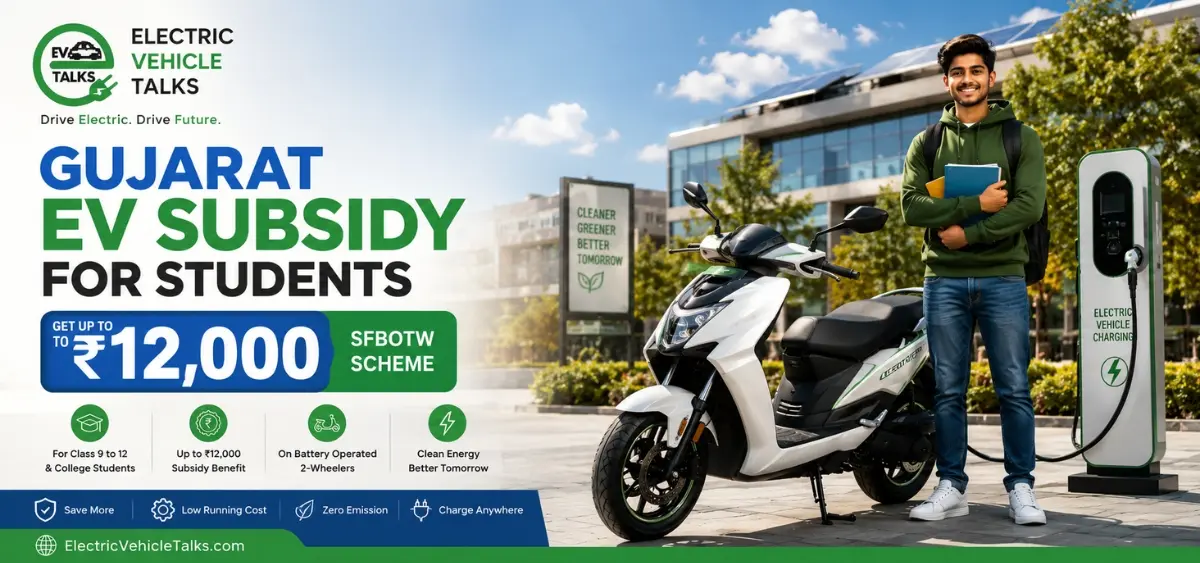

The Gujarat EV Subsidy for Students is associated with the Subsidy for Battery Operated 2-Wheelers (SFBOTW) scheme, under which the supplied scheme material specifies ₹12,000 financial assistance for eligible students purchasing an approved battery-operated two-wheeler. The stated beneficiaries include students from Class 9 to 12 and college students.
The scheme is implemented through the Gujarat Energy Development Agency (GEDA), and the supplied material requires the vehicle to be purchased from a GEDA-authorized manufacturer through the appropriate dealer network.
However, there is an important point that students and parents should understand before relying on the ₹12,000 figure.
The ₹12,000 amount is supported by the scheme material provided for this article, but the current GEDA EV portal should be checked for present-day availability, application windows, and applicable rules before purchasing an EV. The official portal currently displays information indicating that its FY 2024–25 two-wheeler application window closed after midnight on 3 July 2025.
In other words, an old article or dealer advertisement quoting ₹12,000 should not automatically be interpreted as confirmation that a new application is open today.
That distinction is critical in India’s rapidly changing EV subsidy landscape.
What Is the Gujarat EV Subsidy for Students?
The student-focused programme is referred to in the supplied material as the “Subsidy for Battery Operated 2-Wheelers,” or SFBOTW.
Its objective is to encourage the use of cleaner transportation among younger people by helping eligible students purchase battery-operated two-wheelers. The scheme material describes goals including pollution reduction, renewable-energy adoption, and greater awareness of sustainable transportation.
The headline benefit is straightforward:
₹12,000 financial assistance per eligible student
According to the supplied material, the programme covers students studying in Class 9 to 12 as well as college students, subject to the scheme’s conditions.
Subsidy for Battery-Operated 2-Wheelers (SFBOTW) at a glance
| Feature | Details |
|---|---|
| Student EV subsidy | ₹12,000, according to supplied scheme material |
| Scheme | Subsidy for Battery-Operated 2-Wheelers |
| Short form | SFBOTW |
| Target group | Eligible students |
| School students | Class 9 to 12 |
| College students | Yes, according to supplied material |
| Vehicle | Battery-operated two-wheeler |
| Dealer requirement | GEDA-authorized manufacturer/dealer |
| Income limit | None stated in supplied material |
| Implementing agency | GEDA |
| Current application status | Verify on official GEDA portal |
The supplied material also states that incomplete applications or documents can be rejected.
Is GEDA EV Subsidy the Same as the Student EV Subsidy?
This is where much of the online confusion comes from.
“GEDA EV subsidy schemes” is a broader expression. The Subsidy for Battery-Operated 2-Wheelers (SFBOTW) is the specific student-focused scheme described in the material provided for this article.
Meanwhile, phrases such as “Gujarat Government Electric Vehicle Subsidy for Students,” “student EV policy Gujarat,” and “electric scooter subsidy for students” are useful descriptive search terms rather than necessarily being the formal name of the government scheme.
The supplied material explicitly distinguishes the broader GEDA EV subsidy terminology from SFBOTW.
The terminology can be understood this way:
| Term | Meaning |
| SFBOTW | Specific student battery-operated two-wheeler scheme |
| Subsidy for Battery-Operated 2-Wheelers | Full scheme name |
| Gujarat EV Subsidy for Students | Descriptive term for the student benefit |
| Gujarat Government Electric Vehicle Subsidy for Students | Search/descriptive phrase |
| Student EV Policy Gujarat | Search/descriptive phrase |
| GEDA EV Subsidy for Students | Common descriptive reference |
| GEDA EV Subsidy Schemes | Broader GEDA EV-subsidy terminology |
For SEO, these phrases can be covered naturally in one comprehensive article. For factual accuracy, however, they should not be presented as seven separate government schemes.
How Much Is the Student Electric Scooter Subsidy?
The supplied SFBOTW material specifies a ₹12,000 subsidy per eligible student.
Because this is a fixed amount, its impact depends on the price of the electric scooter.
| Illustrative Scooter Price | ₹12,000 Assistance | Balance Before Other Costs* |
| ₹60,000 | ₹12,000 | ₹48,000 |
| ₹70,000 | ₹12,000 | ₹58,000 |
| ₹80,000 | ₹12,000 | ₹68,000 |
| ₹90,000 | ₹12,000 | ₹78,000 |
| ₹100,000 | ₹12,000 | ₹88,000 |
| ₹120,000 | ₹12,000 | ₹108,000 |
*Illustrative mathematics only. Actual subsidy treatment, insurance, registration, taxes, accessories, and other charges may differ.
For a student or family with a limited transportation budget, ₹12,000 can be meaningful.
But the right question is not simply:
“How much subsidy can I get?”
It is:
“What will this electric scooter cost me to own for the next three to five years?”
Who Is Eligible for the Gujarat EV Subsidy for Students?
According to the supplied scheme material, the applicant must be a student and must meet the relevant educational requirements.
The stated student categories include the following:
- Class 9 students
- Class 10 students
- Class 11 students
- Class 12 students
- College students
The student must also purchase an eligible battery-operated two-wheeler through the authorized GEDA channel.
The supplied FAQ states that the scheme applies to students studying in schools and colleges located within Gujarat.
Is there an income limit?
The supplied scheme material says there is no individual or family income limit for applying under this student subsidy.
That makes the programme different from many government assistance schemes where family income is a primary eligibility condition.
Can a Class 9–12 Student Get an Electric Scooter?
The supplied SFBOTW material includes students from Class 9 to 12.
However, eligibility for a subsidy and legal eligibility to ride a particular electric two-wheeler are two different things.
This is particularly important for younger students.
The supplied material distinguishes between low-speed and high-speed battery-operated two-wheelers and notes different license requirements.
Therefore, before purchasing, parents and students should check the following:
- Student’s age
- Vehicle’s certified speed category
- Driving licence requirement
- Registration requirement
- Insurance requirement
- Current RTO rules
A student should never assume that receiving or qualifying for a subsidy automatically gives them permission to operate any electric scooter on public roads.
Which Electric Scooters Qualify for the Subsidy?
This is one of the most important questions for prospective buyers.
Not every electric scooter automatically qualifies.
The supplied scheme requires the vehicle to be purchased from GEDA-authorized manufacturers through registered/authorized dealers.
That means students should verify eligibility before paying a booking amount.
Ask the dealer:
“Is this exact model and variant eligible under the current GEDA/SFBOTW student subsidy?”
Do not settle for a general statement such as
“All our electric scooters get a government subsidy.”
The model, manufacturer, dealer, and current programme rules all matter.
What Documents Are Required?
The supplied material identifies several documents associated with the application.
These include:
- Prescribed application form
- Bonafide certificate
- Student Aadhaar Card
- Academic documentation/mark sheet
- Passport-size photographs
- Supporting vehicle/dealer documents where required
The material specifically mentions a bonafide certificate for the relevant academic year and a self-certified Aadhaar copy. It also warns that incomplete applications may be rejected.
Document checklist
| Document | Purpose |
| Application form | Formal subsidy application |
| Bonafide certificate | Confirms student status |
| Aadhaar | Identity verification |
| Mark sheet | Academic verification where applicable |
| Photograph | Applicant identification |
| Vehicle invoice | Purchase verification |
| Dealer documentation | Confirms eligible purchase route |
Students should keep both physical and digital copies of all submitted documents.
How to Apply for the Gujarat EV Subsidy for Students
The supplied material describes a prescribed application form and document-submission process.
A practical process is the following:
Step 1: Check eligibility
Confirm that the student meets the current academic and location requirements.
Step 2: Verify the vehicle
Ask whether the exact electric two-wheeler is currently eligible.
Step 3: Verify the dealer
Make sure the manufacturer and dealer are authorized under the applicable GEDA process.
Step 4: Prepare documents
Collect the application form, Aadhaar, bona fide certificate, photographs, and academic documents.
Step 5: Complete the application
Check every spelling and number against the supporting documents.
Step 6: Submit the application
The supplied material describes submission of the completed application and supporting documents and recommends obtaining an acknowledgement.
Step 7: Retain the paperwork
Keep the acknowledgement, invoice, and subsidy-related documentation until the process is complete.
Can You Apply for the GEDA EV Subsidy Online?
The phrase “GEDA EV subsidy application online” is common in searches, but this needs careful explanation.
The official GEDA EV website currently provides an online portal and an “Apply Online” facility.
However, the exact availability and workflow of a student SFBOTW application should not be assumed from the existence of the portal alone.
The supplied scheme material describes a prescribed form/document process and also refers to dealer-side processing through the GEDA EV portal.
More importantly, the official portal currently carries a notice that the FY 2024–25 GEDA EV two-wheeler applications closed on July 3, 2025.
Therefore, readers should not interpret the ₹12,000 figure in this article as confirmation that a fresh 2026 application window is currently open.
Best practice
Before buying:
- Visit the official GEDA EV portal.
- Check the current notification.
- Confirm whether the student scheme/application window is open.
- Verify the eligible vehicle list.
- Verify the authorized dealer.
- Ask for written confirmation of the applicable subsidy.
Why the Current Application Status Matters
Government EV incentives are not static.
A subsidy can have:
- A defined financial year
- An application deadline
- A limited budget
- Vehicle eligibility conditions
- Manufacturer requirements
- Dealer requirements
- Revised documentation
- A revised subsidy amount
That is why an article published in 2024 or 2025 can still appear in Google while describing an application process that is no longer open.
The official GEDA portal’s current notice is a useful example: it explicitly says that applications for the FY 2024–25 two-wheeler programme closed in July 2025.
For this reason, always verify the current government notification before making a purchase decision based on a subsidy.
What Is the Difference Between SFBOTW and Gujarat EV Policy?
Another common source of confusion is the broader Gujarat EV policy.
The SFBOTW student programme discussed here should not automatically be treated as synonymous with every incentive ever announced under Gujarat’s broader EV policy framework.
The supplied material specifically identifies SFBOTW as the student battery-operated two-wheeler scheme.
This distinction matters because older online articles may mention different subsidy amounts, vehicle categories or policy periods.
For a student researching an electric scooter, remember:
SFBOTW = specific student two-wheeler scheme
GEDA EV Subsidy Schemes = broader terminology
Gujarat EV Policy = broader state EV policy framework
Gujarat EV Subsidy for Students = descriptive search phrase for the student benefit
This makes the article’s search intent much clearer.
What About FAME II and PM E-DRIVE?
Students may also encounter FAME, FAME II, EMPS, and PM E-DRIVE when searching for an electric scooter subsidy.
These are central government programs and should not be confused with the Gujarat-specific SFBOTW scheme.
PM E-DRIVE is the current central EV-support framework and includes electric two-wheelers among its covered categories. The Ministry of Heavy Industries maintains the official PM E-DRIVE policy and programme information.
The important point for a buyer is the following:
A Gujarat state subsidy and a central EV incentive are separate policy mechanisms.
Whether incentives can be combined depends on the vehicle, manufacturer, purchase date and the applicable rules.
Never assume that every subsidy advertised online can simply be stacked on top of every other subsidy.
How Much Can an Electric Scooter Save a Student?
The upfront subsidy is only one part of the financial equation.
Electric scooters can also benefit from lower energy costs.
Consider an illustrative electric scooter consuming 3 kWh per 100 km.
At an electricity cost of ₹8/kWh:
3 × ₹8 = ₹24 per 100 km
Now consider a petrol scooter delivering 45 km/liter with petrol priced at ₹100/liter:
100 ÷ 45 × ₹100 ≈ ₹222 per 100 km
These are examples rather than guaranteed real-world figures.
Actual EV efficiency depends on the following:
- Rider weight
- Traffic
- Speed
- Tyre pressure
- Road conditions
- Weather
- Battery condition
- Riding mode
- Electricity tariff
Nevertheless, the calculation illustrates why the economics of an EV can extend beyond the subsidy itself.
Example: Five-Year Running-Cost Comparison
Imagine a student travels 25 km per day for 300 days each year.
That is approximately
7,500 km per year
Over five years:
37,500 km
Using the illustrative energy assumptions above:
Electric scooter
37,500 × ₹24 ÷ 100
= ₹9,000
Petrol scooter
37,500 × ₹222 ÷ 100
= approximately ₹83,250
The illustrative energy cost difference is therefore around:
₹74,250 over five years
This is not a guaranteed saving. Petrol prices, electricity tariffs, real-world efficiency, and annual mileage will vary.
It also does not account for insurance, maintenance, battery replacement, financing, or depreciation.
But it demonstrates an important principle:
Don’t evaluate an EV only by its purchase price.
Evaluate the total cost of ownership.
How Should Students Choose an Electric Scooter?
A subsidy can make an electric scooter cheaper to purchase, but it cannot make a poor scooter a good one.
Students should consider at least seven factors.
1. Real-world range
Don’t rely exclusively on the headline’s claimed range.
Ask about realistic city riding.
2. Battery warranty
Check:
- Warranty period
- Kilometre limit
- Battery-health conditions
- Replacement policy
- Warranty exclusions
3. Charging convenience
Ask:
Where will I charge every night?
For many student users, home charging will be the most practical option.
4. Service network
A scooter with excellent specifications but poor service support can become expensive and inconvenient.
5. Spare parts
Check availability and pricing of tires, brakes, the charger, body panels, and other important components.
6. Safety
Prioritize:
- Good braking
- Quality tyres
- Adequate suspension
- Proper lighting
- Vehicle stability
- Battery safety systems
7. Total on-road price
Compare the complete cost—not just the ex-showroom price.
Low-Speed vs High-Speed Electric Scooters
This distinction deserves special attention when the buyer is a student.
The supplied material discusses both low- and high-speed battery-operated two-wheelers and notes different license requirements.
| Factor | Low-Speed EV | High-Speed EV |
| Speed | Up to applicable low-speed limit | Above low-speed limit |
| License | Depends on vehicle/category rules | Generally required |
| Registration | Depends on applicable classification | Generally applicable |
| Best suited to | Short local travel | Wider urban commuting |
| Student consideration | Check age and legal requirements | License eligibility is critical |
The exact regulatory classification of a vehicle should always be confirmed from the manufacturer’s documentation and applicable government/RTO rules.
Do not buy a scooter simply because a salesperson says that a license is not required.
Charging an Electric Scooter in Gujarat
Charging is one of the biggest practical differences between an EV and a petrol vehicle.
For a student with secure parking and a suitable domestic power connection, home charging can be extremely convenient.
The supplied GEDA material also highlights home charging as one of the advantages of battery-operated vehicles.
A typical routine is simple:
Come home → plug in → charge overnight → ride the next morning.
However, students who travel longer distances should also understand local public-charging availability.
The broader EV ecosystem in Gujarat is continuing to develop, while GEDA’s official EV platform itself describes the state’s objective of becoming an EV capital and promoting EV adoption.
The practical advice is simple:
Buy an EV that fits your charging routine, rather than depending entirely on public charging.
Benefits of the Gujarat EV Subsidy for Students
If the student subsidy is currently open and the applicant meets all applicable conditions, the programme can provide several benefits.
Lower upfront cost
The stated ₹12,000 assistance can reduce the initial purchase burden.
Lower daily running costs
Electricity can be cheaper per kilometre than petrol depending on usage and local energy prices.
Cleaner mobility
Battery-electric scooters produce no tailpipe emissions during operation.
Convenient charging
Home charging can eliminate frequent fuel-station visits.
Lower conventional powertrain maintenance
Electric scooters do not require many traditional engine-related maintenance tasks.
Greater EV awareness
The scheme’s stated objective includes creating awareness about sustainable transport among younger people.
Challenges Students Should Consider
The subsidy does not remove the challenges associated with EV ownership.
Battery replacement
The traction battery is one of the most expensive components of an EV.
Charging access
Apartment residents and students without dedicated parking may face charging difficulties.
Service availability
Service quality can vary considerably between manufacturers.
Resale value
The electric two-wheeler resale market continues to evolve.
Technology changes
Battery chemistry, software, and charging technology are developing rapidly.
Policy uncertainty
Subsidy schemes can change, close, or be revised.
That last point is especially important.
The current GEDA portal’s notice about the FY 2024–25 application closure demonstrates why buyers should verify current programme status rather than relying on historical articles.
Common Mistakes When Applying for the Student EV Subsidy
Mistake 1: Assuming the ₹12,000 subsidy is automatically available
Better approach: Check the current official GEDA notification.
Mistake 2: Buying the scooter before verifying eligibility
Better approach: Confirm the vehicle, manufacturer, and dealer before paying.
Mistake 3: Believing every electric scooter qualifies
Better approach: Verify the exact model and variant.
Mistake 4: Confusing old Gujarat subsidy figures
Better approach: Identify the exact scheme and financial year.
Mistake 5: Submitting incomplete documents
The supplied scheme material specifically warns that incomplete applications may be rejected.
Mistake 6: Ignoring license requirements
Subsidy eligibility and road-use legality are separate issues.
Mistake 7: Choosing a scooter only because it gets a subsidy
The best vehicle is the one that fits the student’s actual daily requirements.
Expert Insight from Electric Vehicle Talks
The most important thing for Gujarat students is to look beyond the headline ₹12,000.
A government incentive can reduce the upfront price, but it does not determine whether an EV is reliable, safe, or economical over five years.
From an EV ownership perspective, students should evaluate the vehicle using four questions:
Can I charge it conveniently?
If charging every night is difficult, even an inexpensive EV can become inconvenient.
Can I legally ride it?
Age, license, registration, and vehicle classification must all be considered.
Can I get it serviced locally?
A strong local service network is extremely valuable.
What happens to the battery after several years?
Battery warranty and long-term battery support should be treated as core purchase criteria.
The ₹12,000 SFBOTW benefit can be valuable when it is currently available, but it should be viewed as one component of the ownership equation rather than the entire reason to buy an EV.
For EV buyers, policy awareness is increasingly as important as vehicle awareness.
That is why Electric Vehicle Talks covers EV subsidies alongside batteries, charging infrastructure, ownership costs, and electric-vehicle technology.
Explore Electric Vehicle Talks
Why Student EV Adoption Matters for Gujarat
A student switching from a petrol two-wheeler to an electric scooter represents more than one vehicle becoming electric.
It introduces a younger consumer to a different way of thinking about transportation.
Instead of:
Petrol → fuel station → engine maintenance
the experience becomes the following:
Electricity → home charging → battery management
That behaviour change can have a long-term impact.
Students who become comfortable with EV technology today are likely to be more familiar with electric cars, electric two-wheelers, charging networks, and battery technology when they become larger vehicle buyers tomorrow.
This is one reason student-focused EV programmes can have significance beyond their immediate financial value.
Is the Gujarat EV Subsidy for Students Currently Open?
The supplied scheme material specifies a ₹12,000 student subsidy, but current availability should be verified before purchase.
The official GEDA EV portal currently displays a notice stating that two-wheeler applications for FY 2024–25 closed after 12:00 midnight on July 3, 2025.
Therefore, readers should not assume that the ₹12,000 SFBOTW benefit is automatically available for a new purchase in August 2026 merely because the scheme amount appears in older documentation.
This is an important editorial distinction.
The article explains the scheme and its documented benefit, but the current application window, funding availability, and eligibility must be verified through GEDA.
How to Verify the Latest GEDA EV Subsidy Information
Before making a purchase, follow this sequence:
1. Visit the official GEDA EV portal
2. Check current notifications
Look for:
- Current financial year
- Application dates
- Scheme status
- Eligible vehicles
- Dealer information
3. Confirm the dealer
Don’t rely solely on a showroom’s claim.
4. Confirm the subsidy in writing
Ask the dealer to explain:
- Subsidy amount
- Eligibility
- Application procedure
- Whether the subsidy is deducted from the invoice or processed separately
- Expected processing timeline
5. Keep all records
Retain:
- Application
- Invoice
- Acknowledgement
- Student documents
- Dealer correspondence
- Subsidy documentation
This creates a clear record if there is a later dispute.
Student EV Subsidy Buying Checklist
Before paying for an electric scooter, confirm:
- Student meets the current eligibility requirements
- Student is studying in Gujarat
- The current SFBOTW application window is open
- The exact vehicle is eligible
- Manufacturer authorization is confirmed
- Dealer authorization is confirmed
- ₹12,000 benefit is confirmed under the applicable current rules
- Bonafide certificate is available
- Aadhaar documentation is ready
- Academic documents are ready
- License requirements are understood
- Registration requirements are understood
- Insurance has been included in the budget
- Charging location is available
- Battery warranty has been checked
- A local service centre is available
- The invoice and acknowledgement will be retained
People Also Ask
What is the Gujarat EV subsidy for students?
The Gujarat student EV subsidy discussed in this article refers to the Subsidy for Battery Operated 2-Wheelers (SFBOTW). The supplied scheme material specifies ₹12,000 financial assistance per eligible student.
Who is eligible for the ₹12,000 electric scooter subsidy?
The supplied material identifies students studying in classes 9 to 12 and college students as eligible categories, subject to the applicable scheme requirements.
Is there an income limit for the Gujarat student EV subsidy?
The supplied scheme material states that there is no individual or family income limit for the student subsidy.
Can any electric scooter receive the GEDA subsidy?
No. The supplied scheme requires the vehicle to be purchased from a GEDA-authorized manufacturer through the authorized dealer network.
Is SFBOTW the same as GEDA EV Subsidy Schemes?
Not exactly. SFBOTW is the specific student battery-operated two-wheeler scheme, while GEDA EV Subsidy Schemes is broader terminology associated with GEDA’s EV programs.
Can I apply for the GEDA EV subsidy online?
The GEDA EV portal provides an online platform, but the current availability and exact workflow for the student scheme must be verified through the official portal. The portal currently shows that the FY 2024–25 two-wheeler application window closed in July 2025.
Is the ₹12,000 subsidy currently available in 2026?
The supplied scheme material specifies ₹12,000, but the currently available information on the official portal does not establish that a new 2026 student application window is open. Verify the current notification directly with GEDA before purchasing.
Gujarat EV Subsidy for Students FAQs
1. What does SFBOTW stand for?
SFBOTW stands for Subsidy for Battery-Operated 2-Wheelers.
2. How much is the student EV subsidy?
The supplied scheme material specifies ₹12,000 per eligible student.
3. Which students are covered?
The supplied material covers students from Class 9 to 12 and college students.
4. Is there an income limit?
The supplied material states that there is no individual or family income limit for the scheme.
5. What documents are required?
The supplied information includes an application form, bona fide certificate, Aadhaar, and academic documents among the requirements.
6. Does the student have to buy from a GEDA-authorized dealer?
Yes. The supplied material specifically requires purchase through the authorized manufacturer/dealer network.
7. Can a student from outside Gujarat apply?
The supplied FAQ states that the scheme applies to students studying in schools and colleges located within Gujarat.
8. Can a Class 9 student legally ride every electric scooter?
No. Subsidy eligibility and driving eligibility are different. The student must comply with the applicable age, license, registration, and vehicle-category rules.
9. Is the old ₹20,000 Gujarat EV subsidy the same as SFBOTW?
No. Historical or broader Gujarat EV policy incentives should not automatically be treated as the current SFBOTW student benefit.
10. Where should I check the latest GEDA EV subsidy status?
The official GEDA EV portal should be the first source to check. Its current site carries programme notifications and application information.
Conclusion
The Gujarat EV Subsidy for Students is best understood through the specific scheme identified in the supplied material as the Subsidy for Battery-Operated 2-Wheelers (SFBOTW).
The documented benefit is ₹12,000 for eligible students, with the stated student categories covering Class 9 to 12 and college students. The vehicle must be purchased through the appropriate GEDA-authorized manufacturer and dealer network.
But there is an important 2026 caveat.
The ₹12,000 figure should not be presented as proof that the subsidy is currently open for new applications. The official GEDA EV portal currently shows that the FY 2024–25 two-wheeler application period closed on July 3, 2025.
For that reason, students and parents should verify the latest GEDA notification before booking an electric scooter.
The smartest approach is the following:
Check the scheme → verify eligibility → verify the vehicle → verify the dealer → confirm the current subsidy → prepare documents → calculate total ownership cost → then purchase.
The subsidy can reduce the initial financial barrier, but the best electric scooter is ultimately the one that offers the right combination of safety, battery warranty, real-world range, charging convenience, service support, and long-term value.
India’s EV transition is moving rapidly, and young consumers are becoming an increasingly important part of that shift. For Gujarat students, understanding the policy is therefore just as important as understanding the technology.
For more EV subsidy updates, electric scooter guides, charging information, battery technology, and Indian EV industry analysis, explore Electric Vehicle Talks.