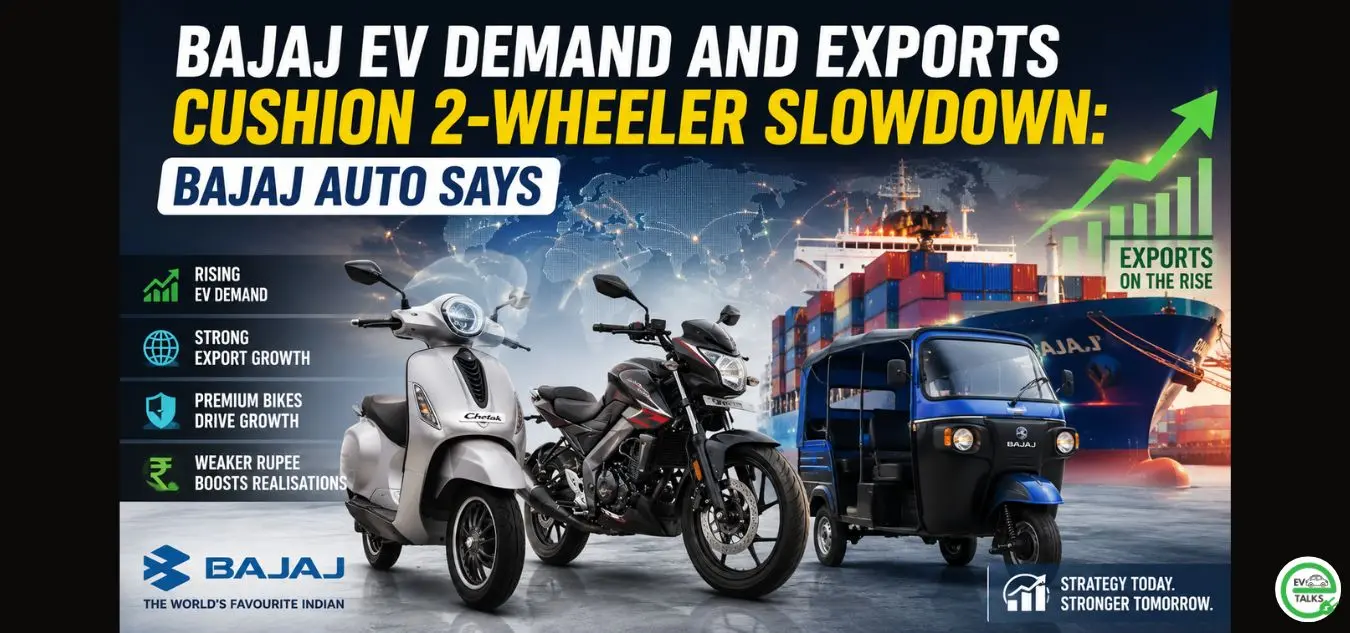

Bajaj Auto is relying on strong export growth, rising electric vehicle adoption, and premium motorcycle sales to offset the ongoing slowdown in India’s domestic two-wheeler market. According to Executive Director Rakesh Sharma, the company is witnessing robust momentum in international markets and electric mobility, even as inflation and weaker consumer sentiment continue to affect entry-level motorcycle demand. Bajaj EV demand and Exports
The company’s strategy comes at a time when the broader two-wheeler industry is experiencing a significant decline in growth, forcing manufacturers to explore new revenue streams and growth opportunities.

Export Business Emerges as a Major Growth Engine
One of the biggest factors supporting Bajaj Auto’s performance is its expanding export business. Sharma stated that the company expects monthly export volumes to exceed 250,000 units in the coming months, reflecting strong demand across key international markets.
“We are looking at 250,000 here and onwards for the next few months,” Sharma said, highlighting confidence in the company’s global operations.
In May 2026, Bajaj Auto’s total exports surged 34% year-on-year to 213,226 units. Two-wheeler exports increased by 30%, while commercial vehicle exports, primarily three-wheelers, jumped an impressive 65%.
The export growth is being driven by a sharp recovery in Nigeria, continued strength across Africa, and sustained expansion in Latin America. Nigeria’s retail volumes have nearly doubled compared to last year, while Bajaj’s business in Latin America continues to grow by more than 35%.
The stabilisation of foreign exchange reserves in several African economies and a weaker Indian rupee have further strengthened export competitiveness and profitability.
Bajaj EV Demand Continues to Accelerate
A key pillar of the company’s growth strategy is the rapid expansion of its electric vehicle business. Rising fuel prices are encouraging consumers to switch from conventional petrol-powered vehicles to electric alternatives.
According to Sharma, every significant increase in petrol prices triggers a noticeable rise in electric vehicle purchases. This trend has significantly boosted Bajaj EV demand across multiple product categories.
Electric scooters are currently growing at a rate of 60-70% across the industry, while electric three-wheelers are witnessing growth close to 100%.
Chetak Strengthens Position in India’s EV Market
The company’s EV portfolio, led by the Chetak scooter range, continues to gain traction. Bajaj has expanded its lineup with more affordable models, such as the Chetak C25, while increasing production capacity to support future demand.
The growing Bajaj EV demand has helped the company cross 50,000 EV unit sales and generate more than ₹1,000 crore in revenue. Chetak’s market share has also improved to 23%, while the EV business continues to maintain healthy single-digit profit margins.
In the electric three-wheeler segment, Bajaj has captured nearly 40% market share and aims to move closer to the dominance it historically enjoyed in internal combustion engine (ICE) three-wheelers.
Premium Motorcycles Continue to Outperform
While entry-level motorcycles are facing demand pressure, premium motorcycles remain a bright spot for the company. Bajaj Auto has introduced 10 new variants since October and continues to gain market share in the 150cc-plus category.
Models under the Pulsar, Dominar, KTM, and Triumph portfolios are benefiting from stronger demand among affluent consumers. Sharma noted that premium motorcycle sales are growing nearly twice as fast as the overall industry, helping protect margins despite broader market weakness.
Domestic Two-Wheeler Industry Faces Headwinds
The domestic two-wheeler market has slowed considerably in recent months. Industry growth, which was close to 20% in March, has now fallen to around 5%.
Higher vehicle prices, inflationary pressures, LPG shortages, and weaker consumer confidence have impacted discretionary spending, particularly in the mass-market segment.
“There has been a sharp decline between March and April and May,” Sharma said, pointing to the challenging demand environment.
Despite these challenges, rising Bajaj EV demand and strong export performance are helping the company maintain growth momentum.
Risks Remain on the Horizon
Although the outlook remains positive, Bajaj Auto continues to monitor several risks. Geopolitical tensions in West Asia have created shipping disruptions, forcing vessel diversions and increasing ocean freight costs by 20% to 50% in some routes.
Additionally, the adoption of Bajaj’s CNG motorcycles has been slower than expected due to a narrowing price gap between petrol and CNG in several Indian states.
Outlook Remains Positive
Despite a slowing domestic market, Bajaj Auto remains optimistic about its growth prospects. Strong international demand, expanding electric vehicle adoption, and continued success in premium motorcycles are expected to support revenue and profitability.
With exports targeting 250,000 units per month and Bajaj EV demand continuing to rise, the company believes its diversified strategy will help it navigate market uncertainties while strengthening its position in both domestic and global markets.

Related Articles: