
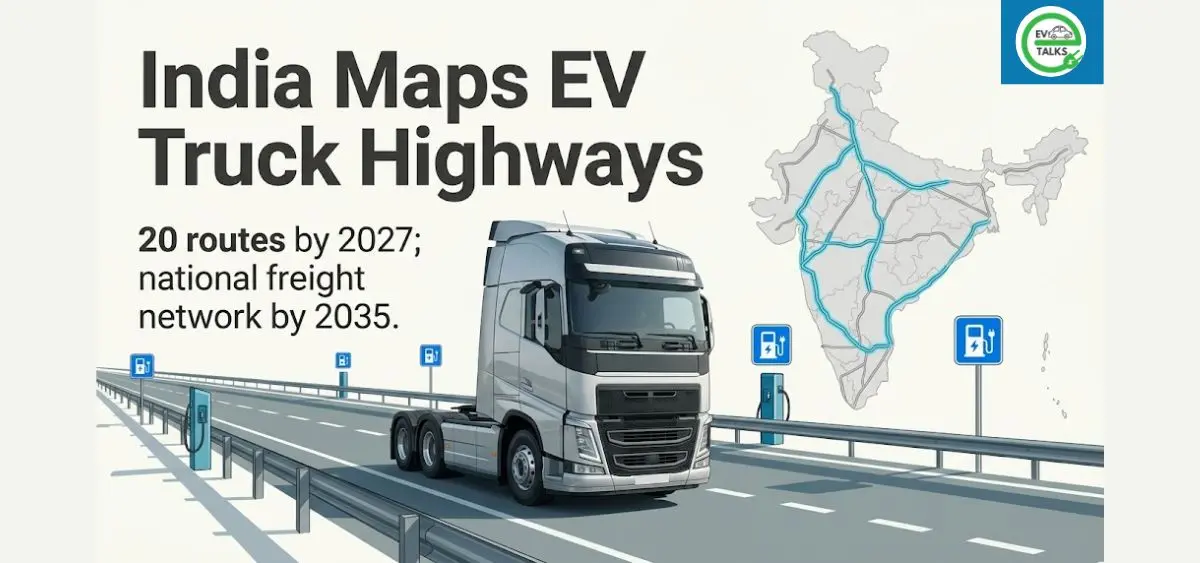

India Launches First National EV Freight Highway Framework, marking a significant milestone in the country’s transition toward sustainable transportation and low-carbon logistics. The newly unveiled National EV Highway Guidance Framework provides India’s first evidence-based roadmap for shifting freight movement from diesel-powered trucks to zero-exhaust-emission Battery Electric Trucks (BETs).
The framework has been introduced by The Climate Pledge and the C40 Cities climate network to reduce emissions from India’s freight sector and improve long-term logistics efficiency. The initiative aligns with India’s broader commitment to achieving net-zero emissions by 2070 and accelerating the adoption of clean mobility solutions.
Why the EV Freight Highway Framework Matters
India’s road transport sector currently handles nearly 70% of the nation’s freight movement. While medium and heavy-duty trucks account for only about 3% of vehicles on Indian roads, they contribute approximately 53% of transport-related particulate emissions.
With freight demand expected to increase more than fourfold by 2050, policymakers and industry leaders see electrification as a critical solution for reducing pollution and supporting sustainable economic growth. The fact that India has launched the first national EV Freight Highway framework demonstrates the urgency of transforming the country’s freight ecosystem.
Key Targets and Implementation Timeline
The National EV Highway Guidance Framework proposes a phased approach to electrifying India’s busiest freight corridors.
2027 Goal
The first phase focuses on electrifying 20 priority freight highways identified by the Ministry of Heavy Industries. These routes will serve as the foundation for large-scale electric freight operations across the country.
2035 Goal
By 2035, the framework envisions a nationwide EV-ready freight network connecting industrial clusters, logistics hubs, manufacturing centers, and major ports through extensive high-power charging infrastructure.
Five Pillars of the Framework
The roadmap is built around five strategic pillars:
- Highway Profiling to identify high-priority freight corridors.
- Demand Enablement through corporate commitments and incentives.
- Infrastructure Development with reliable high-speed charging stations.
- Operations Optimization to improve route planning and fleet efficiency.
- A Just Transition that supports drivers, workers, and small businesses during the shift to electric freight.
Insights from the Laneshift Pilot Project
The framework is based on extensive findings from the Laneshift pilot project. The initiative completed more than 600 electric truck trips along the Bengaluru-Chennai corridor, covering over 200,000 kilometers across various industries.
To evaluate long-distance viability, electric trucks also completed a 6,500-kilometer journey across the Golden Quadrilateral connecting Delhi, Mumbai, Chennai, and Kolkata. The project demonstrated that electric freight operations are commercially viable, particularly for routes exceeding 400 kilometers per day.
The pilot also resulted in a 4.2-fold increase in electric truck orders and secured long-term commercial contracts, highlighting growing confidence in electric freight transportation.
Government and Industry Collaboration Driving Change
Industry leaders and policy experts have emphasized that successful freight electrification will require close collaboration between government agencies, logistics companies, truck manufacturers, energy providers, financiers, and technology partners.
Experts believe the framework creates a scalable pathway for electric trucking by combining corporate procurement commitments with supportive government initiatives such as PM E-DRIVE, which offers incentives for truck scrappage and charging infrastructure development.
The Road Ahead
As India Launches First National EV Freight Highway framework, the country positions itself as a global leader in sustainable freight transportation. The roadmap not only aims to reduce harmful emissions but also seeks to enhance supply chain efficiency, energy security, and economic competitiveness.
With clear targets for 2027 and 2035, strong public-private collaboration, and proven results from real-world pilot projects, India Launches First National EV Freight Highway initiative could become a transformative step toward building a cleaner, smarter, and more resilient logistics network for the future.

Related Articles:









