
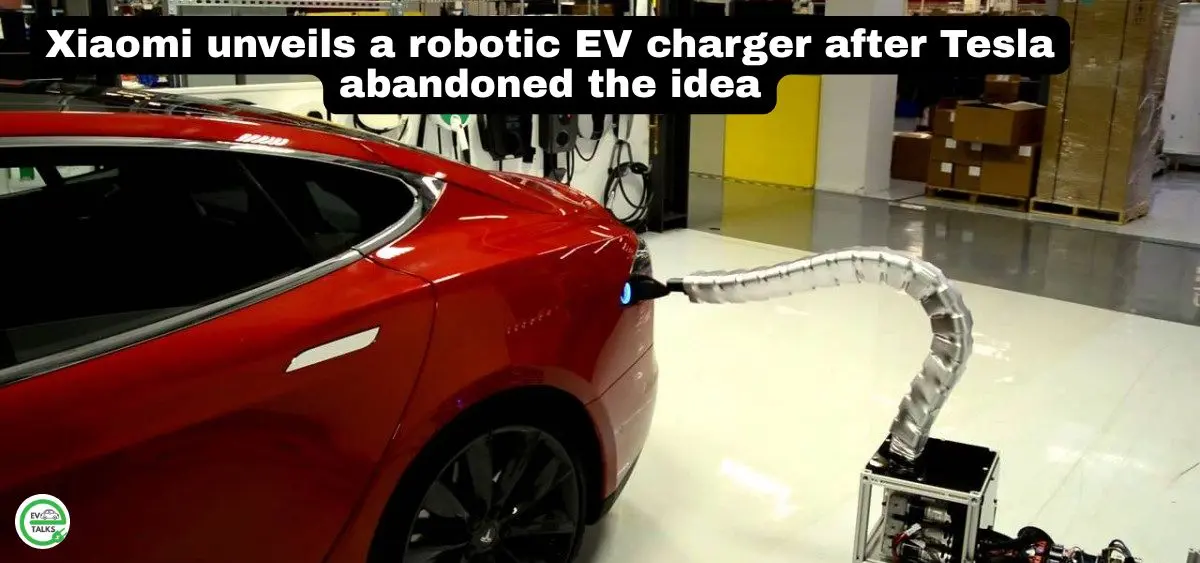

Xiaomi unveils a robotic EV charger designed to eliminate one of the last manual tasks remaining in electric vehicle ownership—plugging in the charging cable. The new Home Charging Robotic Arm automatically connects and disconnects an EV without any human intervention, bringing a fully hands-free charging experience to residential garages.
The technology giant has confirmed plans to launch the innovative charging accessory in the fourth quarter of 2026. Designed specifically for home use, the system aims to simplify daily EV charging while maintaining the efficiency advantages of traditional plug-in charging.

A Smart Charging Solution for Modern EV Owners
The Home Charging Robotic Arm is engineered to handle the complete charging process from start to finish. Once a vehicle is parked, the robotic arm identifies the charging port, aligns itself, plugs in the connector, manages charging, and automatically disconnects when the battery reaches its preset level.
The compact unit features an ultra-slim chassis measuring just 152 mm wide, allowing it to fit easily into tight residential garages where space is often limited.
To achieve precise operation, Xiaomi combines several advanced technologies, including:
- AI-powered visual positioning
- Millimeter-wave radar
- 3D vision recognition
- Vehicle-to-charger communication systems
These technologies enable the robotic arm to locate charging ports with sub-millimeter accuracy and automatically trigger motorized charging port covers when needed.
Bringing Tesla’s Abandoned Concept to Reality
More than a decade ago, Tesla showcased a futuristic “snake charger” prototype capable of automatically connecting to electric vehicles. Although the concept generated significant interest, it never reached commercial production.
Today, Xiaomi unveils robotic EV charger technology that effectively delivers on the promise Tesla once envisioned. Rather than pursuing wireless charging solutions, Xiaomi focused on perfecting a physical robotic charging arm that can be deployed in real-world residential environments.
The company says its demonstration was performed using production-ready hardware in an actual home setting, highlighting its readiness for commercial deployment.
Why Robotic Charging Could Beat Wireless Alternatives
One of the biggest advantages of Xiaomi’s system is its ability to maintain high charging efficiency.
Wireless charging technologies offer convenience but typically operate at efficiency levels between 88% and 93% under ideal conditions. Direct plug-in charging systems generally achieve around 95% efficiency because they eliminate the air gap between the charger and the vehicle.
This efficiency difference can translate into lower energy losses and reduced electricity costs over the years of daily charging. Physical charging systems also support higher power delivery than most wireless charging standards, which are commonly limited to around 11 kW.
As a result, Xiaomi unveils a robotic EV charger as a solution that combines the convenience of automation with the performance benefits of traditional wired charging.
Seamless Integration with Xiaomi’s Smart Ecosystem
The robotic charger integrates directly into Xiaomi’s broader smart home and vehicle ecosystem. Users can monitor charging progress, schedule charging sessions, and send remote commands through a smartphone application.
The system also communicates directly with compatible vehicles, creating a smooth and automated charging experience from arrival to departure.
Growing Competition in the Automated Charging Market
Xiaomi’s announcement places the company among a growing number of Chinese technology and automotive firms exploring autonomous charging solutions. Companies such as Li Auto and Huawei’s HIMA ecosystem are also investing in next-generation charging technologies.
Li Auto has already revealed testing activities involving its own automated charging robot, signaling increasing competition in the premium EV segment.
While Xiaomi has not announced pricing details, the final cost will likely play a major role in determining consumer adoption. The robotic arm is expected to join the company’s existing lineup of 7 kW and 11 kW wallbox chargers.
The Future of Hands-Free EV Charging
As electric vehicles become increasingly mainstream, convenience is emerging as a key differentiator in charging technology. By automating one of the final manual steps in EV ownership, Xiaomi unveils a robotic EV charger that could redefine how drivers charge their vehicles at home.
If the product launches as planned in late 2026, it may mark a significant step toward a future where EV charging happens automatically, efficiently, and without requiring drivers to touch a charging cable at all.

Related Articles:









