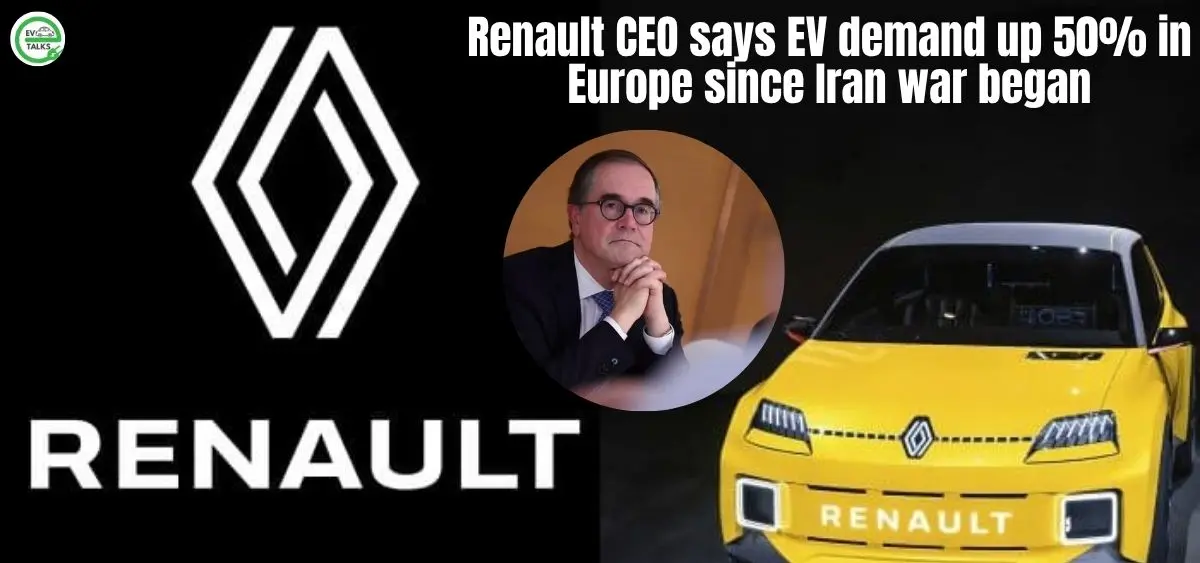

French automaker Renault has reported a sharp increase in demand for its electric vehicles (EVs) across Europe, with company executives revealing that Renault EV orders have surged in Europe by as much as 50% in key markets such as France and Germany since the start of the Iran war.
According to Renault Group CEO François Provost, the geopolitical conflict has triggered a significant rise in fuel prices across Europe, prompting consumers to shift rapidly toward electric mobility. The sudden increase in petrol and diesel costs has encouraged buyers to explore both new and used electric vehicles as a more economical transportation option.
Fuel Price Shock Boosts EV Demand Across Europe
The ongoing conflict in Iran has had a direct impact on global energy markets, pushing fuel prices higher and increasing operating costs for conventional vehicles. As a result, Renault EV orders have surged in Europe, reflecting a broader trend seen across the continent.
Industry data shows that fully electric vehicle sales in Europe increased by 29% during the first four months of the year, reaching nearly one million units. Demand has also risen significantly in the second-hand EV market, as consumers seek alternatives to expensive fuel-powered vehicles.
The Provost noted that the current wave of interest in electric cars is closely linked to the fuel price shock. However, he believes that even if fuel prices decline after the conflict ends, the long-term transition toward electric mobility will continue to gain momentum.
Renault Expands Production Plans to Meet Demand
The rapid growth in orders has created new challenges for Renault’s manufacturing and supply chain operations. The company revealed that it is currently pushing supplier capacity to its limits as it works to fulfill the growing number of EV orders.
To address the situation, Renault has established a dedicated internal task force focused on managing production and delivery requirements. The automaker is also considering adding extra production shifts during the second half of the year at its EV manufacturing facilities in Douai and Maubeuge in France, as well as Novo Mesto in Slovenia.
Despite the surge in demand, Renault confirmed that it is not experiencing any battery supply shortages. Instead, the primary challenge is ensuring suppliers can keep pace with production requirements as Renault EV orders have surged in Europe at an unexpected rate.
Focus on Affordable EV Technology
As part of its long-term electric vehicle strategy, Renault is exploring the use of lithium-iron-phosphate (LFP) batteries at its Douai facility through battery partner Envision AESC.
LFP batteries are significantly cheaper than traditional battery technologies because they do not require costly materials such as cobalt and nickel. Since batteries can account for nearly half the cost of an electric vehicle, adopting LFP technology could help Renault produce more affordable EVs for European consumers.
The company believes this move will strengthen its competitiveness while supporting broader EV adoption across the region.
Renault Rejects Factory-Sharing Offers
While some European automakers have sought partnerships with Chinese manufacturers to utilize unused factory capacity, Renault has taken a different approach.
Provost confirmed that Renault has declined proposals from companies seeking access to its production lines. Unlike competitors dealing with excess manufacturing capacity, Renault is currently focused on increasing output as Renault EV orders have surged in Europe and demand continues to outpace expectations.
Outlook: Strong Growth Expected Despite Market Changes
Although Renault expects the current surge in EV demand to moderate if fuel prices stabilize, the company has already revised its long-term electric vehicle sales forecasts upward. The latest market trends suggest that consumers are increasingly embracing electric mobility, and the transition away from traditional fuel-powered vehicles is expected to continue across Europe.
With expanding production plans, strong battery supply support, and growing consumer interest, Renault appears well-positioned to capitalize on the accelerating shift toward electric transportation.

Related Articles: