
Europe’s electric vehicle industry is entering a new phase as manufacturers look beyond vehicle production for future growth. With EV sales growth slowing in several markets and new regulatory requirements approaching, European EV Makers Turn to BESS as a strategic move to maximize existing battery investments and unlock new revenue streams.
Industry experts believe battery energy storage systems (BESS) could become a major growth engine for automotive manufacturers that have already invested billions of euros in battery gigafactories across Europe.
Battery Passport Regulation Driving Industry Transformation
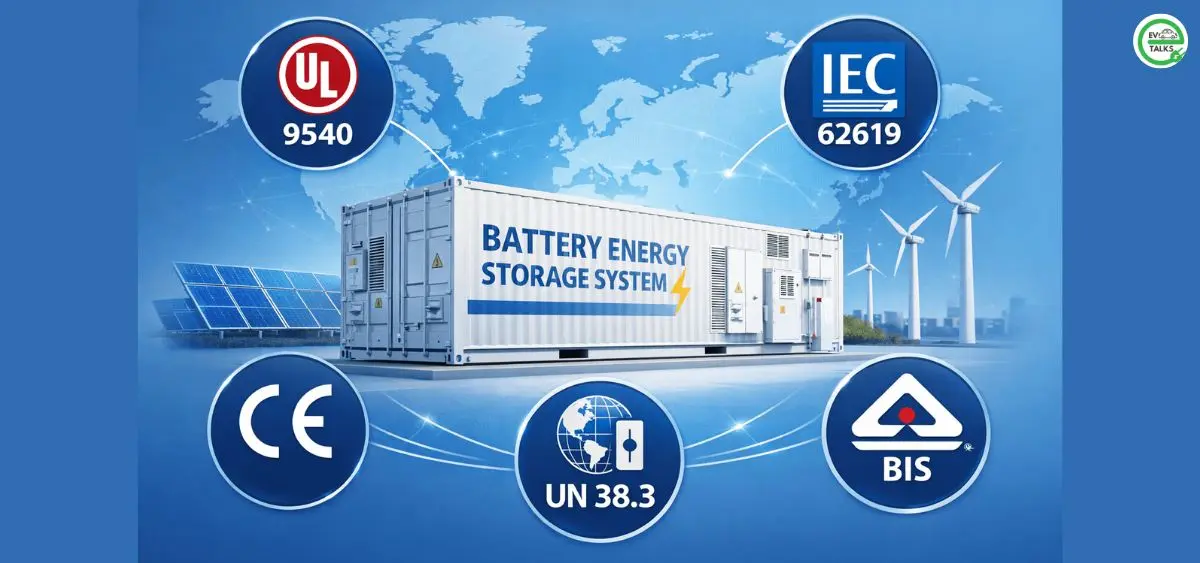
A key factor behind this shift is the European Union’s Battery Regulation (EU) 2023/1542. Beginning on February 18, 2027, all electric vehicle batteries and industrial batteries larger than 2 kWh sold in Europe must carry a Digital Battery Passport.
The Battery Passport will function as a digital record containing critical information throughout a battery’s lifecycle, including:
- Carbon footprint and lifecycle emissions
- Material sourcing and traceability data
- Battery performance and state-of-health information
- Recycling and repurposing records
- Compliance and sustainability documentation
Accessible through a unique QR code, the passport aims to improve transparency, sustainability, and circular economy practices across the European battery sector.
Why European EV Makers Are Investing in BESS
According to industry analysts, European EV Makers Turn to BESS because the same compliance infrastructure developed for Battery Passport requirements can be applied to energy storage projects.
Automakers have already spent substantial resources building digital tracking systems, data management platforms, and battery monitoring tools. Instead of limiting these investments to EV production alone, companies can use them to support large-scale battery storage deployments.
The growing renewable energy sector is creating significant demand for energy storage solutions. As solar and wind generation continue to expand across Europe, utilities increasingly require battery systems to stabilize power grids and store excess electricity.
Strong Economics Behind Battery Energy Storage Systems
The financial potential of BESS is attracting considerable attention. Grid-scale battery projects can generate substantial earnings by storing electricity during periods of low demand and supplying power when prices rise.
Industry estimates suggest that a typical 50-megawatt BESS project in Europe can produce annual EBITDA ranging from $8 million to $10 million, making it an attractive diversification opportunity for automotive manufacturers.
Another major driver is the rapid expansion of data centers across Europe. These facilities require reliable backup power and energy management systems, creating a growing market for battery storage providers.
EV Batteries vs. BESS: Understanding the Difference
| Feature | EV Batteries | Battery Energy Storage Systems (BESS) |
|---|---|---|
| Primary Purpose | Power electric vehicles | Store and manage electricity for grids, renewables, and facilities |
| Typical Capacity | 40 kWh – 110 kWh | 1 MWh – 1 GWh+ |
| Application | Passenger cars, commercial EVs, buses | Renewable energy storage, grid stabilization, data centers |
| Asset Lifetime | 10–12 years | 12–30 years |
| Energy Source | Charged through charging infrastructure | Charged from solar, wind, grid, or hybrid energy systems |
| Target Integration | Light and heavy transportation | Renewable energy plants, utility grids, industrial facilities |
| Operational Goal | Vehicle propulsion and mobility | Energy storage, peak shaving, load balancing, backup power |
| Revenue Model | Vehicle sales and mobility services | Energy trading, grid services, capacity markets, backup power |
| Battery Passport Requirement | Mandatory under EU Battery Regulation | Mandatory for industrial batteries above 2 kWh under the same regulation |
| Key Growth Driver | EV adoption and vehicle demand | Renewable energy expansion and rising electricity demand |
| Typical End Users | Consumers, fleet operators, logistics companies | Utilities, energy developers, data centers, industrial users |
| Scalability | Individual vehicle-based systems | Utility-scale projects ranging from small installations to gigawatt-scale storage |
Compliance Challenges Remain
Despite the opportunities, companies still face several implementation challenges before the Battery Passport becomes mandatory in 2027. Questions remain regarding data ownership, interoperability between systems, lifecycle updates, and responsibilities during battery reuse and recycling phases.
The European Commission is expected to finalize additional technical requirements and access rules before the regulation takes full effect.
Outlook for Europe’s Battery Industry
As Europe accelerates its transition toward clean energy and digitalized supply chains, European EV Makers Turn to BESS to capitalize on existing battery expertise, compliance investments, and manufacturing capacity. The combination of Battery Passport requirements, renewable energy expansion, and increasing data center demand is creating favorable conditions for long-term growth.
With profitability becoming a key priority, European EV Makers Turn to BESS as a practical pathway to strengthen their position in Europe’s increasingly battery-powered economy.

Related Articles: