
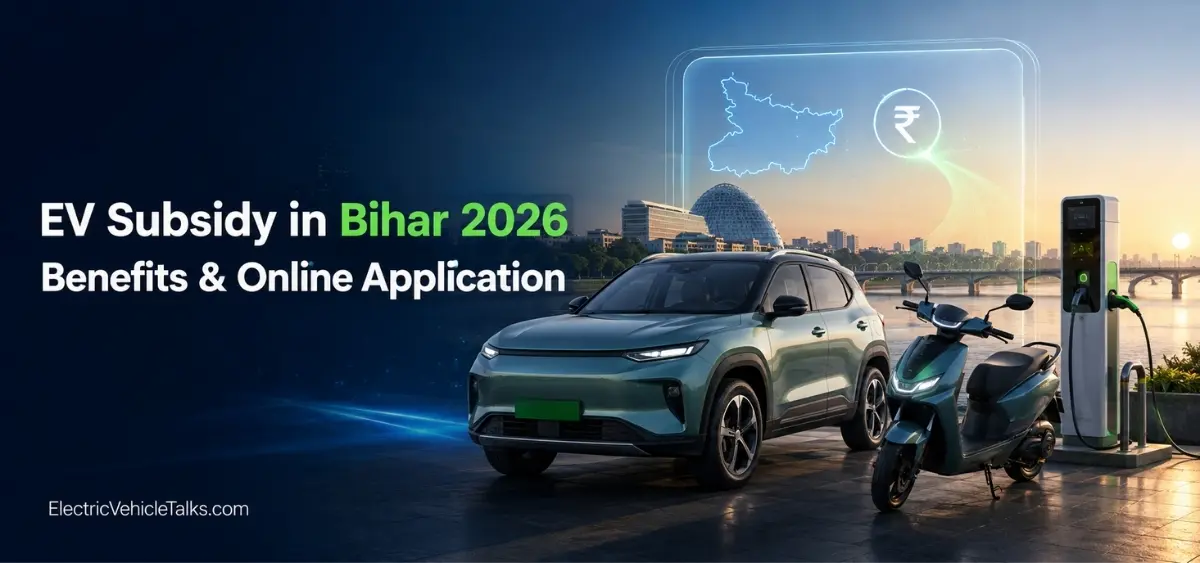

The EV Subsidy in Bihar can reduce the purchase cost of eligible electric two-wheelers, electric cargo three-wheelers, and women-owned non-commercial electric cars. Under the Bihar Electric Vehicle (Amendment) Policy, 2026, eligible buyers can receive a purchase incentive through Direct Benefit Transfer, or DBT, along with up to a 50% exemption from motor vehicle tax.
The headline benefit is a subsidy of ₹1 lakh for an eligible electric car registered in a woman’s name. Electric two-wheelers receive up to ₹12,000, while electric cargo three-wheelers receive up to ₹60,000, depending on the beneficiary category.
However, buyers should not treat every online claim about the policy as fact. Vehicle category, ownership, registration date, and portal verification all matter. Passenger e-rickshaws, electric ambulances, and larger commercial vehicles do not automatically receive the new purchase subsidies merely because they are electric.
This guide explains what is confirmed, what requires verification, and how Bihar EV buyers can protect their subsidy claim.
What is the EV Subsidy in Bihar in 2026?
The Bihar government approved the Bihar Electric Vehicle (Amendment) Policy, 2026, on May 13, 2026. It introduced a more targeted incentive structure focused on women’s mobility, social inclusion, rural transport, and EV-based employment.
The revised policy aims to increase EVs to 30% of new vehicle registrations in Bihar by 2030. The government also approved ₹110 crore for FY 2026–27 to support the Chief Minister Bihar Environment-Friendly Transport Employment Scheme.
According to the announced framework, the principal incentives are the following:
| Eligible vehicle or buyer | General-category benefit | Enhanced benefit | Key condition |
|---|---|---|---|
| Electric scooter or motorcycle | ₹10,000 | ₹12,000 for women and SC/ST beneficiaries | Eligible electric two-wheeler registered in Bihar |
| Electric cargo three-wheeler | Up to ₹50,000 | Up to ₹60,000 for SC/ST beneficiaries | Commercial goods-carrying vehicle |
| Non-commercial electric car | No general cash subsidy announced | ₹100,000 for a woman buyer | The vehicle must be registered in the woman’s name |
| All qualifying EV categories | Up to 50% motor vehicle tax exemption | Same | Purchased and registered in Bihar under applicable rules |
| Scrapping an old vehicle | Additional applicable benefit | Depends on scrappage rules | Must use an authorised vehicle-scrapping facility |
The Bihar government’s announcement describes DBT support for electric two-wheelers, commercial cargo vehicles, and non-commercial electric four-wheelers owned by women. It also confirms up to a 50% motor vehicle tax exemption for EVs purchased and registered in Bihar.
A crucial distinction: subsidy versus tax exemption
A purchase subsidy and a motor vehicle tax exemption are two different benefits.
- A purchase subsidy is transferred or reimbursed after the application is approved.
- A motor vehicle tax exemption reduces the tax payable during registration.
- A permit-fee exemption may apply to certain commercial vehicle categories.
- A central incentive is governed separately and may be built into the eligible vehicle’s invoice.
Do not add all these amounts together until the dealer gives you a written on-road price calculation.
Disclaimer: Incentives are subject to vehicle eligibility, beneficiary category, registration date, available government allocation, and approval by the Bihar Transport Department. Applicants should verify current conditions on the official Bihar eVehicle portal before purchasing an EV.
Bihar Electric Vehicle Policy timeline
| Date | Policy development |
|---|---|
| December 5, 2023 | Bihar Electric Vehicle Policy, 2023, was notified in the Bihar Gazette |
| 2023 policy period | Original policy made effective for five years from notification |
| May 13, 2026 | The state cabinet approved the Bihar Electric Vehicle (Amendment) Policy, 2026 |
| May 15, 2026 | Reported eligibility date for vehicles covered by the amended incentive programme |
| July 20, 2026 | Online applications under the amended framework were reported as operational |
| 2030 | Revised target: EVs to form 30% of Bihar’s new vehicle registrations |
The original policy targeted a 15% electric share in new vehicles purchased and registered in Bihar by 2028. The 2026 amendment raised the state’s ambition to 30% by 2030 and connected incentives more directly with women’s mobility and commercial employment.
Reports on the portal rollout state that applications cover eligible vehicles purchased on or after May 15, 2026. Buyers should nevertheless confirm the applicable date and remaining allocation on the portal before completing a purchase.
Bihar Electric Vehicle Old Policy vs 2026 Policy
The 2023 policy and the 2026 amended programme should not be mixed. The older Gazette offered battery-capacity-linked incentives to a limited number of early adopters. The revised programme uses targeted, beneficiary-oriented amounts.
| Feature | Bihar EV Policy 2023 | Bihar EV Amendment 2026 |
|---|---|---|
| EV adoption target | 15% of new vehicles by 2028 | 30% of new registrations by 2030 |
| Electric two-wheeler incentive | ₹5,000 per kWh; capped at ₹10,000 for SC/ST and ₹7,500 for others, subject to the first 10,000 vehicles | ₹10,000 general; ₹12,000 for women and SC/ST beneficiaries |
| Electric car incentive | ₹10,000 per kWh, capped at ₹1.50 lakh for SC/ST and ₹1.25 lakh for others, subject to the first 1,000 cars | ₹1 lakh DBT for an eligible non-commercial electric car registered to a woman |
| Passenger electric three-wheeler | Tax and applicable permit-fee relief; no general purchase incentive specified | No newly announced blanket DBT amount confirmed |
| Cargo electric three-wheeler | Tax and applicable permit-fee relief | Up to ₹50,000 general or ₹60,000 for SC/ST beneficiaries |
| Tax relief | 75% for early quotas, followed by 50% in specified categories | Up to 50% motor vehicle tax exemption |
| Main policy direction | Early adoption and charging-network development | Women’s mobility, rural access, employment and targeted DBT |
The 2023 Gazette also provided incentives for charging equipment, including support linked to equipment cost and installation. Whether an applicant can claim a particular charging-station benefit in 2026 depends on the current operational rules, the type of charger, and whether the available allocation remains open.
Which rules apply if the vehicle was bought before May 15, 2026?
Do not assume that a vehicle bought before the reported cut-off qualifies under the amended amounts. It may instead fall under the original policy, its quota limits, and the rules operating on the registration date.
The safest approach is to enter the registration and chassis details on the official portal or obtain written confirmation from the District Transport Office.
EV Subsidy in Bihar for electric scooters and bikes
For most households, the electric scooter subsidy in Bihar will be the most accessible benefit.
Eligible general-category buyers can receive ₹10,000. Women and SC/ST beneficiaries can receive ₹12,000, subject to eligibility, verification, and available scheme funds.
What an electric two-wheeler could cost after subsidy
| Item | Illustrative amount |
|---|---|
| Ex-showroom price | ₹110,000 |
| State subsidy for general buyer | –₹10,000 |
| Effective price before insurance and other charges | ₹100,000 |
| Enhanced eligible subsidy | –₹12,000 |
| Effective price with enhanced benefit | ₹98,000 |
This is only an illustration. A DBT benefit may be received after registration rather than deducted instantly at the showroom. The buyer may initially need to finance the full invoice amount.
Buying advice for Bihar’s riding conditions
A subsidy should never be the only reason to select an electric scooter. Bihar buyers should also check:
- The realistic range with a passenger, especially in summer
- Battery and motor water-resistance ratings
- Service availability outside Patna
- Battery warranty and exclusions
- Availability and price of replacement body panels
- Portable versus fixed-battery charging
- Ground clearance for damaged or waterlogged roads
- Whether the model appears in the government’s approved database
For a daily 35-km commute, a scooter delivering a dependable real-world range of 80–100 km provides a more comfortable buffer than one that only meets the commute on paper.
EV Subsidy in Bihar for an electric car
The most prominent 2026 benefit is a ₹1 lakh DBT subsidy for an eligible non-commercial electric car purchased and registered in a woman’s name.
This is not a universal ₹1 lakh electric-car subsidy. If the car is registered to a male buyer, company, fleet operator, or other ineligible entity, the cash incentive should not be assumed.
Illustrative cost impact
| Cost component | Without the women-focused subsidy | With ₹1 lakh subsidy |
|---|---|---|
| Ex-showroom price | ₹1,250,000 | ₹1,250,000 |
| State DBT benefit | ₹0 | –₹100,000 |
| Effective price before other charges | ₹1,250,000 | ₹1,150,000 |
| Motor vehicle tax | Normal applicable amount | Up to 50% exemption, subject to registration calculation |
| Insurance and accessories | Additional | Additional |
What married couples and families must understand
Registering a car in a woman’s name only to obtain the subsidy can create practical complications if the finance agreement, bank account, invoice, insurance, and RC are in different names.
For the strongest claim:
- Keep the invoice and RC in the eligible woman’s name.
- Use a bank account belonging to the registered owner.
- Ensure the loan structure supports the same ownership.
- Match spellings across Aadhaar, PAN, RC, and bank records.
- Do not transfer ownership until any mandatory retention period is understood.
A dealer’s verbal promise is not evidence of eligibility. Ask for a written price sheet showing which benefit is an immediate tax concession and which is a later DBT reimbursement.
EV Subsidy in Bihar for auto rickshaws
This is one of the most misunderstood parts of the policy.
The newly publicized assistance of ₹50,000 or ₹60,000 is directed at goods-carrying electric three-wheelers, not every electric auto-rickshaw.
Passenger e-auto versus cargo e-auto
| Vehicle type | Confirmed 2026 DBT position | Other possible benefits |
|---|---|---|
| Passenger electric auto/e-rickshaw | No blanket ₹50,000–₹60,000 subsidy confirmed in the material reviewed | Tax or permit relief may apply under relevant rules |
| Cargo electric three-wheeler | Up to ₹50,000 general; ₹60,000 SC/ST | Up to 50% motor vehicle tax exemption |
| Personal low-speed e-rickshaw | Depends on registration and vehicle classification | Must be checked on the official portal |
Before ordering an e-auto, ask the dealer for the exact VAHAN category. A vehicle advertised casually as an “e-auto” may legally be classified as an e-rickshaw, e-cart, L5 passenger carrier, or L5 goods carrier. Subsidy eligibility follows the registered classification—not the marketing description.
EV Subsidy in Bihar for commercial vehicles
The original 2023 policy provided motor vehicle tax and permit-related support for several commercial categories:
- Passenger electric three-wheelers
- Goods-carrying electric three-wheelers
- Light electric goods vehicles
- Electric buses and heavy electric goods vehicles
The amended 2026 purchase assistance, however, prominently targets commercial cargo three-wheelers through the employment-oriented scheme.
No confirmed blanket 2026 DBT purchase amount was found in the reviewed material for the following:
- Electric light commercial trucks
- Heavy electric trucks
- Electric buses
- Passenger fleet cars
- Corporate electric cars
- Electric ambulances
These vehicles may still receive tax, permit, scrappage, tender-based, or central-government support, but that is not the same as the ₹50,000 or ₹60,000 cargo-three-wheeler incentive.
Is there an EV Subsidy in Bihar for an electric ambulance?
The Bihar material reviewed does not specify a separate state purchase subsidy for electric ambulances.
Electric ambulances are supported under the central PM E-DRIVE framework. Eligible Type B patient-transport, Type C basic-life-support, and Type D advanced-life-support ambulances may receive the lower of
- ₹30,000 multiplied by battery capacity in kWh; or
- 35% of the ex-factory vehicle price.
This is a central scheme with its own vehicle approval and procurement rules. It should not be presented as a Bihar consumer DBT benefit. The official PM E-DRIVE portal provides the applicable category information.
How to apply for EV subsidy in Bihar online
Applications can be initiated through the official Bihar eVehicle Portal.
The attached process manual explains the underlying workflow: the vehicle owner registers, the RTO verifies the application, an approval authority reviews it, and the payment status is subsequently recorded.
Step 1: Confirm the vehicle is eligible
Before uploading documents, check that:
- The EV is registered in Bihar.
- Its fuel type and electric classification are correct on the RC.
- The vehicle model has been entered and approved by the manufacturer on the EV portal.
- The purchase and registration dates fall within the applicable scheme period.
- The registered owner matches the beneficiary category being claimed.
- The vehicle category is covered by the relevant incentive.
The attached OEM manual states that manufacturers must register the model’s battery capacity and upload the Type Approval Certificate. Vehicle owners can apply after the State Transport Authority approves the model.
Step 2: Open the official EV portal Bihar page
Select Register/Apply on the eVehicle portal.
Avoid imitation websites and anyone asking for an unofficial “processing fee.” The 2024 user manual contains a staging URL marked “only for testing”; buyers should use the current public portal linked above.
Step 3: Enter the vehicle information
The portal workflow requires:
- Vehicle registration number
- Last five digits of the chassis number
- Owner or beneficiary category
Current reporting also lists district, engine number, purchase date, and PAN details among the information applicants should keep ready.
Enter the details exactly as they appear on the RC. A single incorrect chassis digit can stop the application from matching VAHAN records.
Step 4: Select the correct category
Choose the relevant owner category carefully. If claiming the enhanced SC/ST benefit, upload the valid category certificate requested by the portal.
Women claiming the electric-car benefit should ensure that the RC, invoice, and bank account establish the same eligible ownership.
Step 5: Enter bank details
The attached manual specifically states the following:
- The bank-account holder’s name should be the same as the vehicle owner’s name.
- The passbook image must be uploaded in PDF format.
- The uploaded passbook file should be below 3 MB.
Recheck the account number and IFSC code before submission. A wrong account entry can delay or derail DBT payment.
Step 6: Upload the required documents
The portal screen is the final authority, but applicants should ordinarily keep these ready:
- Vehicle Registration Certificate
- Owner’s identity and PAN details
- Purchase invoice
- Bank passbook or other accepted bank proof
- Category certificate for an SC/ST claim
- Any ownership or gender-related evidence requested
- Additional vehicle documents shown on the live form
The pasted text mentions Aadhaar, a cancelled cheque and a “battery registration certificate.” These may be useful or requested in a revised form, but the supplied 2024 owner manual explicitly confirms only category documentation and bank-passbook upload. Follow the current portal checklist rather than relying on a copied third-party list.
Step 7: Submit and retain proof
Save:
- Application or reference number
- Submission acknowledgement
- Screenshot or PDF of the completed claim
- Copies of every uploaded document
- Any RTO query or resubmission notice
The application then moves to RTO verification. It may be verified, returned for correction, or rejected. After verification, the approval authority reviews the beneficiary record before disbursement processing.
How to check electric vehicle subsidy status in Bihar
Return to the official Bihar EV portal and select the application-status option.
Depending on the live interface, you may need the vehicle registration number, chassis digits, or application reference number.
Common status labels can include:
| Status | What it generally means | Recommended action |
|---|---|---|
| Submitted/Pending | Application received but not fully reviewed | Wait and check periodically |
| Under verification | RTO or authority is reviewing the details | Keep originals available |
| Reverted/Resubmit | A correction or clearer document is required | Fix only the cited issue and resubmit |
| Rejected | The claim failed an eligibility or verification check | Read the reason and contact the relevant DTO if incorrect |
| Approved | A competent authority has approved the claim | Monitor payment processing |
| Disbursed | Payment has been marked as completed | Check the registered owner’s bank account |
The pasted text promises payment “within 30 working days.” This timeline is not established by the supplied manuals. Do not publish it as a guaranteed service standard unless the live portal or an official 2026 notification explicitly confirms it.
Benefit list under Bihar Electric Vehicle Policy
Beyond vehicle-purchase assistance, Bihar’s EV framework includes broader measures for developing an electric-mobility ecosystem.
Buyer and owner benefits
- Targeted purchase subsidy for eligible vehicles
- Up to 50% motor vehicle tax exemption under the amended framework
- Applicable permit-fee support for specified commercial categories
- Benefits linked to authorised scrapping of old vehicles
- Subsidised public parking envisaged for personal EVs
- Reduced running and maintenance costs compared with petrol vehicles
Charging-infrastructure provisions
The 2023 policy provides equipment and installation support for specified charger categories, subject to limits and eligibility. It also envisages:
- Private residential charging
- Semi-public charging at commercial premises
- Public charging on government or private land
- Charging at petrol pumps
- Renewable-energy use for charging
- A possible 30% power-tariff subsidy for public and semi-public charging during the specified initial period
Current availability must be verified because charger-number caps, timelines, and budget allocations apply. Government Subsidy for EV Charging Station
Environmental and economic benefits
Bihar expects greater EV use to
- Reduce petrol and diesel consumption
- Lower urban air and noise pollution
- Support women’s independent mobility
- Create delivery and logistics employment
- Improve rural access to lower-cost transportation
- Build jobs in EV servicing, charging and battery management
Charging an EV in Bihar: practical ownership insights
Purchase incentives solve only part of the ownership equation. Reliable charging will determine whether the vehicle remains convenient after the excitement of delivery day has faded.
Bihar still has a relatively thin public-charging network, particularly outside major cities. State officials have acknowledged the need for more chargers at highways, fuel stations, hotels, bus terminals, parking areas, and commercial centers. Times of India
Home charging cost example
Assume an electric car consumes 15 kWh for every 100 km and the effective domestic electricity cost is ₹8 per kWh.
That equals roughly ₹1.20 per kilometer before charging losses. With an assumed 10% loss, the practical energy cost is about ₹1.32 per kilometer.
| Vehicle | Assumed efficiency | Electricity rate | Approximate energy cost |
|---|---|---|---|
| Electric scooter | 3 kWh/100 km | ₹8/kWh | ₹0.24/km |
| Electric car | 15 kWh/100 km | ₹8/kWh | ₹1.20/km |
| Cargo electric three-wheeler | 8 kWh/100 km | ₹8/kWh | ₹0.64/km |
These figures exclude charging losses, battery degradation, finance, insurance, and maintenance.
Charging recommendations
- Arrange a dedicated earthed socket or wallbox before delivery.
- Ask a licensed electrician to inspect the sanctioned load.
- Never use a loose extension board for routine charging.
- Prefer overnight AC charging for battery health and convenience.
- Check rapid-charging compatibility before planning intercity trips.
- Keep a 15–20% range reserve in rural or highway travel.
- Confirm charger uptime and access rather than trusting a map pin alone.
Challenges buyers should consider
Limited public charging outside urban centres
Patna and major corridors will develop first, but village and district-level coverage may remain uneven. Buyers without home parking should treat reliable charging access as a purchase condition.
DBT requires upfront cash flow
A subsidy paid after approval does not necessarily reduce the amount initially financed. Confirm whether the lender calculates the loan on the full invoice or the effective post-subsidy price.
Model approval can block an otherwise eligible buyer
A genuine electric vehicle may still be absent from the portal if the OEM has not completed battery-capacity registration or model approval.
Benefits may be budget- or quota-dependent
Policy announcements do not create an unlimited pool of money. Apply promptly, but never let a salesperson use “subsidy ending tonight” pressure without documentary evidence.
Rural service support varies
An attractive subsidy can quickly lose value if the nearest trained technician is 150 km away. Service reach, spare parts, and roadside assistance matter as much as certified range.
Common subsidy mistakes to avoid
- Buying before confirming the applicable eligibility date
- Confusing a passenger e-auto with an eligible cargo three-wheeler
- Assuming every electric car receives ₹1 lakh
- Using a relative’s bank account instead of the registered owner’s account
- Mismatched names across RC, PAN, and bank records
- Uploading an unclear or oversized passbook PDF
- Selecting the wrong beneficiary category
- Buying a model not approved on the state portal
- Treating DBT as an instant showroom discount
- Claiming two similar state incentives for the same vehicle
- Paying an agent to use an otherwise online process
- Relying on an unverified 30-day payment promise
Expert Insight from Electric Vehicle Talks
The strongest part of Bihar’s amended policy is not simply the ₹1 lakh electric-car headline. Its more meaningful intervention may be in electric two-wheelers and cargo three-wheelers.
A ₹10,000–₹12,000 incentive can represent a substantial percentage of an affordable scooter’s price. Similarly, ₹50,000–₹60,000 can materially improve the financing equation for a small cargo operator who travels predictable urban or rural delivery routes.
That is where electrification can create a double benefit: lower daily energy expenditure and greater self-employment potential.
Our practical recommendation is to evaluate an EV in this order:
- Confirm portal and beneficiary eligibility.
- Verify home or depot charging.
- Calculate monthly kilometers and energy savings.
- Check local service and battery-warranty support.
- Treat the subsidy as a bonus—not the foundation of an unaffordable loan.
A low-running-cost EV with dependable service will remain valuable even if DBT takes time. An unsuitable EV does not become a sound purchase merely because it carries a subsidy.
People Also Ask
1. How much EV subsidy is available in Bihar in 2026?
Eligible electric two-wheelers receive ₹10,000 for general-category buyers and ₹12,000 for women and SC/ST beneficiaries. Eligible electric cargo three-wheelers receive up to ₹50,000 or ₹60,000 for SC/ST beneficiaries. A qualifying non-commercial electric car registered to a woman receives ₹1 lakh.
2. How can I apply for EV subsidy in Bihar?
Use the official Bihar eVehicle portal, select Register/Apply, enter the registration and chassis details, choose the beneficiary category, upload the required certificate and bank proof, and submit the application for RTO verification.
3. Can a male buyer receive the ₹1 lakh electric-car subsidy?
The announced ₹1 lakh DBT benefit is specifically for an eligible non-commercial electric car purchased and registered in a woman’s name. Other EV owners may still qualify for applicable motor vehicle tax relief.
4. Does Bihar provide a subsidy for electric auto-rickshaws?
The new ₹50,000–₹60,000 purchase assistance is associated with goods-carrying electric three-wheelers. Do not assume the same amount applies to a passenger e-rickshaw or passenger e-auto.
5. Can the Bihar EV subsidy be combined with PM E-DRIVE?
State and central benefits are governed separately. An eligible two-wheeler may receive a central incentive through the approved OEM mechanism and, if permitted by the rules, a state benefit. However, the Bihar policy prevents a beneficiary from claiming more than one similar incentive under another Bihar government scheme.
6. How can I check my Bihar EV subsidy application status?
Open the official EV portal and use its status-tracking feature with the requested vehicle or application details. Check whether the claim is pending, reverted, approved, rejected, or disbursed.
7. Is the Bihar EV subsidy deducted by the dealer?
The amended benefit is described as DBT assistance. Therefore, buyers should be prepared for the possibility of paying or financing the invoice first and receiving the state incentive after registration, verification, and approval.
EV Subsidy in Bihar 2026: FAQs
Is an electric bike eligible for EV Subsidy in Bihar?
Yes. Eligible registered electric motorcycles and scooters fall within the electric two-wheeler category. The model and beneficiary must satisfy the portal’s applicable conditions.
What documents are required to apply online?
Keep the RC, purchase invoice, owner details, PAN information, bank passbook, and relevant category certificate ready. The live portal may request additional documents, so follow its current checklist.
Is Aadhaar mandatory for the Bihar EV subsidy?
The pasted material lists Aadhaar, but the supplied 2024 owner manual does not establish it as the only identity document. Applicants should follow the current portal’s mandatory fields and DBT verification requirements.
Does Bihar provide a road-tax exemption on EVs?
The 2026 announcement provides up to a 50% exemption from motor vehicle tax for EVs purchased and registered in Bihar, subject to the applicable implementation rules.
Can I claim the subsidy if my bank account is in another person’s name?
The attached process manual says the bank-account owner’s name must be the same as the registered vehicle owner’s name. A third-party account can lead to verification or payment failure.
What happens if my application is reverted by the RTO?
A reverted application normally requires correction or resubmission. Read the reason carefully, replace the incorrect document or information, and retain proof of the revised submission.
Is there a guaranteed deadline for receiving DBT?
No guaranteed 30-working-day payment period could be verified from the supplied manuals. Actual timing will depend on RTO verification, approval, banking, and the availability of scheme funds.
Conclusion
The EV Subsidy in Bihar 2026 represents a notable shift from broad early-adopter incentives toward targeted support for women, electric two-wheelers, and employment-oriented cargo vehicles.
The benefits can be meaningful: ₹1 lakh for an eligible woman-owned electric car, up to ₹12,000 for an electric scooter or bike, and up to ₹60,000 for an eligible cargo electric three-wheeler. The motor vehicle tax exemption can further improve the purchase economics.
But eligibility must be verified before paying a booking amount. Confirm the vehicle classification, owner category, registration date, model approval, and bank-account alignment. Passenger e-autos, ambulances, and larger commercial EVs should not be assigned benefits intended for other categories.
Most importantly, look beyond the subsidy. Reliable charging, local service, battery warranty, and realistic daily range will determine whether an EV genuinely reduces your household or business transport costs.
For more practical EV policy explainers, ownership advice, charging guides, and electric-vehicle buying insights, explore Electric Vehicle Talks.
Related Articles:









