
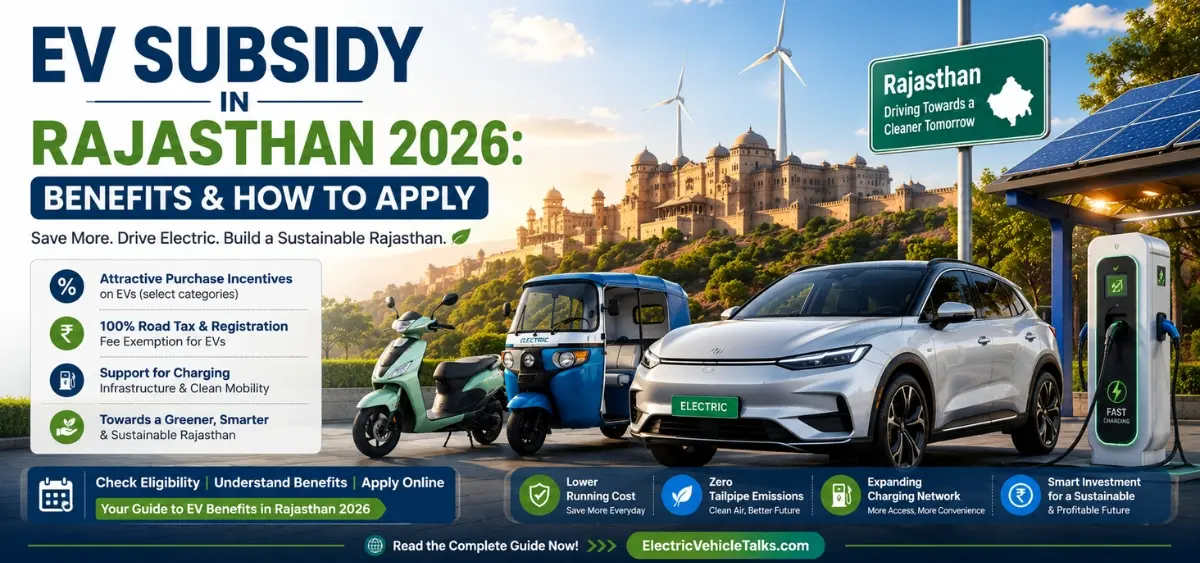

The EV Subsidy in Rajasthan is built around the Rajasthan Electric Vehicle Policy (REVP) 2022, which introduced purchase incentives for selected EV categories alongside tax relief, charging-infrastructure support, and measures to accelerate electric mobility across the state.
For buyers in 2026, however, there is an important distinction: the incentive amounts written into REVP 2022 should not automatically be treated as guaranteed cash benefits available on every EV purchased today. Many purchase incentives were capped by vehicle numbers and policy funding. Buyers should verify current eligibility with the Rajasthan Transport Department or dealer before calculating their final on-road price.
The Rajasthan Transport Department continues to list the Rajasthan Electric Vehicle Policy 2022 on its official policies page.
That distinction matters whether you are buying an electric scooter in Jaipur, running an e-rickshaw in Jodhpur, considering an electric car in Udaipur, or planning a commercial EV fleet.
EV Subsidy in Rajasthan 2026: Quick Answer
Rajasthan offers electric vehicle buyers state purchase incentives, 100% SGST reimbursement, and complete road tax exemptions.
Subsidy Amounts and Benefits
- Two-Wheelers: ₹2,500 per kWh, capped at a maximum of ₹10,000.
- Commercial & Three-Wheelers (E-autos, Carriers): ₹2,500 per kWh, capped at a maximum of ₹50,000.
- Retrofit Kits: Maximum 15% of the kit cost, capped at ₹2,5000.
- Road Tax & Registration: 100% waiver on state road tax, green tax, and vehicle registration fees for battery electric vehicles.
Eligibility Rules
- Applies to eligible EVs purchased and registered in Rajasthan on or after September 1, 2022.
- The vehicle manufacturer must be registered under national guidelines and enrolled on the state transport portal.
Rajasthan offers electric vehicle buyers state purchase incentives, 100% SGST reimbursement, and complete road tax exemptions.
Key EV Benefits in Rajasthan
Purchase Subsidy: Cash incentives ranging from ₹10,000 for two-wheelers up to ₹1.5 lakh for eligible four-wheelers (typically linked to battery capacity and capped at an ex-showroom price of ₹20 lakh for cars).
Tax Exemptions: Total exemption from the state Motor Vehicle Tax and Green Tax.
SGST Reimbursement: 100% refund of the State Goods and Services Tax (SGST) across eligible vehicle categories.
Permit Exemptions: Complete waiver from standard permit requirements for qualifying passenger and goods-carrying electric vehicles.
Central Support
PM E-DRIVE Scheme: Provides national incentives for electric two- and three-wheelers (though direct purchase subsidies for private electric four-wheeler cars are not funded by the central government).
Lower GST: All EVs benefit from a concessional GST rate of just 5% compared to higher rates for traditional internal combustion vehicles.
When Did EV Subsidy in Rajasthan Start?
Rajasthan formally notified the Rajasthan Electric Vehicle Policy (REVP) 2022 on August 31, 2022. The policy became effective on September 1, 2022, and was valid for a period of five years.
The policy was designed not simply as a consumer subsidy programme but as a broader electric-mobility roadmap.
Its vision is to reduce vehicular emissions through cleaner mobility while creating an environment in which Rajasthan’s complete EV ecosystem—from vehicles and batteries to charging stations, manufacturing and skills—can develop. The policy specifically identifies EV adoption, charging and battery-swapping infrastructure, R&D, skills, and EV/battery manufacturing as objectives.
That broader approach is important. Subsidizing the vehicle helps at the point of purchase, but an EV market cannot scale without chargers, trained technicians, affordable electricity, and reliable battery technology.
Rajasthan EV Policy 2022 vs 2026
Rajasthan has not introduced a separately notified “Rajasthan Electric Vehicle Policy 2026.” The Rajasthan Electric Vehicle Policy (REVP) 2022 remains the relevant state EV policy framework in 2026. Therefore, the comparison below explains the original REVP 2022 provisions versus the EV subsidy and policy position in 2026, including changes arising from central schemes such as PM E-DRIVE.
| Parameter | REVP 2022 – Original Policy | Position in 2026 |
|---|---|---|
| Policy status | Official Rajasthan Electric Vehicle Policy 2022 | REVP 2022 remains the EV policy currently listed by Rajasthan government sources; no separate REVP 2026 found |
| Effective date | 1 September 2022 | Still within its original five-year policy framework |
| Policy duration | Five years | The original framework extends into 2027 |
| Electric 2W target | 15% share of new registrations | The original target remains the reference point; current incentive availability must be checked separately |
| Electric 3W target | 30% share | Same policy framework |
| Electric 4W target | 5% share | Same policy framework |
| Electric buses | Phased transition on routes connecting priority cities | Electrification increasingly interacts with newer central schemes such as PM E-DRIVE |
| e-2W purchase incentive | ₹5,000–₹10,000 fixed battery; ₹2,000–₹5,000 swappable | The original capped state incentive should not automatically be assumed available for every 2026 purchase |
| e-3W incentive | ₹10,000–₹20,000 fixed; ₹4,000–₹10,000 swappable | The current buyer should verify remaining eligibility/funding |
| Electric car incentive | ₹30,000–₹50,000 for qualifying four-wheelers, with ₹20 lakh ex-showroom ceiling | Private electric cars do not receive PM E-DRIVE demand subsidy; any state purchase benefit must be checked against current Rajasthan implementation |
| Road/green tax | EV exemption provided under state framework | Remains one of the important state-level EV advantages |
| SGST | 100% reimbursement provision for eligible EVs | Must be interpreted according to current implementation rather than assuming direct cash payment to every buyer |
| Registration | EV-related registration relief | Battery-operated vehicles also benefit from central registration-fee exemption rules |
| Charging stations | De-licensed activity; public and private charging promoted | Charging expansion remains a major EV development priority |
| Charging infrastructure incentive | Up to ₹5 lakh reimbursement for upstream infrastructure for first 100 qualifying fast charging/swapping stations | Availability depends on policy limits and implementation status |
| Renewable charging | Solar/renewable-powered EV charging promoted | Even more relevant in 2026 because of Rajasthan’s growing clean-energy ecosystem |
| Central incentive context | REVP referred to FAME II eligibility framework | FAME II has ended; PM E-DRIVE is now the key central EV-support scheme for eligible categories |
| Private electric cars under central scheme | FAME-era policy context | PM E-DRIVE does not provide standard demand incentives to privately purchased electric passenger cars |
| Electric ambulances | No dedicated major central ambulance programme comparable to today’s scheme | PM E-DRIVE introduced dedicated e-ambulance support in 2026 |
| Policy focus | EV adoption, charging, manufacturing, batteries, recycling, R&D, and skills | Same foundation, but implementation now operates alongside newer central EV programmes and newer Rajasthan industrial/clean-energy policies |
What Is Rajasthan’s ₹200 Crore e-Vehicle Promotion Fund?
Rajasthan’s Modified Budget 2024–25 proposed establishing a ₹200 crore e-Vehicle Promotion Fund under the Electric Vehicle Policy. More importantly, Rajasthan’s Economic Review 2025–26 subsequently states that an order was issued on 14 November 2024 to create this ₹200 crore fund to encourage EV adoption.
Explain why this matters to readers: it provides newer government context beyond simply repeating the original 2022 policies.
Then add a caution:
The existence of the ₹200 crore fund should not be interpreted as meaning every Rajasthan EV buyer automatically receives a cash subsidy. Vehicle-category eligibility, incentive limits, implementation orders, fund availability, and claim conditions still need to be checked.
What Are the Main EV Subsidies in Rajasthan?
REVP 2022 established different incentive structures depending on vehicle category and battery type.
| EV Category | REVP 2022 Incentive Structure | Policy Quantity/Limit |
|---|---|---|
| Electric two-wheeler, fixed battery | ₹5,000–₹10,000 | 100,000 e⁻²Ws |
| Electric two-wheeler, swappable battery | ₹2,000–₹5,000 | Within e-2W allocation |
| Electric three-wheeler, fixed battery | ₹10,000–₹20,000 | 25,000 e-rickshaw/e-cart + 25,000 e-auto/e-goods |
| Electric three-wheeler, swappable battery | ₹4,000–₹10,000 | Within category limits |
| e-3W retrofit | 15% of kit cost, up to ₹10,000 | 3,000 vehicles |
| Eligible electric four-wheeler | ₹30,000–₹50,000 | Category-specific limits |
| e-4W retrofit | 15% of kit cost, up to ₹15,000 | 2,000 vehicles |
| Electric bus | ₹1 lakh–₹5 lakh | 500 e-buses |
| e-bus retrofit | 15% of kit cost, up to ₹2.5 lakh | 200 vehicles |
The original policy also provides 100% SGST reimbursement for eligible EVs and records exemptions from Motor Vehicle Tax and Green Tax, along with permit-related relief.
2026 buyer warning: these are the incentive provisions in the policy, not a promise that every amount remains claimable for a vehicle purchased today. Your supplied research also notes that direct purchase incentives were capacity- and fund-limited.
Always verify the live benefit before paying the booking amount.
EV Subsidy in Rajasthan for Electric Scooters
Electric two-wheelers were deliberately given a prominent role in REVP 2022 because scooters and motorcycles dominate everyday personal mobility in India.
The policy’s original incentive structure for eligible e-2Ws was
- Fixed battery: ₹5,000–₹10,000
- Swappable battery: ₹2,000–₹5,000
- Target: up to 100,000 eligible electric two-wheelers
This can matter disproportionately to scooter buyers. A ₹10,000 saving on a ₹1 lakh scooter represents a much larger percentage reduction than a ₹30,000 incentive on a ₹15 lakh electric car.
What About PM E-DRIVE for Electric Scooters in 2026?
This is where central and state incentives need to be separated.
PM E-DRIVE supports eligible electric two-wheelers equipped with advanced batteries, including registered e-2Ws owned privately, commercially, or corporately.
Current PM E-DRIVE information also states that the demand incentive applicable to qualifying e-2Ws and e-rickshaw/e-cart vehicles registered from April 1, 2025, is ₹2,500 per kWh, subject to scheme rules and applicable caps.
Therefore, when comparing electric scooters in Rajasthan, ask the dealer to separate the following:
- Manufacturer discount
- PM E-DRIVE benefit
- Rajasthan state benefit, if currently available
- Registration-related saving
- Road-tax saving
Do not accept a single headline figure called “EV subsidy” without a breakup.
EV Subsidy in Rajasthan for Electric Cars
The EV car subsidy in Rajasthan 2026 is one of the most misunderstood parts of the policy.
Under REVP 2022, eligible four-wheelers included personal cars, taxis, contract carriages, and light goods vehicles. The original upfront incentive was linked to battery capacity and ranged from ₹30,000 to ₹50,000.
For this purchase incentive, the maximum qualifying ex-showroom price was ₹20 lakh.
The policy table allocated incentives for:
- 1,000 personal electric four-wheelers
- 1,000 commercial electric four-wheelers
- 2,000 e-maxi cabs/e-goods carriers
- 2,000 four-wheeler retrofit vehicles
The official policy also allowed 15% of an approved retrofit-kit cost, capped at ₹15,000 per vehicle.
Does PM E-DRIVE Give a Subsidy on Private Electric Cars?
No.
This is a particularly important point for buyers searching for an electric car subsidy in Rajasthan.
PM E-DRIVE’s demand-incentive categories include e-2Ws, e-3Ws, e-ambulances, e-trucks, and buses; ordinary privately purchased electric passenger cars are not a demand-incentive category under the scheme.
So a private EV car buyer should not assume that a central PM E-DRIVE cash subsidy will reduce the price of a regular electric passenger car.
What Tax Benefits Do Rajasthan EV Buyers Receive?
REVP 2022 records an exemption from the Motor Vehicle Tax and Green Tax payable under the Rajasthan Motor Vehicles Taxation Act for electric vehicles covered by the policy. It also provides permit-related relief and SGST reimbursement provisions.
Separately, the Ministry of Road Transport and Highways has notified an exemption for battery-operated vehicles from fees associated with registration certificates.
That means buyers should distinguish the registration fee, state motor vehicle/road tax, and purchase subsidy. They are not the same benefit.
| Benefit | What It Means |
| State motor vehicle tax relief | Can lower the on-road cost substantially |
| Green-tax relief | Additional state tax saving |
| Registration-fee exemption | Battery-operated vehicles receive registration-fee relief under central rules |
| State purchase incentive | Category/battery-based; subject to policy caps and availability |
| PM E-DRIVE | Applies only to eligible vehicle categories—not normal private e-cars |
| SGST reimbursement | Provided for eligible EVs under REVP framework |
EV Subsidy in Rajasthan for Electric Three-Wheelers
Three-wheelers are arguably one of the strongest use cases for electrification in Rajasthan.
E-rickshaws, e-autos, and electric goods carriers typically travel frequently, which means electricity’s lower running cost can compound quickly.
REVP 2022 provided:
Fixed-battery e-3Ws: ₹10,000–₹20,000
Swappable-battery e-3Ws: ₹4,000–₹10,000
Retrofit: 15% of eligible kit cost, capped at ₹10,000.
The policy targeted 25,000 e-rickshaw/e-cart vehicles and another 25,000 e-auto/e-goods-carrier vehicles.
For a commercial operator, however, subsidy should not be the only purchasing criterion. Calculate daily kilometers, electricity cost, battery warranty, real-world range, charging downtime, and financing EMI.
A vehicle that saves ₹200 per operating day can potentially create more value over several years than a larger one-time subsidy attached to an inefficient operating model.
EV Subsidy in Rajasthan for Commercial Vehicles
Commercial electrification can have an outsized environmental and economic impact because fleet vehicles normally travel much farther than privately owned cars.
REVP provides tax and permit advantages alongside vehicle-specific incentives. The policy explicitly includes three-wheelers used for goods/passenger transport and electric four-wheelers covering commercial applications.
For businesses, calculate total cost of ownership (TCO) rather than simply comparing showroom prices.
Simple Commercial EV Cost Formula
Annual operating saving = annual kilometres × (ICE cost/km − EV electricity cost/km)
For example, assume:
- ICE operating energy/fuel cost: ₹5.5/km
- EV electricity cost: ₹1.5/km
- Annual running: 40,000 km
Potential energy-cost difference:
40,000 × ₹4 = ₹160,000 per year
This is only an illustration; actual savings depend on efficiency, electricity tariffs, fuel prices, payload, charging losses and driving conditions.
For high-utilization fleets, operating economics can therefore matter far more than the initial subsidy.
EV Subsidy in Rajasthan for Electric Ambulances
Electric ambulances have become particularly relevant in 2026 because PM E-DRIVE now includes a dedicated e-ambulance incentive.
The official PM E-DRIVE portal lists the following:
- Type B Patient Transport Vehicle
- Type C Basic Life Support ambulance
- Type D Advanced Life Support ambulance
The demand incentive is the lower of ₹30,000 per kWh of battery capacity or 35% of the vehicle’s ex-factory price.
The Ministry’s scheme-notification page shows that the e-ambulance notification was released on June 17, 2026, followed by operational guidelines on June 18.
This is a useful example of why a 2026 EV subsidy guide cannot simply repeat REVP 2022: central EV incentives continue to evolve.
How to Apply for EV Subsidy in Rajasthan
People searching “ev subsidy in rajasthan apply online” should first establish whether the incentive they want to claim is actually open for their vehicle category.
Your supplied material describes the typical claim workflow as purchasing an eligible vehicle through a registered dealer, entering registration/chassis details on the designated transport platform, authenticating the claim, and providing the documents required for DBT processing.
A practical sequence is
- Check the vehicle category. Confirm whether it qualifies under the relevant state or central scheme.
- Confirm incentive availability before purchase. Ask for the exact notification/scheme under which the dealer says a subsidy is available.
- Confirm vehicle/model approval. This is especially important for PM E-DRIVE.
- Register the vehicle correctly. State benefits generally depend on Rajasthan registration.
- Keep the invoice, RC, and battery documentation.
- Complete the required portal/dealer verification process.
- Retain acknowledgement and transaction details until the benefit is settled.
For PM E-DRIVE vehicles, the central scheme uses Aadhaar-based authentication and an electronic voucher mechanism.
Who Is Eligible for EV Subsidy in Rajasthan?
Give readers a checklist rather than only explaining application steps.
Cover:
- Vehicle category
- Rajasthan registration requirement
- New vs used EV
- Approved/eligible model
- Battery requirements
- Purchase date
- Individual vs commercial registration
- Whether the incentive allocation is still open
- Dealer/OEM eligibility
- Aadhaar authentication where applicable
For PM E-DRIVE specifically, the official FAQs state that privately owned registered e-2Ws can qualify under the relevant rules, while e-3Ws are restricted to commercial use. The central scheme also limits an individual beneficiary to one EV of a specific category and requires Aadhaar authentication.
Documents Required for EV Subsidy in Rajasthan
Use a concise checklist:
- Aadhaar card
- Vehicle purchase invoice
- Registration Certificate (RC)
- Vehicle/chassis details
- Battery-capacity/vehicle eligibility documents where required
- Registered mobile number
- Bank account details/cancelled cheque where DBT applies
- Dealer/OEM documentation where required
- Commercial/permit documents for relevant commercial vehicles
Add:
Document requirements can vary between Rajasthan state benefits and PM E-DRIVE. Buyers should follow the documentation specified by the applicable government portal rather than treating one checklist as universal.
EV Subsidy in Rajasthan Portal and Status Check
There is no substitute for checking an official source when money is involved.
The Rajasthan Transport Department continues to publish REVP 2022 in its policy section and maintains its transport services online.
For central PM E-DRIVE incentives, buyers can use the official PM E-DRIVE system. Its portal provides model information and e-voucher verification functionality.
Practical tip: never rely solely on an old blog, YouTube video, or dealer advertisement for subsidy status. EV incentives can change through amendments, vehicle caps, funding limits, and terminal dates.
EV Subsidy in Rajasthan Last Date
REVP 2022 states that the policy is valid for five years from notification, with annual or need-based reviews, and incentives are to be extended for the policy period unless otherwise stated or notified.
Since the policy became effective on September 1, 2022, its original five-year framework extends into 2027.
But this does not mean every individual purchase incentive automatically remains available until 2027.
Some incentives have vehicle-number caps, financial allocations, or separate implementation conditions.
That is why searches for “ev subsidy in rajasthan last date” should be answered at two levels:
Policy period: REVP 2022 has a five-year framework.
Individual incentive deadline: depends on the specific scheme, vehicle category, fund availability, and subsequent government notifications.
Rajasthan EV Policy Targets
Rajasthan’s ambitions go beyond subsidies.
REVP 2022 established end-of-policy targets of
| Category | Target Share in New Registrations |
| Electric two-wheelers | 15% |
| Electric three-wheelers | 30% |
| Electric four-wheelers | 5% |
| Electric buses | Phased transition on routes connecting priority cities |
The policy additionally envisaged a manufacturing target of 35 lakh units per year within five years.
The eight identified priority cities are Jaipur, Jodhpur, Kota, Udaipur, Bikaner, Ajmer, Bharatpur, and Alwar.
These cities matter because higher vehicle density makes electrification especially valuable for local air quality.
Charging Infrastructure: The Other Half of Rajasthan’s EV Strategy
A subsidy can convince someone to buy an EV. Reliable charging determines whether that person enjoys owning it.
REVP treats charging infrastructure as a core component of the transition. The policy permits private charging at homes and offices through existing electricity connections and envisages public charging in urban areas, rural locations, and highways.
It also states that setting up a charging station is a de-licensed activity, removing a major regulatory barrier for private charging-network investment.
Incentives for Charging Businesses
The policy includes support for fast-charging and battery-swapping infrastructure. Government Subsidy for EV Charging Station
For eligible public fast-charging/swapping stations, upstream electricity-infrastructure expenditure could receive 100% reimbursement up to ₹5 lakh per charging station, applicable to the first 100 qualifying stations during the policy period.
For qualifying investment under the relevant RIPS framework, the policy also described either a 5% interest subsidy subject to limits or a capital subsidy equivalent to 20% of equipment investment, capped at ₹4 lakh.
These measures show that Rajasthan’s strategy was designed around an ecosystem, not merely vehicle rebates.
Renewable Energy Could Give Rajasthan a Structural EV Advantage
Rajasthan’s exceptional solar-resource potential makes EV charging particularly interesting.
REVP links EV charging with the Rajasthan Solar Energy Policy and discusses renewable-powered charging and swapping stations. The policy envisaged concessional land for qualifying renewable-energy-based charging stations and provisions supporting captive renewable generation.
This creates a powerful long-term opportunity: electric mobility can become progressively cleaner as the electricity feeding vehicles becomes more renewable.
The environmental story therefore changes from simply “petrol versus battery” to “fossil-fuel mobility versus increasingly renewable-powered mobility.”
Battery Technology and EV Ownership in Rajasthan
Rajasthan’s climate also makes battery quality particularly important.
EV buyers should evaluate more than the advertised range. Look at:
- Battery chemistry
- Battery thermal-management system
- Battery warranty
- Real-world summer efficiency
- Fast-charging capability
- Service-network availability
- Battery replacement terms
- Water and dust protection
- Charging availability on regular routes
The original policy itself recognized battery cost as a major barrier to EV affordability, noting that battery cells accounted for roughly 30–35% of EV value-chain cost at the time.
Battery prices, chemistry, and localization have evolved since 2022, but the principle remains: the battery is central to an EV’s cost, range, longevity, and resale value.
EV Subsidy Calculator: How Much Could You Actually Save?
Instead of looking only at the subsidy, calculate the effective acquisition cost.
| Cost Component | Example |
| Ex-showroom price | ₹1,500,000 |
| Eligible state purchase incentive | Assume ₹50,000.* |
| Registration-fee saving | Depends on applicable fee |
| Motor vehicle/road-tax saving | It depends on applicable state tax |
| Effective initial saving | Purchase incentive + applicable tax/fee relief |
*Illustrative only. Confirm whether the relevant capped state purchase incentive remains available before buying.
Then calculate lifetime ownership:
Total EV ownership cost = purchase price − incentives + electricity + insurance + maintenance + financing + charging equipment − resale value
This is a better EV subsidy in Rajasthan calculator than merely subtracting a headline subsidy.
Benefits of Rajasthan’s EV Incentive Strategy
The biggest benefits extend beyond a lower showroom price.
Lower acquisition cost: Tax relief and eligible incentives reduce the EV-vs-ICE price gap.
Lower running cost: Home charging can make daily commuting considerably cheaper than petrol or diesel.
Cleaner urban mobility: Jaipur, Jodhpur, and other high-density cities can benefit from zero tailpipe emissions.
Fleet economics: High-mileage e-rickshaws, taxis, and delivery vehicles can generate substantial operating savings.
Charging investment: Infrastructure incentives encourage private capital to expand the network.
Renewable-energy integration: Rajasthan can combine its solar strength with transport electrification.
Challenges Buyers Should Still Consider
Subsidies cannot remove every ownership challenge.
Public charging remains less convenient than refueling in many locations. Apartment residents may face parking and electrical-connection constraints. Highway users should map charging stops before buying.
Battery performance can also vary with temperature, speed, AC usage, payload, and driving behavior.
For rural or long-distance buyers, a larger battery may sometimes be more valuable than a larger subsidy.
Common Mistakes While Claiming EV Benefits
The most common mistake is buying first and checking eligibility later.
Also avoid:
- Assuming an old REVP incentive table guarantees a 2026 payout
- Confusing PM E-DRIVE with a subsidy for private electric cars
- Ignoring vehicle or funding caps
- Treating dealer discounts as government subsidies
- Comparing only ex-showroom prices instead of on-road prices
- Ignoring battery warranty and charging cost
- Failing to keep invoice, registration and battery documents
- Using unofficial subsidy calculators as final authority
Expert Insight from Electric Vehicle Talks
The biggest change in India’s EV market is that the buying decision is gradually moving beyond subsidies.
Early EV adoption needed aggressive incentives because batteries were expensive, charging networks were thin, and consumers were unfamiliar with electric mobility. Today, total cost of ownership, battery warranty, software, charging access and resale confidence increasingly influence the decision.
For Rajasthan, the strongest opportunity may be in electric two-wheelers, commercial three-wheelers, urban fleets, and solar-linked charging. These categories combine high daily utilization with potentially significant operating-cost savings.
Our recommendation at Electric Vehicle Talks is simple: treat subsidy as a bonus, not as the only reason to buy an EV.
A good EV should still make financial and practical sense if the temporary purchase incentive disappears.
For current buying guides and EV ownership analysis, readers can explore ElectricVehicleTalks.com.
People Also Ask
1. How much EV subsidy is available in Rajasthan?
REVP 2022 originally provided category-specific upfront incentives ranging from ₹5,000–₹10,000 for fixed-battery two-wheelers, ₹10,000–₹20,000 for fixed-battery three-wheelers, ₹30,000–₹50,000 for eligible four-wheelers, and ₹1 lakh–₹5 lakh for eligible e-buses. These incentives were subject to category limits and other policy conditions.
For a 2026 purchase, verify whether the relevant incentive allocation remains open before treating these figures as guaranteed savings.
2. Is there an EV car subsidy in Rajasthan in 2026?
REVP 2022 created a ₹30,000–₹50,000 upfront incentive structure for qualifying electric four-wheelers with an ex-showroom ceiling of ₹20 lakh, subject to vehicle limits.
However, buyers should verify current fund/vehicle-cap availability. PM E-DRIVE does not provide a demand incentive for ordinary private electric passenger cars.
3. Is road tax exempt on electric vehicles in Rajasthan?
REVP 2022 explicitly lists exemption from Motor Vehicle Tax and Green Tax among EV incentives already implemented in Rajasthan.
Check the current vehicle-specific tax treatment on the Rajasthan Transport system when generating your on-road quotation.
4. How can I apply online for EV subsidy in Rajasthan?
First confirm that your vehicle and purchase date qualify under an active incentive. The supplied application guidance describes using the designated transport/vehicle portal, verifying registration and chassis information, completing authentication, and providing the required bank and ownership documents.
For PM E-DRIVE-eligible vehicles, the central system uses Aadhaar-authenticated e-vouchers.
5. Does PM E-DRIVE subsidize electric cars?
Ordinary private electric passenger cars are not among PM E-DRIVE’s demand-incentive vehicle categories. Eligible categories include e-2Ws, e-3Ws, e-buses, e-ambulances, and e-trucks, subject to their respective rules.
6. What is the Rajasthan EV subsidy’s last date?
REVP 2022 was notified for five years beginning in 2022, but individual incentives may have separate vehicle caps, funding limits, and implementation conditions. Therefore, there is no safe assumption that every incentive remains claimable until the final day of the overall policy period.
7. Are electric ambulances eligible for subsidy in Rajasthan?
Eligible e-ambulances can receive PM E-DRIVE assistance. The current central incentive is the lower of ₹30,000 per kWh or 35% of the ex-factory price, subject to eligibility requirements.
EV Subsidy in Rajasthan FAQs
Is the Rajasthan Electric Vehicle Policy 2022 still relevant in 2026?
Yes. The Rajasthan Transport Department currently continues to list the Rajasthan Electric Vehicle Policy 2022 on its official policies page. However, the current availability of a particular capped financial incentive should be separately verified.
What is the EV scooter subsidy in Rajasthan?
REVP 2022 specified ₹5,000–₹10,000 for qualifying fixed-battery electric two-wheelers and ₹2,000–₹5,000 for swappable-battery models within the policy’s vehicle limits. Central PM E-DRIVE benefits may separately apply to eligible models.
Can commercial electric vehicles receive benefits?
Yes. Rajasthan’s policy covers electric three-wheelers, commercial four-wheelers, goods carriers, and buses and also provides tax and permit-related provisions. The precise benefit depends on vehicle class and current incentive availability.
Do electric vehicles pay registration fees?
Battery-operated vehicles have been exempted from fees for the issue or renewal of registration certificates and assignment of a new registration mark under the relevant central notification. Do not confuse this registration-fee exemption with state motor vehicle tax.
Is Section 80EEB available for a new EV loan in 2026?
Not for a newly sanctioned 2026 loan. Your supplied research notes that Section 80EEB applied to qualifying EV loans sanctioned between April 1, 2019, and March 31, 2023.
Which Rajasthan cities receive special attention under REVP?
Jaipur, Jodhpur, Kota, Udaipur, Bikaner, Ajmer, Bharatpur, and Alwar are identified as priority cities under the policy.
Is home EV charging allowed in Rajasthan?
Yes. REVP states that private charging at residences and offices can be permitted through existing power connections, while the state policy also encourages broader public charging development.
Conclusion
The EV Subsidy in Rajasthan is an important part of the state’s broader push toward cleaner, more affordable, and sustainable mobility. Under REVP 2022, buyers and operators can benefit from measures such as tax relief, category-based incentives, charging infrastructure support, and commercial EV provisions. However, in 2026, buyers should not assume that every incentive listed in the original policy is still automatically available, as some benefits depend on vehicle caps, funding availability, and updated government notifications.
For private electric car buyers, road-tax and registration-related savings can remain especially valuable, while eligible electric two-wheelers and other categories may also benefit from applicable central schemes. Commercial users should focus on total cost of ownership, charging access, battery warranty, and daily running costs.
As Rajasthan expands EV adoption and renewable-powered charging, electric mobility can become both financially practical and environmentally meaningful for the state’s future.
Related Articles:









