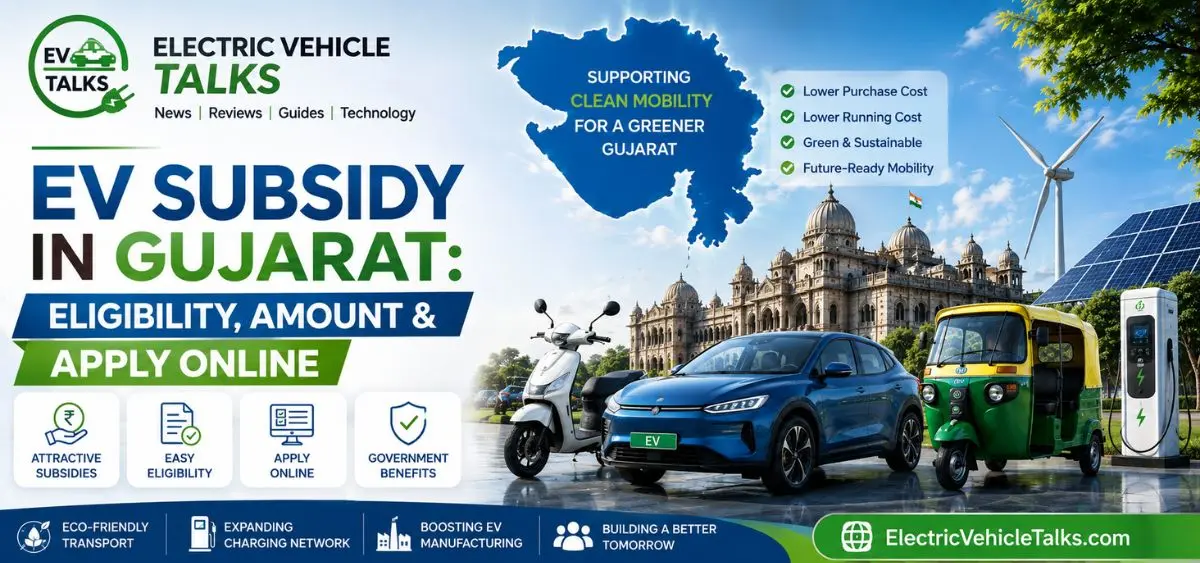

If you are searching for EV subsidy in Gujarat, there is one important point to understand before looking at subsidy amounts: the Gujarat EV incentive system in 2026 is not the same as the Gujarat State Electric Vehicle Policy 2021.
The 2021 policy offered direct purchase incentives of up to ₹20,000 for electric two-wheelers, ₹50,000 for electric three-wheelers and ₹1.5 lakh for electric four-wheelers. However, that policy was valid for four years from July 1, 2021.
As of August 2026, buyers should not automatically assume that these old state-wide subsidies are available for a new EV purchase.
Gujarat is in a policy transition, with the government working on a fresh EV policy covering EV adoption, charging infrastructure, and manufacturing. Reports have also indicated that zero RTO tax and wider purchase incentives are being considered, but these proposals should not be treated as current benefits until formally notified.
That distinction matters because many websites still display the 2021 subsidy figures as though they are current.
What Is the Current EV Subsidy in Gujarat in 2026?
For an ordinary private EV buyer, there is no confirmed new Gujarat state-wide purchase subsidy that can currently be treated as a continuation of the 2021 ₹20,000, ₹50,000, and ₹1.5 lakh incentives.
The amounts frequently appearing in online searches come from the Gujarat State Electric Vehicle Policy 2021.
Under that policy, the state subsidy was linked to battery capacity at ₹10,000 per kWh, subject to the applicable battery-capacity and vehicle-price conditions. The policy specified maximum eligible ex-factory prices of ₹1.5 lakh for two-wheelers, ₹5 lakh for three-wheelers, and ₹15 lakh for four-wheelers.
Historical Gujarat EV subsidy structure
| Vehicle category | 2021 Gujarat subsidy | Maximum eligible ex-factory price |
|---|---|---|
| Electric 2-wheeler | Up to ₹20,000 | ₹1.5 lakh |
| Electric 3-wheeler | Up to ₹50,000 | ₹5 lakh |
| Electric 4-wheeler | Up to ₹1.5 lakh | ₹15 lakh |
These figures are historical Gujarat EV Policy 2021 incentives. They should not be advertised as a guaranteed universal Gujarat subsidy for EVs purchased in August 2026.
The original policy also specified that the incentive was based on battery capacity and that beneficiaries could not claim the state subsidy under more than one state-government scheme.
EV Subsidy in Gujarat by Vehicle Type
Then use a table:
| EV Category | Gujarat Policy 2021 | Current 2026 Position |
|---|---|---|
| Electric 2-wheelers | Up to ₹20,000 | No confirmed universal 2026 subsidy; targeted schemes may apply |
| Electric 3-wheelers | Up to ₹50,000 | No confirmed universal 2026 subsidy |
| Electric 4-wheelers | Up to ₹1.5 lakh | No confirmed universal 2026 subsidy |
| Commercial EVs | Depends on vehicle/category | Check current notified schemes |
| Electric ambulance | No need to claim a general subsidy without specific official support | Verify any specialised scheme separately |
Why Are the Old ₹20,000, ₹50,000, and ₹1.5 Lakh Figures Still Online?
The confusion comes from the fact that Gujarat’s 2021 EV policy was one of India’s prominent state-level EV adoption programs.
The government introduced the policy to:
- move transportation toward electric mobility;
- make Gujarat an EV manufacturing hub;
- encourage EV startups and investment; and
- reduce air pollution.
The policy had an overall target of 2 lakh EVs during its four-year period, covering:
- 1.10 lakh electric two-wheelers;
- 70,000 electric three-wheelers; and
- 20,000 electric four-wheelers.
The policy also had an outlay of ₹870 crore.
However, the policy itself says its operative period was four years beginning July 1, 2021.
Therefore, it is better to describe the ₹1.5 lakh car incentive as a 2021-policy benefit, rather than saying that Gujarat currently gives every eligible electric-car buyer ₹1.5 lakh.
Is the ₹1.5 Lakh EV Car Subsidy Still Available in Gujarat?
The ₹1.5 lakh figure is the maximum electric four-wheeler incentive under Gujarat’s 2021 EV Policy. It should not be treated as a confirmed universal state subsidy for a new EV purchased in 2026.
The 2021 policy allowed a subsidy of ₹10,000 per kWh for electric four-wheelers, with the battery capacity for the incentive capped at 15 kWh and the maximum eligible ex-factory price set at ₹15 lakh.
This is why the maximum historical subsidy worked out to ₹1.5 lakh.
For example, if an eligible electric car had a battery capacity of 15 kWh or more, the theoretical maximum under the 2021 structure was
15 kWh × ₹10,000 = ₹150,000
But this calculation belongs to the 2021 policy framework.
A buyer considering a Tata Punch EV, Nexon EV, Tiago EV, or another electric car in Gujarat in 2026 should therefore ask the dealer to provide the current state-government incentive applicable on the date of registration, rather than assuming that the historical ₹1.5 lakh subsidy is still available.
Are Any EV Subsidies Still Available in Gujarat?
Yes, but this is where the distinction between general consumer subsidies and targeted schemes becomes important.
Gujarat has separate assistance programs aimed at particular beneficiary groups. The scheme information supplied for this article includes assistance for eligible students and workers purchasing battery-operated two-wheelers.
Targeted EV assistance
| Beneficiary | Assistance described in the scheme information |
| Eligible ITI students | ₹12,000 |
| Eligible construction workers | 50% of ex-showroom price or ₹30,000, whichever is lower |
| Eligible industrial workers | 30% of ex-showroom price or ₹30,000, whichever is lower |
These schemes are not the same thing as the universal Gujarat EV subsidy under the 2021 policy.
Eligibility, approved models, documentation, and application status should be verified through the relevant government department or official portal before purchasing the vehicle.
This distinction is especially important for people searching for “Gujarat government electric vehicle subsidy for students.”
What Is the Gujarat Government EV Subsidy for Students?
The targeted student assistance described in the supplied scheme information provides ₹12,000 for eligible students purchasing a battery-operated two-wheeler.
The scheme information identifies students from school/ITI/college categories as potential beneficiaries, subject to the specific eligibility requirements.
The supplied scheme also specifies requirements such as
- current academic-year bona fide certificate;
- student’s Aadhaar;
- student ID card, fee receipt or relevant academic proof; and
- purchase of an eligible battery-operated two-wheeler.
The vehicle also needs to meet the scheme’s technical and empanelment conditions.
This is fundamentally different from the 2021 state-wide EV policy. The ₹12,000 student assistance is a targeted benefit, while the ₹20,000/₹50,000/₹1.5 lakh amounts were part of the broader 2021 EV policy structure.
What EV Assistance Is Available for Construction and Industrial Workers?
The supplied Gujarat scheme information also identifies targeted assistance for eligible workers.
a) Construction workers
Eligible construction workers can receive:
50% of the ex-showroom price or ₹30,000, whichever is lower
along with the specified one-time RTO registration-tax and road-tax assistance under the scheme conditions.
b) Industrial workers
Eligible industrial workers can receive:
30% of the ex-showroom price or ₹30,000, whichever is lower
along with the specified tax assistance under the scheme conditions.
The important point is that these benefits are linked to specific beneficiary categories and scheme rules. They should not be described as a general subsidy available to every Gujarat resident.
What Is the Current EV Policy in Gujarat in 2026?
Gujarat is currently in a transition period.
The formal Gujarat State Electric Vehicle Policy 2021 had a four-year operative period beginning July 1, 2021.
In 2026, the Gujarat government has been working on a fresh comprehensive EV policy. Recent reports say the new framework is being developed around three broad areas:
- increasing EV adoption;
- expanding charging infrastructure; and
- encouraging EV and battery manufacturing.
This means it would be inaccurate to describe the current situation simply as “Gujarat EV Policy 2026 is active.”
A more accurate description is the following:
Gujarat is preparing a new EV policy framework in 2026 following the completion of the 2021 policy period.
That distinction is particularly important when discussing proposed benefits.
Current Policy Facts
- No Retrofitting Subsidy: The Gujarat State Electric Vehicle Policy focuses strictly on promoting the purchase of brand-new factory-made electric vehicles and setting up charging infrastructure, rather than funding aftermarket conversions.
- Expired Purchase Incentives: Direct state purchase subsidies for new electric 2-wheelers and 4-wheelers ended, and temporary regional road tax concessions have lapsed.
- Central Rules Apply: While retrofitting is legally permitted in India through approved kits tested by authorized agencies (like ARAI), no state or central cash subsidy currently covers the conversion cost for private legacy vehicles in Gujarat.
Is Zero RTO Tax Available on EVs in Gujarat?
This is one of the most searched—and most easily misunderstood—questions.
Do not currently present zero RTO tax as a confirmed Gujarat-wide benefit unless and until the new policy is formally notified.
June 2026 reporting said the Gujarat government was considering reducing EV RTO tax to zero as part of the proposed new policy. The same reports said wider EV purchase subsidies were also being considered.
Therefore:
Current status
Zero RTO tax = proposed/under consideration, not a benefit that should automatically be assumed by every EV buyer today.
This is a crucial distinction between a policy proposal and a notified government incentive.
What Happened to the 1% EV Motor Vehicle Tax?
Gujarat also had a temporary tax measure that reduced the effective Motor Vehicle Tax for fully battery-operated EVs.
The interim measure reduced the effective rate from 6% to 1%.
According to the policy-update material supplied for this article, that concession ended on March 31, 2026.
Therefore, an EV buyer purchasing and registering a vehicle in August 2026 should not automatically calculate the vehicle’s on-road price using the old 1% concession.
Instead, the current RTO calculation should be confirmed with the dealer and transport authority at the time of registration.
This is another reason why articles written in 2025 can now produce misleading EV on-road-price calculations.
Gujarat EV Policy 2021 vs Current EV Policy Status in 2026
The easiest way to understand the change is to compare the two periods.
| Feature | Gujarat EV Policy 2021 | Current Gujarat EV Status in 2026 |
| Policy status | Formal state EV policy | New policy being prepared |
| Policy period | Four years from July 1, 2021 | 2021 policy period completed |
| 2W subsidy | ₹10,000/kWh, up to ₹20,000 | No confirmed new universal state subsidy |
| 3W subsidy | ₹10,000/kWh, up to ₹50,000 | No confirmed new universal state subsidy |
| 4W subsidy | ₹10,000/kWh, up to ₹1.5 lakh | No confirmed new universal state subsidy |
| 2W price ceiling | ₹1.5 lakh ex-factory | Historical policy condition |
| 3W price ceiling | ₹5 lakh ex-factory | Historical policy condition |
| 4W price ceiling | ₹15 lakh ex-factory | Historical policy condition |
| Charging infrastructure | 25% capital subsidy, up to ₹10 lakh for first 250 commercial public stations | New framework expected to strengthen charging |
| Manufacturing | Major policy objective | Expected to remain a major focus |
| RTO/MVT | Policy-era benefits and later tax measures | The new tax structure should be checked; zero RTO has been reported as a proposal |
| Student/worker assistance | Separate targeted schemes | Targeted schemes remain relevant where eligibility conditions are met |
| New policy | Not applicable | Being prepared/drafted |
The 2021 policy explicitly provided a 25% capital subsidy on equipment/machinery, capped at ₹10 lakh per station, for the first 250 commercial public EV charging stations.
Recent 2026 reporting indicates that charging infrastructure remains one of the central priorities of the proposed new policy.
What Made the Gujarat EV Policy 2021 Different?
The 2021 policy was not simply a consumer discount programme.
It was designed as an ecosystem policy.
1. Consumer adoption
The battery-linked subsidy reduced the effective purchase price of eligible EVs.
2. Charging infrastructure
Gujarat offered capital support for the development of commercial public charging stations. Government Subsidy for EV Charging Station
3. Manufacturing
The policy explicitly aimed to make Gujarat a manufacturing hub for EVs and ancillary equipment.
4. Startup ecosystem
The policy also sought to encourage startups and investment in electric mobility and related technology sectors.
This broader approach is important because Gujarat is not simply trying to increase EV sales. The state also wants to develop an EV industrial ecosystem.
What Is Different About the Proposed New Gujarat EV Policy?
The proposed framework appears to be moving beyond the original consumer-subsidy model.
Current reporting indicates that Gujarat is considering:
- broader EV purchase incentives;
- zero RTO tax;
- expansion of charging infrastructure;
- power-related incentives for charging operators;
- incentives for EV and battery manufacturing;
- greater electrification of government fleets; and
- measures to increase EV adoption across more vehicle categories.
But there is an important caveat:
These are proposed measures reported during the policy-development process. They should not be presented as confirmed benefits until the Gujarat government formally notifies the new policy and its implementation guidelines.
Gujarat EV Subsidy vs PM E-DRIVE: What Is the Difference?
State and central incentives should always be treated separately.
The Gujarat EV Policy 2021 was a state government programme.
PM E-DRIVE is a central government programme administered by the Ministry of Heavy Industries.
The central scheme was extended to March 31, 2028 overall, but the official notification retained earlier terminal dates for certain categories, including registered e-2Ws and certain e-3W categories.
The official PM E-DRIVE portal also shows model-specific validity periods, demonstrating why buyers should check the current approved-model and incentive status rather than assuming that every EV automatically qualifies.
For a buyer, the practical rule is simple:
Never add a Gujarat state subsidy and a central subsidy to your budget without confirming that both schemes are active and that your exact vehicle qualifies.
Can You Still Get an EV Subsidy When Buying a Car in Gujarat?
For a normal private electric-car buyer in 2026, the safest approach is to separate the purchase calculation into four parts:
| Cost/Benefit | What to check |
| Ex-showroom price | Current manufacturer price |
| Gujarat state subsidy | Whether a current notified scheme applies |
| Central incentive | Whether the exact model/category qualifies |
| RTO/registration taxes | Current rate on registration date |
| Insurance | Actual dealer/insurer quote |
| Charger | Home charger cost and installation |
| Other charges | Fastag, accessories and handling charges |
Do not subtract ₹1.5 lakh from the ex-showroom price simply because an online article says “Gujarat EV subsidy ₹1.5 lakh.”
That number belongs to the 2021 policy framework.
What About the Tata Punch EV Subsidy in Gujarat?
The same principle applies to popular electric cars such as the Tata Punch EV.
A buyer should not assume that the Punch EV automatically receives the historical ₹1.5 lakh Gujarat subsidy.
Instead, ask the dealer for a written breakup showing:
- ex-showroom price;
- current manufacturer discount;
- applicable central incentive, if any;
- current Gujarat state incentive, if any;
- RTO/MVT amount;
- registration charges;
- insurance;
- home charger;
- and final on-road price.
This approach is far more reliable than using a historical subsidy figure to estimate the 2026 purchase cost.
How to Check EV Subsidy Eligibility in Gujarat
Because Gujarat’s EV incentive landscape now includes different categories of schemes, the application process depends on the specific benefit.
For targeted schemes, applicants may need documents such as the following:
- Aadhaar card;
- bank details;
- student bonafide certificate;
- student ID/fee receipt;
- employment or worker documentation;
- vehicle invoice;
- vehicle registration documents; and
- other scheme-specific certificates.
The supplied worker/student scheme information describes an online process broadly involving:
- Registration
- Login and profile update
- Scheme application
- Application submission
The subsidy may then be processed through the relevant government/dealer mechanism after verification.
Before applying, verify the latest application instructions on the relevant official Gujarat portal because scheme availability and eligible vehicle lists can change.
For general government-scheme discovery, readers can also check the official myScheme listing for Gujarat’s EV scheme framework.
Common Mistakes EV Buyers Make in Gujarat
Mistake 1: Assuming ₹1.5 lakh is still available
The ₹1.5 lakh figure belongs to the 2021 policy.
Mistake 2: Treating proposed zero RTO as current
A proposal is not a notified incentive.
Mistake 3: Confusing student subsidy with general subsidy
₹12,000 student assistance is a targeted scheme, not a universal EV-car subsidy.
Mistake 4: Confusing PM E-DRIVE with Gujarat subsidy
Central and state incentives are separate programs.
Mistake 5: Calculating on-road price using the old 1% MVT
The temporary 1% measure ended March 31, 2026, according to the supplied policy update. Buyers now need to verify the applicable RTO treatment.
Mistake 6: Trusting old EV subsidy articles
EV policy changes quickly. A 2024 or 2025 article can contain figures that no longer apply to a 2026 registration.
Why Gujarat Still Matters for India’s EV Industry
Even though the direct consumer subsidy story has changed, Gujarat remains strategically important to India’s EV transition.
The original 2021 policy explicitly aimed to establish the state as an EV manufacturing hub and attract investment into electric mobility.
The next phase could therefore be less about simply reducing the showroom price of an electric car and more about building the ecosystem around it.
That means:
- more charging stations;
- stronger local manufacturing;
- battery investment;
- EV supply chains;
- fleet electrification;
- better urban charging access;
- and potentially wider incentives across vehicle categories.
For consumers, that matters just as much as a purchase subsidy.
An EV that costs slightly more upfront but has dependable charging access, strong service support, and a healthy resale ecosystem can make more sense than a heavily subsidized vehicle with limited infrastructure.
Charging Infrastructure: The Next Big Policy Battleground
Charging availability is one of the biggest factors influencing EV adoption.
The 2021 Gujarat policy recognized this early by offering a 25% capital subsidy, capped at ₹10 lakh, for the first 250 commercial public charging stations.
The proposed new policy is expected to put even greater emphasis on charging infrastructure.
For EV buyers, this is more than a government policy issue.
A practical Gujarat EV ownership decision should consider:
- home charging availability;
- apartment parking permissions;
- workplace charging;
- highway fast chargers;
- charger reliability;
- charging speed;
- electricity tariff;
- and the availability of service centers.
For city users, overnight home charging can eliminate much of the inconvenience associated with public charging. For highway users, the quality and density of DC fast-charging infrastructure become much more important.
What is the GEDA EV subsidy?
GEDA, the Gujarat Energy Development Agency, is closely associated with Gujarat’s renewable-energy and clean-energy programs.
In the EV context, the term “GEDA EV subsidy” is often used broadly online. However, it should not be interpreted as one universal subsidy available for every Gujarat resident.
The supplied scheme information identifies GEDA-linked assistance for targeted battery-operated vehicles, including student two-wheelers and certain three-wheeler programs.
The 2021 state EV policy itself identifies Gujarat’s energy agencies within the broader EV policy framework, while the policy assigns the Energy and Petrochemicals Department responsibility for charging-station incentives.
Why GEDA approval matters
For certain targeted schemes, the vehicle may need to be
- Manufactured in India
- Fitted with a lithium-ion battery
- Approved/empanelled under the applicable government framework
- Purchased from an authorised dealer
- Capable of meeting the prescribed minimum range
- Registered under applicable motor-vehicle rules
The worker-oriented scheme information specifically states that eligible models must be empanelled with FAME-2 and GEDA and have a lithium-ion battery capable of at least 50 km on a single charge.
Expert Insight from Electric Vehicle Talks
The biggest mistake buyers can make in Gujarat today is to treat an old subsidy number as a current purchase benefit.
The ₹1.5 lakh electric-car incentive is real—but it belongs to Gujarat’s 2021 policy framework. It should not be presented as a guaranteed 2026 subsidy.
The current Gujarat EV story is more nuanced.
The state is moving from a clearly defined 2021 consumer-incentive model toward a new framework that is expected to place greater emphasis on EV adoption, charging infrastructure, and manufacturing.
For consumers, the practical lesson is straightforward:
Calculate the EV purchase using today’s confirmed price and taxes. Treat any proposed future subsidy or zero-RTO benefit as upside—not as money already in your pocket.
For students and eligible workers, however, targeted assistance can still be relevant. These buyers should check the specific scheme’s current eligibility and approved vehicle requirements rather than relying on the general 2021 subsidy figures.
From an industry perspective, Gujarat’s next EV phase could ultimately be more important than the first. Direct purchase subsidies can accelerate adoption, but charging networks, manufacturing capacity, battery supply chains, and reliable after-sales support are what make EV adoption sustainable at scale.
People Also Ask
What is the current EV subsidy in Gujarat in 2026?
There is no confirmed new universal Gujarat state purchase subsidy that can be treated as a continuation of the ₹20,000, ₹50,000, and ₹1.5 lakh incentives under the 2021 policy. Targeted schemes for eligible groups may still apply.
Is the ₹1.5 lakh EV subsidy available in Gujarat?
The ₹1.5 lakh amount was the maximum electric four-wheeler incentive under the Gujarat EV Policy 2021. Buyers should not assume that it is a universal subsidy for EVs purchased in 2026.
What is the Gujarat EV subsidy for students?
The targeted scheme information used for this article provides ₹12,000 assistance for eligible students purchasing qualifying battery-operated two-wheelers, subject to scheme conditions.
Is 1% road tax still applicable to EVs in Gujarat?
The temporary 1% effective Motor Vehicle Tax measure ended on March 31, 2026, according to the policy-update information used for this article. Buyers registering an EV after that date should verify the applicable current RTO treatment.
Is zero RTO tax available for EVs in Gujarat?
Zero RTO tax has been reported as a proposed feature of Gujarat’s new EV policy. It should not be treated as a confirmed current benefit until the policy is formally notified.
What was the Gujarat EV Policy 2021 subsidy?
The policy offered ₹10,000 per kWh, with maximum incentives of ₹20,000 for electric two-wheelers, ₹50,000 for electric three-wheelers and ₹1.5 lakh for electric four-wheelers, subject to the policy’s eligibility and price conditions.
Is PM E-DRIVE available in Gujarat?
PM E-DRIVE is a central government program, not a Gujarat state subsidy. Its applicability depends on vehicle category, model eligibility, and the relevant scheme dates. Buyers should check the official PM E-DRIVE portal before calculating any central incentive.
FAQs
1. How much EV subsidy does Gujarat give in 2026?
There is no confirmed universal state purchase subsidy in 2026 equivalent to the broad incentives offered under Gujarat’s 2021 EV Policy. Targeted assistance may be available to eligible students and workers.
2. What was the maximum Gujarat EV car subsidy?
The maximum historical subsidy for an eligible electric four-wheeler under the Gujarat EV Policy 2021 was ₹1.5 lakh, calculated at ₹10,000 per kWh subject to the policy’s limits.
3. Does Gujarat give a ₹20,000 subsidy on electric scooters?
₹20,000 was the maximum electric two-wheeler incentive under the 2021 Gujarat EV Policy. It should not be automatically treated as a current universal 2026 subsidy.
4. Can students get an electric scooter subsidy in Gujarat?
Eligible students may qualify for the targeted ₹12,000 battery-operated two-wheeler assistance described in the scheme information used for this article. Applicants should verify current eligibility and approved models before purchasing.
5. Can construction workers get an EV subsidy in Gujarat?
The targeted scheme information provides eligible construction workers assistance of 50% of the ex-showroom price or ₹30,000, whichever is lower, subject to the scheme’s conditions.
6. Can industrial workers get an EV subsidy in Gujarat?
Eligible industrial workers may receive 30% of the ex-showroom price or ₹30,000, whichever is lower, under the targeted scheme information supplied for this article.
7. What is the Gujarat EV Policy 2021 validity period?
The Gujarat State Electric Vehicle Policy 2021 was valid for four years beginning July 1, 2021.
8. Is Gujarat launching a new EV policy?
Yes. In 2026, Gujarat has been working on a new comprehensive EV policy. Reporting indicates that the proposed framework is expected to address EV sales, charging infrastructure, and EV manufacturing.
9. Will the new Gujarat EV policy provide zero RTO tax?
Zero RTO tax has been reported as a proposal under consideration. It should be treated as proposed rather than confirmed until the government formally notifies the new policy.
Conclusion
The Gujarat EV subsidy story has moved into a new phase.
The Gujarat State Electric Vehicle Policy 2021 was an important milestone that offered direct battery-linked incentives, including up to ₹20,000 for electric two-wheelers, ₹50,000 for electric three-wheelers and ₹1.5 lakh for electric four-wheelers. It also supported public charging infrastructure and aimed to build Gujarat into an EV manufacturing hub.
But those historical figures should not be presented as an automatic universal subsidy for buyers in 2026.
Today, Gujarat is transitioning toward a new EV policy. Targeted assistance for eligible students and workers can still be relevant, while proposed measures such as zero RTO tax and broader EV purchase incentives should be treated as proposals until officially notified.
For anyone buying an EV in Gujarat, the smartest approach is simple: check the latest government notification, confirm the exact vehicle’s eligibility, verify the RTO calculation, and get the final on-road price in writing from the dealer.
The future of Gujarat’s EV market will ultimately depend on more than subsidies. Affordable vehicles, reliable charging, battery technology, local manufacturing, and convenient ownership will determine whether electric mobility becomes the mainstream choice.
For more EV policy updates, buying guides, charging information, and electric-mobility analysis, explore Electric Vehicle Talks at ElectricVehicleTalks.com.

Related Articles: