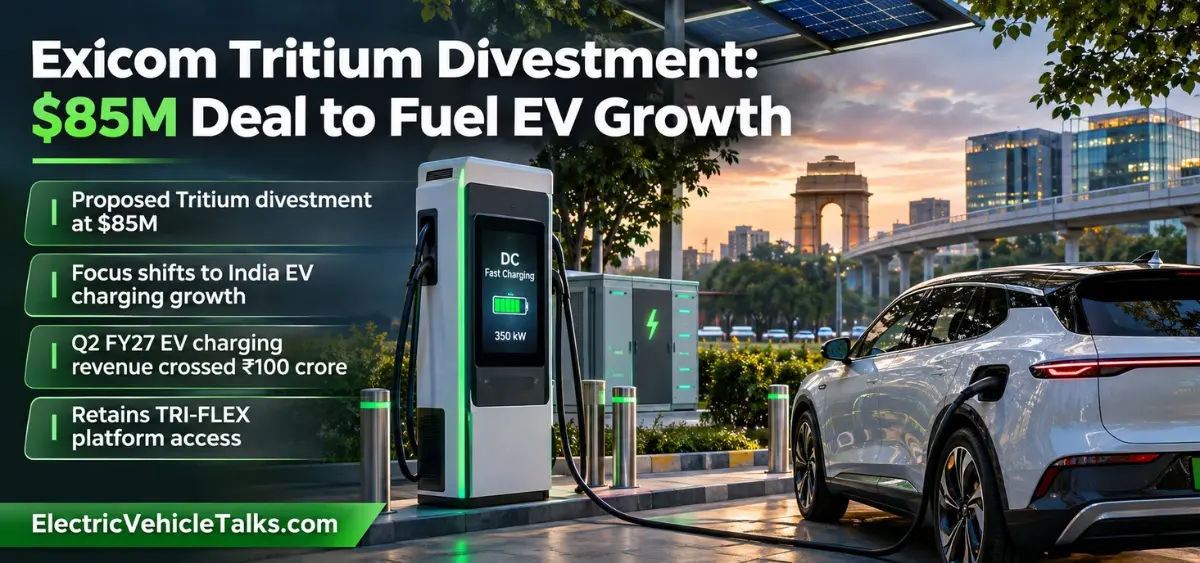

Exicom Tele-Systems is preparing a strategic reset as India’s EV charging industry accelerates. The company has approved a proposal to divest its DC fast-charging subsidiary, Tritium, at an indicative enterprise valuation of $85 million. The Exicom Tritium Divestment could release capital for manufacturing and charging expansion, where management says customer demand is exceeding supply.
The move highlights Exicom’s ambition to prioritize profitable growth while retaining technology. The sale remains subject to approvals. The company also wants to preserve access to advanced charger designs and software, positioning its Indian factories to serve electric cars and commercial fleets and expand public charging networks.
What Is Exicom Selling?
Exicom plans to sell its Tritium business for an indicative enterprise value of $85 million, subject to approvals. Proceeds could strengthen its balance sheet and support Indian EV charging expansion.

Why Exicom Wants to Exit Tritium
Acquired in 2024, Tritium helped Exicom enter American and European markets and commercialize fast chargers. It now contributes one-quarter of consolidated revenue but remains capital-intensive. Tritium USA lost ₹252.5 crore in FY26.
The Exicom Tritium Divestment would redirect financial resources toward India. Chief executive Anant Nahata believes the proposed deal could shift Exicom from net debt to net cash, unlocking hundreds of crores for research and new products.
Crucially, Exicom expects to retain a perpetual license for Tritium’s TRI-FLEX charging platform. Tritium-developed liquid-cooled power modules are manufactured at its Hyderabad facility.
Q2 FY27 Results: EV Business Gains Momentum
Exicom reported these results:
- Consolidated revenue: ₹388.3 crore, up 38% sequentially.
- Standalone revenue: ₹277 crore, up 21.3% year-on-year.
- Standalone EBITDA: ₹25.6 crore, rising 69% annually.
- Consolidated EBITDA: approximately ₹1.8 crore, turning positive.
- Consolidated net loss: ₹57.8 crore, narrowing from ₹68.8 crore.
Its EV charging business surpassed ₹100 crore quarterly revenue for the first time. Charger production jumped 2.5 times for AC units and doubled for DC units quarter-on-quarter.
India EV Charging: Manufacturing and Market Reach
Exicom supplies seven of India’s ten electric passenger-vehicle manufacturers and 17 of the top 20 charging operators. It estimates 50% share in OEM-supplied home chargers and 25% in DC chargers.
The company forecasts annual demand of 130,000 AC chargers, 25,000 DC chargers and 6,000 high-power units for buses and trucks.
Commissioned in March 2026, its Hyderabad plant reached 95% AC-charger utilization, versus 50% for DC chargers and 80% for critical-power products. Major near-term capital spending is unlikely.
Exports and What Happens Next
The Exicom Tritium Divestment supports exports. Management targets raising exports from approximately 10% of revenue in FY27 to 30% within three years, with EV exports exceeding ₹100 crore next year.
With orders in ten markets, Exicom sees FY28 as important for scaling overseas business. It spends ₹50 crore annually on research and engineering and aims to double business within three years.
For India’s charging ecosystem, the Exicom Tritium Divestment signals renewed investment in faster deployment, local manufacturing and next-generation charging technology—if the sale closes.

Related Articles: