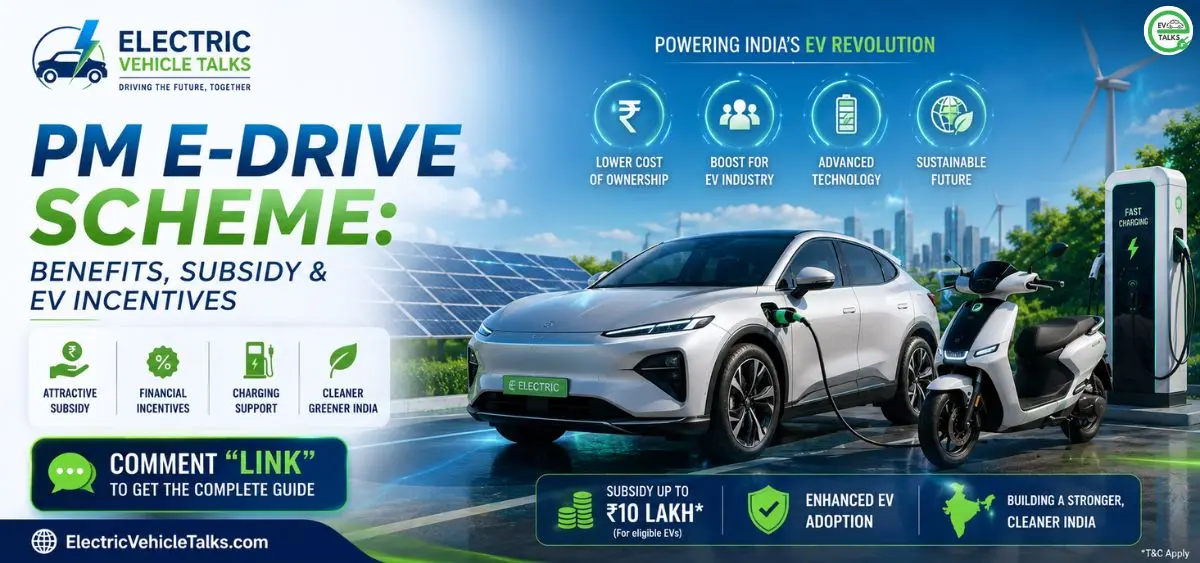

India’s electric mobility journey has entered a transformative phase with the PM E-DRIVE Scheme, a flagship initiative designed to accelerate EV adoption, expand charging infrastructure, strengthen domestic manufacturing, and reduce dependence on fossil fuels. Introduced by the Ministry of Heavy Industries (MHI), the scheme provides financial incentives for electric vehicles while investing in public charging stations, electric buses, electric trucks, e-ambulances, and the broader EV ecosystem.
For EV buyers, fleet operators, manufacturers, and charging infrastructure providers, the PM E-DRIVE Scheme is more than a subsidy program—it is India’s long-term roadmap toward sustainable transportation.
As India’s EV market continues to grow rapidly, understanding this scheme can help buyers save money, businesses reduce operating costs, and manufacturers benefit from government-backed incentives.
What is the PM E-DRIVE Scheme?
The PM Electric Drive Revolution in Innovative Vehicle Enhancement (PM E-DRIVE) Scheme is India’s flagship electric mobility programme announced by the Ministry of Heavy Industries through Gazette Notification dated 29 September 2024. The operational phase began on 1 October 2024. It replaced the earlier EMPS-2024 programme and was designed to support faster EV adoption while building a strong domestic EV ecosystem.
Unlike earlier schemes that primarily focused on vehicle incentives, PM E-DRIVE adopts a holistic approach by supporting:
- Electric two-wheelers
- Electric three-wheelers
- Electric buses
- Electric trucks
- Electric ambulances
- Public charging infrastructure
- Upgradation of testing agencies
- Indigenous EV manufacturing
This broader scope makes it one of India’s most comprehensive EV policies to date.
PM E-DRIVE Scheme at a Glance
| Particular | Details |
|---|---|
| Scheme Name | PM Electric Drive Revolution in Innovative Vehicle Enhancement (PM E-DRIVE) |
| Ministry | Ministry of Heavy Industries |
| Launch Date | 29 September 2024 |
| Implementation | 1 October 2024 |
| Total Outlay | ₹10,900 crore |
| Objective | Promote EV adoption and charging infrastructure |
| Coverage | EV subsidies, charging stations, e-buses, e-trucks, e-ambulances |
| Current Extension | Up to 31 March 2028 (category-specific timelines apply) |
PM E-DRIVE Scheme Timeline (2024–2028)
| Date | Event |
|---|---|
| 29 Sept 2024 | Scheme notified |
| 1 Oct 2024 | Scheme implementation begins |
| Sept 2024 | Operational Guidelines issued |
| Dec 2025 | e-3W (L5) target achieved and closed |
| 27 Mar 2026 | Scheme amendment notified |
| 31 Jul 2026 | e-2W subsidy ends |
| 31 Mar 2028 | Scheme ends (subject to funds) |
Why Was the PM E-DRIVE Scheme Introduced?
India has set ambitious targets to reduce carbon emissions and lower crude oil imports. However, several barriers have slowed EV adoption:
- Higher upfront purchase prices
- Limited charging infrastructure
- Range anxiety
- Low public awareness
- High logistics emissions
- Commercial fleet electrification challenges
The PM E-DRIVE Scheme directly addresses these challenges through financial support and infrastructure investments.
Key Objectives of the PM E-DRIVE Scheme
The scheme aims to:
- Accelerate EV adoption across India
- Make electric mobility more affordable
- Expand public EV charging networks
- Encourage domestic EV manufacturing
- Promote cleaner public transportation
- Reduce greenhouse gas emissions
- Improve urban air quality
- Support commercial electric mobility
- Strengthen India’s battery ecosystem
Together, these objectives align with India’s broader climate and energy security goals.
Components of PM E-DRIVE Scheme
Explain every component separately.
Include:
- Demand Incentives
- Charging Infrastructure
- Electric Buses
- Electric Trucks
- Electric Ambulances
- Testing Agencies
- Administration
PM E-DRIVE Scheme Budget Allocation
The Government has allocated ₹10,900 crore for the scheme, making it one of India’s largest investments in electric mobility. The funding supports three major pillars:
| Component | Purpose |
|---|---|
| Demand Incentives | Subsidies for eligible EV categories |
| Capital Grants | Charging stations, e-buses, testing facilities |
| Administration | Awareness campaigns, project management, implementation |
The scheme subsumed the earlier Electric Mobility Promotion Scheme (EMPS-2024) to ensure continuity in EV incentives.
Which Vehicles Are Eligible?
The operational guidelines specify support for the following categories:
| Vehicle Category | Eligible |
|---|---|
| Electric Two-Wheelers | ✔ |
| Electric Three-Wheelers | ✔ |
| Electric Buses | ✔ |
| Electric Trucks | ✔ |
| Electric Ambulances | ✔ |
| Emerging EV Categories | Future notifications |
Private individuals are eligible for incentives on electric two-wheelers, while electric three-wheelers and trucks are primarily intended for commercial applications. Government departments purchasing EVs are generally not eligible for demand incentives under the scheme.
Eligibility Criteria Under PM E-DRIVE
| Requirement | Details |
|---|---|
| OEM Registered | Yes |
| Vehicle Approved | Yes |
| Aadhaar | Mandatory |
| Dealer | Authorised Dealer |
| e-KYC | Mandatory |
| e-Voucher | Mandatory |
PM E-DRIVE Scheme Incentives
The demand incentive is offered as an upfront reduction in the vehicle’s purchase price, with the manufacturer later reimbursed by the Ministry of Heavy Industries. This means eligible buyers receive the benefit directly at the time of purchase rather than applying separately for reimbursement.
1. Electric Two-Wheelers
| Financial Year | Incentive |
|---|---|
| FY 2024–25 | ₹5,000 per kWh (maximum ₹10,000) |
| 1 Apr 2025 – 31 Jul 2026 | ₹2,500 per kWh (maximum ₹5,000) |
The incentive is also capped at 15% of the ex-factory price, whichever is lower.
2. Electric Three-Wheelers (e-Rickshaw & e-Cart)
| Financial Year | Incentive |
|---|---|
| FY 2024–25 | ₹5,000 per kWh (maximum ₹25,000) |
| FY 2025–28 | ₹2,500 per kWh (maximum ₹12,500) |
Support remains available for eligible registered e-rickshaws and e-carts until 31 March 2028, subject to the overall scheme outlay.
3. Electric Buses
The scheme provides grants for electric buses procured under the operational (OPEX/GCC) model through State Transport Undertakings, with incentives linked to battery capacity, vehicle size, and competitive bidding. Standard buses can receive support up to ₹35 lakh per vehicle under the specified conditions.
4. Electric Trucks
The updated operational guidelines introduce dedicated support for commercial electric trucks in the N2 and N3 categories. Incentives are based on battery capacity, ex-factory price, and gross vehicle weight, with maximum support ranging from ₹2.7 lakh to ₹9.6 lakh depending on the vehicle category. Eligibility also requires a valid Certificate of Deposit (scrappage certificate) for an equivalent or higher GVW ICE truck.
5. Electric Ambulances
The scheme extends demand incentives to eligible electric, plug-in hybrid, and strong hybrid ambulances. OEMs must ensure that incentives are passed on to customers, comply with phased manufacturing requirements, and certify that the vehicles are used exclusively for ambulance and patient transport services.
PM E-DRIVE Scheme Extended Till When?
One of the most significant updates came through the 27 March 2026 notification, which revised the scheme’s timelines.
| Category | Valid Till |
|---|---|
| Registered e-2 Wheelers | 31 July 2026 |
| Registered e-Rickshaw & e-Cart | 31 March 2028 |
| Overall Scheme | 31 March 2028 (subject to fund availability) |
The Government also clarified that the scheme is fund-limited, with total payouts capped at the approved outlay of ₹10,900 crore. If funds are exhausted earlier, the relevant component may close before the terminal date.
PM E-DRIVE Scheme for Electric Trucks
The PM E-DRIVE Scheme marks a significant milestone for India’s commercial transportation sector by extending financial support to electric trucks (e-trucks) for the first time under a dedicated national EV incentive programme.
Recognizing that heavy-duty vehicles contribute substantially to fuel consumption and carbon emissions, the Ministry of Heavy Industries (MHI) has introduced operational guidelines to accelerate the adoption of zero-emission freight vehicles.
The scheme is expected to reduce logistics costs, improve air quality, and encourage fleet operators to transition from diesel-powered trucks to cleaner electric alternatives.
The inclusion of both electric trucks and electric ambulances under the PM E-DRIVE Scheme demonstrates that the Government’s vision extends well beyond private passenger vehicles. By supporting commercial logistics and essential healthcare services, the scheme lays the foundation for a cleaner, more efficient, and sustainable transportation ecosystem across multiple sectors of the Indian economy.
Objectives of the Electric Truck Component
The electric truck initiative under PM E-DRIVE aims to
- Promote the adoption of electric trucks in commercial freight transport.
- Reduce greenhouse gas emissions from the logistics sector.
- Lower dependence on imported fossil fuels.
- Encourage domestic manufacturing under the Make in India initiative.
- Support cleaner and more sustainable freight mobility across India.
Eligible Vehicle Categories
The scheme provides demand incentives for eligible N2 and N3 category electric trucks, as defined under the Central Motor Vehicle Rules (CMVR). These categories cover medium and heavy commercial vehicles used for goods transportation.
| Truck Category | Description |
|---|---|
| N2 | Medium Goods Vehicles |
| N3 | Heavy Goods Vehicles |
Only vehicles approved under the PM E-DRIVE Scheme and meeting the prescribed technical and safety standards are eligible for incentives.
Demand Incentives for Electric Trucks
Financial incentives are linked to the truck’s gross vehicle weight (GVW) and battery capacity. Depending on the eligible category, incentives range from ₹2.7 lakh to ₹9.6 lakh per vehicle, helping reduce the high upfront cost of electric commercial vehicles.
Scrappage Requirement
One of the unique features of the electric truck component is the mandatory Vehicle Scrappage Certificate. To claim the demand incentive, buyers must submit a valid Certificate of Deposit (CoD) issued under the Vehicle Scrappage Policy for an equivalent or higher Gross Vehicle Weight (GVW) diesel truck. This requirement encourages the replacement of older, high-emission vehicles with cleaner electric alternatives.
Benefits for Fleet Operators
The PM E-DRIVE Scheme offers several advantages for logistics companies and commercial fleet operators:
- Lower operating and maintenance costs.
- Reduced fuel expenditure.
- Improved fleet sustainability.
- Compliance with future emission regulations.
- Enhanced corporate ESG (Environmental, Social, and Governance) performance.
- Opportunity to modernise commercial fleets with government support.
As battery technology improves and charging infrastructure expands, electric trucks are expected to become increasingly viable for both urban and regional freight transport.
PM E-DRIVE Scheme for Electric Ambulances
The PM E-DRIVE Scheme also introduces dedicated support for electric ambulances, reflecting the Government of India’s commitment to decarbonizing essential public services while improving healthcare mobility.
The operational guidelines cover Battery Electric Vehicles (BEVs) as well as eligible Strong Hybrid Electric Vehicles (SHEVs) and Plug-in Hybrid Electric Vehicles (PHEVs) that are certified and approved for ambulance applications.
Objectives of the Electric Ambulance Component
The electric ambulance initiative seeks to:
- Promote cleaner emergency medical transportation.
- Reduce emissions from healthcare fleets.
- Improve energy efficiency in public health services.
- Encourage the deployment of advanced electric mobility solutions in hospitals and emergency response systems.
- Support India’s broader clean transportation goals.
Eligible Ambulance Categories
The operational guidelines support:
- Battery Electric Ambulances (BEVs)
- Plug-in Hybrid Electric Ambulances (PHEVs)
- Strong Hybrid Electric Ambulances (SHEVs)
All eligible vehicles must comply with the prescribed technical standards, safety requirements, and certification procedures under the scheme.
OEM Responsibilities
Manufacturers participating in the electric ambulance programme are required to:
- Register under the PM E-DRIVE Scheme.
- Obtain vehicle approval from designated testing agencies.
- Pass the full demand incentive to the buyer.
- Ensure compliance with localisation and phased manufacturing requirements.
- Maintain complete documentation for verification and audit.
- Certify that the vehicle is intended exclusively for ambulance and patient transport services.
Benefits of Electric Ambulances
Electric ambulances offer several long-term advantages:
- Lower operating and maintenance costs.
- Reduced noise pollution during emergency response.
- Zero tailpipe emissions for battery-electric models.
- Improved air quality around hospitals and urban areas.
- Lower lifecycle fuel costs compared to conventional diesel ambulances.
- Contribution to greener and more sustainable healthcare infrastructure.
As India’s healthcare and emergency response systems continue to modernize, electric ambulances have the potential to become an integral part of future public health mobility, particularly in urban centers where reducing emissions and operating costs are key priorities.
What Is the PM E-DRIVE Charging Infrastructure Plan?
One of the biggest challenges slowing EV adoption in India has been the availability of reliable charging infrastructure. While vehicle technology has improved significantly, charging accessibility has remained a concern for both private owners and commercial fleet operators.
Recognizing this gap, the PM E-DRIVE Scheme allocates substantial funding to develop a nationwide charging network, making EV ownership more practical across cities, highways, and rural regions.
According to the scheme, approximately 72,300 public EV charging stations are planned across India, making this one of the country’s largest charging infrastructure initiatives. The deployment will support passenger vehicles as well as commercial fleets. You must know about government subsidies for establishing EV charging stations in India.
Where Will the Charging Stations Be Installed?
The charging infrastructure will be strategically deployed across multiple high-demand locations.
| Location | Purpose |
|---|---|
| Metro cities | Daily commuting |
| Tier-2 & Tier-3 cities | Expand EV accessibility |
| National Highways | Long-distance travel |
| State Highways | Intercity connectivity |
| Expressways | Fast charging corridors |
| Commercial hubs | Fleet operations |
| Bus depots | Public transport electrification |
| Logistics centres | Cargo EV charging |
The operational guidelines also state that inter-city and interstate highways will gradually become EV-ready in consultation with the Ministry of Road Transport & Highways (MoRTH). Financial support may cover up to 100% of the project cost, including upstream electrical infrastructure, depending on the approved implementation framework.
Why Does Charging Infrastructure Matter?
A robust charging network delivers benefits beyond convenience:
- Reduces range anxiety
- Encourages first-time EV buyers
- Supports commercial fleet electrification
- Improves highway connectivity
- Enables faster EV adoption
- Increases confidence among rural buyers
- Strengthens India’s clean energy transition
As public charging expands, EV ownership becomes practical even for households without dedicated home parking.
How to Apply for the PM E-DRIVE Scheme?
For most individual buyers, there is no separate subsidy application. Eligible incentives are passed on directly by the dealer at the time of purchase, provided all scheme requirements are met. The reimbursement process then takes place between the OEM and the Ministry of Heavy Industries.
Steps for Individual Buyers
- Choose an eligible PM E-DRIVE-approved vehicle.
- Visit an authorized dealership.
- Complete Aadhaar-based e-KYC.
- Submit the required identity documents.
- Register the vehicle with the Regional Transport Office (RTO).
- The dealer generates the official e-Voucher.
- Receive the subsidy as an upfront reduction in the invoice price.
This streamlined process helps minimize paperwork for end users.
PM E-DRIVE Registration Online: How Does It Work?
The scheme introduces a digital workflow to improve transparency and prevent misuse.
For individual buyers, Aadhaar authentication using face-based e-KYC through the PM E-DRIVE mobile application is mandatory. Dealers must also upload one additional identity proof, such as a PAN card, driver’s license, voter ID, or passport. After verification, the e-Voucher is generated through the PM E-DRIVE portal.
For non-individual buyers (companies, partnerships, proprietary firms), the authorized representative undergoes Aadhaar face authentication, while PAN and GST details are uploaded before the e-Voucher is issued.
PM E-DRIVE Scheme Subsidy Process: Step-by-Step
Step 1: Buyer selects an eligible PM E-DRIVE electric vehicle
↓
Step 2: Purchase through an authorised dealership
↓
Step 3: Aadhaar-based e-KYC verification is completed
↓
Step 4: Vehicle is registered with the Regional Transport Office (RTO)
↓
Step 5: Dealer generates the PM E-DRIVE e-voucher.
↓
Step 6: Customer signs the e-Voucher, and a selfie is uploaded
↓
Step 7: Dealer uploads all required documents on the PM E-DRIVE portal
↓
Step 8: OEM submits the reimbursement claim to the Ministry of Heavy Industries (MHI)
↓
Step 9: MHI verifies the claim and supporting documents
↓
Step 10: Government releases the incentive amount to the OEM
↓
Step 11: Buyer receives the subsidy as an upfront discount in the vehicle invoice
Documents Required
This section is missing completely.
Include:
Individual buyers
- Aadhaar
- PAN
- Driving License
- Mobile Number
- Vehicle Registration
Business buyers
- GST
- PAN
- Authorised Representative
- Aadhaar
- Registration Documents
Supported by dealer guidelines.
What Is the PM E-DRIVE e-Voucher?
The e-Voucher is one of the scheme’s most important innovations.
Once the vehicle is registered:
- A unique e-Voucher number is generated.
- The buyer receives a download link on the registered mobile number.
- The voucher is signed by both the dealer and the customer.
- A signed copy is uploaded to the scheme portal.
- A customer selfie is captured and uploaded.
- Incentive claims are processed only after verification of the e-Voucher and selfie.
This digital trail improves transparency and significantly reduces fraudulent claims.
Important Eligibility Conditions for Buyers
The operational guidelines include several safeguards to ensure fair distribution of incentives.
A) Individual Buyers
- Aadhaar authentication is mandatory.
- Only one incentive per vehicle category is allowed for each individual.
- If an individual has already received an incentive for the same category, the portal will flag the application as ineligible.
B) Commercial Buyers
Commercial entities may purchase multiple eligible vehicles, subject to compliance with the scheme’s documentation and registration requirements.
OEM Registration Under the PM E-DRIVE Scheme
Manufacturers wishing to participate must complete a formal registration process with the Ministry of Heavy Industries.
Required documents include:
- Manufacturer registration application
- Company Registration Certificate
- GST Registration Certificate
- PAN Card
- Trade License
- Type approval and homologation certificate
- Memorandum and Articles of Association
- Details of sales and service network
- Photographs of approved vehicle models
OEMs previously registered under FAME-II are required to submit fresh applications under PM E-DRIVE, while OEMs registered under EMPS-2024 are automatically considered registered under PM E-DRIVE.
Responsibilities of OEMs
Manufacturers have significant responsibilities under the scheme, including:
- Obtain vehicle certification from designated testing agencies.
- Upload production details, including chassis and battery numbers.
- Pass the demand incentive to dealers after all taxes.
- Submit reimbursement claims within the prescribed timelines.
- Maintain accurate documentation for audit and verification.
The guidelines also state that reimbursement claims should generally be submitted within 120 days of the vehicle sale.
Responsibilities of Dealers
Dealers play a central role in successful implementation.
They are required to:
- Verify buyer identity.
- Conduct Aadhaar face authentication.
- Upload customer information.
- Generate e-Vouchers.
- Pass the subsidy directly to customers.
- Upload sales data promptly.
- Maintain records for the required retention period.
- Obtain customer acknowledgement forms before reimbursement claims.
Billing Mechanism Explained
One of the most practical yet least understood aspects of the PM E-DRIVE Scheme is how the demand incentive is reflected in the vehicle invoice. Unlike many government subsidy programs where buyers must claim the benefit after purchase, the PM E-DRIVE Scheme provides the incentive as an upfront discount on the vehicle’s invoice.
The manufacturer (OEM) first passes the approved demand incentive to the authorized dealer, who then deducts the subsidy from the vehicle’s price before billing the customer. After the sale is completed and all required documents are verified, the OEM submits a reimbursement claim to the Ministry of Heavy Industries (MHI) through the PM E-DRIVE portal.
OEM determines the eligible demand incentive
↓
The Vehicle invoice is prepared by the dealer
↓
Applicable GST is calculated as per tax regulations
↓
PM E-DRIVE demand incentive is deducted from the invoice value
↓
The dealer sells the vehicle to the customer at the reduced price
↓
The customer pays the final invoice amount after subsidy adjustment
↓
OEM submits the reimbursement claim with supporting documents
↓
Ministry of Heavy Industries (MHI) verifies the claim
↓
The approved incentive amount is reimbursed to the OEM
Example of How the Billing Works
| Particular | Amount (Example) |
|---|---|
| Ex-factory Price | ₹120,000 |
| GST & Other Applicable Charges | ₹21,600 |
| Gross Invoice Value | ₹1,41,600 |
| PM E-DRIVE Demand Incentive | – ₹10,000 |
| Final Amount Paid by Customer | ₹131,600 |
Note: The figures above are for illustration only. The actual incentive depends on the vehicle category, battery capacity, applicable incentive rate, and the limits specified under the PM E-DRIVE Scheme.
Role of Testing Agencies
Vehicle quality is another major focus of the PM E-DRIVE Scheme.
Testing agencies are responsible for:
- Type approval under AIS standards.
- Battery capacity verification.
- PM E-DRIVE eligibility certification.
- Random surveillance testing.
- Periodic compliance assessments.
- Uploading certification documents to the PM E-DRIVE portal.
These measures help ensure that only compliant vehicles receive government incentives.
Benefits of the PM E-DRIVE Scheme
A) For Consumers
- Lower purchase prices through demand incentives
- Easier access to charging infrastructure
- Increased confidence in EV ownership
- Improved resale prospects as EV adoption grows
B) For Businesses
- Reduced fleet operating costs
- Support for commercial electrification
- Improved logistics efficiency
- Access to charging infrastructure
C) For Manufacturers
- Stronger domestic demand
- Stable policy environment
- Incentives that encourage innovation
- Growth opportunities for indigenous production
Challenges Facing the Scheme
Despite its comprehensive design, implementation will require addressing several challenges:
| Challenge | Impact |
|---|---|
| Charging deployment pace | Rural accessibility may remain limited initially |
| Grid readiness | High-capacity charging requires stronger power infrastructure |
| Consumer awareness | Many buyers remain unfamiliar with subsidy procedures |
| Battery supply | Domestic cell manufacturing is still expanding |
| State-level policy differences | Incentives vary across states |
Addressing these issues will be essential to maximize the scheme’s long-term impact.
Sustainability Impact
The PM E-DRIVE Scheme contributes to India’s broader sustainability objectives by:
- Reducing greenhouse gas emissions
- Improving urban air quality
- Encouraging clean public transport
- Supporting renewable energy integration
- Lowering dependence on imported fossil fuels
- Promoting domestic manufacturing under the Make in India initiative
The combination of vehicle incentives and charging infrastructure investment makes the programme a key pillar of India’s transition toward sustainable mobility.
PM E-DRIVE vs FAME II vs EMPS-2024
India’s EV policy has evolved significantly over the past few years. While FAME II focused on kickstarting electric mobility, EMPS-2024 served as a transitional scheme after FAME II ended. The PM E-DRIVE Scheme builds on these efforts with a much broader scope by supporting charging infrastructure, commercial vehicles, and public transport in addition to demand incentives.
| Feature | FAME II | EMPS-2024 | PM E-DRIVE Scheme |
|---|---|---|---|
| Launch | 2019 | 2024 | 2024 |
| Implementing Ministry | Ministry of Heavy Industries | Ministry of Heavy Industries | Ministry of Heavy Industries |
| Charging Infrastructure | Limited | Minimal | Large-scale national rollout |
| Electric Two-Wheelers | ✔ | ✔ | ✔ |
| Electric Three-Wheelers | ✔ | ✔ | ✔ |
| Electric Buses | ✔ | Limited | Expanded support |
| Electric Trucks | ✖ | ✖ | ✔ |
| Electric Ambulances | ✖ | ✖ | ✔ |
| Public Charging Stations | Limited | No major expansion | Large-scale support |
| Testing Infrastructure | Basic | Limited | Major upgrades |
| Total Budget | Lower | Interim | ₹10,900 Crore |
The PM E-DRIVE Scheme represents a shift from simply encouraging EV purchases to building a complete electric mobility ecosystem supported by charging infrastructure, testing facilities, commercial vehicle electrification, and digital subsidy management.
Buying Guide: Should You Buy an EV Under the PM E-DRIVE Scheme?
If you’re planning to purchase an electric vehicle, the scheme can make ownership more affordable—provided the vehicle and buyer meet the eligibility requirements.
Ideal for:
- Daily urban commuters
- College students
- Office professionals
- Delivery businesses
- Fleet operators
- Ride-sharing drivers
- Small business owners
- Municipal transport operators
Things to Check Before Buying
✔ Confirm that the vehicle model is approved under the PM E-DRIVE Scheme.
✔ Purchase from an authorised dealer.
✔ Verify that the subsidy is reflected in the invoice.
✔ Ensure your Aadhaar details are updated for e-KYC.
✔ Keep copies of the invoice, registration certificate, and e-Voucher for future reference.
EV Ownership Tips Under the PM E-DRIVE Scheme
Owning an electric vehicle goes beyond the initial purchase. To maximize savings and battery life:
- Charge the battery between 20% and 80% for daily use where practical.
- Prefer overnight home charging when available.
- Use public fast chargers mainly for long-distance travel.
- Follow the manufacturer’s recommended service schedule.
- Install firmware updates if supported by your EV.
- Drive smoothly to improve efficiency and range.
- Plan highway journeys using verified charging locations.
These habits can improve battery longevity while reducing operating costs over the vehicle’s life.
State-Level Incentives: Can You Combine Benefits?
In many cases, PM E-DRIVE Scheme benefits can be combined with state-specific EV incentives, but eligibility depends on the respective state government’s electric vehicle policy and the terms of the central scheme.
While the PM E-DRIVE Scheme provides demand incentives through the Ministry of Heavy Industries (MHI), several states offer additional benefits such as purchase subsidies, road tax exemptions, registration fee waivers, interest subsidies, or incentives for installing charging infrastructure.
Since these policies are revised periodically, buyers should always verify the latest eligibility criteria with their respective state transport or industries department before purchasing an EV.
Potential Benefits Available Under State EV Policies
| State | Common EV Incentives* |
|---|---|
| Delhi | Purchase incentives, road tax and registration fee exemptions, charging infrastructure support |
| Maharashtra | Purchase subsidies, registration fee waivers, incentives for commercial EVs |
| Gujarat | Direct purchase subsidies, registration benefits, charging infrastructure support |
| Uttar Pradesh | Manufacturing incentives, investment support, selected buyer benefits under the state EV policy |
| Tamil Nadu | Strong manufacturing ecosystem, incentives for EV industries and charging infrastructure |
| Karnataka | EV manufacturing incentives, R&D support, charging infrastructure development |
| Telangana | Incentives for EV manufacturing, battery production, and charging station deployment |
| Kerala | Charging infrastructure support and incentives for public transport electrification |
| Assam | EV purchase incentives and tax benefits under the state EV policy |
| Meghalaya | Incentives for EV buyers, charging stations, and battery swapping under the Meghalaya EV Policy 2026 |
*Note: State EV policies are subject to periodic revisions. Incentives, eligibility conditions, and validity periods may change over time. Always check the latest notifications issued by your respective state government before making a purchase.
Can you avail yourself of both Central and State Incentives?
In many states, yes—buyers may receive the PM E-DRIVE demand incentive along with eligible state-level benefits, provided the vehicle and purchaser satisfy the conditions of both schemes. However, some states may limit or modify benefits based on their own policy provisions. Therefore, it is advisable to:
- Confirm that your chosen EV model is approved under the PM E-DRIVE Scheme.
- Check whether your state’s EV policy is currently active.
- Verify if the state subsidy is automatically adjusted by the dealer or requires a separate application.
- Ask the authorised dealer about the combined financial benefits available in your state.
- Keep all purchase documents, registration certificates, and e-Vouchers for future reference.
Expert Tip
Combining PM E-DRIVE Scheme incentives with applicable state subsidies can significantly reduce the overall cost of EV ownership. In some cases, buyers may also benefit from additional savings through lower road tax, reduced registration fees, and concessional electricity tariffs for EV charging, making electric vehicles more affordable over their lifetime.
Industry Trends: What Does PM E-DRIVE Mean for India’s EV Market?
The scheme arrives at a time when India’s EV sector is experiencing rapid growth.
Key trends include:
- Rising demand for electric two-wheelers in urban markets.
- Increasing electrification of commercial last-mile delivery fleets.
- Expansion of battery manufacturing under the Production Linked Incentive (PLI) scheme.
- Growth in fast-charging infrastructure.
- Adoption of electric buses by State Transport Undertakings.
- Stronger investment in commercial electric trucks and logistics.
The inclusion of charging infrastructure, e-trucks, and e-ambulances under PM E-DRIVE signals a broader focus on decarbonizing multiple transport segments rather than only private mobility.
Expert Insight from Electric Vehicle Talks
From our analysis, the PM E-DRIVE Scheme is India’s most comprehensive electric mobility programme to date because it addresses the three critical pillars of EV adoption simultaneously:
- Affordability through demand incentives.
- Accessibility through nationwide charging infrastructure.
- Confidence through stronger testing, certification, and digital verification.
The Aadhaar-based e-Voucher system, model approval process, and structured responsibilities for OEMs and dealers are designed to improve transparency and reduce misuse of public funds. At the same time, investments in charging infrastructure and commercial electrification indicate that the government’s focus extends beyond private passenger vehicles.
For Indian buyers, the greatest long-term benefit may not be the subsidy alone—it is the creation of a more mature EV ecosystem with better charging access, improved product quality, and growing consumer confidence.
At Electric Vehicle Talks, we believe that informed consumers make better ownership decisions. Staying updated on government policies, vehicle technology, and charging infrastructure developments can help buyers maximise both financial savings and long-term ownership value.
People Also Ask
1. What is the PM E-DRIVE Scheme?
The PM E-DRIVE Scheme is a Government of India initiative launched by the Ministry of Heavy Industries to accelerate electric mobility through vehicle incentives, charging infrastructure, and support for electric buses, trucks, ambulances, and testing facilities.
2. Which ministry launched the PM E-DRIVE Scheme?
The scheme was launched by the Ministry of Heavy Industries (MHI) through a Gazette Notification dated 29 September 2024.
3. When was the PM E-DRIVE Scheme launched?
The scheme was officially notified on 29 September 2024, with implementation beginning from 1 October 2024.
4. Is there an online registration process?
Individual buyers do not submit a separate subsidy application. Dealers complete Aadhaar-based e-KYC, upload documents, and generate an e-Voucher through the PM E-DRIVE portal for eligible purchases.
5. How many charging stations are planned?
The Government plans to support around 72,300 public EV charging stations under the PM E-DRIVE Scheme, with installations across cities and major highways.
6. Has the PM E-DRIVE Scheme been extended?
Yes. The March 2026 notification extended the overall scheme until 31 March 2028, while registered electric two-wheelers remain eligible until 31 July 2026, subject to the scheme’s funding limits.
7. Who benefits the most from the scheme?
The scheme benefits private EV buyers, commercial fleet operators, public transport agencies, charging infrastructure developers, OEMs, dealers, and the wider electric mobility ecosystem.
FAQs about PM E-Drive Scheme
1. What is the budget of the PM E-DRIVE Scheme?
The total approved outlay is ₹10,900 crore, subject to fund availability.
2. Can private individuals buy an electric scooter under the scheme?
Yes. Eligible electric two-wheelers purchased through authorised dealers can receive demand incentives, provided the buyer and vehicle satisfy the scheme’s conditions.
3. Is Aadhaar mandatory?
Yes. The operational guidelines require Aadhaar-based e-KYC for individual buyers to generate the e-Voucher.
4. Can one person claim the subsidy multiple times?
No. Individual buyers can generally claim the demand incentive only once for each eligible vehicle category under the scheme.
5. Does the scheme support electric trucks?
Yes. Dedicated operational guidelines provide incentives for eligible commercial electric trucks, subject to the prescribed conditions and documentation.
6. Does the scheme support charging stations?
Yes. The PM E-DRIVE Scheme includes financial support for establishing public EV charging infrastructure across cities, highways, and expressways.
7. Where can I learn more about electric vehicles?
You can explore more EV news, buying guides, charging infrastructure updates, ownership tips, and policy analysis at Electric Vehicle Talks.
Conclusion
The PM E-DRIVE Scheme marks a significant milestone in India’s transition to cleaner and more sustainable transportation. By combining demand incentives with investments in charging infrastructure, commercial electrification, testing capabilities, and digital verification systems, the programme aims to build a stronger and more reliable EV ecosystem.
For consumers, it lowers the cost of adopting electric mobility. For businesses, it creates opportunities to modernise fleets and reduce operating expenses. For manufacturers, it provides a structured policy framework that supports innovation and domestic production. At the national level, the scheme contributes to reduced emissions, lower dependence on imported fossil fuels, and improved energy security.
If you’d like to stay informed about the latest electric vehicle news, buying guides, charging infrastructure developments, and expert policy analysis, explore more in-depth resources at Electric Vehicle Talks.

Related Articles: